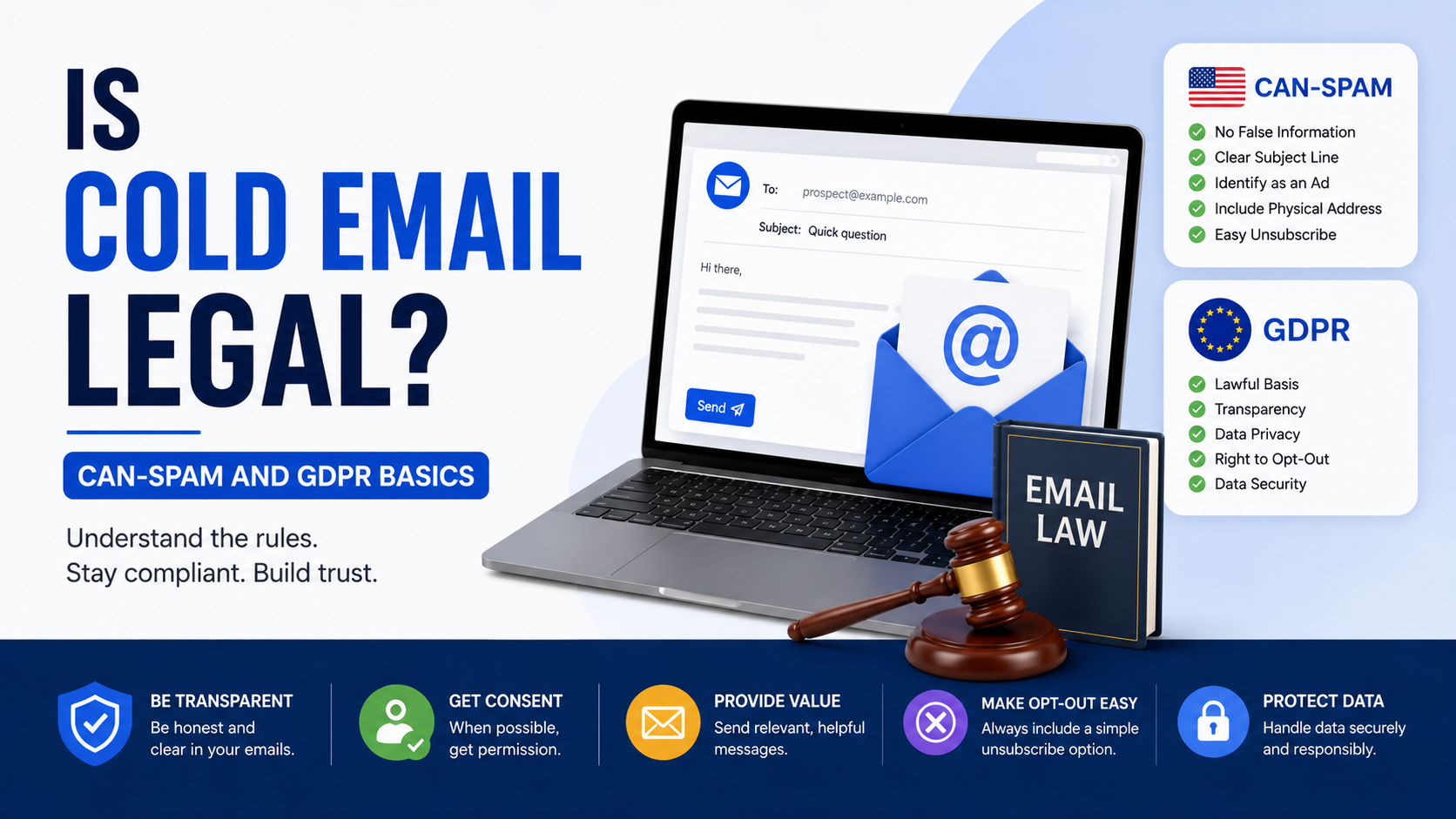
A cold email campaign can feel perfectly normal right up until someone replies with:
“Where did you get my email address?”
That one question tends to make people nervous.
You start wondering whether finding a business email on a company website was allowed.
Should the person have opted in first?
Do you need an unsubscribe link?
Does GDPR mean you cannot contact anyone in Europe?
Can you email a business owner in the United States without permission?
I have seen plenty of outreach campaigns built around good targeting and reasonable messages but almost no thought given to compliance until after the emails were already being sent.
That is backwards.
The legal side of cold email is not something you should figure out after uploading 20,000 contacts into an outreach tool.
The good news is that cold email is not automatically illegal.
The difficult part is that there is no single worldwide “cold email law.”
A campaign that may be permitted under U.S. federal law could face different requirements when contacting someone in Germany, France, Ireland, or the UK.
The safest way to understand the subject is to separate two of the rules people mention most often:
CAN-SPAM in the United States.
GDPR in the European Economic Area.
And even that needs one important clarification: GDPR is primarily a data-protection law. European electronic marketing is also affected by the EU ePrivacy framework and national laws implementing it. In other words, “GDPR allows legitimate interests” does not automatically mean “I can send any cold email I want in Europe.”
This guide is general educational information, not legal advice. If outbound email is a major part of your business or you are targeting several countries, getting jurisdiction-specific legal guidance is worth the cost.
So, Is Cold Email Legal?
The short answer:
Yes, cold email can be legal.
But the rules depend on things such as:
- Where your business operates
- Where the recipient is located
- Whether you are contacting a consumer or business
- Whether the email identifies a specific individual
- How you obtained the contact information
- What you are promoting
- Whether consent is required
- Whether another lawful basis is available
- What you include in the email
- How you handle objections and opt-outs
That is why I would be skeptical of anyone giving a universal answer like:
“Cold email is completely legal as long as it’s B2B.”
That is too broad.
So is:
“You need permission before sending any business email anywhere.”
Also too broad.
The reality depends heavily on jurisdiction.
CAN-SPAM Is More Permissive Than Many People Think
Let’s start with the United States.
The CAN-SPAM Act regulates commercial email.
One detail surprises a lot of new outbound marketers: CAN-SPAM does not create a general federal rule requiring someone to opt in before you send them a commercial email.
That means a properly conducted cold email campaign can potentially comply with U.S. federal CAN-SPAM rules even when the recipient did not previously subscribe.
But that absolutely does not mean “anything goes.”
The Federal Trade Commission says CAN-SPAM covers commercial messages and applies to business-to-business email as well as consumer-facing commercial email.
There are specific requirements you need to follow.
CAN-SPAM Rule #1: Do Not Fake Who You Are
Your sending information should be accurate.
That includes information such as:
From
To
Reply-To
Originating domain
Email address
You should not create an email that appears to come from another company or disguise who actually initiated the message.
Imagine your real company is:
Northstar Web Design
but your email appears to come from:
Google Website Support
That is obviously misleading.
Even less dramatic deception is a bad idea.
Use your real business identity.
CAN-SPAM Rule #2: Do Not Use Deceptive Subject Lines
Your subject line should accurately represent the email.
Bad example:
Subject: Payment problem with your account
Then the email says:
“Hi Sarah, we sell SEO services.”
You may get the open, but you got it by making the person believe something completely different was happening.
Another tactic I avoid is adding:
Re:
to a subject line when there was never an earlier conversation.
For example:
Re: website project
when the prospect has never heard from you.
Even outside strict legal analysis, starting a business conversation with deception makes no sense.
A normal subject line is better:
“Question about your website”
“Your Dallas location”
“Google Maps question”
“Commercial cleaning”
The FTC specifically requires commercial email subject lines not to be deceptive.
CAN-SPAM Rule #3: Identify Commercial Messages Properly
CAN-SPAM requires commercial messages to be clearly and conspicuously identified as advertisements, although the law gives senders flexibility in how that disclosure is made.
This is one of the areas where businesses should be careful about relying on internet folklore.
You will sometimes see people say:
“Personal-looking B2B cold emails don’t count.”
That is not a safe assumption.
What matters is the primary purpose of the message.
If the message is promoting your product or service, CAN-SPAM may apply even if it looks like a one-to-one message rather than a newsletter.
CAN-SPAM Rule #4: Include a Valid Physical Postal Address
This is another requirement people forget.
The FTC says commercial emails covered by CAN-SPAM need to include a valid physical postal address.
That could be an appropriate current street address or certain properly registered mailbox options recognized under the rules.
This is one reason proper email signatures and footers matter.
A legitimate commercial email should not look like it came from a mysterious person who cannot be identified or located.
CAN-SPAM Rule #5: Give People a Way to Opt Out
Your email needs a clear method for recipients to tell you they no longer want marketing messages.
That could involve an unsubscribe process that complies with the law.
The process should not be deliberately difficult.
You should not make someone:
Create an account.
Pay a fee.
Complete a 12-question form.
Provide unrelated personal information.
before letting them stop marketing email.
The FTC says an opt-out mechanism must remain capable of processing requests for at least 30 days after the email is sent, and requests generally must be honored within 10 business days.
From a practical perspective, I would not wait anywhere near 10 business days if someone says:
“Please stop emailing me.”
Remove them immediately.
Keep a Suppression List
This is an operational habit every outbound team should have.
Suppose Sarah writes:
“Please remove me from future outreach.”
You add her to your do-not-contact list.
Three months later, someone on your team buys another contact database.
Sarah appears in that database again.
If you simply upload the new list without checking your suppression data, she receives another cold email.
That looks terrible.
Your CRM or outreach system should maintain a suppression list containing contacts who have opted out or objected to further marketing.
Before launching new campaigns, screen the list against it.
Hiring an Agency Does Not Remove Your Responsibility
This is another important CAN-SPAM point.
Suppose you hire an outsourced lead-generation agency.
They build the lists.
They write the emails.
They send everything from their software.
You might assume:
“If they break the rules, that’s their problem.”
The FTC specifically warns that businesses cannot simply contract away their CAN-SPAM responsibility. Both the business being promoted and the company actually sending may potentially have legal responsibility.
That means you should understand how an outreach agency works before giving them access to your brand.
Ask:
Where does the data come from?
How are opt-outs handled?
What sender identity is used?
How are suppression lists maintained?
What happens when someone complains?
“Don’t worry, we handle everything” is not enough.
GDPR Is a Different Kind of Law
Now things become more complicated.
GDPR is not simply Europe’s version of CAN-SPAM.
It regulates the processing of personal data.
That matters because a business email address can still be personal data.
For example:
john.smith@company.com
clearly identifies John Smith.
His email relates to him as an identifiable individual even though he is using it for work.
That means collecting, storing, enriching, exporting, uploading, or using that address for outreach can involve processing personal data.
Publicly Available Does Not Mean “Free to Use However You Want”
This is one of the biggest misconceptions in prospecting.
Imagine you find this on a company website:
“Sarah Ahmed — Head of Marketing”
You find her LinkedIn profile.
Then a data platform returns:
sarah.ahmed@company.com
People sometimes assume:
“All this information is online, so GDPR doesn’t matter.”
That is wrong.
The European Commission makes clear that when personal data obtained from third parties is used for marketing, the organisation using the data still has GDPR responsibilities. It also says electronic direct marketing must comply with applicable ePrivacy rules.
Public availability does not remove data-protection obligations.
You Need a Lawful Basis Under GDPR
GDPR requires a lawful basis for processing personal data.
Consent is one possible lawful basis.
But it is not the only one.
Another basis often discussed in B2B prospecting is:
Legitimate interests.
This is where many cold email guides become dangerously oversimplified.
They say:
“GDPR says direct marketing is a legitimate interest, so cold email is legal.”
Not quite.
The European Commission explains that an organisation may sometimes rely on legitimate interests for business-related processing, including direct marketing, but it must consider whether the individual’s rights and freedoms are seriously affected.
In practical terms, you need to think about:
Purpose: What legitimate business interest are you pursuing?
Necessity: Is processing this person’s data reasonably necessary for that purpose?
Balancing: Does your interest outweigh the privacy impact and reasonable expectations of the person?
This is often called a legitimate interests assessment.
It should not be treated as a checkbox you automatically pass because you sell B2B software.
A Realistic Legitimate-Interest Example
Suppose you provide commercial building maintenance.
You identify the facilities director at a large corporation.
You use their professional email to send one short message specifically about facilities maintenance.
That is very different from collecting a person’s personal Gmail address and sending repeated unrelated marketing messages about cryptocurrency, web design, insurance, software, and investment services.
Context matters.
Relevance matters.
Reasonable expectations matter.
The less connected your outreach is to the person’s professional role, the harder your argument may become.
But Legitimate Interests Still Does Not Automatically Give You Permission to Email
This distinction is extremely important.
GDPR governs processing of personal data.
Electronic communications may also be governed by ePrivacy rules and national laws.
EU rules on unsolicited electronic marketing include consent requirements and allow Member States to determine aspects of how unsolicited communications are treated in certain circumstances.
That means you should not create one “GDPR-compliant” email rule and apply it across every European country.
A campaign targeting Germany may need a different legal analysis from one targeting another jurisdiction.
This is where professional legal advice becomes useful if Europe is an important market for you.
GDPR Gives People a Strong Right to Object to Direct Marketing
This rule is much easier to understand.
Under GDPR, individuals have the right to object to processing of their personal data for direct marketing.
The European Commission states that when someone objects to processing for direct marketing, the organisation may no longer process their personal data for that purpose.
That means this reply:
“Please don’t contact me again.”
should be treated seriously.
Do not argue.
Do not continue the automated sequence.
Do not upload the contact again next month.
Suppress the person from future marketing.
You Also Need to Be Transparent
Suppose you collected a prospect’s personal information from somewhere other than directly from them.
GDPR Article 14 creates transparency requirements in situations where personal data was not obtained from the person directly.
The required information can include things such as:
Who you are.
Why you are processing the data.
Your lawful basis.
What types of personal data you hold.
Relevant recipients of the data.
Other required privacy information.
The GDPR also addresses when that information must be provided.
In practice, businesses often provide appropriate privacy information through a clear privacy notice linked from outreach.
Do not hide the privacy notice three layers deep inside an unrelated website.
Transparency is the point.
Where You Got the Data Can Matter
Buying a database does not transfer compliance responsibility to the data vendor.
Suppose a prospecting company tells you:
“Here are 50,000 GDPR-compliant contacts.”
That phrase alone proves very little.
The European Commission says an organisation acquiring contact data from another party should ensure the data was obtained in compliance with GDPR and can legally be used for the intended marketing purpose.
That is another reason I dislike random bulk contact lists.
Besides poor deliverability, you may not understand:
Where the addresses came from.
When they were collected.
What the individuals were told.
What permissions existed.
Whether people previously objected.
Whether the information is current.
Better data sourcing makes both compliance and outreach quality easier.
GDPR and CAN-SPAM Are Not Either/Or
Imagine your company operates in the United States but emails prospects in France.
You cannot simply say:
“We are American, so CAN-SPAM is all that matters.”
Likewise, a European company emailing U.S. contacts should not assume GDPR is the only relevant framework.
Jurisdiction becomes more complicated when sender, recipient, company, infrastructure, and data processing happen in different countries.
For international campaigns, think in terms of:
Where is the recipient?
What law applies to them?
Where is my business established?
Where did the data come from?
Where is the data processed?
Which electronic-marketing rules apply?
That is much safer than applying the easiest law you can find.
The UK Is a Good Example of Why Details Matter
The UK now operates under UK-specific data-protection and electronic-marketing rules, including the UK GDPR and PECR.
Current ICO guidance says PECR treats corporate subscribers differently from individual subscribers for electronic mail.
For example, electronic marketing rules under PECR generally do not require prior consent when emailing a corporate subscriber such as a limited company, although sender identity and a valid opt-out address are still important. But sole traders and certain partnerships receive stronger protections and may require consent unless an exception such as the soft opt-in applies. UK GDPR can also still apply when you process identifiable business-contact data.
That is a perfect illustration of why:
“It’s B2B, so consent doesn’t matter”
is not a reliable worldwide rule.
The type of business itself can change the answer.
What About Generic Business Email Addresses?
An address like:
info@company.com
is different from:
sarah.jones@company.com
The second clearly relates to an identifiable person.
The first may simply represent the company.
That distinction can matter for data-protection analysis.
But do not assume a generic inbox gives you unlimited marketing rights.
Electronic-communications laws, business subscriber rules, sender-identification requirements, and opt-out obligations may still apply.
Again, jurisdiction matters.
Does an Unsubscribe Link Make an Email Legal?
Not automatically.
This is another common misunderstanding.
Someone says:
“My emails have an unsubscribe link, so they’re GDPR compliant.”
That is like saying:
“My car has seat belts, so I automatically follow every traffic law.”
An unsubscribe mechanism is important.
But compliance may also involve:
Lawful basis.
Transparency.
Data sourcing.
Purpose limitation.
Accurate sender identity.
National electronic-marketing law.
Data protection rights.
Suppression procedures.
Security.
An unsubscribe link is one piece of the system.
What About a Simple “Reply STOP”?
For small B2B campaigns, some businesses allow recipients to reply with an opt-out request.
Whether that alone satisfies every applicable requirement depends on the law governing the campaign.
Under CAN-SPAM, the FTC permits certain straightforward opt-out processes, but you need to satisfy its full requirements rather than simply adding “reply stop” and ignoring everything else.
If you use an outreach platform such as HubSpot, Smartlead, Instantly, Lemlist, Mailshake, Apollo, or another tool, make sure opt-outs are actually synchronized across future campaigns.
The technology should support compliance rather than creating duplicate contact problems.
Do Not Hide Your Identity Behind Multiple Domains
Some outbound teams use secondary domains for deliverability reasons.
For example:
Main domain:
northstarconsulting.com
Outbound domain:
meetnorthstar.com
That can be a reasonable technical strategy.
But the secondary domain should still clearly represent Northstar Consulting.
It should not be used to conceal the real sender.
Your email signature, company identity, privacy information, and other details should make it clear who is contacting the prospect.
Using separate domains for infrastructure is one thing.
Using disposable identities to avoid complaints is something completely different.
Be Careful With Scraping
Just because software can scrape thousands of names and contact details does not mean every use of that data is automatically lawful.
Think carefully about:
Where the information came from.
Whether it is personal data.
What the source site’s rules say.
What lawful basis you rely on.
Whether marketing to the person is reasonably expected.
Whether electronic-marketing laws allow the communication.
Whether appropriate privacy information is provided.
Whether the recipient previously objected.
This is another area where “it’s publicly available” is not a complete compliance strategy.
Keep Your Data Minimal
One thing I like about good compliance is that it often encourages better prospecting.
You probably do not need to collect:
A prospect’s home address.
Personal phone number.
Family members.
Personal Instagram account.
Birthday.
Personal Gmail address.
If you are contacting someone about a professional service, you may only need:
Name.
Job title.
Company.
Business email.
Professional context.
Reason for outreach.
Collecting less data reduces both privacy risk and operational clutter.
It also makes your personalization less creepy.
Do Not Keep Prospect Data Forever
A lot of prospect databases become graveyards.
Someone imports 20,000 contacts.
Two years later, nobody remembers where they came from.
Half the people changed jobs.
The company continues keeping everything “just in case.”
Good data hygiene means having retention rules.
Ask:
How long do we actually need this information?
Is the contact still relevant?
Is the information accurate?
Did this person object?
Do we still have a valid reason for storing it?
GDPR emphasizes principles including data minimisation, accuracy, storage limitation, fairness, and transparency.
Even aside from compliance, old prospect data usually performs badly.
Common Cold Email Legal Mistakes
Assuming B2B Means No Rules
B2B email is regulated too.
The exact rules simply differ by jurisdiction and recipient.
Assuming GDPR Means All Cold Email Is Illegal
That is also too broad.
GDPR provides several lawful bases for processing, including legitimate interests in appropriate circumstances. But other electronic-marketing rules must also be considered.
Treating Legitimate Interest Like Automatic Permission
It requires an actual assessment.
Buying a List and Asking No Questions
Know where your data came from.
Ignoring Opt-Outs
This is one of the easiest mistakes to avoid.
Using Fake Subject Lines
Do not pretend your sales message is an account warning, reply, invoice, or legal notice.
Hiding the Sender
Make your business identity clear.
Thinking an Outreach Tool Handles Everything
Software can automate workflows.
It cannot make legal decisions for your company.
Adding Unsubscribe Text and Assuming You’re Done
Compliance is broader than one footer line.
Using Personal Information That Has Nothing to Do With the Offer
Professional outreach should stay professional.
A Practical Compliance Workflow for Cold Email
If I were helping a small business organise an outbound campaign, I would use a process like this.
Step 1: Decide Where You Are Sending
List the countries you intend to target.
Do not start with “worldwide.”
Step 2: Identify the Rules for Each Market
For example:
United States.
European Economic Area.
United Kingdom.
Canada.
Australia.
Each may have different requirements.
Step 3: Decide Who You Are Contacting
Consumer?
Sole trader?
Employee at a corporation?
Generic company inbox?
Company director?
These distinctions can matter.
Step 4: Document Where Your Data Comes From
Company website.
LinkedIn.
Data provider.
Public directory.
Existing customer records.
Referral.
Do not let data appear inside your CRM without a traceable source.
Step 5: Establish Your Lawful Basis Where Required
If GDPR applies, document the appropriate lawful basis rather than simply writing “legitimate interest” because everyone else does.
Step 6: Check Electronic-Marketing Rules
GDPR is not the only consideration in Europe.
Look at the applicable ePrivacy/national marketing rules.
Step 7: Prepare a Clear Privacy Notice
Explain how you process business-contact data.
Step 8: Use Honest Sender Information
No fake identities.
No deceptive domains.
Step 9: Use Accurate Subject Lines
The subject should match the message.
Step 10: Include Required Business Information
That can include appropriate company and postal information depending on the applicable law.
Step 11: Provide an Easy Opt-Out
Do not make people fight to stop the emails.
Step 12: Maintain a Suppression List
Never rely solely on deleting someone from one campaign.
Step 13: Stop Automation When Someone Objects
Do this immediately.
Step 14: Review Third-Party Tools
Know what your email finder, enrichment provider, CRM, and sending platform are actually doing with personal data.
Step 15: Review the Process Regularly
Laws change.
Regulatory guidance changes.
Tools change.
Your markets change.
Compliance should not be a one-time checkbox.
A Compliant-Looking Email Is Usually a Better Email Anyway
One thing becomes obvious after working through these rules.
A lot of the habits that reduce legal risk also improve cold outreach.
Clear identity.
Relevant targeting.
Accurate data.
Honest subject lines.
Professional contact information.
Easy opt-outs.
Reasonable personalization.
No fake urgency.
No endless follow-ups.
Those things make people more comfortable responding.
Compare these two emails.
Bad:
Subject: URGENT ACCOUNT NOTICE
“Hi Sarah,
We guarantee your company can 10X revenue with our revolutionary marketing system.
Book a call immediately here: [link].”
versus:
Subject: Question about your Austin location
“Hi Sarah,
I noticed your clinic recently opened a second location in Austin.
We work with multi-location practices on local search visibility, and I spotted one issue with how the newer location is appearing.
Happy to send the detail if useful.
Alex
Northstar Marketing
[Business details / appropriate opt-out information]”
The second message is not only easier to trust.
It is also more likely to start a normal business conversation.
Legal Does Not Automatically Mean Good Outreach
This is an important distinction.
You may be able to structure a campaign that satisfies the minimum legal requirements.
That does not mean recipients will appreciate it.
You could technically comply with the relevant rules and still send badly targeted, irritating email.
That will create:
Spam complaints.
Brand damage.
Poor deliverability.
Low reply rates.
Negative reviews.
Being allowed to contact someone does not mean you should contact everyone.
Good outreach asks another question:
“Is there a legitimate professional reason this person might care?”
If the answer is no, leave them out.
The Simple Answer to “Is Cold Email Legal?”
Cold email itself is not automatically illegal.
In the United States, CAN-SPAM permits commercial email under a compliance framework that includes truthful sender information, non-deceptive subject lines, required identification and address information, an effective opt-out process, and prompt handling of opt-out requests. It applies to B2B commercial email too.
In Europe, the picture is more complicated.
GDPR regulates your processing of personal data and may allow legitimate interests as a lawful basis in appropriate circumstances, including some direct-marketing situations. But individuals have a strong right to object to direct marketing, transparency obligations apply, and email marketing must also comply with the ePrivacy framework and applicable national laws.
So I would not build an outreach strategy around:
“Can I technically get away with sending this?”
A better standard is:
Do I have a legitimate reason to contact this person?
Do I understand which rules apply?
Did I source the data responsibly?
Am I transparent about who I am?
Is the message relevant?
Can they easily tell me to stop?
Will I actually stop when they ask?
If you can answer those questions properly, you are already approaching cold email more responsibly than businesses that simply buy a giant contact database, connect it to an automation tool, and hope nobody complains.
Cold email can be an effective way to start business conversations.
It just needs to be treated like a real business process — with targeting, data protection, transparency, compliance, and respect for the person receiving the message built in from the start.