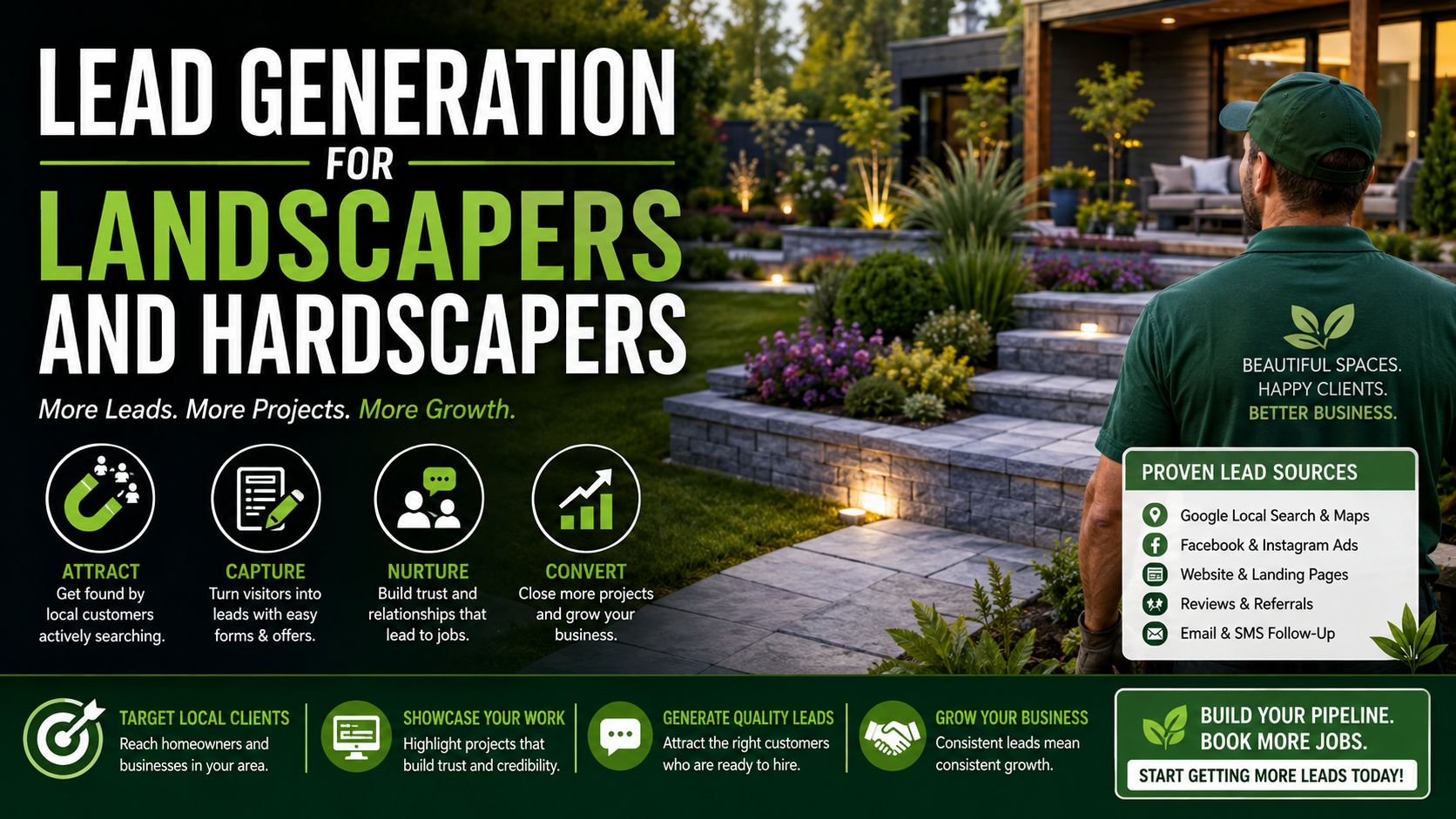
A landscaping company can stay busy for three weeks and then suddenly have an empty schedule.
One week, the phone is full of requests for patios, drainage work, lawn installation, and garden redesigns. The next week, the team is finishing existing projects while the owner starts wondering where the next deposit will come from.
This is one of the most frustrating parts of running a landscaping or hardscaping business.
The work is highly visible, customers regularly need it, and one good project can be worth thousands. Yet lead flow often depends on the weather, referrals, seasonal demand, or whether someone happens to notice a truck parked nearby.
Many contractors respond by boosting a few Facebook posts or buying shared leads. That may create activity, but it does not always create profitable projects.
The real goal is not to collect as many names and phone numbers as possible.
It is to attract property owners who need the right service, live within your working area, understand the likely investment, and are ready to take the next step.
For landscapers and hardscapers, that usually means building a system around local visibility, strong project proof, fast qualification, site visits, professional estimates, and consistent follow-up.
Decide Which Projects You Actually Want
“Landscaping leads” is too broad to be useful.
A request for weekly lawn mowing is completely different from a $30,000 outdoor living project. Both may be valid enquiries, but they require different teams, pricing, marketing, and follow-up.
Start by deciding which services you want to grow.
These may include:
- Landscape design
- Paver patios
- Retaining walls
- Walkways
- Driveways
- Outdoor kitchens
- Fire pits
- Drainage solutions
- Grading
- Sod installation
- Artificial turf
- Irrigation
- Planting
- Mulching
- Commercial landscaping
- Seasonal maintenance
- Full backyard renovations
Do not advertise every service in one general message.
A homeowner interested in a new patio should see patio projects, patio pricing factors, material choices, installation steps, and a clear way to request a site visit.
Someone dealing with standing water needs a different message focused on grading, drainage, soil conditions, and inspection.
Focused campaigns attract better enquiries because customers understand exactly what they are responding to.
Define a Qualified Landscaping Lead
Not every enquiry deserves a site visit.
Site visits cost time, fuel, and estimating hours. If the owner or estimator spends half the week visiting unsuitable properties, the business may appear busy while sales remain weak.
A qualified residential landscaping lead may be someone who:
- Is inside your service area
- Needs a service you provide
- Owns the property or can approve the project
- Has a realistic budget
- Wants to start within a reasonable period
- Understands that professional work requires planning and preparation
- Is willing to share basic project details
For larger hardscaping projects, you may also need to know:
- Approximate area
- Access for machinery
- Slope or drainage conditions
- Existing surface
- Preferred material
- Desired completion date
- Whether drawings or permits may be required
- Whether other contractors are involved
Qualification is not about discouraging customers.
It is about making sure a visit will be useful for both sides.
Build a Portfolio That Helps Customers Make Decisions
Landscaping is visual, which gives the industry a major marketing advantage.
A customer can understand a transformation quickly when they see:
- The original yard
- The construction process
- The finished space
- The materials used
- The drainage or grading work
- The planting once established
The mistake is posting finished photos without explaining anything.
A beautiful patio may earn likes, but a potential customer still wants to know:
- Where was the project completed?
- What problem existed before?
- What materials were used?
- How long did the work take?
- Was drainage included?
- What affected the price?
- Was the design created by the same company?
Add context to your project photos.
For example:
This backyard had an uneven concrete area and poor drainage near the rear door. We removed the old surface, corrected the grade, installed a compacted base, and completed the patio with large-format concrete pavers. A channel drain was added along the house to move water away from the foundation.
That description demonstrates much more experience than simply writing, “Another amazing transformation.”
Take Before Photos Before Work Begins
This sounds obvious, but teams regularly forget.
Once the project is complete, the original condition cannot be recreated.
Create a basic project-photo routine:
- Photograph the full area before unloading equipment.
- Capture the main problem closely.
- Take wide and vertical versions.
- Photograph important construction stages.
- Take final images after cleanup.
- Return later for planting photos when possible.
Clean the camera lens before shooting. Remove rubbish, loose tools, buckets, and personal items before taking the final images.
You do not need professional photography for every project.
A recent smartphone, steady framing, natural light, and a clean job site can produce useful content.
For larger projects, professional photos may be worth the cost because the images can support your website, proposals, advertising, social media, and printed materials for years.
Create Separate Website Pages for High-Value Services
A website with one short “Landscaping Services” page makes it difficult to rank for specific searches and difficult for customers to understand your expertise.
Create individual pages for the services you want to sell.
A patio installation page might explain:
- Patio design options
- Paver and stone choices
- Base preparation
- Drainage
- Borders and steps
- Typical timelines
- Price factors
- Maintenance
- Service locations
- Consultation process
A retaining wall page should discuss different concerns:
- Soil pressure
- Drainage behind the wall
- Wall height
- Material choices
- Access
- Excavation
- Engineering or permit considerations
- Existing slope conditions
The pages should not be duplicates with different service names.
Each page should answer the questions a customer would naturally ask about that project.
Make Your Service Area Clear
Local customers should not have to search through several pages to learn whether you work in their area.
Display your service region on:
- Homepage
- Contact page
- Service pages
- Google Business Profile
- Social media profiles
- Estimate request form
Use real project examples from the towns and neighborhoods you serve.
For example:
Backyard patio and drainage project completed in Oakville.
This is more believable than creating dozens of thin location pages containing the same generic paragraph with only the city name changed.
A useful location page should include:
- Services available in that area
- Relevant local projects
- Property types commonly served
- Travel or scheduling information
- Customer reviews
- Clear contact details
Improve Your Google Business Profile
For local landscapers and hardscapers, Google Business Profile can become one of the strongest sources of calls and estimate requests.
Complete the profile carefully.
Include:
- Correct business name
- Main business category
- Secondary categories where relevant
- Phone number
- Website
- Opening hours
- Service area
- Service descriptions
- Project photos
- Logo
- Customer reviews
Upload fresh project photos regularly.
A profile with recent patios, retaining walls, gardens, walkways, and crew photos feels more active than one with three old images from several years ago.
Use real work rather than generic stock photos.
Potential customers want evidence that you have completed the kind of project they are considering.
Ask for Reviews at the Right Time
Reviews are especially important for outdoor construction work because customers are trusting a company with a valuable part of their property.
Ask for a review after:
- The work is complete
- The site has been cleaned
- Final questions have been answered
- Any small correction has been handled
- The customer has expressed satisfaction
A simple message works:
Thanks again for trusting us with your backyard project. Would you mind sharing a short Google review about your experience? It helps other local homeowners understand what working with our team is like.
Do not tell customers exactly what to write.
Natural reviews are more convincing.
Reviews that mention communication, punctuality, cleanup, design, drainage, material selection, or the completed project can help future customers understand the full experience.
Respond to every review professionally.
Use Google Search for High-Intent Leads
Search campaigns can reach people actively looking for a contractor.
Useful search themes may include:
- Landscaper near me
- Hardscape contractor
- Patio installer
- Retaining wall contractor
- Backyard landscaping company
- Paver driveway installation
- Landscape drainage contractor
- Outdoor kitchen builder
- Sod installation
- Artificial turf installer
Keep services separated.
Someone searching for lawn maintenance should not see the same advertisement as someone searching for a full backyard redesign.
Send each visitor to the most relevant service page or landing page.
Review Search Terms Regularly
Broad campaigns often attract unrelated searches.
Depending on your services, you may need to exclude searches involving:
- Jobs
- Salary
- Courses
- DIY
- Free design software
- Material suppliers
- Used equipment
- Wholesale stone
- Gardening tips
- Landscaping ideas with no local buying intent
A click can be cheap and still be useless.
The real question is whether the search produced a suitable project enquiry.
Use Facebook and Instagram as a Visual Sales Tool
Landscaping and hardscaping perform well on visual platforms because the results are easy to show.
Useful content includes:
- Before-and-after transformations
- Patio installations
- Retaining wall construction
- Drainage corrections
- Planting layouts
- Outdoor lighting
- Material comparisons
- Time-lapse videos
- Design drawings compared with the finished result
- Customer testimonials
- Behind-the-scenes work
Avoid filling the feed with only designed promotional graphics.
A real 20-second video showing the base preparation for a patio often builds more trust than a polished graphic saying, “Quality You Can Trust.”
Use a Simple Video Structure
A practical short video could show:
- The original problem
- Excavation or preparation
- Material installation
- Final cleanup
- The completed result
Add a short explanation:
This section of the yard collected water after every heavy rain. We adjusted the grade, added drainage, rebuilt the base, and installed a new paver patio that directs water away from the house.
The content now shows both appearance and technical understanding.
Promote Specific Projects, Not General Services
A weak social advertisement might say:
We provide complete landscaping solutions. Contact us today.
A stronger advertisement could say:
Planning a new patio this season? Request a site consultation for paver patio design and installation in selected service areas.
Another example:
Water collecting near your foundation? Our team evaluates grading and drainage problems before recommending a solution.
Specific offers attract people with specific needs.
They also make lead qualification easier.
Use Lead Forms Carefully
Facebook and Instagram lead forms can generate enquiries without sending users to a separate website.
They are easy to complete, which can increase volume.
That ease can also attract weak leads.
Add a few useful qualification questions:
- Which service are you interested in?
- Where is the property located?
- What is the approximate project area?
- When would you like to begin?
- What investment range are you considering?
- Are you the property owner?
Do not create a form with 20 questions.
Collect enough information to decide whether a phone call or site visit makes sense.
If budget is important, use ranges rather than forcing the person to enter an exact amount.
Show Pricing Guidance Where Possible
Many landscaping companies hide all pricing information because every property is different.
Exact prices may not be possible without measurements, access details, material selections, and site conditions.
But you can still explain what affects cost.
For a patio, price factors may include:
- Square footage
- Excavation depth
- Access
- Base requirements
- Paver type
- Pattern
- Steps
- Borders
- Drainage
- Removal of old materials
- Equipment access
You can also provide realistic starting ranges when appropriate.
For example:
Smaller professionally installed patio projects typically begin at a certain investment level, while larger designs with steps, retaining walls, lighting, or outdoor kitchens require a higher budget.
Pricing guidance reduces surprises.
It may lower the number of enquiries, but the leads who remain are often better prepared.
Use a Project Minimum
Without a minimum, the estimator may spend time visiting projects that cannot be completed profitably.
A project minimum could be based on:
- Dollar value
- Minimum area
- Type of service
- Travel distance
- Required crew time
Explain it politely.
For example:
Our installation team focuses on complete landscape and hardscape projects starting from approximately [amount]. For smaller repair requests, we can recommend an appropriate specialist where possible.
A clear minimum is better than attending the visit and disappointing the customer later.
Create a Strong Estimate Request Form
Your estimate form should collect information that helps the team prepare.
Useful fields include:
- Name
- Phone number
- Property address or neighborhood
- Service needed
- Approximate project size
- Desired start date
- Budget range
- Short project description
- Photo upload
- How they found the company
Photo uploads can be extremely helpful.
A few clear images may reveal:
- Access limitations
- Slope
- Existing materials
- Drainage concerns
- Project scale
- Whether the service fits
The photos do not replace a site visit, but they improve the first conversation.
Respond Quickly Without Promising a Price Too Soon
A strong landscaping lead may contact several contractors.
The first helpful response has an advantage.
A good first message might say:
Thanks for sending the patio details. I’ve received the photos and can see the existing concrete area. Before arranging a visit, could you confirm the approximate dimensions and whether there is side access for equipment?
That response shows attention.
Avoid giving a fixed price from one photograph unless the work is genuinely standardized.
A rushed estimate may create problems when excavation, drainage, access, or base conditions are different from expected.
Qualify Leads Before Scheduling Site Visits
A short phone conversation can prevent wasted trips.
Ask:
- Which service are you considering?
- Where is the property?
- What would you like to change?
- What problem are you trying to solve?
- What is the approximate project size?
- When would you like the work completed?
- Have you set an investment range?
- Are you collecting ideas or ready to begin planning?
- Who will be involved in the decision?
- Are there access or property restrictions?
Budget questions should not sound confrontational.
Try:
Projects of this type can vary considerably depending on materials and site preparation. Have you set a comfortable investment range so we can recommend the right approach?
The purpose is not to force a number.
It is to avoid designing a $40,000 project for someone expecting to spend $4,000.
Charge for Design When Design Has Real Value
Many landscapers provide hours of free design work hoping to win the installation.
That can become expensive.
The company visits the property, measures the site, develops a layout, recommends materials, revises the plan, and then watches the customer take the concept to another contractor.
For larger projects, consider a paid design or planning service.
The fee may include:
- Site consultation
- Measurements
- Concept plan
- Material direction
- Planting suggestions
- One or more revisions
- Budget guidance
- Installation proposal
The design fee can be credited toward the project when the customer hires the company, if that structure makes financial sense.
A paid design process also helps identify serious clients.
Be clear about what the customer receives and who owns the final design documents.
Turn Every Project Into Neighborhood Marketing
Landscaping work naturally attracts local attention.
Neighbors see:
- Trucks
- Excavation
- Material deliveries
- Crew activity
- The finished yard
Use that visibility professionally.
With the customer’s permission, you can use:
- Yard signs
- Door hangers
- Neighbor introduction cards
- Project postcards
- Branded vehicles
A simple neighbor message could say:
We’re completing a patio and drainage project nearby this week. If you are considering a similar project, you can view examples and request a consultation through the link below.
Do not use aggressive door-to-door tactics.
Respect local solicitation rules and the homeowner’s privacy.
One well-run project can create several nearby enquiries because neighbors can see the quality directly.
Build Relationships With Complementary Businesses
Landscapers and hardscapers often serve the same customers as:
- Pool builders
- Deck contractors
- Fence installers
- Home builders
- Architects
- Interior designers
- Real estate agents
- Property managers
- Irrigation specialists
- Garden centers
- Tree-care companies
- Exterior lighting contractors
A pool builder may need a reliable patio and planting partner.
A landscaper may need a fence, deck, or pool specialist.
Start by understanding the partner’s work rather than immediately requesting referrals.
A useful introduction might be:
We regularly meet homeowners planning decks after their patio and landscape work. I’d like to understand your process and service area so we can refer suitable projects confidently.
Referral relationships depend on reliability.
Respond quickly, communicate clearly, and treat referred customers well. Your performance affects the partner’s reputation too.
Create a Customer Referral Program
Past customers can become a strong source of landscaping leads because friends and neighbors often ask who completed the work.
A referral offer could include:
- Garden-center gift card
- Service credit
- Seasonal maintenance visit
- Planting upgrade
- Small cash thank-you
- Donation to a local cause
For one-time hardscaping customers, a gift card may feel more useful than credit toward another patio.
Define when the reward is earned.
For example:
The referral reward is issued after the new customer signs the project agreement and pays the deposit.
Track referrals carefully.
Do not make customers chase the business for the promised reward.
Reconnect With Old Estimates
Many old landscaping estimates were not rejected permanently.
The customer may have delayed because of:
- Budget
- Weather
- Property purchase
- Another renovation
- Family schedule
- Permit delay
- Material decision
- Lack of urgency
Review suitable estimates from the previous season.
A natural message could say:
We discussed your backyard patio and drainage plan last year, but the project was delayed. I wanted to check whether it is back on your schedule for this season. We still have the original notes and measurements on file.
Do not send the same generic message to every old lead.
Use the project details you already have.
Plan Around Seasonal Demand
Landscaping lead generation changes through the year.
Demand may increase during:
- Early spring
- Home-improvement season
- Pool construction periods
- Property sales
- Storm or drainage seasons
- Autumn cleanup
- Commercial budget cycles
Do not wait until the calendar is empty to begin marketing.
Content, SEO, reviews, partnerships, and campaign setup should happen before peak demand.
For example, patio marketing may begin while customers are still planning for spring. Drainage content may be prepared before the rainy season. Commercial maintenance outreach may begin before annual budgets are finalized.
A reliable pipeline is built ahead of the season.
Offer Seasonal Services Without Confusing the Brand
Seasonal work can create cash flow and introduce new customers.
Possible services include:
- Spring cleanup
- Mulching
- Planting
- Lawn renovation
- Irrigation startup
- Fall cleanup
- Pruning
- Snow services, where offered
- Seasonal commercial maintenance
However, a premium hardscape company should consider how small seasonal services fit its positioning and capacity.
Do not attract hundreds of low-value enquiries if they prevent the team from handling profitable installation projects.
You may need separate crews, pages, or campaigns for maintenance and construction.
Use Email to Stay Connected With Past Customers
Landscaping customers may need additional work later.
A patio customer may later want:
- Planting
- Lighting
- Outdoor kitchen
- Walkway
- Retaining wall
- Irrigation
- Seasonal maintenance
A useful email could include:
- Seasonal care advice
- New service information
- Recent project example
- Maintenance reminders
- Referral program
- Booking availability
Keep the content helpful.
Do not send repeated messages saying only, “Book now.”
A seasonal email about protecting new planting during extreme weather can provide value while keeping the business familiar.
Use a CRM or Simple Lead Tracker
Landscaping leads may arrive through:
- Website forms
- Phone calls
- Referrals
- Yard signs
- Partners
- Home shows
Every lead should enter one system.
Useful tools include:
- HubSpot
- Pipedrive
- Zoho CRM
- Jobber
- Housecall Pro
- Airtable
- Monday.com
- Google Sheets
A simple lead tracker should include:
- Lead date
- Source
- Customer name
- Property location
- Service
- Estimated project value
- Budget
- Timeline
- Assigned estimator
- Site visit date
- Estimate date
- Follow-up date
- Won or lost
- Lost reason
- Final revenue
Every active lead needs a clear owner and next action.
Deliver Professional Estimates
A landscaping estimate should make the project easier to understand.
Include:
- Scope of work
- Material information
- Preparation
- Disposal
- Drainage considerations
- Exclusions
- Payment schedule
- Estimated timeline
- Warranty information
- Change-order process
- Expiration period where appropriate
Photographs, sketches, plans, or material images can help.
Avoid sending a one-line price with no explanation.
Customers comparing quotes may not understand why one contractor costs more. A detailed scope makes differences easier to see.
Follow Up After Sending the Estimate
Many good projects are lost because the company sends the estimate and waits.
A reasonable follow-up sequence might include:
First Follow-Up
Confirm the estimate arrived.
I’ve sent the patio proposal and material options. Please let me know if the attachment opened correctly.
Second Follow-Up
Address a likely question.
I wanted to check whether you had questions about the drainage allowance or the difference between the two paver options.
Third Follow-Up
Ask about the decision process.
Is the project still planned for this season, and would another site discussion help before you make a decision?
Final Active Follow-Up
Close the loop respectfully.
I’ll close the estimate for now rather than continue sending reminders. We can reopen the project later if your timing changes.
Do not create fake deadlines.
If pricing or availability genuinely changes after a certain date, explain it honestly.
Track Why Projects Are Lost
“Customer did not proceed” does not provide enough information.
Use specific lost reasons:
- Budget too low
- Chose competitor
- No response
- Project delayed
- Wrong service
- Outside service area
- Timeline not available
- Design fee declined
- Material preference
- Permit issue
- Property sold
- Decided to DIY
- Estimate delivered too slowly
- Trust or communication issue
Review these reasons every month.
If many customers say the project costs more than expected, the marketing may need better price education.
If customers choose competitors after long estimating delays, the estimating process needs improvement.
More leads will not solve either problem.
Measure the Complete Lead Funnel
Useful landscaping lead metrics include:
- Total enquiries
- Qualified leads
- Contact rate
- Site visits
- Designs sold
- Estimates delivered
- Projects won
- Estimate close rate
- Average project value
- Cost per qualified lead
- Customer acquisition cost
- Revenue by source
- Gross profit by source
- Lost reasons
Example
Suppose a hardscape campaign generates:
- 50 enquiries
- 30 qualified leads
- 20 site visits
- 16 estimates
- 5 projects
- $75,000 in revenue
The raw lead-to-sale rate is:
5 ÷ 50 × 100 = 10%
The qualified-lead-to-sale rate is:
5 ÷ 30 × 100 = 16.7%
The estimate close rate is:
5 ÷ 16 × 100 = 31.25%
If the company wants more projects, it should identify the weakest stage.
The answer may be better qualification, faster site visits, stronger proposals, or improved follow-up—not necessarily more advertising.
Common Landscaping Lead Generation Mistakes
Advertising Every Service Together
Patio buyers, maintenance customers, and drainage clients respond to different messages.
Showing Only Finished Photos
Show the problem, preparation, and process too.
Hiding the Service Area
Customers should know immediately whether you work in their location.
Avoiding Budget Questions
Budget mismatches waste site visits and design time.
Giving Away Too Much Design Work
Create clear limits or introduce a paid design process.
Responding Too Slowly
Strong leads may contact several contractors.
Sending Estimates Late
The first contractor to visit can still lose by being the last to quote.
Ignoring Small Projects Without a Policy
Create a clear minimum or referral process instead of handling each request differently.
Taking Every Project
Poor-fit work can damage scheduling and profit.
Relying Only on Social Media
Build Google visibility, reviews, referrals, partnerships, and email follow-up too.
Posting Stock Images
Real work creates stronger trust.
Failing to Track Phone Calls
Many valuable landscaping enquiries begin by phone.
Counting Every Message as a Lead
Separate job seekers, suppliers, spam, and unsupported projects.
Marketing Only When Work Slows Down
Lead generation should continue before the schedule becomes empty.
Failing to Follow Up
A detailed estimate does not sell itself.
A Practical 30-Day Lead Generation Plan
Week One: Fix the Foundation
- Define your preferred services
- Set a project minimum
- Write qualification rules
- Test every website form
- Improve mobile contact options
- Update Google Business Profile
- Add recent project photos
- Create one central lead tracker
Week Two: Improve Service Pages
- Build or improve the patio page
- Build or improve the drainage page
- Add real project examples
- Explain pricing factors
- Add customer reviews
- Clarify the service area
- Improve estimate request questions
Week Three: Activate Lead Sources
- Ask recent customers for reviews
- Reconnect with old suitable estimates
- Contact two potential referral partners
- Publish two project videos
- Share one educational post
- Test one focused campaign
Week Four: Review and Improve
- Count qualified leads
- Review response time
- Check site-visit quality
- Measure estimate delivery time
- Review lost reasons
- Compare lead sources
- Improve the weakest stage
Do not judge the whole system after a few days.
Landscaping demand changes with season, weather, location, and project type. Look for repeatable patterns.
Build a Reliable Project Pipeline
Lead generation for landscapers and hardscapers is not only about advertising.
A strong system combines:
- Local search visibility
- Real project proof
- Clear service pages
- Customer reviews
- Social content
- Referral partners
- Fast qualification
- Professional site visits
- Detailed estimates
- Consistent follow-up
- Accurate tracking
The photos attract attention.
The website answers questions.
The reviews build confidence.
The qualification process protects your time.
The estimate explains the value.
The follow-up helps the customer make a decision.
When these parts work together, the business becomes less dependent on random referrals, seasonal spikes, and last-minute promotions.
You do not need hundreds of enquiries.
A smaller number of property owners with the right project, realistic expectations, and a clear next step can keep crews busier and produce far better profit than a crowded inbox full of people who were never a good fit.