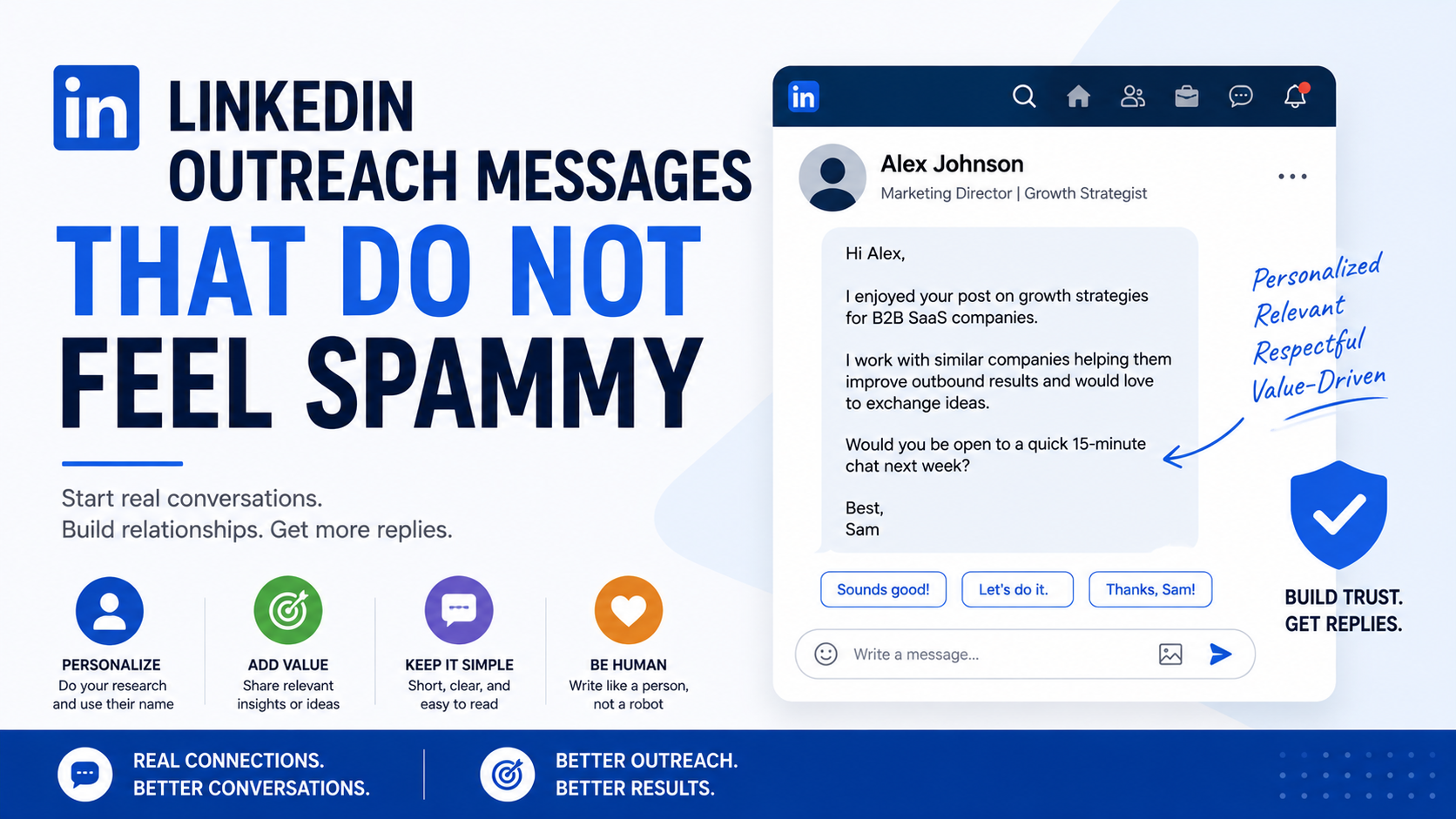
I used to think LinkedIn outreach was mostly a numbers game.
Send enough connection requests.
Message enough people.
Follow up enough times.
Eventually, someone replies.
Technically, that can happen.
But the problem becomes obvious pretty quickly: if your message looks like every other sales message in someone’s inbox, people start ignoring you before they even finish the first line.
I learned this the hard way after writing messages that sounded polished but completely unnatural.
Things like:
“Hi John, I hope you are doing well. I came across your impressive profile and wanted to connect because we help businesses achieve scalable growth through innovative solutions.”
It looked professional.
It also looked exactly like something sent to 500 people that morning.
The messages that started better conversations were much simpler.
They mentioned something real.
They asked a reasonable question.
They did not pretend there was already a relationship.
Most importantly, they did not try to close a sale inside the first message.
That is the main difference between LinkedIn outreach that feels personal and outreach that feels like spam.
LinkedIn Is Not Email With Profile Photos
This was one of the biggest mindset changes for me.
A lot of people take their cold email template, remove the subject line, and paste the rest into LinkedIn.
That usually feels wrong.
LinkedIn is more conversational.
People use it to:
- Connect with colleagues
- Follow industry updates
- Share work
- Recruit
- Find jobs
- Build partnerships
- Talk to potential customers
That means your message should feel more like a professional conversation than a miniature sales page.
If your first LinkedIn message is 300 words long, there is a good chance you are doing too much.
The first message usually needs one clear purpose:
Start a conversation.
The Spam Test I Use Before Sending
Before sending a LinkedIn message, I ask myself one simple question:
Could I send this exact message to 1,000 different people by changing only the first name?
If the answer is yes, it probably needs work.
For example:
“Hi Sarah, I help businesses improve their digital presence and generate more leads. Would you be interested in a quick call?”
That could go to almost anyone.
Now compare it with:
“Hi Sarah, saw you recently opened a second dental location in Austin. Curious — are you handling local marketing for both locations with the same setup?”
That gives Sarah a real reason to believe you contacted her specifically.
The difference is not complicated personalization.
It is relevance.
Stop Starting With “I Came Across Your Profile”
This line appears everywhere.
“I came across your profile and was impressed by your experience.”
“Came across your profile and wanted to connect.”
“I stumbled upon your profile…”
There is nothing technically wrong with it.
It is just worn out.
And most of the time, it says nothing.
Of course you saw their profile.
You are messaging them on LinkedIn.
If you have something specific to mention, say that instead.
For example:
“Saw you’re hiring two account executives right now.”
Or:
“Noticed your team just launched in Dubai.”
Or:
“Saw your post about reducing client onboarding time.”
Those openings give the message context immediately.
Do Not Compliment People Just to Get Their Attention
Fake compliments are one of the quickest ways to make LinkedIn outreach feel automated.
You have probably received messages like:
“Really impressed by your incredible journey!”
Or:
“Your work is truly inspiring!”
Then, two sentences later:
“We offer web development, SEO, branding, PPC, and social media services.”
The compliment was not genuine.
It was just a bridge to the pitch.
If you genuinely liked something, mention exactly what it was.
Instead of:
“Loved your content.”
Try:
“Your point about reducing demo friction in yesterday’s post was interesting, especially the part about removing unnecessary form fields.”
Now the compliment has substance.
If you have nothing meaningful to say, skip the compliment.
A straightforward message is better than fake praise.
The Best Connection Requests Are Usually Short
A connection request is not the place for your full pitch.
I prefer something simple.
For example:
“Hi Daniel, saw you’re expanding the engineering team at Acme. Thought it made sense to connect.”
That is enough.
Another:
“Hi Amanda, I work with property businesses in Dallas and noticed your team manages several commercial sites there. Happy to connect.”
No sales deck.
No calendar link.
No claim about increasing revenue by 300%.
The purpose of the connection request is to create permission for a conversation.
Use it that way.
What to Send After They Accept
This is where people often ruin a perfectly good connection.
The prospect accepts.
Thirty seconds later, they receive:
“Thanks for connecting! We are a full-service digital agency providing SEO, web development, PPC, social media, branding, content marketing, and more. Can we schedule a 30-minute call?”
That feels like a trap.
The connection request was not really about networking.
It was just the first step in an automated pitch sequence.
A better message might be:
“Thanks for connecting, Sarah. I noticed your firm is running paid campaigns for commercial property leads. Are you handling the landing pages internally too?”
Now you have a real business question.
LinkedIn Outreach Works Better When You Ask About Their Situation
One of the simplest ways to avoid sounding spammy is to stop talking so much about yourself.
Ask about what they are already doing.
For example:
“Are you handling local SEO internally or working with an agency?”
“Are those open developer roles tied to a current product deadline?”
“Do you manage the bookkeeping in-house?”
“Are you currently generating most of your leads through referrals?”
“Do you already have a commercial cleaning provider?”
These questions are useful because they reveal context.
And context makes the next message easier.
A Good LinkedIn Message Does Not Need to Explain Everything
This was another mistake I made early.
I tried to make every message complete.
Who we are.
What we do.
Why we are different.
Who we work with.
Proof.
Call to action.
All inside one LinkedIn message.
It was too much.
People do not need your entire business story before deciding whether to answer one question.
For example:
“Hi Chris, saw your roofing company has a strong review profile in Dallas. Curious — are you doing anything actively around Google Maps rankings at the moment?”
That can be enough to start.
If Chris replies:
“Yes, we have an agency.”
Then the conversation becomes about that.
If he says:
“No.”
Now you have another path.
Let the conversation earn the pitch.
LinkedIn Outreach Example for SEO Services
Bad version:
“Hi Mark, we are an award-winning SEO agency helping businesses improve rankings, increase traffic, and generate more leads. Would you be interested in a free audit?”
Better version:
“Hi Mark, noticed your plumbing company has more than 100 Google reviews, but a couple of competitors with fewer reviews are still appearing above you locally. Are you doing anything actively with local SEO right now?”
Why does the second one feel better?
Because it starts with a business observation.
The offer comes later.
LinkedIn Outreach Example for Web Design
Bad version:
“Hi Sarah, we build modern and responsive websites for businesses. Can we redesign your website?”
Better version:
“Hi Sarah, I was looking through your clinic site on mobile and noticed the appointment CTA gets harder to find on some of the treatment pages. Is the website managed internally?”
Again, the message is about the situation first.
Not the service.
LinkedIn Outreach Example for Recruiting
“Hi Daniel, saw your team is hiring several backend engineers right now. Are those hires mostly for long-term growth, or are you trying to fill capacity for a current project?”
This works because it qualifies the opportunity.
If Daniel says:
“Long-term growth.”
You can decide whether your service is relevant.
If he says:
“We need people urgently.”
Now you may have a stronger reason to continue.
LinkedIn Outreach Example for Software Development
“Hi Alex, noticed you’re hiring React and Node.js developers. We sometimes support SaaS teams when hiring hasn’t caught up with roadmap deadlines. Are the open roles tied to anything time-sensitive?”
That introduces what you do without turning the message into a brochure.
LinkedIn Outreach Example for a Local Service Business
Suppose you run commercial landscaping.
“Hi Amanda, saw you manage several commercial properties around Dallas. Quick question — do you handle landscaping vendors directly or does someone else on the team manage that?”
That message can save you from pitching the wrong person.
If Amanda says:
“Talk to our facilities manager.”
Great.
You just improved your targeting.
Do Not Ask for a Call Too Early
This is one of the biggest reasons LinkedIn outreach feels pushy.
You send a message to a stranger.
They have not replied.
Then you ask:
“Do you have 30 minutes this week?”
That is a large commitment.
A smaller CTA usually works better.
Try:
“Worth sending a quick example?”
“Is this something you’re working on?”
“Are you the right person for this?”
“Want me to send the two things I noticed?”
“Are you handling this internally?”
Once there is actual interest, then suggest a call.
Do Not Drop a Calendly Link in the First Message
I have nothing against scheduling links.
Calendly and similar tools are useful.
But dropping a calendar link into an unsolicited first message often feels like you are assigning the prospect a task.
Something like:
“Here’s my calendar, book a time.”
The prospect has not even said they want a meeting yet.
A better sequence is:
Prospect shows interest.
You agree a call makes sense.
Then send the link.
That feels natural.
Keep Your First Message Easy to Read
LinkedIn messages are often read on phones.
That means formatting matters.
Do not send a wall of text.
Keep paragraphs short.
For example:
“Hi James,
Saw your company is currently hiring several sales reps.
We work with B2B teams on outbound research, so I was curious — are the new hires expected to build their own prospect lists too?”
That is much easier to read than a 250-word company introduction.
Personalization Should Be Relevant, Not Creepy
There is a line between useful research and uncomfortable research.
Good:
“Saw your company opened a second office in Miami.”
Not good:
“I saw you were at a restaurant in Miami with your family last weekend.”
Stick to professional context.
Useful sources include:
- LinkedIn posts
- Company pages
- Job listings
- Company websites
- Public announcements
- Press releases
- Business news
- Public professional information
Do not dig into unrelated personal details just to prove you researched someone.
That is not better personalization.
It is just intrusive.
Use LinkedIn Sales Navigator for Better Targeting
If you are doing B2B outreach seriously, LinkedIn Sales Navigator can be useful because the real challenge is often finding the right people.
You can filter prospects by things such as:
Industry
Company size
Role
Seniority
Location
Company headcount
Function
That helps you avoid sending random connection requests.
Suppose your ideal customer is:
Heads of Marketing at US-based SaaS companies with 20 to 100 employees.
That is much more useful than searching:
“Marketing.”
The better your targeting, the less aggressive your message needs to be.
Do Not Automate Before You Know What Works
Automation is tempting.
There are tools that can help organize LinkedIn outreach and CRM activity.
But the danger is obvious.
If you automate a weak message, you simply annoy more people faster.
I prefer testing manually first.
Send 20 or 30 carefully chosen messages.
See what people say.
If nobody replies, investigate why.
Maybe the audience is wrong.
Maybe the question is weak.
Maybe the offer is irrelevant.
Only after the basic approach starts producing real conversations should you think about scaling parts of the workflow.
Be Careful With Automation Tools
LinkedIn has platform rules and usage limits, and these can change.
If you use third-party automation, understand what the tool is doing and whether it complies with LinkedIn’s current policies.
Do not risk an important professional account just because a tool promises hundreds of automated connection requests every day.
Your LinkedIn profile may represent years of:
Connections
Messages
Content
Reputation
Business relationships
Treat it like an asset.
Your Profile Matters Before the Message
People often check your profile before replying.
That means outreach quality is not only about the message.
Imagine someone receives:
“Hi Sarah, noticed your company is hiring developers…”
They click your profile.
Your headline says:
“Helping Companies 10X Growth 🚀 DM ME NOW!!!”
There are no clear details about what you do.
No relevant experience.
No real company.
That can kill trust immediately.
Your profile should make it easy to understand:
Who you are.
What you do.
Who you work with.
Why you are credible.
You do not need to turn it into a sales landing page.
Just make it real.
Use a Normal Profile Photo
This seems basic, but it matters.
A real, professional profile photo helps people understand there is an actual person behind the message.
You do not need a formal corporate headshot.
A clean, recognizable photo is enough.
Anonymous-looking profiles with aggressive sales messages naturally create more suspicion.
Your Headline Should Make Sense
A clear headline helps support outreach.
For example:
“Local SEO for Multi-Location Service Businesses”
is easier to understand than:
“Growth Hacker | Entrepreneur | Visionary | Digital Ninja”
Clear beats clever.
If the prospect checks your profile after receiving a message, they should immediately understand why your outreach makes sense.
Content Can Make Cold Outreach Warmer
One of the advantages of LinkedIn over cold email is that prospects can see your activity.
If you regularly post useful content about your area of expertise, your message has more context.
Imagine you contact a founder about improving local SEO.
They check your profile and see several recent posts about:
Google Business Profile optimization
Local ranking problems
Multi-location SEO
Review strategies
Now your message feels more credible.
Content does not replace outreach.
But it can make outreach warmer.
Engage Before Messaging When the Account Is Valuable
For high-value prospects, I sometimes prefer not to message immediately.
Follow them.
Read their posts.
Leave a useful comment when you genuinely have something to contribute.
Then connect later.
This does not mean:
Comment “Great post!” five times and then pitch.
That feels obvious.
The idea is to become familiar naturally.
This approach takes more time, so I would reserve it for prospects where the potential relationship justifies the effort.
A Simple Connection Request Template
“Hi [Name], saw [specific professional context]. Thought it made sense to connect.”
Examples:
“Hi James, saw you’re expanding the sales team at Northstar. Thought it made sense to connect.”
“Hi Emma, noticed you work with several commercial developments in Austin. Happy to connect.”
“Hi Daniel, saw your post about reducing onboarding time. Thought it was interesting, so figured I’d connect.”
Short.
Normal.
No pitch required.
A Simple Message After Connecting
“Thanks for connecting, [Name].
I noticed [specific business observation].
Curious — [simple question]?”
Example:
“Thanks for connecting, Sarah.
I noticed your clinic recently opened a second location.
Curious — are you managing local search for both locations internally?”
That gives Sarah something easy to answer.
A Message When You Have a Clear Offer
“Hi [Name], noticed [relevant signal].
We help [similar companies] with [specific problem].
Not sure if it’s relevant right now, but are you currently handling [problem] internally?”
For example:
“Hi Mark, noticed your team is hiring several SDRs.
We help B2B sales teams reduce the manual research reps do before outreach.
Not sure if it’s relevant right now, but are your SDRs still building their own prospect lists?”
Useful.
Specific.
Conversational.
A Follow-Up That Does Not Feel Annoying
Do not follow up the next hour.
Give people time.
When you do follow up, keep it light.
For example:
“Hey Mark, quick follow-up on this. I mainly asked because I noticed the SDR hiring and thought prospect research might be relevant. No worries if it’s already handled.”
Another:
“Hi Sarah, one extra thing I noticed — your newer location has a different Google Business setup from the original one. Happy to send the detail if useful.”
The second one is stronger because it adds something.
Stop Sending “Just Bumping This”
You can use it occasionally.
But five messages that say:
“Bumping this.”
“Just checking in.”
“Thoughts?”
“Following up.”
“Any update?”
do not create value.
If you have nothing new to say after a few attempts, stop.
Not every prospect needs to reply.
Do Not Use Guilt
Avoid messages like:
“I’ve messaged you three times and haven’t received a response.”
Or:
“I guess growth isn’t a priority.”
Or:
“I’m surprised you haven’t replied.”
That is an easy way to turn a neutral prospect into someone who actively dislikes your brand.
The recipient did not ask you to message them.
They do not owe you a response.
Know When to Stop
If someone says:
“Not interested.”
stop.
If they say:
“We already have this handled.”
you can ask one reasonable follow-up if appropriate, but do not argue.
If they ask not to be contacted again, respect it.
If someone ignores several messages, move on.
Good outbound includes knowing when an opportunity is not there.
Common LinkedIn Outreach Mistakes
Sending the Pitch Immediately
Build enough context for the pitch to make sense.
Writing Huge Messages
LinkedIn is conversational. Keep it readable.
Fake Compliments
Specific observations are better.
Generic Connection Requests
Give people a reason to recognize why you chose them.
Asking for a Call Too Soon
Start with a smaller question.
Sending Calendar Links Immediately
Wait until the prospect actually wants to speak.
Over-Automating
Test the approach manually first.
Ignoring the Prospect’s Profile
Make sure the person actually owns the problem you solve.
Contacting Only CEOs
Sometimes the operations, marketing, HR, facilities, or sales manager is the better buyer.
Continuing After a Clear No
Persistence does not mean ignoring boundaries.
A Practical LinkedIn Outreach Workflow
If I were building a LinkedIn outreach campaign from scratch, I would do it like this.
Step 1: Define One Audience
For example:
“Marketing directors at multi-location dental groups.”
Step 2: Define One Problem
Maybe:
“Inconsistent local search visibility across locations.”
Step 3: Build a Small Prospect List
Start with 30 to 50 people.
Step 4: Review Their Profiles
Check role, company, and recent activity.
Step 5: Find One Relevant Signal
New location.
Hiring.
Recent post.
Expansion.
Marketing activity.
Step 6: Send a Short Connection Request
Do not pitch everything.
Step 7: Start With a Question
Ask about the situation.
Step 8: Listen to the Reply
Do not force the same script on everyone.
Step 9: Introduce the Offer When Relevant
Let the conversation earn it.
Step 10: Track Results
Use Google Sheets, HubSpot, Pipedrive, or another CRM.
Track:
Connection requests sent
Accepted
Replies
Positive conversations
Meetings
Opportunities
Customers
Step 11: Improve Based on Real Replies
If nobody responds, fix targeting or messaging before increasing volume.
The Best LinkedIn Outreach Usually Feels Almost Boring
This may be the most useful thing I have learned.
People think high-performing outreach needs a clever hook.
It often does not.
A message like:
“Hi Daniel, saw your team is hiring several backend engineers. Are those roles tied to a current delivery deadline?”
looks almost too simple.
That is why it works.
It sounds like something one professional might genuinely ask another.
No exaggerated promise.
No fake friendship.
No giant pitch.
No psychological trick.
Just context and a reasonable question.
That is the standard I would use for LinkedIn outreach.
Before sending, ask:
Why this person?
Why this message?
Why now?
If you can answer those three questions clearly, the outreach will usually feel more natural.
If you cannot, no template will save it.
LinkedIn works best when you remember there is a person on the other side of the screen.
They are not a “lead.”
They are someone deciding whether this conversation is worth their attention.
Give them a legitimate reason to answer, keep the pressure low, and let the conversation develop from there.
That is how LinkedIn outreach stops feeling like spam and starts feeling like actual business development.