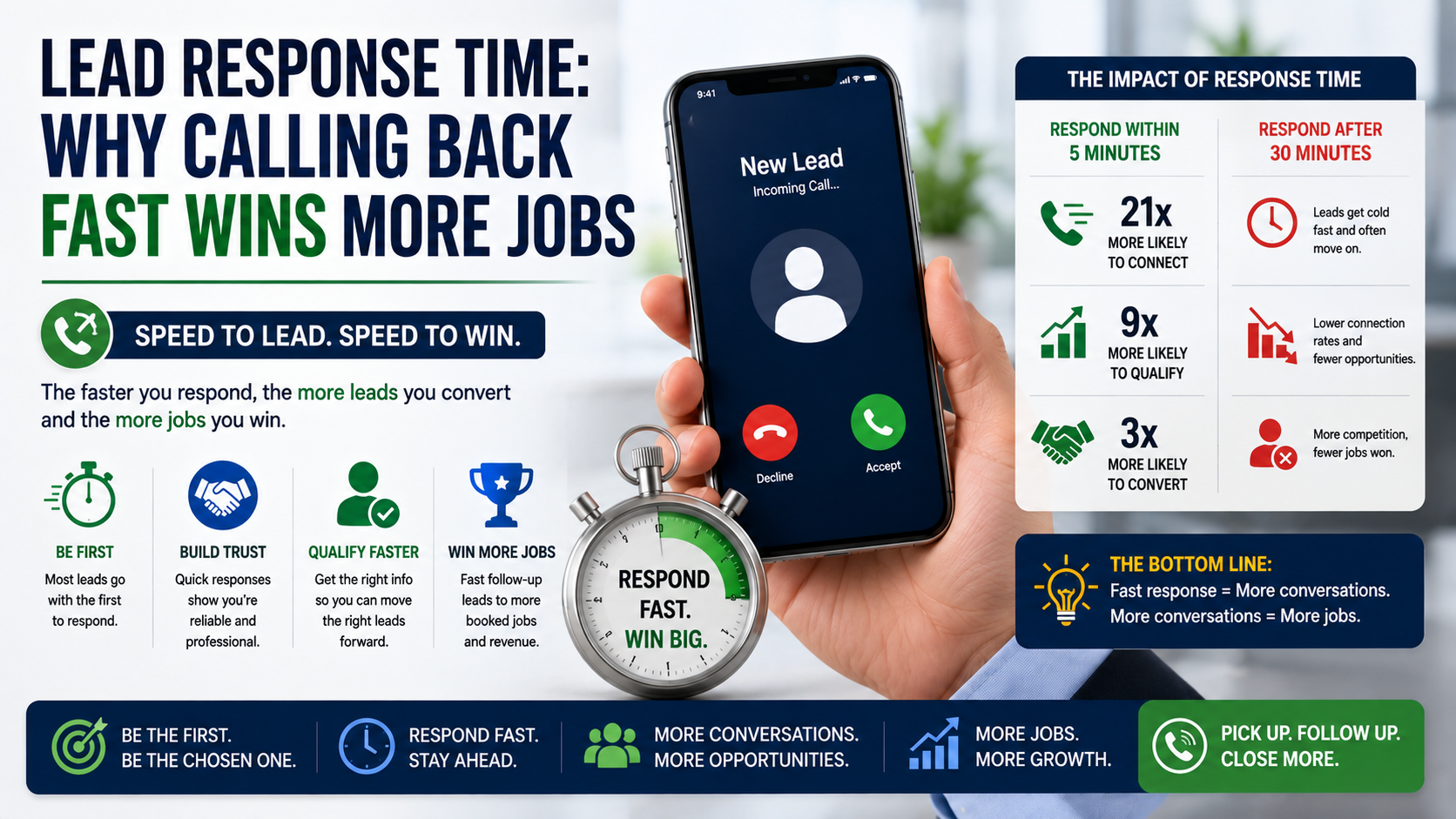
A homeowner notices water dripping through the ceiling after heavy rain.
They search Google, open three roofing websites, and submit a quote request to each company.
The first roofer calls within four minutes.
The second replies by email two hours later.
The third calls the next morning.
By then, the homeowner has already booked an inspection with the first company.
The other roofers may be equally skilled. One might even offer a better price. But the first business responded while the problem still felt urgent.
That is the part many businesses miss.
Customers do not submit an enquiry and patiently wait for every company to reply. They keep searching, calling, comparing, and making decisions.
The longer a lead sits unanswered, the more likely someone else is already having the conversation you wanted.
Fast response does not guarantee a sale. You still need the right service, sensible pricing, clear communication, and a professional process.
But responding quickly gives you something valuable: the first real chance to understand the customer’s problem.
What Lead Response Time Actually Means
Lead response time is the gap between a person contacting your business and receiving a meaningful reply from someone on your team.
That contact might arrive through:
- A website form
- A phone call
- Facebook Messenger
- Google Business Profile
- A lead marketplace
- A booking platform
An automatic confirmation email is helpful, but it is not always a complete response.
If someone asks for a plumbing appointment and receives a message saying, “Thanks, we received your enquiry,” they still do not know whether you can help.
A meaningful response moves the conversation forward.
It might be:
- A phone call
- A personal text message
- A request for photos
- A few qualification questions
- A confirmed appointment time
- A clear explanation of the next step
The goal is not just to acknowledge the lead.
The goal is to make contact while the person is still paying attention.
Why Speed Changes the Conversation
People usually contact a business because something has created momentum.
A pipe is leaking.
A website has stopped generating sales.
A business needs cleaning staff before opening a new office.
A landlord wants repairs completed before the next tenant moves in.
A company has received approval for a project.
At that moment, the prospect is focused on solving the problem.
If you respond quickly, you enter the conversation while that motivation is still strong.
If you wait several hours—or until the next day—the situation may have changed.
The prospect may have:
- Spoken with another provider
- Booked an appointment
- Received a quote
- Found a temporary solution
- Become distracted by other work
- Lost confidence in your responsiveness
- Decided the problem can wait
This is why fast follow-up often feels more important than a polished sales pitch.
The customer wants evidence that someone is available, organised, and paying attention.
A quick, calm response provides that reassurance.
The First Business to Respond Often Sets the Standard
The first useful conversation influences how the prospect evaluates everyone else.
Suppose a homeowner requests quotes from three kitchen renovation companies.
The first contractor calls and asks:
- What type of renovation are you planning?
- When would you like to begin?
- Have you set a budget range?
- Do you already have drawings?
- Would a site visit next week be useful?
The homeowner now has a clearer understanding of the process.
When the second contractor calls later and asks only, “What is your budget?” the conversation may feel less helpful.
The first business has already shaped the customer’s expectations.
It has also had the first chance to:
- Build rapport
- Explain its process
- Understand the project
- Address concerns
- Arrange an appointment
- Identify the decision-maker
- Suggest the next step
That early advantage matters, especially when several companies offer similar services.
Fast Does Not Mean Pushy
Some teams hear “respond quickly” and turn it into aggressive sales behaviour.
They call repeatedly, send several messages, and pressure the prospect to book immediately.
That is not good response time. It is poor communication delivered quickly.
A strong first response should feel helpful.
For example:
“Hi David, this is Sarah from Northside Roofing. I’ve just received your request about the leak near the chimney. Is water still entering the property now?”
That message is fast, specific, and connected to the customer’s problem.
Compare it with:
“Hi, we received your lead. When can you make payment?”
Speed works when it reduces uncertainty.
It fails when it increases pressure.
What Is a Good Lead Response Time?
For high-intent enquiries, aim to respond within a few minutes whenever possible.
This includes people requesting:
- An urgent repair
- A quote
- A consultation
- A service appointment
- A product demonstration
- A call back
- A property viewing
- Immediate technical support
Not every business can answer every lead within five minutes.
A contractor may be on a roof. A consultant may be in a meeting. A small business owner may be serving another customer.
The practical goal is to build a system that responds as quickly as your team realistically can.
A useful internal target might be:
- Within five minutes: Ideal for urgent or high-intent leads
- Within 15 minutes: Strong for most direct enquiries
- Within one hour: Acceptable for many non-emergency services
- Same business day: Minimum standard for lower-urgency enquiries
- Next day or later: Often too slow for competitive local services
The right target depends on the type of business.
An emergency locksmith should respond almost immediately.
An architecture firm receiving a detailed commercial project brief may not need to call within five minutes, but it should still acknowledge the enquiry and set a clear expectation.
The Mistake of Waiting Until You Have a Perfect Answer
One reason businesses respond slowly is that they want to prepare everything before contacting the lead.
They research the project.
They calculate a price.
They check staff availability.
They speak with a manager.
Only then do they reply.
Meanwhile, the customer hears nothing.
You do not need every answer before making first contact.
The initial response can simply say:
“Thanks for sending the details. I’m reviewing the project with our team now. I’ll come back to you with availability by 2 p.m. Could you also confirm the property location?”
This keeps the conversation active.
It shows the lead that the enquiry has reached a real person.
A fast partial answer is often better than a perfect answer delivered too late.
Build a Simple Lead Response System
Fast follow-up should not depend on someone remembering to check an inbox.
You need a repeatable process.
Step 1: List Every Place Leads Arrive
Write down all the channels customers use.
Common sources include:
- Website forms
- Google Ads
- Facebook Lead Ads
- Instagram messages
- Phone calls
- Lead providers
- Booking forms
- Referral partners
Businesses often improve website response time while forgetting that Instagram messages sit unanswered for two days.
Every active channel needs an owner and a notification system.
Step 2: Send an Immediate Confirmation
An automatic confirmation reassures the prospect that the enquiry was received.
Keep it honest.
For example:
“Thanks for contacting Greenway Landscaping. We’ve received your request and a team member will call you within 20 minutes during business hours.”
Do not promise a 20-minute response unless the team can consistently deliver it.
Outside business hours, explain what will happen next:
“Thanks for your message. Our office is currently closed. We open at 8 a.m., and a team member will contact you shortly after opening.”
This is much better than leaving the person wondering whether the form worked.
Step 3: Notify the Right Person Immediately
New leads should trigger an alert.
Depending on your setup, that alert might be:
- A CRM notification
- An email
- A text message
- A Slack message
- A Microsoft Teams alert
- A mobile app notification
- A WhatsApp notification
Tools such as HubSpot, Pipedrive, Zoho CRM, Salesforce, Zapier, and Make can route enquiries automatically.
A very small business can use Google Forms connected to Google Sheets and email notifications.
The technology does not need to be advanced.
The important part is that the lead reaches the person who can act.
Step 4: Assign One Owner
Every lead should belong to one person.
Without clear ownership, team members assume someone else has responded.
The lead owner should be responsible for:
- Making the first contact
- Updating the status
- Recording notes
- Scheduling the next action
- Handing the lead over when necessary
If the assigned person is unavailable, there should be a backup.
Step 5: Use a First-Response Script
A script prevents hesitation and keeps the first conversation focused.
It should not sound robotic.
A simple structure is:
- Introduce yourself
- Mention the specific enquiry
- Check whether it is a good time
- Ask one useful opening question
- Agree on the next step
For example:
“Hi Maria, this is Ahmed from BrightBuild Renovations. You requested information about renovating a two-bedroom apartment. Is now a good time for a quick call? I’d like to understand the scope before suggesting the next step.”
This is more natural than immediately launching into a sales presentation.
Step 6: Record the Outcome
After the first attempt, update the lead record.
Useful statuses include:
- New
- Contact attempted
- Connected
- Qualified
- Appointment booked
- Quote needed
- Follow-up scheduled
- Not qualified
- No response
Do not leave the lead marked as “new” after someone has called.
Accurate statuses prevent duplicated work and missed follow-ups.
What to Do When the Lead Does Not Answer
Fast response does not mean the person will pick up.
They may be at work, driving, or speaking with another company.
A practical first attempt can include:
- Call once
- Leave a short voicemail when appropriate
- Send a text or WhatsApp message
- Send an email
- Schedule the next attempt
Avoid calling five times in ten minutes.
A useful text message might say:
“Hi James, this is Olivia from ClearFlow Plumbing. I just tried calling about your request for a bathroom leak repair. You can reply here with a suitable time, or send a photo of the leak if that is easier.”
This gives the prospect options.
It also reminds them why you called.
Do not write vague messages such as:
“Call me urgently.”
The person may assume it is spam.
A Practical Follow-Up Schedule
The schedule should match the urgency of the enquiry.
For a normal service request, you might use:
First Five Minutes
Call and send a short message if there is no answer.
After 30 to 60 Minutes
Try again if the request appears urgent.
Later the Same Day
Send a helpful email or message with a simple next step.
The Next Business Day
Make another contact attempt.
Two to Three Days Later
Send a final active follow-up before moving the lead into a slower nurture process.
The messages should not all say the same thing.
Each attempt should make responding easier.
For example:
- First attempt: confirm the enquiry
- Second attempt: ask for a suitable call time
- Third attempt: request a photo or missing detail
- Final attempt: let the person know the enquiry will be closed for now
Real Example: A Local Repair Business
Imagine an air-conditioning company receives this form at 2:10 p.m.:
“My AC is running, but the house is not getting cold. I need someone as soon as possible.”
Slow Process
The form goes to a general email inbox.
The office assistant checks it at 5 p.m.
A technician calls the next morning.
The homeowner has already booked another company.
Fast Process
The form enters the CRM immediately.
The office assistant receives a mobile notification.
At 2:14 p.m., they call the homeowner and ask:
- Is the system still running?
- Is any air coming through the vents?
- When did the problem begin?
- What area is the property in?
- Is someone available between 4 and 6 p.m.?
The company books a same-day visit.
The speed did not replace technical expertise.
It simply allowed the company to use that expertise before a competitor did.
Real Example: A B2B Service Lead
Fast response matters in business-to-business sales too, although the conversation may be less urgent.
Suppose a company submits a request for an SEO audit.
The form says:
“We have lost traffic over the last two months and need help understanding why.”
A good response could arrive within 15 minutes:
“Hi Rachel, thanks for the context. I’ve received your request about the traffic decline. Before we schedule the audit, could you send the website address and confirm whether any redesign or migration happened during the last three months?”
This reply shows attention.
It also starts qualification immediately.
A weak response sent two days later might say:
“Please see our attached company profile and service packages.”
The fast response feels more relevant because it focuses on the problem rather than the seller.
Use Mobile Tools When You Are Away From a Desk
Small-business owners are not always sitting in front of a computer.
That is not a reason to leave leads unanswered.
Useful mobile tools include:
- HubSpot mobile app
- Pipedrive mobile app
- Zoho CRM mobile app
- Gmail
- Outlook
- Slack
- Microsoft Teams
- WhatsApp Business
- Google Voice
- Calendly
- Call-tracking apps
Create saved replies for common first messages, but personalise them before sending.
WhatsApp Business quick replies can help with questions such as:
- Service area
- Opening hours
- Appointment availability
- Information required for a quote
- Payment methods
- Emergency response
Templates save time.
They should not make every customer feel like they are speaking with a machine.
Use Round-Robin Assignment for Sales Teams
When several salespeople handle leads, round-robin assignment can distribute enquiries evenly.
For example:
- Lead one goes to Sarah
- Lead two goes to Hamza
- Lead three goes to Daniel
- Lead four returns to Sarah
This prevents one person from receiving every lead.
However, even distribution is not always the best rule.
You may want to assign leads based on:
- Location
- Service type
- Language
- Industry
- Account size
- Existing relationship
- Salesperson availability
Set an acceptance window.
If the assigned salesperson does not act within a certain period, the lead can move to another available person.
This prevents good enquiries from sitting untouched because someone is in a meeting.
Measure Response Time Properly
You cannot improve what you do not record.
Track:
- Time the lead arrived
- Time of first response
- Time of first successful contact
- Number of attempts
- Whether an appointment was booked
- Whether the lead became a customer
- Revenue generated
- Lead source
Do not measure only the average.
An average response time of 20 minutes may look good, but it can hide the fact that half the leads receive replies within five minutes while others wait six hours.
Review response times by:
- Team member
- Lead source
- Day of the week
- Time of day
- Service type
- Location
Patterns may reveal operational problems.
For example, leads arriving during lunch may receive slow responses. Weekend enquiries may sit unanswered until Monday. One campaign may generate urgent leads outside normal office hours.
Once you see the pattern, you can adjust staffing, automation, or campaign schedules.
Track Contact Rate, Not Just Response Time
A fast call that nobody answers is not the same as a real conversation.
Measure both:
First response time: How quickly did the business attempt contact?
Time to connect: How long did it take to speak with the person or receive a reply?
You should also track:
- Contact rate
- Qualification rate
- Appointment rate
- Quote rate
- Close rate
This helps you identify where the real issue sits.
If the team responds quickly but few people answer, the lead source may be weak or the contact method may need improvement.
If many people answer but few book appointments, the first conversation may need work.
If appointments are booked but few become customers, pricing, sales skills, or service fit may be the problem.
Common Lead Response Mistakes
Relying on a Shared Inbox
A shared inbox can work, but only if someone is responsible for checking it.
Otherwise, everyone assumes another person will reply.
Sending Only an Automatic Email
Automation confirms receipt.
It does not replace personal contact for high-intent leads.
Calling Without Reading the Enquiry
Customers notice when you ask for information they already provided.
Take 30 seconds to review the form before calling.
Waiting Until the End of the Day
Batching all lead follow-ups at 5 p.m. may be convenient for the team, but it gives competitors several hours to respond first.
Treating Every Lead the Same
An emergency repair request should not enter the same queue as a general newsletter signup.
Use priority rules.
Giving Up After One Attempt
Many good leads miss the first call.
Use a reasonable mix of calls, texts, and emails.
Contacting Too Aggressively
Fast response is valuable.
Repeated unwanted contact damages trust.
Failing to Leave Notes
Without notes, the next team member may repeat questions or misunderstand the situation.
Ignoring After-Hours Leads
A clear after-hours confirmation and scheduled next step are better than silence.
Responding Fast but Following Up Slowly
A quick first call means little if the quote takes a week to arrive.
Speed should continue through the whole process.
Response Time Is Part of the Customer Experience
Customers often use the early sales process to predict what working with the company will feel like.
If the business responds quickly, communicates clearly, and keeps promises, the prospect may assume the service will be organised too.
If messages go unanswered and appointments are difficult to arrange, the prospect may worry that the actual project will be handled the same way.
That judgment may not always be fair, but it is understandable.
The lead has not yet seen your finished work.
They can only judge the experience available to them.
At the beginning, that experience is mostly communication.
Build Speed Without Burning Out the Team
A fast response system should be sustainable.
It should not require one employee to stare at a phone every evening and weekend.
Set realistic boundaries.
You can:
- Display business hours clearly
- Use an after-hours confirmation
- Rotate on-call responsibility
- Pause campaigns when nobody can respond
- Use online booking for suitable services
- Hire an answering service for urgent calls
- Create backup lead owners
- Schedule staff around the busiest enquiry periods
Do not promise 24-hour availability if the team cannot provide it.
Reliable expectations are better than impressive promises that are frequently broken.
The First Five Minutes Are Not the Whole Sale
Speed creates an opportunity.
It does not complete the job.
After making contact, the business still needs to:
- Ask sensible questions
- Listen carefully
- Confirm fit
- Explain the process
- Provide accurate pricing
- Deliver the quote on time
- Follow up appropriately
- Show proof and credibility
- Keep commitments
Calling first and then sending a poor proposal will not win many customers.
The strongest businesses combine speed with competence.
They respond while the prospect is interested, then give the person a clear reason to continue.
A Simple Response Process You Can Set Up Today
A small business can improve lead response time without rebuilding its entire sales system.
Start with this:
- Send every enquiry into one inbox, spreadsheet, or CRM.
- Turn on mobile notifications.
- Assign each lead to one person.
- Send an immediate confirmation.
- Attempt personal contact within 15 minutes during business hours.
- Use a short first-call structure.
- Send a text when the call is unanswered.
- Record the result.
- Schedule the next follow-up.
- Review missed and delayed leads every week.
This process is simple enough to follow and strong enough to prevent many leads from being wasted.
The biggest improvement often comes from removing small delays.
A form notification goes to the wrong inbox.
A salesperson does not know the lead has arrived.
Nobody is sure who should call.
The team waits for more information before responding.
Each delay seems minor.
Together, they give the customer time to choose someone else.
Fast response is not about rushing people into a decision.
It is about being present when they are actively looking for help.
Call while the problem is still fresh.
Ask useful questions.
Make the next step easy.
Even when you are not the cheapest provider, being the first business to respond clearly and professionally can be the reason you get the appointment—and eventually the job.