A small-business owner once told me he wanted 500 leads a month.
At the time, his team was receiving around 60 enquiries. That sounded like a serious shortage until we looked at what happened after those leads arrived.
Almost half were not contacted on the same day. Several quotes were sent without any follow-up. The business did not record why prospects said no, and nobody could say with confidence how many leads became paying customers.
The company did not need 500 leads.
It needed to handle the 60 it already had properly.
That situation is more common than people think. Business owners often choose a lead target because a competitor mentioned a number, an agency promised “hundreds of leads,” or a marketing dashboard made more volume look like the obvious answer.
But the right number of leads depends on much more than business size.
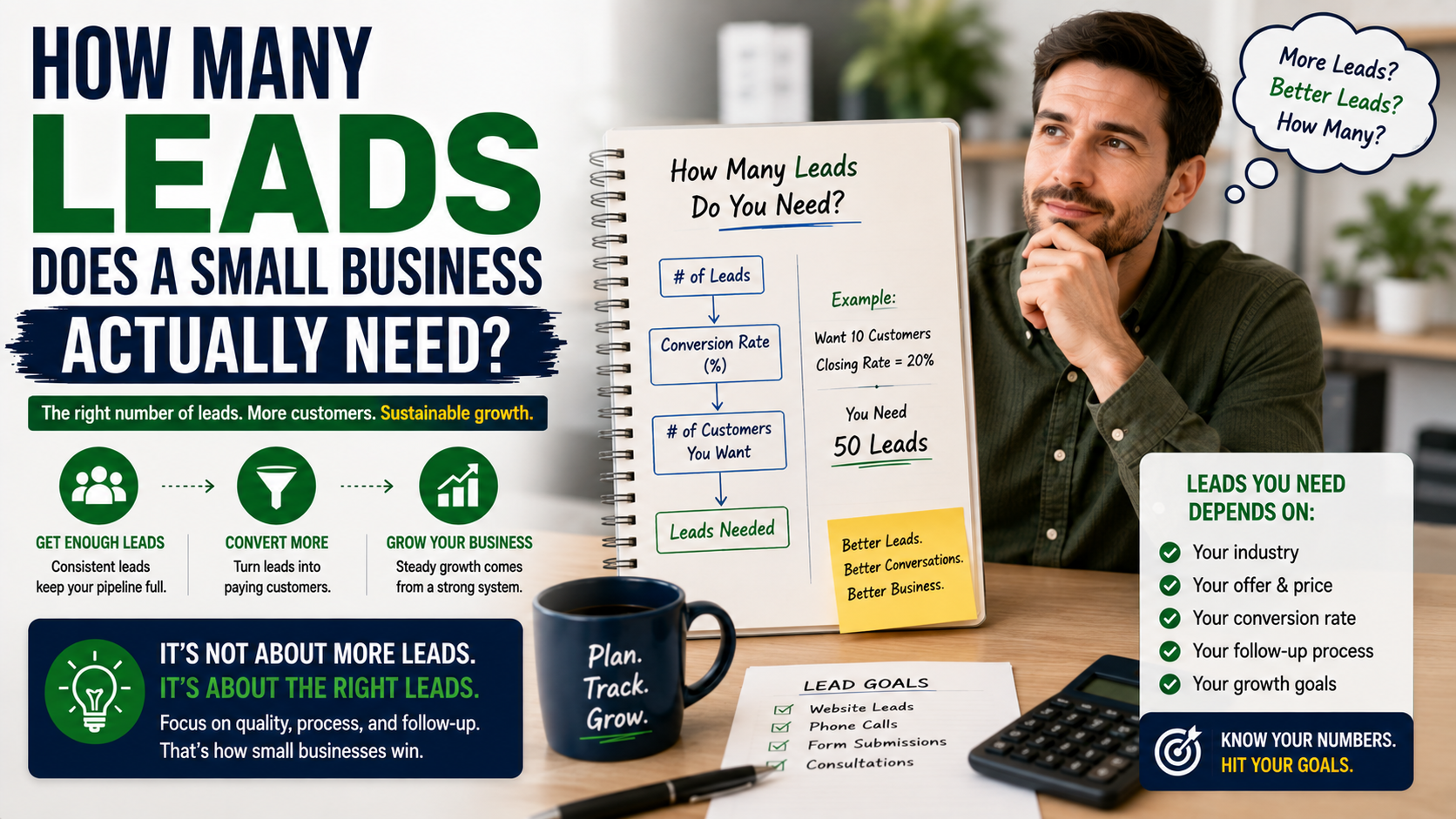
It depends on:
- How many customers you need
- Your sales conversion rate
- Your average sale value
- Your profit margin
- Your team’s available capacity
- The quality of the leads
- How quickly you respond
- How often customers buy again
A solo consultant may need only five strong leads per month.
A cleaning company may need 100.
A local retailer could need hundreds of enquiries or store visits, while a commercial contractor might build an excellent year from ten suitable opportunities.
The goal is not to generate the largest number possible.
It is to generate enough qualified opportunities to reach your sales target without overwhelming the business or wasting money.
Start With the Number of Customers You Need
The easiest way to estimate your lead requirement is to work backward.
Do not begin with traffic, clicks, followers, or form submissions.
Begin with customers.
Suppose your goal is to win ten new customers next month.
If your business closes one out of every five qualified leads, your close rate is 20%.
The calculation is:
Customers needed ÷ Close rate = Qualified leads needed
Using the example:
10 ÷ 0.20 = 50 qualified leads
You would need approximately 50 qualified leads to win ten customers.
The word “qualified” matters.
If half of your enquiries are unsuitable, you would need around 100 total enquiries to produce those 50 qualified opportunities.
That gives you a second calculation:
Qualified leads needed ÷ Qualification rate = Total enquiries needed
If your qualification rate is 50%:
50 ÷ 0.50 = 100 total enquiries
This is already more useful than choosing a random target.
Raw Leads and Qualified Leads Are Not the Same
A raw lead is usually anyone who provides contact information or starts a conversation.
That may include people who:
- Live outside your service area
- Need a service you do not provide
- Cannot afford the minimum price
- Entered an incorrect phone number
- Are applying for a job
- Are collecting information
- Have no realistic buying timeline
- Never answer after submitting the form
A qualified lead fits the basic conditions required to become a customer.
For a local contractor, that might mean the person:
- Needs the correct service
- Owns or manages the property
- Lives within the service area
- Has a realistic budget
- Wants to begin within a reasonable period
- Can take part in the decision
A campaign producing 200 raw leads may create fewer sales opportunities than one producing 40 well-qualified leads.
This is why “How many leads did we get?” is usually the wrong first question.
Ask:
How many suitable people did we speak with?
Calculate Your Current Conversion Rate
Before estimating future lead needs, find out what your business currently converts.
A basic lead-to-customer conversion rate is:
Number of new customers ÷ Number of leads × 100
Suppose you received 80 leads and won eight customers.
Your conversion rate would be:
8 ÷ 80 × 100 = 10%
That means you currently need about ten leads to generate one customer.
However, this broad number can hide important details.
A better breakdown may include:
- Total enquiries
- Valid leads
- Qualified leads
- Appointments
- Quotes or proposals
- Customers
Imagine this monthly funnel:
- 100 enquiries
- 80 valid contact records
- 50 qualified leads
- 30 appointments
- 20 proposals
- 8 customers
Your overall lead-to-customer rate is 8%.
But your qualified-lead-to-customer rate is:
8 ÷ 50 × 100 = 16%
Both numbers are useful.
The first helps you estimate the total marketing volume required.
The second helps you assess how well the sales team handles suitable opportunities.
Use Real Data, Not Your Best Month
Business owners sometimes estimate conversion rates from memory.
They remember a month when almost every enquiry seemed to buy and assume the normal close rate is 40%.
The CRM tells a different story.
Use at least three to six months of data where possible. Seasonal businesses may need a full year to get a fair average.
Remove obvious spam, but do not quietly exclude every lead that did not answer. Unreachable leads are part of the real performance of that source.
Track the numbers in a tool your team will maintain.
This could be:
- Google Sheets
- Microsoft Excel
- HubSpot
- Pipedrive
- Zoho CRM
- Airtable
- Monday.com
- Notion
A simple spreadsheet is enough to begin.
Include:
- Lead date
- Source
- Service requested
- Qualified or not
- Appointment booked
- Quote sent
- Won or lost
- Sale value
- Lost reason
Without these records, the lead target is mostly guesswork.
Work Backward From Your Revenue Goal
Customer count is useful, but revenue can produce a more realistic target when services have different values.
Suppose your monthly new-business revenue target is $30,000.
Your average new customer spends $3,000.
The first calculation is:
Revenue goal ÷ Average sale value = Customers needed
$30,000 ÷ $3,000 = 10 customers
If your qualified-lead close rate is 25%, you need:
10 ÷ 0.25 = 40 qualified leads
If 60% of your total enquiries are qualified, you need:
40 ÷ 0.60 = approximately 67 total leads
Your target would therefore be around 67 enquiries, producing 40 qualified opportunities and ten customers.
This is much more meaningful than deciding you need 1,000 website visitors or 100 social media messages.
Account for Different Services
Average sale value can become misleading when a business sells several services.
Imagine a home-services company offers:
- $150 maintenance visits
- $800 repairs
- $5,000 installations
It may receive many maintenance leads but still miss its revenue goal because the service mix is wrong.
Instead of creating one company-wide lead target, calculate requirements by service.
For example:
Maintenance
- Customer target: 30
- Close rate: 50%
- Qualified leads required: 60
Repairs
- Customer target: 12
- Close rate: 30%
- Qualified leads required: 40
Installations
- Customer target: 4
- Close rate: 20%
- Qualified leads required: 20
The business needs 120 qualified opportunities in total, but each category plays a different role.
This approach also improves marketing.
An installation lead may be worth much more than a basic maintenance enquiry, so it can justify a higher acquisition cost.
Check How Much Work You Can Actually Deliver
More customers are not always helpful.
If your team can complete only 20 projects per month, generating enough leads for 50 new customers creates another problem.
The business may:
- Delay projects
- Miss deadlines
- Reduce quality
- Stop answering messages
- Overwork employees
- Receive poor reviews
- Refund unhappy customers
- Damage its reputation
Before setting a lead target, calculate capacity.
Ask:
- How many new customers can we serve each week?
- How many hours does each job require?
- Which services create bottlenecks?
- Is the sales team able to follow up properly?
- Can operations handle a sudden increase?
- Do we need more staff, equipment, or inventory?
- How far ahead are we comfortable booking?
Suppose a renovation company can start only three projects each month.
If it closes 20% of qualified consultations, it may need around 15 suitable leads—not 150.
Additional leads can still be valuable for future bookings, but expectations need to be managed. The company may need a waiting list or a clear future start date.
Know Your Sales Cycle
Not every lead generated this month becomes a customer this month.
A cleaning service may close someone within a few hours.
A commercial construction project may take six months.
This affects how you interpret lead targets.
Suppose a B2B consultant needs four new clients per quarter, but the average sales process lasts 60 days.
Waiting until the final month of the quarter to generate leads would be too late.
The consultant needs enough opportunities entering the pipeline earlier.
Track:
- Average time from enquiry to first conversation
- Average time from first conversation to proposal
- Average time from proposal to decision
- Average total sales cycle
If customers normally take 45 days to decide, this month’s lead generation may support next month’s revenue rather than the current month.
A healthy pipeline contains opportunities at several stages instead of depending entirely on brand-new enquiries.
Lead Source Changes the Number You Need
Leads from different sources rarely convert at the same rate.
A referral lead may already trust your business.
A Google Search lead may have an urgent need.
A Facebook lead may have responded to an attractive offer but still be exploring.
A cold outreach lead may require several conversations.
For example:
Referrals
- 10 leads
- 5 customers
- Conversion rate: 50%
Google Search
- 30 leads
- 9 customers
- Conversion rate: 30%
Facebook Ads
- 60 leads
- 6 customers
- Conversion rate: 10%
Cold Email
- 40 positive replies
- 2 customers
- Conversion rate: 5%
The business should not expect every source to produce the same result.
To win five customers, it might need:
- 10 referral leads
- 17 Google leads
- 50 Facebook leads
- 100 positive cold outreach responses
This is why a company-wide average can hide valuable information.
Calculate conversion rates by source whenever possible.
Customer Quality Matters Too
Two customers are not always equally valuable.
One may make a single small purchase.
Another may continue buying for three years, refer other customers, and purchase additional services.
When deciding how many leads you need, look beyond the first transaction.
Useful numbers include:
- Average first sale
- Average gross profit
- Repeat purchase rate
- Customer retention period
- Customer lifetime value
- Refund or cancellation rate
- Referral value
A subscription business may need fewer new leads if it retains customers well.
A company with weak retention may constantly need new leads just to replace customers leaving each month.
Improving customer retention can reduce lead pressure significantly.
Suppose a maintenance company normally loses ten customers each month.
It needs ten new customers simply to remain the same size.
If it reduces customer losses to five, half of its new sales can support actual growth.
Sometimes the fastest way to reduce the number of leads you need is to keep more of the customers you already have.
Include No-Shows and Unreachable Leads
A lead may submit a form but never answer.
Another may book a call and not attend.
These losses need to be included in the calculation.
Suppose you need 20 completed appointments.
Your appointment attendance rate is 70%.
The calculation is:
Completed appointments needed ÷ Attendance rate = Bookings needed
20 ÷ 0.70 = approximately 29 bookings
If 60% of qualified leads book an appointment, you would need:
29 ÷ 0.60 = approximately 49 qualified leads
This shows why small improvements in the funnel matter.
If appointment reminders increase attendance from 70% to 85%, you would need:
20 ÷ 0.85 = approximately 24 bookings
You now need five fewer bookings to achieve the same number of attended appointments.
That can save time and marketing money.
Tools such as Calendly, Google Calendar, HubSpot, and many CRM platforms can send reminders automatically.
A simple email or WhatsApp confirmation can also reduce no-shows.
Build a Simple Lead Requirement Formula
A useful formula is:
Revenue target ÷ Average sale value ÷ Close rate ÷ Qualification rate = Total leads needed
Suppose:
- Revenue target: $40,000
- Average sale: $4,000
- Qualified-lead close rate: 25%
- Qualification rate: 50%
First, calculate customers:
$40,000 ÷ $4,000 = 10 customers
Then calculate qualified leads:
10 ÷ 0.25 = 40 qualified leads
Then calculate total leads:
40 ÷ 0.50 = 80 total leads
The business would need approximately 80 enquiries to reach the target, assuming the averages remain stable.
A more complete formula may also include contact and appointment rates.
For example:
Customers needed ÷ Close rate ÷ Appointment attendance rate ÷ Booking rate ÷ Qualification rate = Total enquiries needed
The calculation can become detailed, but do not make it so complicated that nobody uses it.
Start with customers, close rate, and qualification rate.
Add other stages when your tracking becomes more reliable.
Example: A Local Cleaning Company
Imagine a residential cleaning company wants 25 new recurring customers over the next three months.
Its recent data shows:
- 70% of enquiries are within the service area and suitable
- 60% of qualified leads book a first cleaning
- 80% of booked customers complete the appointment
- 50% of completed first-cleaning customers choose recurring service
Work backward.
To gain 25 recurring customers, the business needs:
25 ÷ 0.50 = 50 completed first cleanings
To get 50 completed cleanings:
50 ÷ 0.80 = 63 bookings
To get 63 bookings:
63 ÷ 0.60 = 105 qualified leads
To get 105 qualified leads:
105 ÷ 0.70 = 150 total enquiries
Over three months, that is approximately:
- 50 enquiries per month
- 35 qualified leads per month
- 21 bookings per month
- 17 completed first cleanings per month
- 8 to 9 new recurring customers per month
The business now has a realistic operating target instead of simply asking for “more leads.”
Example: A Small Web Design Agency
A web agency wants to win three projects per month.
Its average project value is $6,000, creating a monthly new-business target of $18,000.
The agency’s recent funnel looks like this:
- 50% of enquiries are suitable
- 40% of qualified leads book a discovery call
- 75% of calls result in a proposal
- 40% of proposals are accepted
To win three projects, the agency needs:
3 ÷ 0.40 = 7.5, or around 8 proposals
To generate eight proposals:
8 ÷ 0.75 = approximately 11 discovery calls
To generate 11 calls:
11 ÷ 0.40 = approximately 28 qualified leads
To generate 28 qualified leads:
28 ÷ 0.50 = 56 total enquiries
The result may surprise the agency.
Fifty-six monthly enquiries is a large target for a small team selling high-value projects.
Instead of only increasing lead volume, the agency could improve the booking rate.
If better qualification and follow-up raise the discovery-call booking rate from 40% to 60%, it would need:
11 ÷ 0.60 = approximately 19 qualified leads
At a 50% qualification rate, that equals 38 total enquiries instead of 56.
Improving the funnel reduces the marketing requirement.
Example: A Solo Consultant
A consultant wants two new clients each month.
The consultant closes 30% of qualified calls.
To win two clients:
2 ÷ 0.30 = approximately 7 qualified sales calls
If 50% of suitable leads agree to a call, the consultant needs:
7 ÷ 0.50 = 14 qualified leads
If 70% of initial enquiries are suitable:
14 ÷ 0.70 = 20 total enquiries
Twenty leads per month may be enough.
Trying to generate 200 could overwhelm the consultant with calls, follow-ups, and proposals.
For high-value services, quality and fit usually matter more than volume.
Improve Conversion Before Buying More Leads
When sales are low, generating more leads feels like the obvious solution.
But the existing funnel may be leaking.
Review each stage.
Are Leads Contacted Quickly?
A lead waiting until the next day may already be speaking with a competitor.
Are Leads Properly Qualified?
The team may spend too much time on people outside the target market.
Are Appointments Easy to Book?
Slow scheduling and long forms create friction.
Are Reminders Sent?
No-shows reduce the value of good leads.
Are Proposals Clear?
Complicated documents can delay decisions.
Is Follow-Up Consistent?
Many opportunities are lost after one unanswered message.
Are Lost Reasons Recorded?
Without this information, the business cannot identify recurring problems.
Improving one stage can reduce the number of leads needed across the whole system.
Small Conversion Improvements Create Large Differences
Suppose a business needs ten customers.
At a 10% lead-to-customer conversion rate, it requires:
10 ÷ 0.10 = 100 leads
If it improves the conversion rate to 15%, it needs:
10 ÷ 0.15 = approximately 67 leads
That is 33 fewer leads for the same customer target.
If each lead costs $30, the difference is:
33 × $30 = $990
Improving response time, qualification, sales calls, and follow-up may be more profitable than increasing the advertising budget.
Set a Lead Range, Not One Perfect Number
Sales results vary.
Some months close better than others. Average project values change. Leads may arrive unevenly. Customers delay decisions.
Instead of setting one exact target, use a range.
For example:
- Minimum: 40 qualified leads
- Target: 50 qualified leads
- Upper capacity: 65 qualified leads
The minimum shows when the pipeline may become weak.
The target supports the revenue plan.
The upper figure warns when the team may become overloaded.
This is more practical than believing the business must generate exactly 52 leads every month.
Separate Leading and Lagging Indicators
Revenue is a lagging indicator. It tells you what has already happened.
Lead activity gives earlier warning.
Useful leading indicators include:
- New leads
- Qualified leads
- First-response time
- Conversations
- Appointments
- Proposals
- Follow-up tasks completed
Lagging indicators include:
- Customers
- Revenue
- Profit
- Retention
- Customer acquisition cost
If qualified leads drop sharply this month, revenue may decline later.
Tracking both gives the business time to react.
Review the Numbers Weekly
You do not need to rebuild the forecast every day.
A short weekly review can include:
- Total new leads
- Qualified leads
- Leads waiting for contact
- Appointments booked
- No-shows
- Proposals sent
- Customers won
- Lost opportunities
- Lead source performance
- Capacity for new work
Then ask:
- Are we ahead of or behind the target?
- Is the problem lead volume or conversion?
- Which source produces the strongest opportunities?
- Are leads receiving quick follow-up?
- Is the team approaching capacity?
- Which stage is losing the most people?
This prevents the business from waiting until the end of the month to discover the pipeline is weak.
Common Mistakes When Setting Lead Targets
Copying Another Business’s Number
Two businesses in the same industry may have different prices, teams, locations, conversion rates, and capacity.
Calculate your own requirement.
Counting Every Contact as a Lead
Spam, job applications, vendors, and irrelevant enquiries should not be treated as sales opportunities.
Ignoring Lead Quality
A high lead count can hide poor targeting.
Track qualified leads separately.
Using an Unrealistic Close Rate
Base forecasts on recent averages, not the strongest month in company history.
Forgetting the Sales Cycle
Leads generated today may support revenue several weeks or months later.
Ignoring Customer Retention
A company replacing lost customers needs more leads than one with strong retention.
Generating More Than the Team Can Handle
Unanswered leads and delayed delivery waste marketing investment.
Measuring Only Leads
Track appointments, proposals, customers, revenue, and profit.
Combining Every Source
Referral, paid advertising, search, and outreach leads often convert differently.
Failing to Update the Calculation
Your target should change when prices, capacity, conversion rates, or business goals change.
So, How Many Leads Does a Small Business Need?
There is no useful universal number.
A small business needs enough qualified leads to produce its required customers at its current conversion rate, while staying within operational capacity.
The calculation starts with four numbers:
- Revenue or customer goal
- Average sale value
- Close rate
- Qualification rate
For example:
- Need 10 customers
- Close 20% of qualified leads
- Qualify 50% of total enquiries
The business needs:
- 50 qualified leads
- 100 total enquiries
That is the starting estimate.
Then adjust for:
- Appointment booking
- No-shows
- Sales-cycle length
- Lead source
- Repeat purchases
- Customer retention
- Team capacity
- Profitability
Do not chase a larger lead number simply because it looks impressive in a report.
A business receiving 30 strong leads and closing ten may be healthier than one receiving 300 and closing five.
The right question is not:
“How do we get as many leads as possible?”
It is:
“How many suitable opportunities do we need, and what must happen after each one arrives?”
Once you can answer that, lead generation becomes easier to plan, budget, and improve.
You stop paying for volume without purpose.
You start building a pipeline based on the number of customers the business can profitably win and successfully serve.