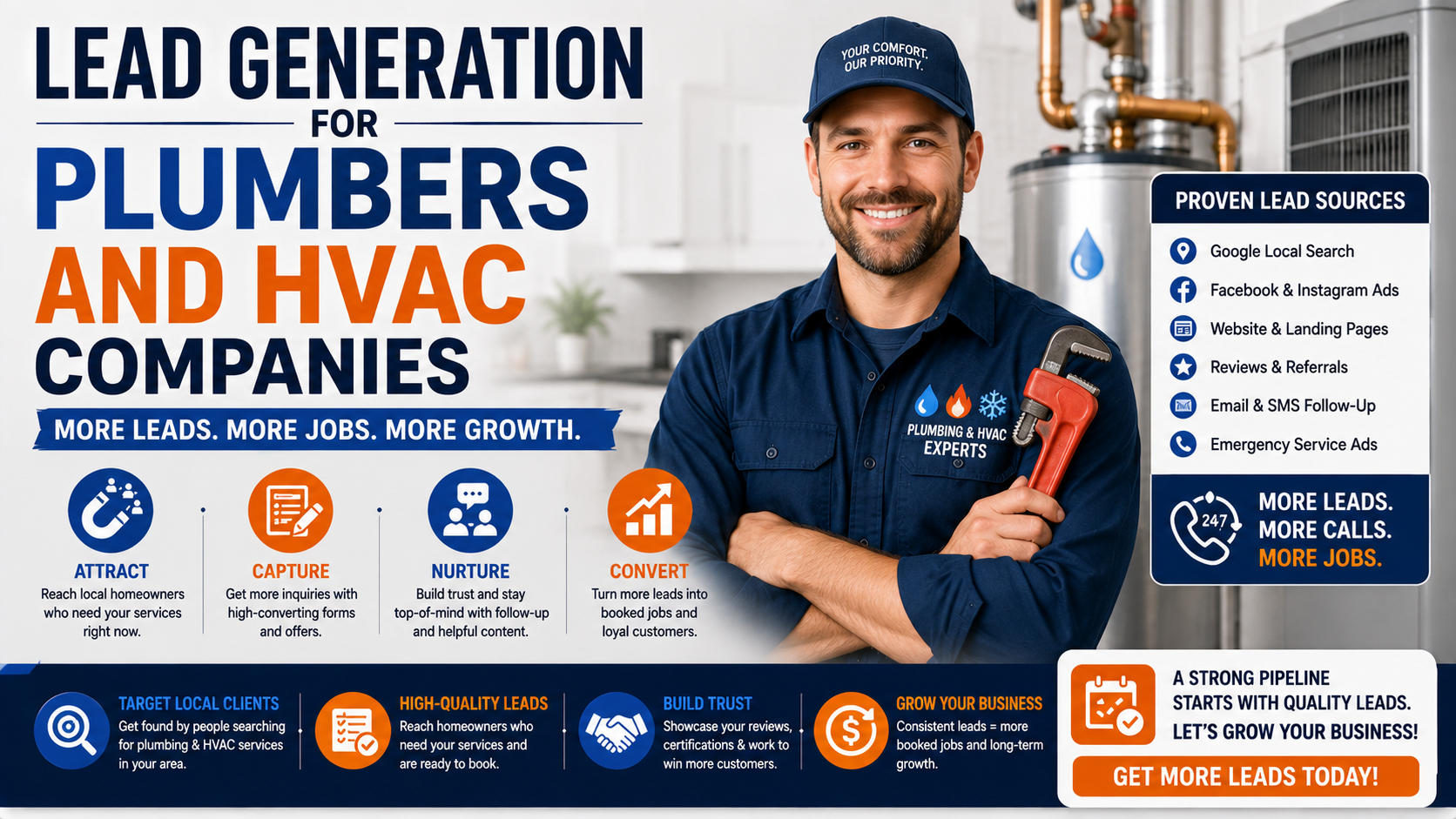
A homeowner with water spreading across the kitchen floor is not comparing ten beautifully designed websites.
They are calling the first plumbing company that looks trustworthy, serves their area, and appears ready to answer.
The same thing happens when an air conditioner stops working during a hot weekend. The customer is not looking for a long explanation about company values. They want to know whether someone can come out, how soon they can arrive, and what the next step will be.
I have seen plumbing and HVAC businesses spend heavily on ads while missing calls, replying to forms hours later, or sending every visitor to a general homepage. The campaign gets blamed, even though the real problem begins after the lead arrives.
I have also seen smaller companies win jobs against larger competitors simply because they answered quickly, explained the process clearly, and followed up after sending the estimate.
That is what makes lead generation for plumbers and HVAC companies different from many other industries.
The marketing has to attract the right local customer, but the operating system behind it matters just as much. A strong campaign cannot rescue a phone that nobody answers. A polished website cannot close a replacement project when the estimate arrives six days late.
The complete process looks more like this:
- A customer notices a problem.
- They search, ask for a recommendation, or see an advertisement.
- They find your business.
- They call, message, or submit a form.
- Someone responds quickly.
- The request is qualified.
- A visit is booked.
- The technician arrives and communicates well.
- The repair, installation, or replacement is approved.
- The customer is followed up for reviews, maintenance, and future work.
Lead generation is not only about getting the phone to ring.
It is about turning suitable local demand into profitable jobs without losing good customers along the way.
Decide Which Jobs You Want More Of
“More plumbing leads” or “more HVAC leads” is too broad.
A leaking tap, blocked sewer line, water-heater replacement, annual AC service, and complete HVAC installation have different values, urgency levels, and sales processes.
Before choosing marketing channels, decide which services the business wants to grow.
For a plumbing company, those services may include:
- Emergency leak repair
- Drain cleaning
- Sewer-line repair
- Water-heater installation
- Bathroom plumbing
- Pipe replacement
- Leak detection
- Commercial plumbing
- Preventive maintenance
- Gas-line work, where properly licensed
For an HVAC company, they may include:
- AC repair
- Furnace repair
- Seasonal maintenance
- HVAC replacement
- New system installation
- Heat-pump service
- Indoor air quality services
- Ductwork
- Commercial HVAC
- Maintenance agreements
Do not place every service inside one advertisement.
Someone with an overflowing drain needs a different message from a homeowner comparing replacement systems.
A focused drain-cleaning campaign might say:
Slow or blocked drain? Book a local drain inspection and cleaning appointment.
A replacement campaign could say:
Is your HVAC system breaking down repeatedly? Request a replacement assessment and compare suitable system options.
The clearer the offer, the easier it is for the right customer to respond.
Define a Qualified Lead
Not every call is a real job opportunity.
Some callers may be:
- Outside your service area
- Looking for a service you do not offer
- Requesting free technical advice
- Applying for a job
- Selling products
- Asking for a price without sharing any details
- Looking for an unlicensed or unsafe shortcut
- Trying to book work for a property they do not control
A qualified residential plumbing or HVAC lead usually has:
- A valid service address
- A problem you handle
- A realistic service timeline
- Authority to approve the visit
- Working contact details
- Willingness to discuss the issue
- Acceptance of the basic service-call process
For larger replacements or commercial jobs, qualification may also include:
- Property type
- Approximate system age
- Number of units
- Current equipment
- Access requirements
- Budget expectations
- Decision-making process
- Desired completion date
- Financing needs, when legitimately offered
Write these conditions down.
If the office, technicians, and marketing team use different definitions of a good lead, your reports will never make sense.
Understand the Difference Between Emergency and Planned Demand
Plumbing and HVAC companies often serve two very different customer situations.
Emergency or Urgent Demand
The customer needs help now.
Examples include:
- Burst pipe
- No cooling during extreme heat
- No heating during cold weather
- Sewer backup
- Active water leak
- Failed water heater
- Commercial system failure
These leads value:
- Fast response
- Clear availability
- A working phone number
- Trust
- Accurate service areas
- Simple booking
Planned or Research-Based Demand
The customer has time to compare options.
Examples include:
- HVAC replacement
- Bathroom renovation plumbing
- Preventive maintenance
- Heat-pump installation
- Commercial service contracts
- Indoor air quality upgrades
- Water-heater replacement before failure
These customers want more information:
- Equipment or service options
- Price factors
- Financing
- Warranty
- Timeline
- Efficiency
- Installation process
- Reviews
- Company experience
Do not treat both groups the same way.
An emergency page should make calling easy.
A replacement page should help the customer make a thoughtful decision.
Build a Website That Works During a Real Emergency
A plumbing or HVAC website does not need complicated animation.
It needs to work quickly on a phone.
A customer should be able to see:
- What you do
- Where you work
- Whether emergency service is available
- How to call
- How to request a visit
- What happens next
- Why the business appears trustworthy
Test the site using mobile data, not only office Wi-Fi.
Check:
- Page speed
- Clickable phone numbers
- Button size
- Form length
- Service-area visibility
- Opening hours
- Emergency-service wording
- Confirmation messages
- Contact notifications
One surprisingly common problem is a form that appears to submit successfully but never reaches the office.
Test every form yourself.
Submit it from an iPhone, an Android phone, and a desktop browser if possible. Confirm that the lead reaches the correct inbox or CRM and that someone receives a notification.
Create Separate Pages for Major Services
A single page titled “Our Services” is not enough for most established plumbing or HVAC businesses.
Create focused pages for important services.
A drain-cleaning page might cover:
- Common signs of a blockage
- Types of drains serviced
- What the visit includes
- When camera inspection may be appropriate
- Service areas
- Booking options
- What customers should avoid doing
An AC repair page could explain:
- Common symptoms
- What technicians inspect
- Repair versus replacement considerations
- Service-call process
- Availability
- Brands or system types serviced, where accurate
- How to book
A replacement page should answer different questions:
- When replacement may make sense
- Factors affecting system selection
- Property size
- Efficiency considerations
- Installation stages
- Warranty
- Financing options, where available
- Estimated timelines
- How to request an assessment
Focused pages improve both customer understanding and local search visibility.
Make the Service Area Obvious
A lead outside your operating area wastes advertising money and office time.
List the service area clearly on:
- Homepage
- Service pages
- Contact page
- Google Business Profile
- Social media profiles
- Lead forms
- Advertisements
Do not assume geographic ad targeting will filter every unsuitable customer.
People travel, use work locations, and submit forms for relatives in other areas.
Ask for the service address or neighborhood early.
For example:
Which city or neighborhood is the property located in?
This one question can save several minutes on every unsuitable call.
Improve Your Google Business Profile
For local plumbing and HVAC companies, Google Business Profile can be a major source of phone calls, directions, website visits, and trust.
Complete the profile carefully.
Include:
- Correct business name
- Accurate category
- Phone number
- Website
- Business hours
- Service areas
- Services
- Logo
- Team photos
- Vehicle photos
- Real job photos
- Customer reviews
Keep hours updated during holidays and seasonal schedule changes.
If you advertise emergency availability, make sure the actual call-handling process supports it.
A customer who sees “Open 24 hours” and reaches a voicemail saying the office will reopen Monday is unlikely to trust the business.
Use Real Photos, Not Only Stock Images
Stock photographs of smiling technicians have become so common that many customers ignore them.
Real photos build stronger confidence.
Useful images include:
- Branded service vehicles
- Technicians in clean uniforms
- Water-heater installations
- HVAC outdoor units
- Furnace replacements
- Drain equipment
- Commercial mechanical rooms
- Before-and-after work
- Clean completed installations
- Team training
- Warehouse or shop
- Safety procedures
Avoid sharing private addresses, customer documents, access codes, or identifying details without permission.
The goal is to show real capability, not expose the customer.
Build a Review Process Into Every Completed Job
Reviews matter heavily in home services because customers are inviting someone into their property.
Do not wait until the business has a slow month to ask for reviews.
Make the request part of the job process.
A technician or office team can ask after:
- The problem has been resolved
- The area has been cleaned
- The customer understands the invoice
- Follow-up questions have been answered
- The customer expresses satisfaction
A simple message works well:
Thanks for choosing us for your AC repair. Would you mind sharing a short Google review about your experience? It helps other local homeowners know what to expect from our team.
Do not offer rewards for positive reviews or tell customers what rating to leave.
Ask for honest feedback.
Respond professionally to negative reviews. Do not publish private customer information while defending the company.
A calm response that acknowledges the issue and offers a way to continue the conversation usually looks better than a public argument.
Use Google Search Ads for High-Intent Leads
Search ads can be effective because they reach people actively looking for help.
Useful plumbing search themes include:
- Plumber near me
- Emergency plumber
- Drain cleaning
- Water-heater repair
- Burst pipe repair
- Sewer-line repair
- Leak detection
Useful HVAC themes include:
- AC repair near me
- Furnace repair
- HVAC company
- Emergency AC repair
- Air-conditioner replacement
- Heat-pump installation
- HVAC maintenance
Separate campaigns or ad groups by service and urgency.
Do not send an AC repair search to a general homepage containing plumbing, heating, cooling, electrical, and remodeling services.
Send the customer to the page that matches the problem.
Add Negative Keywords
Negative keywords help prevent ads from appearing for irrelevant searches.
Depending on the business, you may need to exclude terms involving:
- Jobs
- Salary
- Apprenticeship
- Training
- Certification
- DIY
- Free
- Parts only
- Wholesale
- Used equipment
- Manuals
- Troubleshooting guides
- Unserved locations
Review the real search terms regularly.
Do not assume the platform understands your services perfectly.
Treat Phone Calls as the Main Conversion
Many plumbing and HVAC customers prefer to call.
If your reporting tracks only website forms, you may miss the strongest source of business.
Use call tracking where appropriate to understand:
- Which campaign produced the call
- Which page the caller visited
- Whether the call was answered
- Call duration
- Service requested
- Qualified status
- Booking result
- Revenue
Do not treat every call as a lead.
Separate:
- Existing customers
- Vendors
- Job seekers
- Wrong numbers
- Spam
- Unsupported services
- Qualified new enquiries
A campaign that produces 50 calls may have generated only 18 genuine sales opportunities.
That distinction matters.
Answer the Phone Like the Advertising Budget Depends on It
Because it does.
A strong search campaign may cost a meaningful amount for each click or call. Missing one good replacement lead can waste far more money than many businesses realize.
Create a simple call-handling process.
The person answering should be able to:
- Introduce the company clearly
- Confirm the customer’s location
- Understand the problem
- Identify urgency
- Explain the service-call process
- Book an appointment
- Set realistic expectations
- Record the source
- Confirm contact information
Avoid answering with only:
Hello?
Use the business name.
For example:
Thank you for calling ClearFlow Plumbing and Heating. This is Sarah. How can I help?
That immediately reassures the caller that they reached the correct company.
Build an After-Hours System
Plumbing leaks and HVAC breakdowns do not respect office hours.
That does not mean every company must operate around the clock.
It does mean the customer should understand what happens after hours.
Your process might include:
- Live answering service
- On-call technician
- Recorded message
- Automatic text reply
- Online booking request
- Emergency call-routing
- Next-morning callback queue
Be honest about availability.
Do not advertise 24-hour emergency service when calls are only returned the next business day.
If you do provide after-hours service, explain any service-call or emergency charges before dispatch when possible.
Clear expectations reduce disputes.
Use Local Services and Lead Platforms Carefully
Some plumbers and HVAC companies use local advertising programs, directories, home-service marketplaces, and shared-lead providers.
These sources can produce work, but the numbers need close attention.
Ask:
- Is the lead exclusive or shared?
- How many businesses receive it?
- How quickly is it delivered?
- What information is included?
- Can invalid leads be disputed?
- Which services are selected?
- Which locations are included?
- How is the business charged?
- Are calls recorded?
- Does the platform own the customer relationship?
Shared leads can become expensive when several contractors call the same homeowner immediately.
Track each source separately.
Do not combine marketplace leads with referrals and organic Google enquiries in one general report.
Their conversion rates may be completely different.
Use Facebook and Instagram for Visual and Seasonal Campaigns
Social media is usually less urgent than search, but it can work well for:
- Seasonal maintenance
- HVAC tune-ups
- System replacement
- Water-heater upgrades
- Indoor air quality
- Maintenance memberships
- Drain-prevention education
- Commercial maintenance
- Retargeting website visitors
Use real situations rather than generic graphics.
A short video could show:
- A badly clogged outdoor AC coil
- The cleaning process
- Improved airflow
- A simple explanation of why maintenance matters
A plumbing video might show:
- A leaking water-heater connection
- The visible warning signs
- The repaired installation
- A reminder to schedule an inspection when corrosion appears
Do not show unsafe practices or encourage untrained viewers to work on gas, electrical, pressurized, or hazardous systems.
Educate customers about warning signs and when to call a qualified professional.
Create Seasonal Campaigns Before Demand Peaks
HVAC demand often changes sharply with the weather.
Plumbing demand can rise during freezing conditions, heavy rain, holidays, or periods when properties sit unused.
Do not wait until the phones are already busy to prepare campaigns.
Before cooling season, prepare:
- AC maintenance landing page
- Replacement assessment page
- Email campaign
- Social videos
- Call scripts
- Technician capacity
- Booking slots
- Follow-up messages
Before heating season, prepare similar materials for:
- Furnace inspection
- Heating maintenance
- No-heat repair
- Replacement
- Safety checks
Plumbing companies can prepare campaigns for:
- Frozen pipes
- Holiday drain problems
- Water-heater failure
- Storm-related drainage issues
- Seasonal property inspections
Planning ahead allows the business to control the message rather than reacting during a rush.
Sell Maintenance Plans Without Making Them Confusing
Maintenance agreements can improve retention and create more predictable revenue.
For HVAC companies, a plan may include:
- Scheduled seasonal visits
- Priority booking
- Maintenance reminders
- Member pricing
- Equipment records
- Filter or inspection services
- Repair benefits, where clearly defined
For plumbing companies, a plan might include:
- Annual plumbing inspection
- Water-heater check
- Leak inspection
- Drain assessment
- Priority scheduling
- Member discounts
Do not overload the plan with vague promises.
Explain:
- What is included
- What is not included
- How often visits occur
- Whether unused visits expire
- How cancellation works
- Whether discounts apply to all services
- How priority scheduling is handled
The plan should make sense even without aggressive sales pressure.
Turn One-Time Repairs Into Long-Term Customers
A small repair can become much more valuable over time.
A customer who first books a drain cleaning may later need:
- Water-heater replacement
- Pipe repair
- Bathroom plumbing
- Leak detection
- Annual inspection
An AC repair customer may later need:
- Maintenance
- System replacement
- Ductwork
- Indoor air quality work
- Service for another property
Record equipment and property information when appropriate.
This may include:
- System age
- Model
- Installation date
- Repair history
- Recommended future work
- Warranty information
- Customer preferences
Do not use these records to create fear-based sales messages.
Use them to provide useful reminders.
For example:
Your annual AC maintenance is due next month. The last visit showed the system was operating normally, but the outdoor coil needed cleaning. Reply here if you would like to schedule the next service.
That message is specific and helpful.
Create Educational Content Around Real Customer Questions
Plumbing and HVAC customers repeatedly ask the same questions.
Turn those questions into useful content.
Plumbing topics may include:
- Why does a drain keep blocking?
- When should a water heater be replaced?
- What causes low water pressure?
- Why is a pipe making noise?
- What should I do when I notice a leak?
- Repair or replace a leaking fixture?
- What affects plumbing repair cost?
HVAC topics may include:
- Why is the AC running but not cooling?
- How often should HVAC maintenance be scheduled?
- Repair or replace an older system?
- Why is one room hotter than the others?
- What causes high energy bills?
- What should happen during a maintenance visit?
- How long does HVAC installation take?
Keep safety in mind.
Do not encourage homeowners to dismantle systems, handle refrigerants, repair gas equipment, or work around unsafe electrical components.
Simple checks such as confirming thermostat settings or checking whether a filter is visibly dirty may be reasonable, but the content should make professional limits clear.
Use Video to Show the Work
Plumbing and HVAC work contains many useful visual stories.
Examples include:
- Corroded water-heater components
- Blocked drain findings
- Camera-inspection footage
- Clean equipment installations
- Damaged HVAC coils
- Filter comparisons
- Duct leaks
- Thermostat upgrades
- Before-and-after mechanical rooms
- Commercial service visits
A simple video format is:
- Show the symptom.
- Explain what caused it.
- Show part of the repair or inspection.
- Show the completed result.
- Explain when a customer should request help.
Avoid filming customer documents, house numbers, family photos, or private conversations.
Get permission before using a recognizable property or customer testimonial.
Build Referral Partnerships
Plumbers and HVAC companies often share customers with other local professionals.
Potential partners include:
- Electricians
- Roofers
- Restoration companies
- Property managers
- Real estate agents
- Home inspectors
- General contractors
- Remodelers
- Appliance repair companies
- Cleaning companies
- Facility managers
A restoration company may need a plumber to stop the source of water damage.
An HVAC company may need an electrician for related power work.
A property manager may need reliable emergency coverage across several buildings.
Do not start by asking for referrals.
Start by understanding the partner’s needs and service standards.
A useful message might say:
We often meet customers who need electrical work connected to HVAC replacements. I’d like to learn more about your service area and scheduling process so we can refer suitable customers confidently.
Good partnerships depend on communication.
A referred lead should never disappear into an unanswered inbox.
Build a Customer Referral Program
Satisfied customers can become a reliable source of local work.
A referral request may be as simple as:
We’re glad the repair went smoothly. If a neighbor or family member needs plumbing help, feel free to send them our number. We’ll make sure they receive a prompt response.
A formal referral reward may include:
- Service credit
- Gift card
- Maintenance discount
- Account credit
- Small cash reward, where appropriate
Define the rules clearly.
Explain when the reward is earned and how it will be delivered.
Track referrals so customers do not have to remind you repeatedly.
Use Email and Text Without Becoming Annoying
Past customers are valuable, but that does not mean they should receive constant promotions.
Useful messages include:
- Seasonal maintenance reminders
- Appointment confirmations
- Equipment service reminders
- Cold-weather pipe preparation
- Water-heater inspection reminders
- Filter reminders
- Maintenance-plan information
- Relevant service updates
Get appropriate consent and follow applicable messaging and privacy rules.
Make unsubscribing simple.
A useful message should sound like customer service, not pressure.
Qualify Calls With a Short Script
The first call should collect enough information to book the right response.
For plumbing enquiries, ask:
- What problem are you experiencing?
- Is water actively leaking?
- Can the water supply be shut off safely?
- Where is the property located?
- Is it residential or commercial?
- Are you the owner, tenant, or property manager?
- Has anyone worked on the problem already?
- When did the issue begin?
- What is the best contact number?
- Is someone available to provide access?
For HVAC enquiries, ask:
- Is the system heating or cooling at all?
- When did the problem begin?
- Is the property residential or commercial?
- Do you know the system’s approximate age?
- Has it been repaired recently?
- Are there unusual sounds, smells, or leaks?
- Where is the property?
- Is someone available for the visit?
- Are you interested in repair, replacement, or diagnosis?
- What is the best contact method?
Do not give unsafe technical instructions over the phone.
For situations involving gas smells, electrical hazards, flooding, smoke, or immediate danger, follow proper emergency guidance and local safety procedures.
Give the Customer a Real Appointment Window
One of the fastest ways to damage trust is to give a vague all-day window and communicate nothing.
Customers are often taking time away from work.
Use realistic arrival windows.
Send updates when the technician is:
- Assigned
- On the way
- Delayed
- Arriving soon
Field-service platforms such as Jobber, Housecall Pro, ServiceTitan, and similar tools can help businesses manage scheduling, dispatch, customer messages, estimates, and job records.
A smaller company can also begin with Google Calendar, a shared spreadsheet, WhatsApp Business, and clear internal responsibility.
The system does not need to be expensive.
It needs to be reliable.
Train Technicians to Support Lead Conversion
The technician is often the person the customer trusts most.
Marketing may generate the call, but the technician’s communication can determine whether the business wins additional work.
Technicians should be able to:
- Explain findings simply
- Show photographs where helpful
- Separate urgent work from optional improvements
- Present approved options
- Avoid exaggerated claims
- Confirm the next step
- Record customer questions
- Request office support when needed
Do not turn technicians into aggressive salespeople.
A homeowner should not feel frightened into approving work.
The goal is to help the customer understand the condition, choices, risks, and costs.
Clear education usually creates more trust than pressure.
Present Repair and Replacement Options Honestly
HVAC companies frequently face repair-versus-replacement discussions.
Plumbers may face similar decisions involving water heaters, old piping, fixtures, or recurring drain problems.
Give customers enough context to decide.
Explain:
- Current condition
- Repair cost
- System or component age
- Previous failures
- Availability of parts
- Expected reliability
- Efficiency considerations
- Warranty
- Replacement cost
- Safety concerns
- Whether the problem is isolated or recurring
Avoid telling every customer that replacement is the only sensible choice.
Equally, do not keep repairing a failing system without explaining the long-term cost.
Document the options clearly.
Deliver Estimates Quickly
For planned projects, speed still matters.
A homeowner comparing three HVAC replacement companies may choose the one that provides a clear proposal first.
A professional estimate should include:
- Scope of work
- Equipment or materials
- Labor
- Removal and disposal
- Permit responsibility, where relevant
- Warranty
- Payment terms
- Estimated schedule
- Exclusions
- Optional upgrades
- Validity period, when needed
Do not send a single total price with no explanation.
Customers need to understand what they are comparing.
Follow Up After Every Estimate
Many replacement jobs are lost because the company sends the quote and waits.
A useful follow-up sequence might look like this:
After Sending
I’ve sent the HVAC replacement options and warranty details. Please let me know if the attachment opened correctly.
Two Days Later
Did you have any questions about the differences between the two system options or the installation timeline?
One Week Later
Is the replacement still planned for this month? I’m happy to review the proposal with you by phone if that would help.
Final Active Follow-Up
I’ll close the estimate for now so we do not keep sending reminders. We can reopen it later if your timing changes.
Each follow-up has a purpose.
Avoid sending repeated messages that say only, “Any update?”
Reconnect With Old Estimates
An old estimate is not always a dead opportunity.
The customer may have delayed because of:
- Budget
- Weather
- Property sale
- Financing
- Other renovations
- Seasonal timing
- Landlord approval
- Business cash flow
Review old estimates by service and reason.
A useful message could say:
We prepared an estimate last season for replacing the older upstairs AC system. I wanted to check whether that project is still being considered before the hotter months begin. We still have the previous equipment notes on file.
This feels more natural than a generic mass promotion.
Use a CRM or Central Lead Tracker
Plumbing and HVAC leads can arrive through:
- Website forms
- Phone calls
- Social media
- Referrals
- Local directories
- Lead platforms
- Maintenance reminders
- Commercial outreach
Every lead should enter one system.
A useful record includes:
- Lead date
- Source
- Customer name
- Phone number
- Service address
- Service requested
- Urgency
- Assigned staff member
- Appointment date
- Job status
- Estimate amount
- Follow-up date
- Won or lost
- Lost reason
- Revenue
- Future service reminder
HubSpot, Pipedrive, Zoho CRM, Jobber, Housecall Pro, ServiceTitan, Airtable, and Google Sheets can all support this process at different business sizes.
The best system is the one the team updates.
Measure the Full Funnel
Do not judge lead generation by calls or forms alone.
Track:
- Total enquiries
- Valid leads
- Qualified leads
- Contact rate
- Booking rate
- Completed appointments
- Estimates
- Approved jobs
- Average job value
- Cost per qualified lead
- Customer acquisition cost
- Revenue by source
- Gross profit by source
- Repeat jobs
- Memberships sold
- Lost reasons
Example
Suppose an HVAC campaign produces:
- 80 enquiries
- 60 valid leads
- 45 qualified leads
- 35 booked appointments
- 30 completed visits
- 12 estimates
- 5 replacement jobs
- $42,000 in revenue
The raw lead-to-replacement rate is:
5 ÷ 80 × 100 = 6.25%
The qualified-lead-to-replacement rate is:
5 ÷ 45 × 100 = 11.1%
The estimate close rate is:
5 ÷ 12 × 100 = 41.7%
These numbers reveal different parts of the process.
If the company wants more replacement jobs, it may need more replacement assessments. It may not need more general repair enquiries.
Track Lead Sources by Profit, Not Only Revenue
Two channels can produce the same revenue and very different profit.
One may generate nearby maintenance jobs that are easy to schedule.
Another may produce distant emergency calls requiring overtime and long travel.
Track:
- Advertising cost
- Labor
- Travel
- Parts
- Discounts
- Platform fees
- Call-center costs
- Refunds
- Repeat business
A lead source that appears expensive may produce better long-term customers.
A cheap source may create low-value, high-friction jobs.
Common Lead Generation Mistakes
Advertising Every Service Together
Emergency repairs and system replacements need different messages.
Hiding the Service Area
Customers should know immediately whether you cover their location.
Missing Calls
A missed urgent call often becomes a competitor’s job.
Advertising 24-Hour Service Without Staffing It
Make availability truthful.
Sending Every Visitor to the Homepage
Use focused service pages.
Tracking Forms but Not Calls
Many of the best leads arrive by phone.
Counting Every Call as a Lead
Separate customers, vendors, spam, and job seekers.
Responding Slowly to Online Forms
Online customers may also be contacting competitors.
Using Stock Photos Only
Real team and project photos build stronger trust.
Failing to Ask for Reviews
Reviews should be part of the completed-job process.
Offering Unsafe Advice
Know when a customer needs emergency services or professional help.
Giving Fixed Prices Without Enough Information
Site conditions, equipment, access, and scope matter.
Sending Estimates Without Follow-Up
A quote does not automatically close itself.
Focusing Only on Cost per Lead
Track cost per booked job and customer.
Ignoring Existing Customers
Past customers can create maintenance, replacement, and referral opportunities.
Marketing Only During Slow Periods
Prepare campaigns before seasonal demand begins.
Generating More Leads Than the Team Can Handle
Slow response and poor service waste the marketing budget.
A Practical 30-Day Lead Generation Plan
Week One: Fix the Basics
- Define priority services
- Confirm service areas
- Test all phone numbers
- Test website forms
- Improve mobile contact buttons
- Update Google Business Profile
- Set response-time targets
- Create one lead tracker
Week Two: Improve Conversion Pages
- Build or improve the emergency service page
- Improve the AC or furnace repair page
- Improve the water-heater or drain page
- Add real photos
- Add reviews
- Explain the booking process
- Add clear calls to action
Week Three: Activate Lead Sources
- Ask recent customers for reviews
- Reconnect with old estimates
- Publish two educational videos
- Contact referral partners
- Prepare seasonal emails
- Test one focused search or social campaign
Week Four: Review the Funnel
- Count valid and qualified leads
- Check missed calls
- Measure response times
- Review booking rates
- Review estimate speed
- Record lost reasons
- Compare revenue by source
- Fix the weakest stage
Do not judge the entire strategy after a few days.
Weather, season, technician availability, and service mix can change results quickly.
Look for patterns over several weeks and months.
Build a Lead System That Supports the Service Team
The strongest plumbing and HVAC companies do not depend on one campaign.
They build several connected sources:
- Google Business Profile
- Local search visibility
- Search advertising
- Reviews
- Referrals
- Maintenance plans
- Existing customer reminders
- Social content
- Partnerships
- Commercial relationships
Those channels generate attention.
The operating system turns attention into booked work.
That operating system includes:
- Answered calls
- Fast replies
- Accurate qualification
- Clear scheduling
- Professional technicians
- Honest options
- Timely estimates
- Consistent follow-up
- Reliable tracking
A plumbing or HVAC company does not need the largest number of leads in the market.
It needs enough suitable local customers, handled quickly and professionally, to keep the right technicians working on profitable jobs.
When the marketing and service process support each other, the business becomes less dependent on emergency demand, seasonal spikes, and last-minute advertising.
The phone still rings when something breaks.
But the company also builds maintenance work, replacement opportunities, repeat customers, and referrals that make the pipeline far more predictable.