The first cold email I ever wrote for a local service business was terrible.
It looked professional. The grammar was fine. The company introduction sounded polished.
And almost nobody replied.
The email started with something like:
“Dear Sir, we are a leading service provider offering high-quality solutions at competitive prices…”
By the third sentence, I had explained the company, the services, the experience, and why the reader should book a call.
What I had not explained was why I was emailing that particular person.
That turned out to be the real problem.
Local service businesses have a big advantage when it comes to cold outreach: the service is usually easy to understand.
A commercial cleaning company cleans offices.
A landscaper maintains properties.
A roofing contractor repairs roofs.
An HVAC company handles heating and cooling.
You do not need six paragraphs explaining what you do.
What you need is a reason for the recipient to care right now.
The best cold emails I have seen for local businesses tend to be short, specific, and connected to something real: a property, location, existing provider, seasonal need, recent expansion, visible issue, or upcoming project.
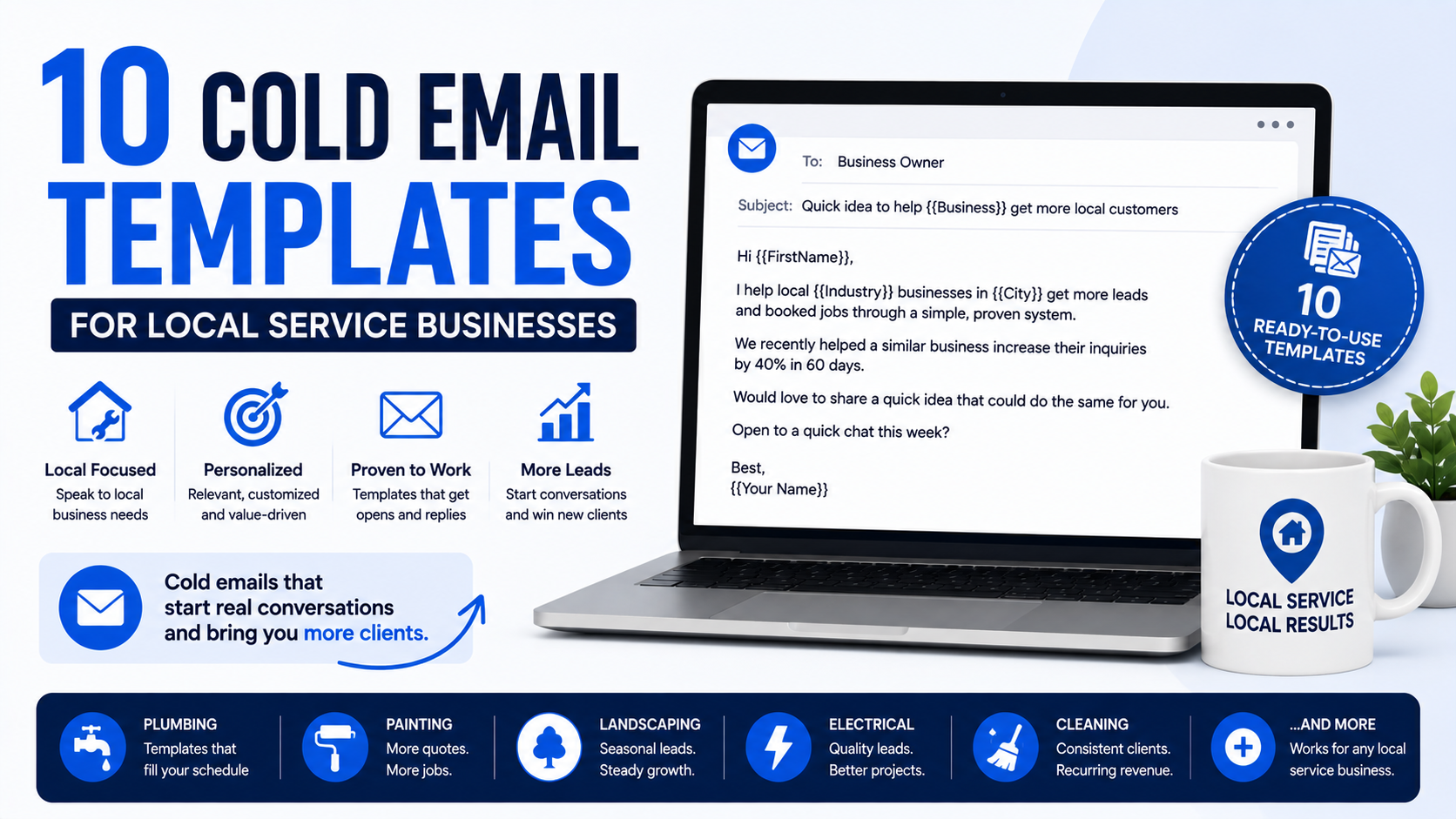
Below are 10 cold email templates I would actually use as starting points.
Do not copy them blindly.
Take the structure, change the details, and make the message fit the person receiving it.
Before Using Any Template, Fix Your Prospect List
This is the boring part, but it matters more than people expect.
If you own a commercial cleaning company, emailing every business in your city is not targeting.
A better list might be:
Dental offices with 10+ employees.
Property management companies managing multiple buildings.
Small warehouses.
Private schools.
Medical practices.
Local office buildings.
The same principle applies to other local services.
A landscaping company may target property managers, HOAs, restaurants with outdoor areas, offices, or retail centers.
A roofing business may target commercial property owners, facilities managers, or general contractors.
The narrower your audience, the easier your email becomes to write.
I usually keep prospect information in a simple Google Sheet before moving anything into a CRM.
Useful columns include:
Company
Contact name
Role
Location
Website
Reason for outreach
Last contact date
Response
Next follow-up
You can use HubSpot, Pipedrive, Zoho CRM, or another CRM once the process grows.
But a clean spreadsheet is much better than an expensive CRM filled with bad leads.
Template 1: The Simple Local Introduction
This is useful when you do not have a strong trigger but the prospect clearly fits your market.
Subject: Quick question about [Company]
Hi [First Name],
I’m [Your Name] from [Business Name]. We work with several [type of businesses] around [area] and I came across [Company].
We help with [specific service/outcome].
Not sure how you’re currently handling that, but are you using someone locally at the moment?
[Your Name]
Why It Works
The email does not pretend you know everything about the prospect.
That is important.
Fake research sounds worse than a straightforward introduction.
This template is especially useful for recurring services such as:
Commercial cleaning
Landscaping
Pest control
Waste removal
Security
Maintenance
Bookkeeping
IT support
The question at the end is easy to answer.
The prospect can simply say:
“Yes, we already use someone.”
That is still useful information.
Template 2: The Existing Provider Email
One of the biggest mistakes in local sales is assuming every prospect is waiting for a new vendor.
Most established businesses already have someone.
Instead of pretending otherwise, acknowledge it.
Subject: Current [service] provider
Hi [First Name],
I’m guessing you probably already have someone handling [service] for [Company].
I run [Business Name], and we work with businesses around [location] that occasionally need a backup option, second quote, or replacement when their current provider is not working out.
Would it be useful if I sent over our details so you have them on file?
[Your Name]
When I Like This Approach
This works well for services where companies regularly compare vendors.
Think:
Commercial cleaning
HVAC
Electrical work
Plumbing
Snow removal
Landscaping
Security
Facility maintenance
The email removes pressure.
You are not asking them to fire their current provider today.
You are simply trying to become the second phone number they have available.
That can be surprisingly valuable.
Template 3: The Visible Problem Email
This is one of the strongest templates when you can genuinely identify something relevant.
Suppose you are a landscaper and the commercial property’s outdoor area looks neglected.
Or you provide pressure washing and notice stained exterior concrete.
Your email could look like this:
Subject: Quick question about your [location/property]
Hi [First Name],
I was near your [location/property] recently and noticed [specific, non-insulting observation].
We handle [service] for local commercial properties and that is something we regularly help with.
I can send over a rough idea of what I’d recommend if that would be useful.
Interested?
[Your Name]
Do Not Be Rude
There is a big difference between:
“Your property looks terrible.”
and:
“I noticed the front walkway has developed some staining.”
Stick to observations.
Do not insult someone’s business to create a sales opportunity.
Template 4: The Free Estimate Email
Free estimates are normal in many local service industries, so you do not need to make the offer complicated.
Subject: Estimate for [service]
Hi [First Name],
I’m [Your Name] from [Business Name].
We provide [service] around [area], and I wanted to see whether you’re planning any [relevant work] at [Company] in the next few months.
If so, I’d be happy to put together an estimate so you have another option to compare.
No pressure if nothing is planned right now.
[Your Name]
Why This Works
There is no exaggerated promise.
No “limited-time offer.”
No attempt to create fake urgency.
You are simply offering another quote.
For local service companies, that can be enough to start a conversation.
Template 5: The Property Manager Outreach Email
Property managers can be excellent prospects because one relationship may lead to work across multiple properties.
But they also receive a lot of vendor outreach.
Keep the message practical.
Subject: Vendor question
Hi [First Name],
I saw that you manage properties around [location].
I run [Business Name], and we provide [service] for commercial and multifamily properties in the area.
We’re looking to add a few more property management relationships and can help with [two or three specific jobs].
Are you currently adding vendors for this type of work, or do you already have a preferred list?
[Your Name]
Make the Services Specific
Avoid:
“We provide complete property solutions.”
Say:
“Lawn maintenance, seasonal cleanups, and irrigation repairs.”
Or:
“Unit turns, interior painting, and drywall repair.”
Specific services help the property manager immediately understand where you fit.
Template 6: The Seasonal Service Email
Timing matters enormously for local services.
An HVAC email is more relevant before peak summer.
Roof inspections may become more important before rainy or storm seasons.
Landscaping changes with weather.
Commercial cleaning may increase around events or busy periods.
Use that context.
Subject: Before [season/event]
Hi [First Name],
With [season/weather/event] coming up, I wanted to reach out before schedules start filling.
We help [type of customer] around [location] with [specific service].
If [Company] needs any [service] over the next few weeks, I’d be happy to take a look and give you a quote.
Should I send over our availability?
[Your Name]
Avoid Fake Scarcity
Only say schedules are filling if that is actually true.
Do not write:
“Only two spots left!”
unless there really are only two spots.
Normal businesses do not need fake countdown timers inside personal email.
Template 7: The Referral-Style Local Email
This template works well when you already serve businesses or properties near the prospect.
Subject: We’re already working nearby
Hi [First Name],
We’re currently doing [service] for a few clients around [neighborhood/area], so I wanted to introduce myself.
I’m [Your Name] from [Business Name].
We handle [specific services], mainly for [customer type].
If you ever need another local company for [service], I’d be happy to provide a quote.
Are you the right person to speak with about that?
[Your Name]
Why Local Proof Matters
Local businesses often care more about whether you can reliably serve their area than whether you have worked with some giant national brand.
Saying that you already work nearby can remove a practical concern immediately.
Just make sure it is true.
Template 8: The Before-and-After Email
This works particularly well for visually obvious services such as:
Landscaping
Painting
Pressure washing
Flooring
Roof cleaning
Window cleaning
Exterior restoration
Remodeling
Subject: Similar project in [area]
Hi [First Name],
We recently finished a [type of project] for a property near [location], and your business came up while I was looking at other properties in the area.
The work involved [brief description].
I thought it might be relevant if you’re planning anything similar at [Company].
Would you like me to send a couple of before-and-after photos?
[Your Name]
Do Not Attach Everything Immediately
This is a mistake I used to make.
I would attach several large images, a PDF brochure, pricing sheet, and company portfolio to the first email.
It was too much.
Ask first.
If they say yes, send the proof.
That keeps the initial email light and gives the prospect an easy reason to reply.
Template 9: The New Business or New Location Email
New businesses often need a lot of local services at the same time.
Cleaning.
Signage.
Landscaping.
Pest control.
Security.
Internet.
Painting.
HVAC.
Maintenance.
If you notice a business opening nearby, the timing can be excellent.
Subject: Your new [location/office/store]
Hi [First Name],
I saw that [Company] is opening a new location in [area].
Congrats on the expansion.
I run [Business Name], and we help local businesses with [specific service].
Not sure whether you already have that covered for the new location, but I wanted to introduce myself before opening.
Would it help if I sent over our pricing/details?
[Your Name]
Keep the Congratulations Brief
Do not write half a paragraph pretending you are emotionally invested in their expansion.
“Congrats on the expansion” is enough.
Then get to the reason for the email.
Template 10: The Follow-Up Email
A lot of good opportunities are lost because the first email gets no reply and the sender stops.
People miss emails.
They read them while busy.
They intend to answer later.
Following up is normal.
A simple follow-up:
Subject: Re: [original subject]
Hi [First Name],
Just following up in case my last message got buried.
We help [type of business] around [area] with [service], and I wanted to see whether it makes sense to send over a quote or keep our details on file.
Either way is completely fine.
[Your Name]
A second follow-up could add something useful:
Hi [First Name],
One last note from me.
We recently completed a similar [job/project] nearby and I can send a couple of examples if you’re considering [service] this year.
If it’s not relevant, no problem.
[Your Name]
Follow Up Without Becoming Annoying
There is a difference between persistence and refusing to take a hint.
If the prospect says no, stop.
If they ask not to be contacted, remove them.
Do not keep sending “just bumping this up” messages for three months.
How I Personalize These Templates Without Spending All Day
You do not need to research every prospect for half an hour.
For most local businesses, I try to find one useful detail.
That could be:
Location
Property type
Number of locations
Recent opening
Visible maintenance issue
Current hiring
Recent renovation
Type of business
Neighborhood
Service they appear to need
Google Maps is extremely useful here.
So are company websites, LinkedIn, Facebook business pages, and Instagram.
If you are targeting commercial businesses, LinkedIn can help identify:
Owners
Office managers
Facilities managers
Operations managers
Property managers
General managers
Depending on what you sell, emailing the owner may not even be the best choice.
If you provide commercial cleaning to a 100-person office, the facilities or operations manager may be more relevant than the CEO.
A Simple Cold Email Workflow for Local Businesses
If I were starting a campaign this week, I would keep it small.
Step 1: Pick One Type of Customer
Do not target:
“Every business in Dallas.”
Try:
“Dental offices in Dallas with 5+ employees.”
Step 2: Pick One Service
If your company offers 12 services, do not pitch all 12.
Choose the one most relevant to that prospect.
Step 3: Build a Small List
Start with 50 to 100 businesses.
That is enough to find obvious problems in your targeting or message.
Step 4: Find the Right Person
Try the owner, office manager, property manager, facilities manager, or operations person depending on the service.
Step 5: Write One Short Email
Do not turn it into a brochure.
Step 6: Create Two Follow-Ups
Prepare them before launching.
Step 7: Track Everything
Use Google Sheets, HubSpot, Pipedrive, or another CRM.
Track:
Sent
Reply
Interested
Not interested
Follow up later
Quote requested
Meeting
Customer
Step 8: Read the Replies
The replies tell you what to improve.
If everyone says:
“We already have someone.”
Try positioning yourself as a backup provider.
If people keep asking:
“What areas do you serve?”
Make location clearer in the email.
If nobody understands what you do, simplify the offer.
Cold email is market feedback.
Treat it that way.
Common Mistakes Local Service Businesses Make
Writing Like a Corporate Sales Team
You do not need:
“Dear Prospective Client,
We are pleased to introduce our comprehensive facility management solutions…”
Just speak normally.
Pitching Every Service
A landscaping company may offer maintenance, design, irrigation, hardscaping, tree work, and seasonal cleanup.
That does not mean all six belong in the first email.
Asking for a 30-Minute Meeting Immediately
For many local services, a quote, site visit, or short phone call makes more sense.
Match the next step to the service.
Sending Generic Emails to Random Businesses
A relevant list beats a massive list.
Faking Personalization
“I was really impressed by your amazing business.”
That sentence proves nothing.
Mention something real or skip the compliment.
Insulting the Current Provider
Never write:
“Your current landscaper is clearly doing a terrible job.”
You do not know their relationship.
Stay professional.
Sending Huge Attachments
Ask before sending portfolios, PDFs, or lots of photos.
Using Fake Urgency
Local service sales do not need manipulation.
Forgetting to Follow Up
A polite follow-up can recover conversations that would otherwise disappear.
Ignoring Opt-Outs
If someone asks you to stop emailing, stop.
Cold outreach should also comply with the commercial email and privacy rules that apply to your business and recipients.
Your Email Address and Deliverability Matter Too
Even good outreach can struggle if your technical setup is poor.
Use a legitimate business email rather than a suspicious free address when possible.
Make sure the sending domain is configured properly with SPF, DKIM, and DMARC.
Avoid using old or obviously scraped email lists.
Verify questionable addresses where appropriate.
Tools such as Hunter, NeverBounce, or ZeroBounce can help with email discovery or verification, although no database or verification platform is perfect.
Also avoid suddenly sending huge volumes from a mailbox that normally sends very little.
Cold email is not only about copy.
Your targeting, data quality, sending behavior, and reputation all affect results.
Keep the Call to Action Small
One pattern you probably noticed in the templates is that I rarely ask for a big commitment.
Instead of:
“Can we schedule a 45-minute discovery session?”
try:
“Want me to send a quote?”
“Should I send our availability?”
“Would before-and-after photos be useful?”
“Are you the right person for this?”
“Would you like our details on file?”
Those are easy questions.
The prospect does not need to decide whether they want to hire you.
They only need to decide whether continuing the conversation is worthwhile.
That is the job of the first email.
Templates Are Starting Points, Not the Strategy
You could take the best template in this article and send it to 10,000 random businesses.
It would probably perform badly.
You could also take a very simple email and send it to 50 businesses that clearly need the exact service you provide.
That campaign may start several real conversations.
The difference is not some secret phrase.
It is relevance.
For local service businesses, I would spend more time deciding who to contact than trying to create the world’s cleverest email.
Find a good-fit business.
Understand why they might need your service.
Write a short message explaining why you reached out.
Offer a reasonable next step.
Follow up politely.
Then pay attention to what people actually tell you.
That process is not glamorous, but it is repeatable.
And for a local service company trying to build a steadier pipeline instead of relying only on referrals, repeatable is exactly what you want.