A local home-improvement company had been posting on Instagram almost every day.
The feed looked busy. There were polished graphics, motivational quotes, holiday greetings, stock photos, and the occasional service promotion. Some posts received likes, so the owner assumed social media was doing its job.
Then someone asked a simple question:
“How many paying customers came from those posts?”
Nobody knew.
Messages were spread across Instagram, Facebook, WhatsApp, and personal phones. No one recorded where enquiries came from. The company celebrated engagement but could not connect that attention to appointments, quotes, or completed jobs.
Once the team started tracking properly, it discovered something unexpected. The attractive promotional graphics produced very little business. Simple before-and-after project posts, short videos showing work in progress, and quick answers inside local Facebook groups generated most of the useful conversations.
That is the reality of social media lead generation for local businesses.
The content that looks the most polished is not always the content that produces leads. A post can receive hundreds of likes from people who will never buy, while a plain video filmed on a phone can bring in a customer from three streets away.
What works is usually less glamorous than people expect:
- Showing real work
- Answering specific questions
- Making the location obvious
- Giving people a simple next step
- Responding quickly
- Tracking what happens after the message arrives
Social media can generate local leads, but only when it is treated as part of a sales system rather than an online popularity contest.
Start With the Platform Your Customers Already Use
A common mistake is creating accounts on every platform at once.
The business opens Facebook, Instagram, TikTok, LinkedIn, YouTube, Pinterest, and X. For two weeks, everything is updated enthusiastically. Then client work gets busy, posting slows down, and most accounts become abandoned.
A local business rarely needs to be active everywhere.
The better question is:
Where do our customers already spend time, ask for recommendations, and research local providers?
For many consumer-focused local businesses, Facebook and Instagram are sensible starting points.
Facebook is useful for:
- Neighborhood groups
- Local recommendations
- Community discussions
- Customer reviews
- Events
- Service updates
- Direct messages
Instagram works well when the service can be shown visually, including:
- Landscaping
- Interior design
- Construction
- Cleaning
- Beauty services
- Restaurants
- Fitness
- Photography
- Auto detailing
- Home renovation
LinkedIn usually makes more sense for businesses serving other businesses, such as:
- Commercial cleaning companies
- Accountants
- IT providers
- Recruiters
- Consultants
- Marketing agencies
- Corporate event services
- Office contractors
TikTok and YouTube can be valuable when customers regularly need demonstrations, education, or visual proof. However, both require a willingness to create useful video content consistently.
Choose one primary platform and one supporting platform.
It is better to manage two active profiles properly than six neglected ones.
Stop Posting Like a Brochure
Most local business social accounts look like digital brochures.
Every post says some version of:
- We offer quality services.
- Contact us today.
- Customer satisfaction is our priority.
- We are the best in town.
- Book now.
The problem is not that these statements are necessarily false.
The problem is that every competitor says the same thing.
Customers need evidence.
Instead of telling people that your work is high quality, show the work. Instead of saying that you solve problems, explain one you recently solved. Instead of claiming that customers trust you, share genuine feedback.
A useful social feed should answer questions such as:
- What kind of work does this company actually do?
- Does it serve my area?
- Has it handled a problem like mine?
- What does the process look like?
- Can I trust the people behind the business?
- What should I do next?
When a profile answers those questions clearly, it starts supporting sales.
Show Real Work, Even When It Is Not Perfect
Real project content consistently outperforms generic stock content for many local businesses because it gives people something believable to evaluate.
Useful project content includes:
- Before-and-after images
- Work-in-progress clips
- Short site walkthroughs
- Finished installations
- Repairs being completed
- Materials being selected
- Tools being used
- Problems discovered during a job
- Team members explaining a process
- Customer reactions, with permission
The video does not always need professional lighting or a cinema camera.
A modern phone, a clean lens, steady movement, and clear audio are often enough.
For example, a tile contractor could record a 30-second clip showing:
- The damaged grout before work begins
- The cleaning and preparation process
- The new grout being applied
- The finished surface
- A short explanation of how long it needs to cure
That video answers more customer questions than a designed graphic saying, “Premium Tile Solutions.”
The goal is not to make the business look unprofessional.
The goal is to make the content feel connected to real work.
Before-and-After Content Needs Context
Before-and-after posts are useful, but a pair of images alone does not tell the full story.
Add a short explanation:
- What problem did the customer have?
- What caused it?
- What work was completed?
- How long did it take?
- What should another customer know?
- Where was the project located?
For example:
This garden in North Lahore had poor drainage, compacted soil, and several areas where grass would not grow. We improved the drainage, replaced the damaged soil, and used lower-maintenance plants around the boundary. The project took four working days.
That description helps nearby customers recognize their own problem.
It also naturally connects the work to the service area without forcing location names into every sentence.
Do not share private addresses or identifying customer details without permission.
A neighborhood, city, or general service area is usually enough.
Educational Posts Generate Better Conversations
Some businesses worry that explaining too much will allow customers to do the work themselves.
In practice, helpful education often creates trust.
A person who understands the problem is better prepared to appreciate the solution.
Educational content could answer:
- Why does bathroom grout keep cracking?
- How often should an air-conditioning unit be serviced?
- What causes low website conversion rates?
- How do you prepare a home for pest treatment?
- What affects the price of a kitchen renovation?
- How can a restaurant reduce food photography costs?
- When should a roof be repaired rather than replaced?
Keep each post focused on one question.
A short video could begin:
“Three signs your roof leak may be coming from the flashing rather than the tiles.”
Then explain the signs in plain language.
End with a practical next step:
“If you are unsure, take a clear photo from a safe location and send it to us. We can usually tell whether an inspection is needed.”
That call to action feels helpful rather than aggressive.
Use Local Details Without Forcing Them
A local business should make its service area obvious.
Customers often discover a post without visiting the full profile. If the location is unclear, they may assume the business is too far away.
Location can be added naturally through:
- Captions
- Profile descriptions
- Project descriptions
- Location tags
- Local landmarks
- Neighborhood references
- Service-area graphics
- Customer stories
- Local hashtags used selectively
For example:
“Completed this storefront sign installation near Gulberg Main Boulevard.”
That sounds more natural than adding 25 city names to every caption.
Google Business Profiles can also display supported social profile links in eligible regions, helping customers move between a local search listing and a business’s social channels. Google notes that availability varies by region, and it does not currently provide click-performance data for those social links.
Make sure the business name, phone number, website, and service details remain consistent across platforms.
Small inconsistencies create doubt.
Facebook Groups Can Work, but Only When You Behave Like a Member
Local Facebook groups can generate strong leads because people regularly ask for recommendations.
Typical posts include:
- Can anyone recommend a reliable electrician?
- Looking for someone to repair a leaking roof.
- Need a photographer for a small event.
- Does anyone know a good local accountant?
- Looking for a company that installs security cameras.
The worst response is usually a copied advertisement containing a phone number, several emojis, and a long list of services.
It looks like spam.
A better response is direct and relevant:
We handle this type of repair in your area. Before booking anyone, check whether the leak is coming from the pipe joint or the surrounding seal, because the repair is different. You can send us a photo if you would like a quick opinion.
That reply demonstrates knowledge before asking for the sale.
A few practical rules help:
- Read the group rules.
- Use a real personal or business identity.
- Answer the actual question.
- Do not post the same promotional comment everywhere.
- Avoid criticizing competitors.
- Move personal details into private messages.
- Do not continue messaging someone who is not interested.
It also helps to participate when you are not selling.
Recommend local resources. Answer common questions. Thank people who mention the business. Share useful community information when relevant.
People remember the businesses that contribute consistently.
Instagram Works Best as Visual Proof
Instagram is often treated as a place to chase followers.
For a local business, the more useful goal is building a proof library.
When a potential customer lands on the profile, they should quickly see:
- Recent work
- Customer experiences
- The people behind the company
- Services offered
- Areas covered
- How to enquire
A practical content mix could include:
Project Proof
Finished work, before-and-after posts, and progress videos.
Helpful Advice
Short answers to real customer questions.
Process Content
What happens before, during, and after a service.
Trust Content
Customer reviews, team introductions, certifications, or behind-the-scenes moments.
Offer Content
Clear information about consultations, bookings, seasonal services, or availability.
Not every post needs to sell.
But the profile as a whole should make the next step obvious.
Use the bio link wisely. Sending people to a homepage with ten different options may create unnecessary friction. A focused contact page, booking page, WhatsApp link, or service page may work better.
Short Videos Do Not Need to Be Complicated
Short-form video works well for local services because it can show proof quickly.
A simple video format is:
- Show the problem
- Explain what caused it
- Show the work
- Reveal the result
- Offer one next step
For example, an auto-detailing company could create:
- A close-up of stained upholstery
- A brief explanation of the cleaning method
- A few seconds of the extraction process
- The cleaned seat
- A booking message for local customers
Keep the opening specific.
Weak opening:
“Hello everyone, welcome back to our page.”
Stronger opening:
“This stain had been sitting in the seat for nearly two years.”
The second opening gives the viewer a reason to keep watching.
Add readable captions because many people watch videos without sound.
Avoid filling the screen with several fonts, animated stickers, logos, phone numbers, and long paragraphs. The work should remain the main focus.
Stories Are Useful for Daily Trust
Feed posts usually show the best work.
Stories can show the normal day-to-day business.
Useful story content includes:
- Today’s project
- Appointment availability
- A quick customer question
- A delivery arriving
- Worksite preparation
- A team member explaining a detail
- A poll
- A reminder
- A customer review
- A finished job
Stories can make the business feel active and reachable.
They also give customers an easy way to reply privately.
When someone responds to a story, do not immediately send a large sales message.
Continue the conversation naturally.
If they ask, “How much does this cost?” answer with useful context:
Projects like this usually depend on the area size and surface condition. This one was approximately 400 square feet. If you send the size and a photo, I can give you a more relevant range.
The goal is to move from public content to a useful one-to-one conversation.
Direct Messages Need a Sales Process
Receiving a DM feels like success, but it is only the beginning.
Many social media leads are lost because the response is slow, vague, or incomplete.
Create a simple DM process.
First, Understand the Request
Ask what the person needs rather than sending a full price list immediately.
Confirm the Location
Local businesses waste time when they forget to check whether the person is inside the service area.
Ask for Useful Details
Depending on the service, this may include:
- Photos
- Measurements
- Property type
- Preferred date
- Project timeline
- Budget range
- Current problem
Move Important Details Into the Main System
Do not leave valuable information trapped inside Instagram or Facebook.
Record the lead in a CRM, spreadsheet, or central lead tracker.
Give a Clear Next Step
That might be:
- A phone call
- A site visit
- A quotation
- A booking link
- A request for documents
- A consultation
Saved replies can speed up common responses, but they should still be adjusted to the person’s question.
A message that looks copied and irrelevant can end the conversation quickly.
WhatsApp Often Converts Better Than a Complicated Form
For many local service businesses, customers prefer messaging to completing a long form.
WhatsApp Business can make this easier through:
- Business information
- Quick replies
- Labels
- Greeting messages
- Away messages
- Product or service catalogs, where appropriate
A useful flow might be:
- A person sees an Instagram project.
- They tap the WhatsApp link.
- A pre-filled message identifies the service.
- The business asks two or three qualification questions.
- The prospect sends photos.
- A call or visit is booked.
Keep the process simple.
Do not ask 15 questions before providing any help.
Collect enough information to understand the request, then move the conversation forward.
Also avoid adding every WhatsApp enquiry to promotional broadcast lists. Ongoing marketing should respect consent and applicable privacy rules.
Lead Ads Can Work, but Cheap Leads Can Be Misleading
Paid social advertising can generate local leads, but businesses often focus too heavily on the cost shown inside the advertising dashboard.
Meta currently supports several lead-focused paths, including forms that open inside Facebook or Instagram, forms hosted on a business website, messaging conversations, and phone-call campaigns.
Each method has a different tradeoff.
Instant Forms
These are easy for users to complete because they stay inside the platform.
That convenience can increase form submissions, but it may also attract people with weaker intent.
Add a small number of qualifying questions, such as:
- Which service do you need?
- Where are you located?
- When do you want to start?
- What is the approximate project size?
Do not make the form unnecessarily long.
Website Forms
These require the person to visit your site.
You may receive fewer submissions, but the visitor has more opportunity to review your work, pricing guidance, testimonials, and process.
The landing page must be fast and mobile-friendly.
Click-to-Message Campaigns
These can work well when customers naturally need to discuss the service before booking.
They are particularly useful for visual services where the prospect can send photos.
However, someone must be ready to answer.
A campaign that creates 30 conversations is not useful if messages remain unread for hours.
Call Campaigns
Calls suit urgent services and customers who prefer speaking immediately.
Meta’s official guidance recommends aligning call campaigns with operating hours and using forms or messaging options outside those hours.
Do not pay to generate calls at times when nobody can answer.
Boosting a Post Is Not a Complete Strategy
The Boost Post button is easy to use.
That convenience is why many local businesses rely on it.
Boosting can increase reach, engagement, profile visits, messages, or other selected outcomes. But pressing Boost without a clear plan can produce plenty of activity and very few customers.
Before spending money, decide:
- What service are we promoting?
- Who should see it?
- Which location should be targeted?
- What should the person do?
- Where will the lead information go?
- Who will respond?
- How will we know whether the lead became a customer?
A popular project post is not automatically a good advertisement.
Organic followers may enjoy a dramatic transformation, while potential buyers may need pricing guidance, availability, location, and a clearer explanation of the service.
Build the campaign around the desired action, not only the post’s existing likes.
Local Offers Work Better When They Are Specific
“Contact us for all your needs” is not a strong offer.
A useful local offer is connected to a clear service and situation.
Examples include:
- Free roof inspection after storm damage
- Same-week air-conditioning servicing in a defined area
- Complimentary website conversion review for local clinics
- Fixed-price first cleaning for new customers
- Free measurement visit for kitchen renovations
- Seasonal lawn-care assessment
- New-client consultation for tax preparation
The offer should answer:
- What does the customer receive?
- Who is it for?
- Which area is covered?
- Is there a real deadline?
- What happens next?
Avoid fake urgency.
If there are only four booking slots, say so.
If the offer runs throughout the month, do not pretend it ends tonight.
LinkedIn Is Useful for Local B2B Services
A local business selling to other businesses should not automatically ignore LinkedIn.
A commercial electrician, office designer, IT support company, recruiter, or business consultant may find more suitable prospects there than on Instagram.
The content should focus on business problems.
Examples include:
- A recurring issue discovered during office maintenance
- Lessons from a commercial project
- A compliance or planning mistake
- A before-and-after operational improvement
- A short case study
- A practical checklist
- An explanation of project costs
LinkedIn’s own small-business guidance emphasizes maintaining an active Page, sharing useful content, and engaging with mentions and followers rather than treating the platform only as an advertising space.
The personal profiles of owners and specialists often matter as much as the company page.
People prefer conversations with identifiable professionals.
Keep outreach relevant.
A message saying, “We help companies grow—let’s connect,” is easy to ignore.
A better message references something specific:
I noticed your team is opening a second office in Karachi. We recently helped a similar company plan the network and access-control setup before the interior work began. Happy to share the checklist we used if it would be helpful.
That message has a reason to exist.
Reviews Turn Social Attention Into Trust
A person may discover the business through Instagram but check Google reviews before making contact.
Another may see a Facebook recommendation, visit the website, and then return to send a message.
Social media rarely works alone.
It works alongside:
- Google Business Profile
- Website
- Reviews
- Local search
- Referrals
- Phone calls
Share genuine customer reviews on social media, but do not rely only on designed quote cards.
Add context.
For example:
This customer contacted us after two previous repairs failed. We found that the visible crack was not the main water-entry point. The review below was sent after the first heavy rain following the repair.
That background makes the testimonial more meaningful.
Never invent reviews or improve a customer’s wording so heavily that it changes the meaning.
Response Time Can Matter More Than Content Quality
A business can create excellent content and still lose the lead through slow follow-up.
Social media customers often contact several businesses quickly.
Set up notifications for:
- Facebook messages
- Instagram DMs
- Comments containing questions
- Lead forms
- Missed calls
During business hours, try to acknowledge high-intent enquiries within minutes rather than hours.
The first reply does not need to contain the complete solution.
It can say:
Thanks for sending the photos. I can see the damaged area. I’m checking today’s schedule now and will confirm the earliest inspection time within 15 minutes.
That message tells the customer that a real person is handling the request.
Create backup responsibility when the normal responder is unavailable.
Social media lead generation fails quickly when everyone assumes someone else is watching the inbox.
Track Leads Beyond Likes and Messages
Social media platforms report activity such as:
- Reach
- Views
- Likes
- Shares
- Saves
- Link clicks
- Messages
- Form submissions
These numbers can help diagnose performance, but they do not tell you whether the business made money.
Track each lead through the full journey.
A simple spreadsheet can include:
- Date
- Name
- Platform
- Post or campaign
- Service requested
- Location
- Qualified or not
- Appointment booked
- Quote sent
- Customer won or lost
- Sale value
- Notes
Use UTM parameters on website links so Google Analytics can identify the source and campaign more consistently.
For direct messages, ask a simple question during the conversation:
“Which post or page brought you to us?”
The customer may not always remember, but the answer can still help.
Review results monthly.
You may discover:
- Instagram generates more conversations but Facebook produces more bookings.
- Project videos attract fewer views but better leads than educational posts.
- A neighborhood group produces more customers than the main business page.
- WhatsApp leads close faster than website forms.
- One service creates attention but little profit.
- Most enquiries arrive after customer-review posts.
Without tracking, content decisions remain based on feelings.
A Simple Content System That a Local Business Can Maintain
A sustainable plan is more useful than an ambitious plan that lasts ten days.
A local business could publish three times per week.
Post One: Show the Work
Share a project, result, repair, installation, or customer outcome.
Post Two: Answer a Question
Address something customers regularly ask.
Post Three: Build Trust
Share a review, team member, behind-the-scenes process, or local business update.
Stories can be used between those posts to show current activity.
One piece of work can create several items.
For example, a completed landscaping project could become:
- A before-and-after post
- A short Reel
- A Story walkthrough
- A post about drainage mistakes
- A customer testimonial
- A project case study for the website
- A Google Business Profile update
Google allows eligible businesses to publish updates, offers, event details, photos, videos, and action links through Business Profile posts on Search and Maps.
Reusing the same real project across several channels is not lazy.
It is efficient.
A 30-Day Local Social Lead Generation Plan
Week One: Fix the Foundation
- Choose one primary platform.
- Update the profile description.
- Add the service area.
- Check the phone number and website link.
- Create a simple enquiry path.
- Set up message notifications.
- Build a lead-tracking sheet.
- Collect five recent project examples.
Week Two: Publish Proof
- Share two project posts.
- Create one before-and-after video.
- Add one genuine customer review.
- Post Stories from current work.
- Add clear location details.
- Respond to every relevant comment.
Week Three: Educate and Engage
- Answer three common customer questions.
- Join two relevant local groups.
- Provide useful answers without spamming.
- Create one short checklist.
- Ask followers which problem they want explained next.
Week Four: Improve Conversion
- Review all enquiries.
- Check average response time.
- Identify which posts generated conversations.
- Record which leads became appointments.
- Improve the call to action.
- Test one specific local offer.
- Plan next month using the results.
Do not judge the strategy by follower growth alone.
A local company does not need 50,000 followers.
It needs the right people in the right area to understand the service and feel comfortable making contact.
Common Social Media Lead Generation Mistakes
Posting Without a Clear Next Step
People may enjoy the content but have no idea how to enquire.
Tell them what to do.
Copying Competitors
Using the same post ideas, stock photos, and claims makes the business forgettable.
Show your own work.
Hiding the Location
A local customer should not need to search the entire profile to determine whether you cover their area.
Replying Too Slowly
A lead may be speaking with a competitor before your response arrives.
Using Too Many Designed Graphics
Graphics have a place, but real work should not disappear beneath templates.
Chasing Followers Outside the Service Area
A large audience is not valuable when most people cannot buy.
Posting Only Discounts
Constant offers train customers to wait for the next discount.
Balance offers with proof and education.
Treating Every Comment as a Sales Opportunity
Sometimes a person is simply asking a question.
Help first.
Moving Too Quickly Into Private Messages
Do not send unsolicited sales messages to everyone who likes or comments on a post.
Failing to Qualify Leads
Confirm the service, location, timeline, and basic fit before spending hours preparing a quote.
Ignoring Existing Customers
Past customers can provide repeat business, reviews, referrals, and useful content.
Measuring Engagement Instead of Revenue
Likes do not pay invoices.
Track appointments, customers, and sales.
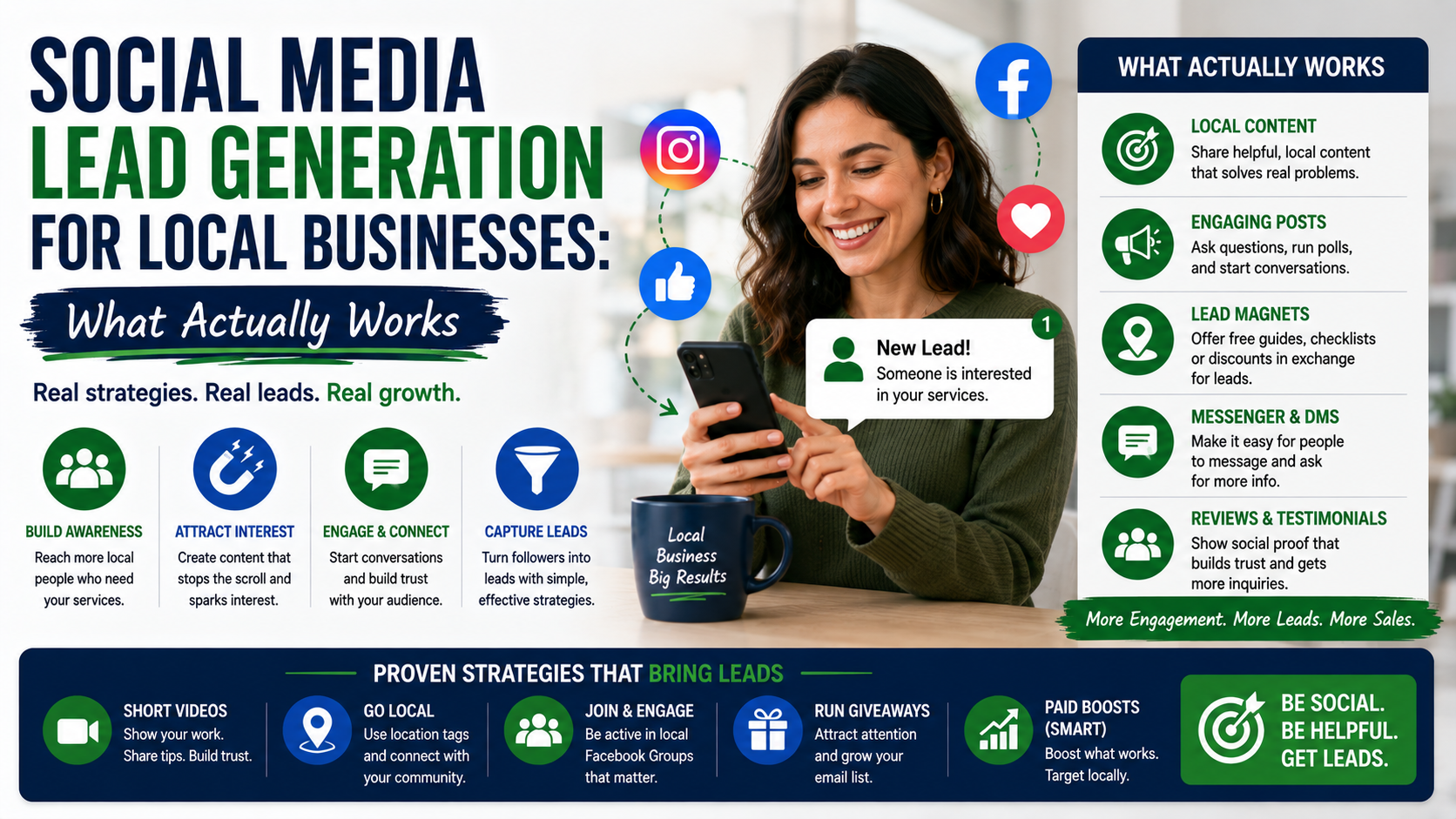
What Actually Works
Social media lead generation works for local businesses when the account does four things well:
- Shows believable proof
- Answers real customer questions
- Makes contacting the business easy
- Moves every enquiry into a reliable follow-up process
The platform matters less than the system around it.
A plain Facebook post can generate a valuable customer when it reaches the right local group. A polished Instagram Reel can generate nothing when the location and next step are unclear. A small LinkedIn post can lead to a commercial contract when it explains a problem a local decision-maker recognizes.
Start with the work already happening inside the business.
Photograph it.
Explain it.
Connect it to the customer’s problem.
Mention where you operate.
Invite the person to take one simple next step.
Then respond while the conversation is still active.
That is what turns social media from a collection of posts into a practical source of local leads.