There’s a particular kind of frustration that comes with sending cold emails.
You spend 20 minutes writing what feels like a solid message. You check the grammar twice, make the subject line sound professional, add a nice signature, and hit send.
Then nothing happens.
No reply.
No “not interested.”
Not even an unsubscribe.
Just silence.
This is where most people assume cold email doesn’t work anymore.
Usually, the problem isn’t cold email itself. The problem is that the message looks exactly like the other 40 sales emails sitting in the prospect’s inbox.
I learned pretty quickly that the emails I thought sounded “professional” were often the ones least likely to get a response. The better-performing messages were shorter, more specific, and much more human.
They didn’t try to close the deal inside the first email.
They simply gave the person a good reason to reply.
That sounds obvious, but it changes almost everything about how you write cold outreach.
The Goal of a Cold Email Is Not to Make the Sale
This is probably the biggest mindset shift.
If you’re selling a $2,000 website, a consulting service, SEO, software, recruiting, bookkeeping, or some other business service, the prospect probably isn’t going to read one email and immediately send you their credit card.
Your first email has a much smaller job.
Start a conversation.
That’s it.
A useful cold email might get a response like:
“Sure, send me more details.”
“We already have someone handling this.”
“Can you show me an example?”
“What’s your pricing?”
“Let’s talk next week.”
Even the second response can be valuable because now you know where they stand.
Cold outreach becomes much easier when you stop trying to squeeze your entire sales presentation into one email.
Why Most Cold Emails Get Ignored
Open your spam folder sometime and look at a few sales emails.
You’ll probably notice the same patterns.
“Dear Sir/Madam…”
“I hope this email finds you well…”
“We are a leading provider of…”
“We offer high-quality services at competitive prices…”
“Would you be available for a 30-minute call to discuss potential synergies?”
None of these sentences are technically wrong.
They’re just incredibly easy to ignore.
The prospect has no reason to believe the email was actually written for them.
One of the simplest tests I use when looking at cold email copy is this:
Could I send this exact message to 5,000 different companies without changing anything except the name?
If the answer is yes, the email is probably too generic.
Start With the Right Prospect, Not the Right Template
Before worrying about copywriting, look at who you’re contacting.
This is where a lot of cold outreach campaigns quietly fail.
If you’re emailing the wrong businesses, even an excellent message won’t save you.
Let’s say you sell local SEO services.
You could build a list of every small business in Chicago.
Or you could narrow it down to:
Dentists with 50+ Google reviews that are ranking below competitors in local search.
The second group gives you a much stronger reason to reach out.
Now your email can reference something real.
Instead of:
“We help businesses improve their Google rankings.”
You could say:
“I noticed your practice has over 100 Google reviews, but a few nearby clinics with fewer reviews are appearing above you for some local searches.”
That immediately feels more relevant.
Tools like LinkedIn Sales Navigator, Apollo, Clay, Crunchbase, Hunter, BuiltWith, Google Maps, Ahrefs, and Semrush can all help with prospect research depending on what you sell.
You don’t necessarily need all of them.
For a small campaign, Google, LinkedIn, and a spreadsheet can be enough.
Your Subject Line Doesn’t Need to Be Clever
I’ve seen people spend more time writing the subject line than the actual email.
They try things like:
“Unlock 300% Growth 🚀”
“Quick Question!!!”
“Massive Opportunity for [Company]”
“URGENT: Your Competitors Are Winning”
Those subject lines may attract attention, but not necessarily the kind of attention you want.
For B2B outreach, plain subject lines often feel more natural.
Examples:
“Question about [Company]”
“[Company] website”
“Local SEO question”
“Regarding your hiring page”
“Quick question, Sarah”
“Your Dallas location”
The best subject line depends on context.
I generally prefer something that looks like it could have come from a normal business contact rather than an advertisement.
Also, avoid misleading tricks like pretending an email is a reply with “Re:” when there was no previous conversation.
You might get the open.
You probably won’t build trust.
The First Line Matters More Than Most People Think
Once the email is opened, the first line decides whether the prospect keeps reading.
A weak opener:
“My name is James and I am the founder of XYZ Digital Solutions.”
The prospect doesn’t know James.
And at this point, they probably don’t care.
A stronger opener talks about them.
“I was looking at your Dallas roofing page earlier and noticed you’re already ranking well for a few service terms.”
Or:
“Saw that you recently opened a second location in Austin.”
Or:
“I came across your LinkedIn post about expanding the sales team.”
These lines give the email context.
But there’s an important warning here.
Don’t fake personalization.
I’ve received messages saying:
“I really loved your recent content!”
Then they immediately pitch something completely unrelated.
That’s worse than sending a straightforward email.
If you’re going to personalize, mention something specific and relevant.
A Simple Cold Email Structure That Works
You don’t need a 14-step copywriting formula.
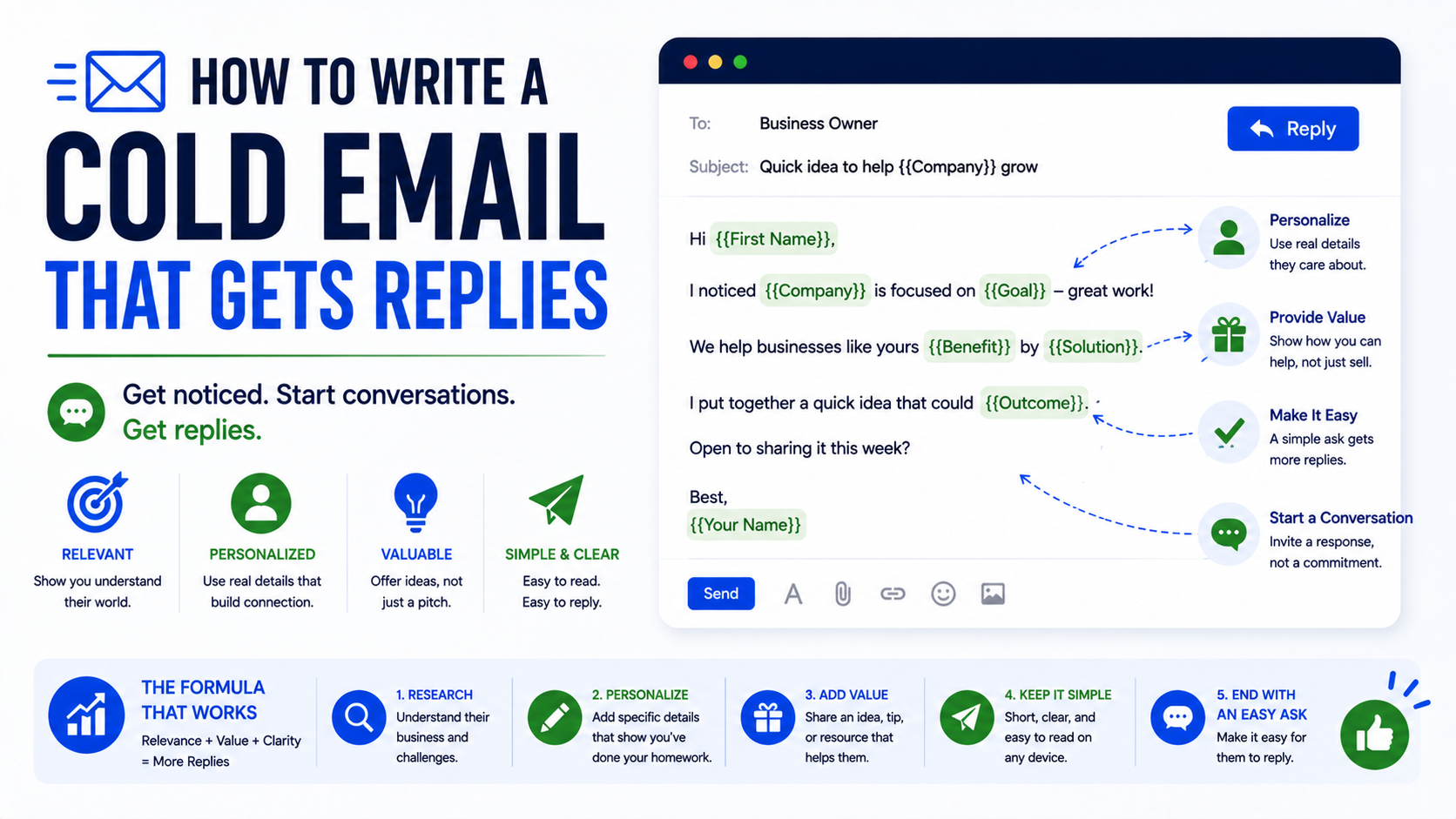
A good cold email can often be built from five parts:
- Relevant opening
- Problem or opportunity
- Simple explanation of what you do
- Proof or credibility
- Low-friction question
Here’s what that might look like.
“Hi Mark,
I noticed your company is running Google Ads for commercial roofing in Houston.
I checked the landing page and saw that mobile visitors have to go through several steps before they can request an estimate.
We help service businesses simplify those pages so more ad clicks turn into actual inquiries.
We recently worked on a similar setup for another contractor.
Would you be open to me sending over two changes I’d test on the page?”
That’s it.
No company autobiography.
No ten-item service list.
No giant calendar link.
Just a reason to reply.
Make Your Email About a Problem They Recognize
One of the most useful lessons in cold outreach is this:
People care more about their problem than your service.
Imagine you’re selling bookkeeping.
This:
“We provide professional bookkeeping and accounting solutions for growing businesses.”
is far less interesting than:
“Once a company starts adding employees and contractors, monthly reconciliation tends to become surprisingly time-consuming.”
The second sentence describes something the reader may actually be experiencing.
If you sell websites, talk about leads, conversion, speed, usability, or updating content.
If you sell recruiting, talk about unfilled roles, candidate quality, or time spent screening applicants.
If you sell cybersecurity, talk about risk, compliance, access management, or whatever issue genuinely applies to that prospect.
Your service is the bridge.
The problem is what makes them care about crossing it.
Be Specific About What You Do
There’s a strange habit in business writing where people make simple services sound unnecessarily complicated.
Instead of:
“We leverage cutting-edge strategies to maximize your digital presence and drive measurable business outcomes.”
Try:
“We help local contractors get more estimate requests from Google.”
Instead of:
“We deliver innovative talent acquisition solutions.”
Try:
“We help software companies hire senior developers.”
The clearer your service is, the easier it is for the prospect to decide whether it’s relevant.
Confusion rarely creates replies.
Use Proof Without Turning the Email Into a Case Study
Social proof helps.
But one sentence is usually enough.
For example:
“We recently helped a local service company increase qualified form submissions without increasing ad spend.”
Or:
“We’ve built similar Shopify stores for brands doing high-volume online sales.”
Or:
“One client was spending several hours each week manually processing the same reports, so we automated most of that workflow.”
If you have a specific, verifiable result, use it.
If you don’t, don’t invent one.
You can simply mention relevant experience:
“We’ve done this for several accounting firms.”
That’s more credible than making an impressive-looking number up.
Your CTA Should Be Easy to Answer
This is where good emails often become too aggressive.
Imagine you’ve exchanged zero messages with someone.
Then you ask:
“Are you available Tuesday at 10:00 AM for a 45-minute strategy call?”
That’s a big commitment.
A smaller question is easier.
“Worth sending over a few ideas?”
“Is this something you’re currently working on?”
“Would it be useful if I sent an example?”
“Open to a quick look?”
“Are you handling this internally?”
The exact wording matters less than the amount of effort required to respond.
The easier it is to say yes or no, the better.
A Cold Email Example for SEO Services
Here’s a practical version.
“Hi Daniel,
I found your plumbing company while looking at local search results around Phoenix.
You’ve got strong reviews, but I noticed a couple of competitors with fewer reviews are showing above you for some high-intent searches.
I work on local SEO for service businesses, mainly improving the pages and Google Business Profile signals that influence those results.
Would you like me to send over the two gaps I noticed?”
There’s something important happening here.
The email doesn’t say:
“Your SEO is bad.”
That’s unnecessarily confrontational.
It points out an opportunity.
A Cold Email Example for Web Design
“Hi Rebecca,
I was looking at your clinic website earlier and noticed the appointment button becomes difficult to find once you’re deeper into the mobile pages.
We build websites for local businesses, and mobile booking paths are one of the things we pay close attention to.
I have a couple of simple changes I’d make before considering a redesign.
Want me to send them?”
This works well because you’re giving value before pushing a full website project.
A Cold Email Example for Software Development
“Hi Alex,
Saw that your team is hiring for two backend roles.
We help SaaS teams with short-term development capacity when hiring hasn’t caught up with the roadmap.
Most of our work is around Node.js, React, APIs, and cloud infrastructure.
Not sure if outside development help is relevant right now, but are those roles tied to any immediate project deadlines?”
The question creates a conversation around timing and need.
A Cold Email Example for Bookkeeping
“Hi Sarah,
I noticed your agency has grown to around 15 people.
That’s usually around the point where invoicing, expenses, payroll coordination, and month-end reporting start taking more time than owners expect.
We handle bookkeeping for small agencies that don’t need a full internal finance team yet.
Are you managing that internally at the moment?”
Again, easy question.
Easy reply.
Don’t Stuff Your Email With Links
This is another mistake I’ve made and seen others make.
Website link.
Portfolio link.
Calendly link.
YouTube video.
Case study.
PDF.
LinkedIn profile.
Now the prospect has eight different things they can ignore.
Your first email normally needs one action.
Reply.
You can share supporting material after they show interest.
There are also deliverability reasons to be careful with excessive links and attachments in first-touch outreach.
Keep the message clean.
Cold Email Follow-Ups Matter More Than You Think
A lot of people send one email and stop.
That’s not necessarily enough.
People miss emails.
They read them during meetings and forget.
They intend to reply later.
A simple follow-up can work.
For example:
“Hi Mark,
Just following up on this in case it got buried.
I still have those two landing page suggestions if you’d like me to send them over.”
That’s much better than:
“Have you had a chance to review my previous email?”
The second one sounds like you’re assigning them homework.
Another follow-up could add useful context:
“Quick follow-up — one of the changes I mentioned is related to the mobile quote form. It currently takes several taps to reach.
Happy to send a screenshot if helpful.”
Now you’re adding something rather than merely asking for attention.
How Many Follow-Ups Should You Send?
There’s no magic number that applies to every industry.
For many B2B campaigns, a small sequence might look something like:
Initial email
Follow-up a few days later
Another follow-up with useful context
A final polite check-in
Don’t keep emailing someone indefinitely.
And if they ask you to stop, stop.
Respecting opt-outs isn’t just good manners. Depending on where you and your recipients are located, commercial email can also be subject to laws and regulations such as CAN-SPAM, GDPR, PECR, and other local requirements.
If you’re doing outreach at scale, understand the rules that apply to your campaign rather than copying someone’s automation sequence blindly.
Use Tools to Save Time, Not to Remove the Human Part
Cold email software can be incredibly useful.
Platforms such as Instantly, Smartlead, Lemlist, Mailshake, Reply.io, Apollo, HubSpot, and Close can help organize campaigns, follow-ups, and prospect data.
Tools like Hunter and NeverBounce can help with email discovery or verification.
Clay can be useful when you need more sophisticated enrichment and personalization workflows.
But automation creates an obvious temptation:
Send more.
If 50 emails aren’t working, send 5,000.
That’s usually the wrong lesson.
Automation should help you execute a good process more efficiently.
It shouldn’t make a bad message louder.
Don’t Ignore Email Deliverability
You can write the best cold email in your industry and still get poor results if it lands in spam.
Use a professional business domain.
Set up proper email authentication.
That generally means making sure SPF, DKIM, and DMARC are configured correctly for your sending domain.
Avoid sudden, extreme sending spikes.
Verify addresses where appropriate.
Keep bounce rates under control.
And don’t pack the first message with suspicious links, giant images, or attachments.
If you’re using Google Workspace or Microsoft 365, remember that your mailbox is still subject to sending limits and anti-abuse systems.
Cold outreach isn’t just a copywriting problem.
The technical setup matters too.
The Mistake of Writing Too Much
I understand why people write long cold emails.
They think:
“If I explain everything clearly, they’ll understand why they should buy.”
The problem is that the prospect hasn’t decided whether they care yet.
A cold email isn’t a proposal.
You don’t need sections explaining:
Who we are
Our mission
Our process
Our services
Our team
Our packages
Our guarantees
Our company history
Save that for later.
A useful editing exercise is to finish your email and then try cutting it by 30%.
Most cold emails improve.
Stop Using Fake Urgency
“Only two spots left!”
“Offer expires Friday!”
“Last chance!”
Unless those statements are genuinely true, leave them out.
Cold email already begins with a trust disadvantage because the person doesn’t know you.
Don’t make it worse with artificial scarcity.
A calm email can actually stand out because so much sales outreach sounds desperate.
Don’t Pretend You Know More Than You Do
Another bad tactic is pretending you’ve deeply analyzed a company when you’ve only looked at the homepage for 30 seconds.
For example:
“I’ve identified several critical revenue leaks in your funnel.”
Maybe you haven’t.
Instead:
“I noticed one thing on the mobile checkout that may be worth testing.”
That’s believable.
Specific.
And easy to discuss.
Track Replies, Not Just Opens
Email open tracking has become less reliable because of privacy features and image proxying.
So don’t obsess over open rates.
The metrics that matter more are usually things like:
Positive replies
Total replies
Meetings booked
Qualified opportunities
Bounce rate
Unsubscribe or opt-out rate
Eventually, revenue
If everyone opens your email but nobody replies, the subject line isn’t your biggest problem.
The offer, targeting, or email body probably needs work.
Create a Simple Testing Process
Don’t rewrite everything every day.
Pick one thing to test.
Maybe you try two different opening lines.
Or two CTAs.
Or two customer segments.
Suppose you email:
50 dentists
50 lawyers
Same service.
Same general format.
The dentists reply at a much higher rate.
That’s useful information.
You may have found a better market.
Cold email campaigns teach you about positioning as much as they teach you about copywriting.
A Simple Cold Email Template You Can Adapt
If you’re starting from scratch, use something like this:
“Hi [First Name],
I noticed [specific observation].
It looks like [relevant problem or opportunity].
We help [type of customer] with [clear outcome].
[Short proof or relevant experience.]
Would it be useful if I sent over [small next step]?”
Then rewrite it until it sounds like something you’d actually say to another person.
That’s important.
Read the email out loud.
If you sound like a corporate brochure, simplify it.
One Final Test Before You Hit Send
Before sending a cold email, ask yourself five questions.
Is it obvious why I’m emailing this specific person?
Can they understand what I do within a few seconds?
Did I talk more about their situation than my company?
Am I asking for a reasonable next step?
Would I reply to this if I received it?
That last question catches a surprising number of problems.
Cold email doesn’t need to sound impressive.
It needs to sound relevant.
The messages that get replies are often much simpler than people expect. They mention something real, describe a problem the prospect understands, explain the value clearly, and ask an easy question.
You don’t need to manipulate someone into responding.
You need to give the right person a legitimate reason to continue the conversation.
That’s a much better foundation for cold outreach — and usually a much better way to start a business relationship.