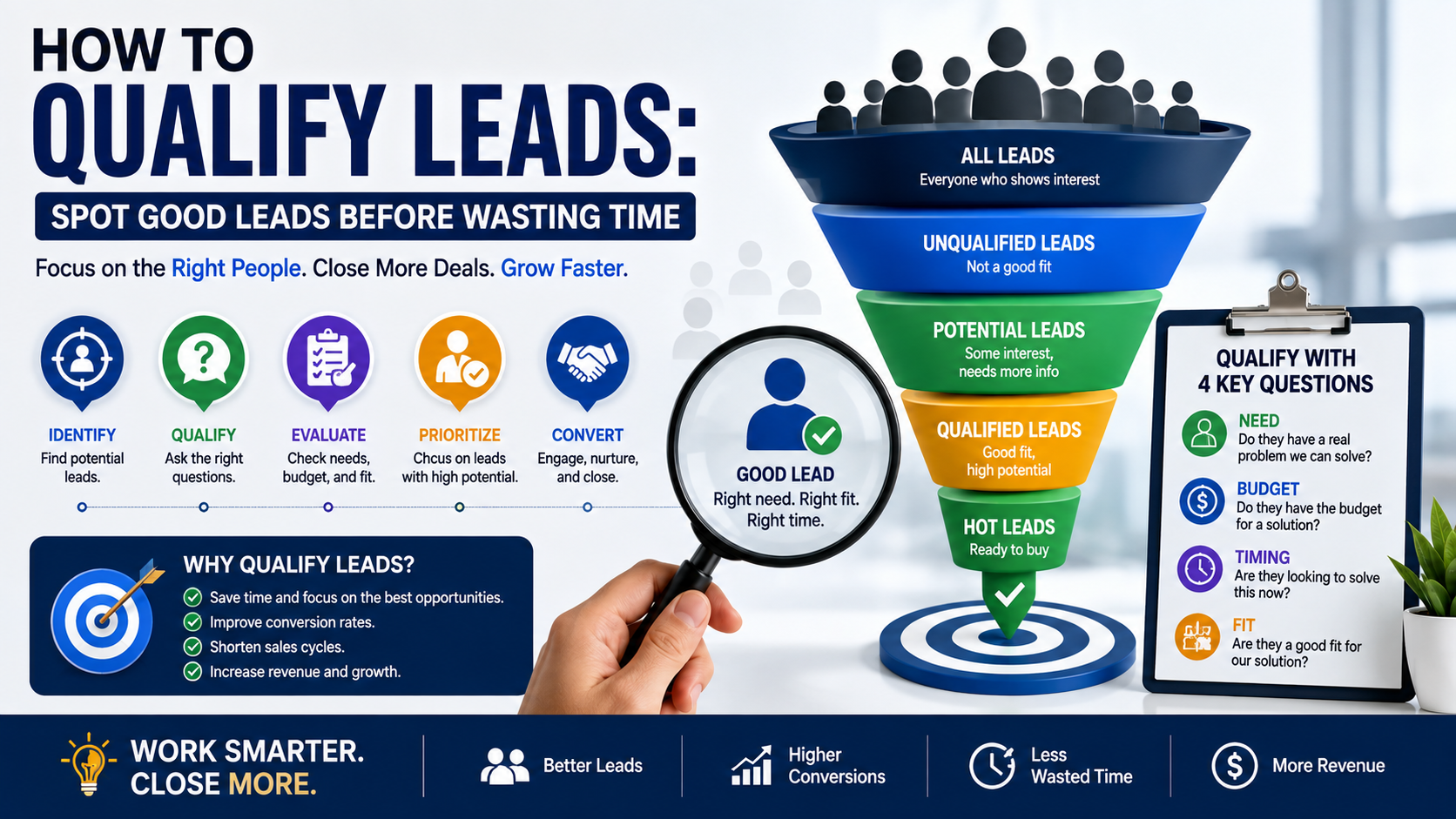
The calendar looked full, which usually feels like a good sign.
There were six calls booked for the week, several new contact forms in the inbox, and a few people asking for prices through WhatsApp. On paper, the sales pipeline looked healthy.
By Friday, almost none of those conversations had gone anywhere.
One person was only collecting prices for a project planned next year. Another had no authority to approve the purchase. Two wanted services the business did not provide. One stopped replying after receiving the meeting link.
The problem was not a shortage of leads.
The problem was that every enquiry had been treated as a serious opportunity.
This happens more often than most small businesses admit. A new form submission creates excitement, so the team immediately starts calling, preparing proposals, arranging meetings, and answering long lists of questions.
Some of those leads deserve that attention.
Others can be ruled out—or placed into a slower follow-up process—after a few simple questions.
Learning how to qualify leads is not about being rude or rejecting people too quickly. It is about understanding which prospects are ready, suitable, and worth prioritizing.
A good lead qualification process protects your time while also giving serious buyers a faster and more helpful experience.
What Is a Qualified Lead?
A qualified lead is someone who fits your business and has a realistic chance of becoming a customer.
That usually means the person:
- Needs a service you provide
- Falls within your target market
- Has a suitable budget
- Has the authority to make or influence the decision
- Has a reasonable timeline
- Understands what your service involves
- Is willing to take the next step
A lead does not need to be ready to buy today to be useful.
Someone planning a project three months from now could still be a strong opportunity. The key is knowing where they belong in your pipeline.
A person who needs your service next week should not receive the same follow-up as someone who is “just exploring options” for next year.
Lead qualification helps you separate those situations.
Not Every Enquiry Is a Sales Opportunity
One of the most expensive sales mistakes is confusing interest with intent.
People show interest for many reasons.
They may be:
- Comparing prices
- Researching for a future project
- Looking for free advice
- Completing a school assignment
- Checking prices for their employer
- Applying for a job
- Searching for a service you do not offer
- Collecting proposals without approval
- Contacting several providers at once
None of these people are necessarily doing anything wrong.
They simply may not be ready or suitable.
The goal is not to force every person into a sales conversation. The goal is to understand what they actually need and decide what should happen next.
Some leads should be called immediately.
Some should receive helpful information by email.
Some should be followed up with next month.
Others should be politely declined.
Start by Defining What a Good Lead Looks Like
You cannot qualify leads properly until you define what “qualified” means for your business.
Many teams skip this step.
The marketing team celebrates form submissions. The sales team complains about poor-quality leads. Management looks at the total numbers and cannot understand why revenue is not increasing.
Everyone is measuring something different.
Write down the basic characteristics of a good customer.
For a local roofing business, a qualified lead might be:
- Located within the service area
- Owns or manages the property
- Needs roof repair or replacement
- Wants work completed within three months
- Has a realistic project budget
- Is available for an inspection
For a web design agency, a qualified lead might be:
- Owns an established business
- Needs a new website or major redesign
- Has a budget above the agency’s minimum
- Can provide content or approve its creation
- Has a clear decision-maker
- Wants to start within the next 60 days
For a software company, qualification may involve:
- Company size
- Current software
- Number of users
- Technical requirements
- Purchasing authority
- Security requirements
- Implementation timeline
The definition does not need to be complicated.
Start with five or six conditions that have consistently separated good customers from time-wasters.
Ask Better Questions on the Lead Form
The lead form is the first opportunity to qualify someone.
A basic form usually asks for:
- Name
- Phone number
- Message
That is easy to complete, but it tells you very little.
You do not know whether the person is in your service area, what they need, when they need it, or whether their budget is realistic.
Adding a few useful questions can save hours of follow-up.
For example:
What service do you need?
Use a dropdown containing your main services.
Where is the project located?
This can immediately identify enquiries outside your service area.
When would you like to start?
Useful options might include:
- As soon as possible
- Within one month
- Within three months
- More than three months
- Just researching
What is your estimated budget?
Use realistic ranges rather than requiring an exact amount.
Tell us briefly about the project.
This gives serious prospects an opportunity to explain what they need.
Tools such as Typeform, Jotform, Google Forms, Gravity Forms, WPForms, and HubSpot Forms can create forms with conditional questions.
Conditional logic keeps the form shorter.
For example, someone selecting “website redesign” can see questions about their current website, while someone selecting “SEO” can see questions about traffic and target locations.
The form should not feel like a loan application.
Ask only what you need to decide the next step.
Do Not Be Afraid to Ask About Budget
Many salespeople avoid budget questions because they worry the prospect will leave.
That fear is understandable, but avoiding the subject often creates a bigger problem later.
A team may spend several hours on discovery calls, internal discussions, research, and proposal writing before learning that the prospect expected the entire project to cost one-tenth of the normal price.
A budget question does not have to sound aggressive.
Instead of asking, “What is your exact budget?” try:
- “Have you set a budget range for this project?”
- “Projects like this usually start around $3,000. Is that within the range you are considering?”
- “Which investment range feels realistic for this work?”
- “Would you prefer a basic solution or a more complete package?”
Being transparent about starting prices can also improve lead quality.
If your service begins at $2,500, mention that on the page or form when appropriate.
You may receive fewer enquiries, but the people who contact you will have better expectations.
More leads are not always better.
Ten suitable enquiries can be more valuable than 100 people expecting a service you cannot profitably deliver.
Understand the Prospect’s Actual Need
Some leads describe a solution rather than the real problem.
A business owner may say, “I need Facebook Ads.”
After a few questions, you may discover that the real issue is not advertising. Their website loads slowly, the offer is unclear, and no one responds to enquiries for two days.
Running more ads would send additional people into a broken process.
A useful qualification conversation explores the reason behind the request.
Ask questions such as:
- What are you trying to improve?
- What is happening at the moment?
- What have you already tried?
- What result would make this project successful?
- Why are you looking for a solution now?
- What happens if the problem is not fixed?
- Is there a specific deadline?
These questions reveal urgency and seriousness.
Someone saying, “We are just curious about SEO prices,” is at a different stage from someone saying, “Our organic enquiries dropped by 40%, and we need to present a recovery plan to management next month.”
Both may become customers eventually, but they should not receive the same priority.
Check Whether You Are Speaking With the Decision-Maker
A lead can be interested, responsive, and perfectly suited to your service—but still unable to approve the purchase.
This happens frequently in business-to-business sales.
A marketing assistant may be asked to collect three proposals. A property manager may need approval from the owner. A department head may need finance to sign off on the budget.
That does not make the lead poor.
It means you need to understand the decision process.
Ask:
- Who else will be involved in this decision?
- Who will approve the final budget?
- Are there other departments that need to review the proposal?
- What does the approval process usually look like?
- Is there a date by which the decision needs to be made?
Avoid asking, “Are you the decision-maker?” too directly.
It can make the person feel unimportant.
A better approach is to ask how decisions are normally made.
When possible, invite the relevant people to the next conversation. This reduces repeated explanations and prevents the project from stalling after the proposal.
Pay Attention to Timing
A good fit with no timeline is often a long-term lead rather than an immediate opportunity.
Ask when the prospect wants to begin and why that date matters.
Common answers include:
- The current provider’s contract is ending
- A new location is opening
- The company has received funding
- A product is launching
- The property must be repaired before winter
- Management has approved a new budget
- A website needs to be ready for an event
- The prospect is only researching options
The reason behind the timeline matters.
“Within one month” sounds urgent, but the prospect may still be waiting for internal approval.
“Within six months” sounds less urgent, but the company may already have an approved budget and a structured selection process.
Timing should influence follow-up.
Hot leads may need a call the same day.
Medium-term leads can enter a structured email sequence.
Early-stage prospects can receive useful content and a scheduled check-in later.
Use a Simple Lead-Scoring System
Lead scoring sounds technical, but it can be very simple.
Assign points based on the characteristics that matter to your business.
For example:
Positive Points
- Correct service required: +20
- Located in the target area: +15
- Budget meets the minimum: +20
- Wants to start within 30 days: +15
- Decision-maker involved: +15
- Provided detailed project information: +10
- Replied to follow-up: +10
Negative Points
- Outside the service area: -30
- Budget far below the minimum: -25
- Looking for a service you do not offer: -30
- Fake or incomplete contact information: -20
- No timeline and no clear need: -10
- Student, job seeker, or vendor enquiry: -20
You might classify leads like this:
- 60 points or more: High priority
- 35 to 59 points: Needs further qualification
- Below 35 points: Nurture, decline, or close
The exact numbers do not matter at first.
The value comes from applying the same logic consistently.
HubSpot, Salesforce, Zoho CRM, ActiveCampaign, and some versions of Pipedrive can automate lead scoring. Small teams can start with a Google Sheet.
Add columns for each qualification factor and calculate a total score.
After a few months, compare scores with actual sales. You may discover that certain factors matter more than expected.
For example, project detail may predict conversion better than stated budget. Or leads who book calls themselves through Calendly may close more often than those who require repeated reminders.
Let real sales data improve the score.
Watch How the Lead Behaves
Qualification is not based only on what someone says.
Behaviour can reveal just as much.
Positive signals include:
- Completing the form carefully
- Providing a business email
- Mentioning specific problems
- Sharing documents or project details
- Attending the scheduled call
- Inviting another decision-maker
- Asking about process, timing, and results
- Responding promptly
- Reviewing your case studies
- Requesting next steps
Warning signs include:
- Refusing to answer basic questions
- Repeatedly cancelling meetings
- Demanding a detailed strategy before agreeing to work
- Focusing only on the cheapest price
- Asking for unrealistic guarantees
- Providing inconsistent information
- Avoiding all discussion of budget
- Insisting on immediate work without supplying necessary details
- Treating every provider as interchangeable
One red flag does not always mean the lead should be rejected.
People miss meetings. Budgets change. Some buyers are cautious because they previously had a bad experience.
Look for patterns rather than judging one isolated action.
Create a Short Discovery Call Structure
An unstructured sales call can easily turn into 45 minutes of free consulting.
The prospect asks questions, you offer ideas, and the conversation ends with, “Let me think about it.”
A simple call structure keeps the discussion useful.
1. Set Expectations
Start by explaining what the call will cover.
For example:
“We’ll spend a few minutes discussing what you need, what you’ve already tried, and your timeline. Then I’ll explain whether we can help and what the next step would look like.”
This creates a clear purpose.
2. Understand the Current Situation
Ask what is happening now.
Do not rush into presenting your service.
3. Identify the Desired Result
Find out what the prospect wants to achieve.
“More leads” is vague.
Ask how many leads, from which services, in which locations, and what those leads would mean for the business.
4. Explore the Impact
Understand why the project matters.
Is the problem costing money, delaying growth, frustrating customers, or creating pressure from management?
5. Confirm Practical Fit
Discuss budget, timing, authority, scope, and required resources.
6. Agree on the Next Step
Do not end with a vague promise to stay in touch.
The next step might be:
- Sending a proposal
- Booking a technical call
- Reviewing documents
- Arranging a site visit
- Speaking with another decision-maker
- Following up on a specific date
- Politely deciding not to proceed
A clear “not a fit” is often more useful than weeks of uncertain follow-up.
Separate Hot, Warm, and Early-Stage Leads
Not every qualified lead is ready for the same action.
A simple pipeline can use three groups.
Hot Leads
These prospects have a clear need, suitable budget, authority, and near-term timeline.
They should receive fast, personal follow-up.
Warm Leads
These prospects fit the service but have a future timeline, incomplete approval, or unanswered questions.
Schedule a specific follow-up date.
Share relevant case studies, pricing information, or guides in the meantime.
Early-Stage Leads
These people may be suitable later but are currently researching.
Add them to a helpful email sequence, provided they have agreed to receive communication.
Do not call them every two days.
Nurturing is not the same as chasing.
Tools such as Mailchimp, Brevo, ActiveCampaign, and HubSpot can send useful follow-up emails based on the lead’s interests.
For example, a web design prospect might receive:
- A guide to planning website content
- A checklist for choosing a web agency
- A relevant project case study
- An invitation to book a consultation
The content should help the person make a decision, not simply repeat “Are you ready to buy?”
Real Example: Qualifying a Local Service Lead
Imagine a plumbing company receives this message:
“My bathroom has a leak. Please send prices.”
There is not enough information to quote accurately.
A quick qualification process might ask:
- Which area are you located in?
- Is the leak active now?
- Can you identify where the water is coming from?
- Is this a residential or commercial property?
- Are you the property owner or tenant?
- When do you need someone to visit?
- Can you send a photo or short video?
The answers could reveal three very different situations.
Lead One
The property is within the service area, water is actively leaking, the owner needs an emergency visit, and they send clear photos.
This is a high-priority lead.
Lead Two
The property is outside the service area.
The company can decline immediately or refer the person to another provider.
Lead Three
The person is a tenant collecting prices but needs landlord approval.
This may still be useful, but the company should ask whether the landlord or property manager can join the conversation.
Without qualification, all three enquiries may be treated the same.
Real Example: Qualifying a B2B Marketing Lead
A company submits a form saying:
“We need help with lead generation.”
A weak response would be to send a standard package immediately.
A better process asks:
- Which services or products do you want to promote?
- Who is the target customer?
- How are you currently generating leads?
- How many qualified enquiries do you receive each month?
- What is your average customer value?
- Who handles sales follow-up?
- Which CRM do you use?
- What monthly budget have you set?
- When do you want to start?
- Who will approve the campaign?
These questions may expose an unexpected problem.
The company might already receive 100 leads per month but respond to them slowly. The best first step may be fixing the CRM and sales process rather than buying more traffic.
Qualification protects both sides from starting the wrong project.
Common Lead Qualification Mistakes
Asking Too Many Questions Too Early
A first contact form with 25 required fields can scare away good prospects.
Collect enough information to decide the next step, then ask deeper questions during the call.
Relying Only on Budget
A large budget does not automatically make someone a good customer.
Poor communication, unrealistic expectations, unclear authority, and a bad service fit can still make the project difficult.
Treating Small Leads Disrespectfully
A person with a small current need may become a valuable long-term customer.
Qualification should be polite and helpful, even when the lead is not a fit.
Sending Proposals Before Qualification
A detailed proposal takes time.
Confirm the scope, budget range, timeline, and decision process first.
Confusing Activity With Progress
Several calls and emails can create the feeling that a lead is moving forward.
Look for actual commitments:
- Sharing required information
- Bringing in decision-makers
- Confirming the budget
- Booking the next meeting
- Approving the scope
- Signing an agreement
Keeping Dead Leads Open Forever
A pipeline filled with unresponsive contacts gives a false picture of future revenue.
Create a rule.
For example, after three unsuccessful follow-ups, move the lead into a long-term nurture list or mark it closed.
Failing to Record Why Leads Are Rejected
Rejected leads contain useful marketing information.
Track reasons such as:
- Outside service area
- Budget too low
- Wrong service
- No authority
- No response
- Timeline too far away
- Chose a competitor
- Project cancelled
If 40% of leads are requesting a service you do not provide, your advertising message may be unclear.
If many leads cannot afford the service, your pricing expectations may need to appear earlier.
Build a Process Your Team Can Actually Follow
The best qualification framework is not the most complicated one.
It is the one your team uses consistently.
A practical small-business process could look like this:
- A lead submits a form.
- The CRM records the source.
- An automatic email confirms receipt.
- A team member reviews location, service, budget, and timeline.
- High-priority leads receive a call within minutes.
- Medium-priority leads receive a request for more information.
- Early-stage leads enter a useful email sequence.
- Unqualified leads are politely declined.
- Every result is recorded.
- Qualification rules are reviewed monthly.
You can manage this with HubSpot, Pipedrive, Zoho CRM, Salesforce, Monday.com, or even a carefully maintained spreadsheet.
Software helps, but the questions and process matter more than the platform.
A Good Lead Is More Than Someone Who Can Pay
The best customers usually share more than a suitable budget.
They have a real problem, realistic expectations, clear communication, and a willingness to participate in the process.
They answer questions.
They provide information.
They involve the right people.
They understand that good work requires time, cooperation, and decisions from both sides.
Lead qualification helps you find those people sooner.
It also helps you stop spending hours chasing contacts who are not ready, not suitable, or not genuinely interested.
The goal is not to reject as many leads as possible.
The goal is to give your attention to the right leads at the right time.
Once you define a qualified lead, ask better questions, track behaviour, and record real sales outcomes, the pipeline becomes much easier to trust.
You may end up with fewer “opportunities” showing inside the CRM.
But the opportunities that remain will be far more likely to turn into useful conversations, signed projects, and profitable customers.