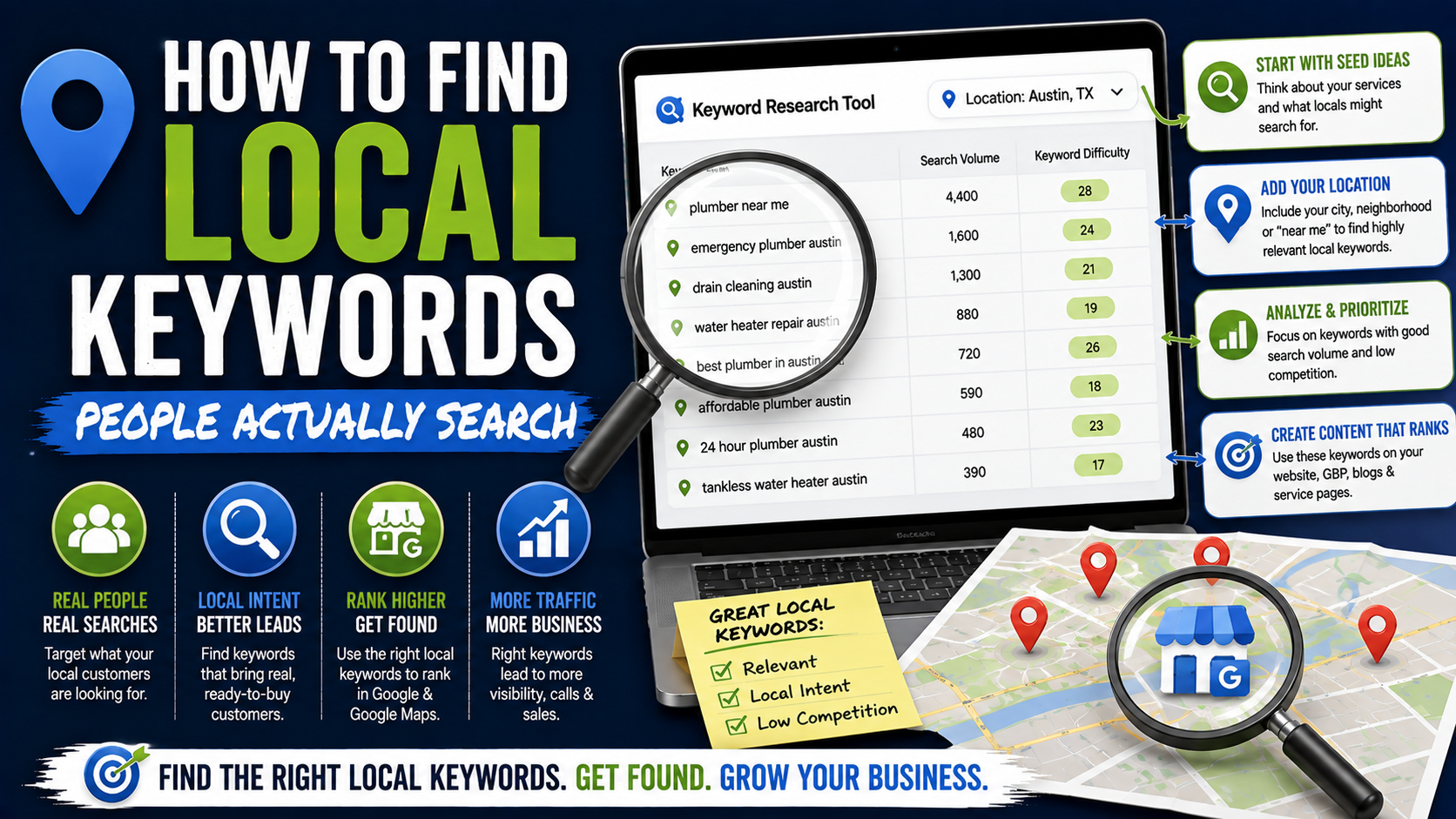
One of the easiest ways to waste a few months on local SEO is to optimize for keywords that look perfect in a spreadsheet but barely matter to real customers.
I have seen this happen with local service websites again and again.
Someone opens a keyword research tool, types in “landscaping,” exports hundreds of suggestions, sorts the sheet by search volume, and starts creating pages.
A few months later, the website has articles about landscaping ideas, landscaping definitions, landscaping careers, landscaping software, and all sorts of topics.
Traffic might even increase.
Phone calls do not.
The problem was not necessarily the SEO.
The problem was the keywords.
A homeowner who searches:
“how does landscaping work”
is in a completely different situation from someone searching:
“landscaping company near me.”
And someone searching:
“interlocking driveway contractor Burlington”
may be far more valuable to a paving company than a broader keyword with ten times the apparent search volume.
Local keyword research is not about finding the biggest numbers.
It is about discovering how people in your market actually search when they need what you sell.
That sounds simple, but doing it properly requires a little digging.
Here is the process I use.
Start With Services, Not SEO Tools
Before opening Ahrefs, Semrush, Google Keyword Planner, or anything else, I make a basic list of what the business actually sells.
This saves a surprising amount of time.
Suppose I am researching keywords for a landscaping contractor.
The owner tells me they offer:
- Interlocking driveway installation
- Patio installation
- Retaining walls
- Sod installation
- Yard grading
- Drainage
- Interlocking repair
- Outdoor steps
That is my starting point.
Not “landscaping.”
The actual services.
This distinction matters because customers often search for the solution they need rather than the broad category the business uses to describe itself.
The company may think of itself as a landscaper.
A customer may search:
“fix sinking patio pavers”
“new sod installation near me”
“backyard drainage contractor”
“retaining wall company”
“driveway pavers near me”
Those searches could all lead to the same company.
Your first task is therefore simple:
Write down every meaningful service customers can actually pay you for.
Do not worry about search volume yet.
Think About How Customers Describe the Service
Business owners often use different language from their customers.
That can cause surprisingly big keyword gaps.
A contractor might call a service:
Interlocking Releveling
A homeowner might search:
- Sinking pavers repair
- Uneven patio repair
- Fix sunken interlock
- Patio pavers sinking
- Paver leveling near me
The technical name may still be a keyword.
But it should not be the only keyword you investigate.
One exercise I like is asking:
What would a customer type if they did not know the professional name for this service?
That question produces some of the best keyword ideas.
For an HVAC company, the official service might be:
Air Conditioning Repair
Customers may search:
“AC not cooling”
“air conditioner stopped working”
“AC repair near me”
“home AC technician”
“emergency air conditioner repair”
For a plumber:
Drain Cleaning
might become:
“blocked drain plumber”
“sink won’t drain”
“clogged drain service”
“drain cleaning near me”
Your website can use professional terminology while still covering the natural language customers use.
1. Use Google Autocomplete
Google itself is one of my favorite keyword research tools.
Start typing a service into Google and pay attention to the suggestions.
For example:
patio contractor
Google may suggest variations involving location, cost, installation, or nearby services.
Autocomplete is useful because Google’s predictions are influenced by real searches, along with factors such as the user’s location, language, trending interest, and previous searches.
That location element makes it particularly useful for local research.
Try different versions:
patio contractor
patio installer
patio pavers
patio repair
Then add your location:
patio contractor Burlington
patio installer Burlington
pavers Burlington
Do the same with nearby cities and neighborhoods you genuinely serve.
One important warning:
Autocomplete is an idea source, not a complete measurement tool.
A phrase appearing there tells you it is worth investigating. It does not automatically tell you whether it gets 20 searches or 2,000 searches per month.
Still, it is excellent for understanding language.
2. Search Your Main Keyword and Study the Results
This is one of the most overlooked parts of keyword research.
Actually Google the keyword.
Suppose you are considering:
retaining wall contractor
Look at what Google returns.
Do you see local contractors?
A map pack?
Service pages?
Home improvement articles?
DIY videos?
Product stores?
The results tell you what Google believes the searcher wants.
This is called search intent, although you do not really need the jargon.
You are simply asking:
What does someone searching this phrase appear to be trying to accomplish?
If your goal is to generate leads and Google shows mostly local service businesses, that is a good sign.
If Google shows tutorials explaining how to build a retaining wall yourself, the keyword may have more informational intent.
This does not necessarily mean you should ignore it.
It just means the keyword may belong in an article rather than on your primary service page.
3. Look at the Google Maps Results
For local businesses, I also check whether a keyword triggers Google Maps results.
Search:
“landscaper near me”
“driveway paving company”
“emergency plumber”
“roof repair”
“dentist”
You will often see a local map pack.
That is a strong indication that Google considers location highly relevant to the query.
Now compare that with something like:
“how long should a roof last”
You are much more likely to see informational pages.
This distinction helps organize keywords into different groups.
Commercial local keywords
These usually belong on service or location pages.
Examples:
“plumber Chicago”
“roofing company near me”
“patio installer Burlington”
“dentist Austin”
Informational keywords
These usually work better as articles or guides.
Examples:
“why is my shower pressure low”
“how long do paver patios last”
“when should a roof be replaced”
Both can be useful.
Just do not treat them as if they have identical value.
4. Use Google Search Console Before Paying for Anything
If the website already receives Google traffic, Search Console is one of the first places I check.
Why?
Because this is not hypothetical keyword data.
It shows queries that have actually caused your site to appear in Google Search.
Google describes queries in the Search Console Performance report as the search terms that led to your site. You can analyze them using metrics such as impressions, clicks, CTR, and average position.
Open:
Google Search Console → Performance → Search Results → Queries
Then start looking.
You may discover searches you never deliberately targeted.
For example:
“interlock repair Burlington”
“paver repair near me”
“patio stone leveling”
“driveway releveling”
If a page already gets impressions for a relevant term while sitting outside the strongest positions, that can be a very useful opportunity.
I particularly like looking for:
- High impressions with low clicks
- Relevant keywords ranking around positions 5-20
- Service variations I missed originally
- Location variations
- Questions customers are searching
- Unexpected terminology
Google itself recommends using the Queries report to identify both expected and unexpected searches and to find queries with strong impressions but weaker click-through rates.
There is one limitation worth understanding.
Search Console does not expose every individual query. Some are anonymized for privacy, and the interface also has data limitations.
So use Search Console as one source, not your only source.
5. Use Google Keyword Planner
Google Keyword Planner can help validate your list and uncover additional variations.
Start with a few core services.
For example:
- Patio installation
- Interlocking driveway
- Retaining wall
- Paver repair
- Sod installation
Then explore related ideas.
Keyword Planner lets users discover and refine keywords using information such as keyword text, average monthly searches, and advertising bid ranges. Google’s current documentation notes that account setup, including billing information, is required to access basic Keyword Planner functionality.
For local research, be careful with volume.
If your service area is small, extremely precise keyword numbers can become unreliable or too sparse to be useful.
I do not throw away a commercially valuable keyword simply because a tool says:
10 searches per month
Ten local people looking for a $10,000 service are very different from 1,000 people looking for a free template.
Search volume needs context.
6. Use Semrush or Ahrefs for Expansion
Paid SEO tools become useful once you already understand the business.
The mistake is letting the tool decide the entire strategy for you.
In Semrush, you can take a seed phrase and use Keyword Magic Tool to uncover related queries, questions, volume estimates, keyword difficulty, intent, and other variations. Semrush currently says its Keyword Magic database contains more than 27 billion keywords.
Ahrefs Keywords Explorer offers a similar workflow, including matching terms, related terms, search suggestions, volume estimates, difficulty data, and traffic-potential metrics.
For local research, I might search:
concrete contractor
Then add variations like:
concrete contractor Toronto
concrete patio
concrete driveway
concrete repair
From there, I look for modifiers such as:
- Near me
- Company
- Contractor
- Installer
- Installation
- Repair
- Replacement
- Cost
- Service
- Best
- Emergency
- Residential
- Commercial
Not every modifier deserves its own page.
You are collecting language first.
Page planning comes later.
7. Research Competitors That Actually Rank
This is where keyword research gets interesting.
Search one of your main services.
For example:
“landscaping company Burlington”
Find the businesses that consistently appear.
Then look at their websites.
What service pages do they have?
What wording do they use?
Which cities do they target?
What topics appear repeatedly?
You can take this further with Semrush or Ahrefs.
Both platforms provide tools for examining keywords competitors already rank for. Semrush, for example, currently offers keyword-gap and organic-ranking tools designed to compare keyword portfolios between competing sites.
The goal is not to copy competitors.
You are looking for gaps in your own understanding.
Imagine your company describes a service as:
Interlocking Restoration
But three competitors get traffic for:
“paver repair”
“interlock repair”
“paver releveling”
That is useful information.
Maybe customers simply use different language.
8. Look at Customer Questions
One of the easiest keyword sources is sitting inside the business already.
Talk to whoever answers the phone.
Ask:
What do customers ask before booking?
You might hear:
“How much does a patio cost?”
“Can you repair just part of my driveway?”
“Why are my pavers sinking?”
“Do I need to replace the whole retaining wall?”
“Can you fix drainage beside the house?”
Those questions can become keywords and content topics.
This method is especially valuable because the questions are tied to real potential customers rather than an SEO database.
Check:
- Emails
- Contact form submissions
- Live chat
- Sales call notes
- Customer support messages
- Google reviews
- CRM notes
- Social media messages
I have found that a sales team’s vocabulary can sometimes be more useful than an export containing 10,000 keywords.
9. Pay Attention to “Near Me” Searches Without Stuffing “Near Me” Everywhere
“Near me” searches are clearly important for local SEO.
That does not mean your website needs sentences like:
“Looking for the best plumber near me? Our plumber near me service provides plumbing near me…”
That reads terribly.
You normally do not need to literally repeat “near me” all over a page.
Google already has location context.
Focus instead on making your business location and service area clear.
Use:
- Accurate Google Business Profile information
- Location-relevant website content
- Service pages
- Genuine local reviews
- Clear contact details
- Real project locations where appropriate
You can still track “near me” queries because they reveal demand.
Just do not write your website as if “near me” is the name of a town.
10. Use Google Trends for Language and Seasonality
Google Trends is useful when you want to compare phrases or understand when demand changes.
Google currently allows users to compare search terms, examine interest by region, discover related searches, and refine results by category.
Suppose you are unsure whether customers more commonly use:
“artificial grass”
or:
“artificial turf”
Trends may help you compare interest.
Or perhaps you offer:
- Snow removal
- Lawn installation
- Pool landscaping
- Roof repair
Demand is obviously not flat throughout the year.
Search interest can change with weather and seasons.
This helps with both SEO and content scheduling.
A landscaping company probably does not need to publish its major “spring lawn preparation” guide in November just because someone added it to the content calendar.
Timing matters.
11. Add Geographic Modifiers
Once you have service keywords, combine them with the real locations you serve.
For example:
Service: Patio installation
Potential local variants:
- Patio installation Burlington
- Patio contractor Burlington
- Patio installer Burlington
- Paver patio Burlington
- Patio company Burlington
Then repeat the research for relevant nearby areas.
But do not automatically create a page for every combination.
You might discover:
“patio contractor Burlington”
“patio installer Burlington”
“paver patio Burlington”
all represent essentially the same intent.
One strong page may be able to cover all three naturally.
That is usually better than creating:
/patio-contractor-burlington/
/patio-installer-burlington/
/paver-patio-burlington/
with nearly identical content.
Keyword research should help organize a website, not explode it into hundreds of thin pages.
12. Do Not Ignore Low-Volume Keywords
This is probably one of the most useful lessons in local keyword research.
Low volume does not mean low value.
Consider:
interlocking driveway repair Burlington
Maybe an SEO tool reports only a small number of monthly searches.
But think about the person making that search.
They know the service.
They know their location.
They apparently have a problem.
They may be close to contacting someone.
Compare that with:
driveway ideas
which could have far more searches.
The second searcher could be:
- Browsing Pinterest
- Doing school research
- Planning a project three years from now
- Looking for DIY ideas
- Living outside your country
Volume alone does not tell you business value.
For local SEO, I would rather find 20 keywords that repeatedly lead to qualified jobs than rank for 2,000 irrelevant searches.
A Simple Way to Score Local Keywords
You do not need a complicated formula.
I normally think about four things.
1. Relevance
Does the business genuinely provide what the searcher wants?
2. Intent
Does this person seem ready to hire, compare providers, or at least seriously research the service?
3. Location
Is the search coming from or referring to an area the business actually serves?
4. Demand
Is there evidence that people search the term?
Demand evidence can come from:
- Keyword tools
- Search Console impressions
- Autocomplete
- Google Trends
- Competitor rankings
- Actual customer questions
- PPC search-term data
- Leads
If a keyword scores well on the first three but has apparently low volume, I do not automatically reject it.
Build Keyword Groups, Not Giant Lists
At some point, you will have a spreadsheet full of variations.
Now comes the important part.
Group keywords based on intent.
For example:
Patio Installation
- Patio installation
- Patio installer
- Patio contractor
- Paver patio installation
- Interlocking patio contractor
These probably belong together.
Patio Repair
- Patio repair
- Paver repair
- Sunken patio repair
- Interlock releveling
- Uneven paver repair
That is a different service intent and may deserve a separate page.
Patio Cost
- Patio installation cost
- Paver patio cost
- How much does a patio cost
- Interlocking patio price
These might fit naturally into the installation page or a detailed cost guide depending on the site’s structure.
Clustering keywords like this prevents a very common SEO mistake:
Creating one page for every keyword variation.
Match Keywords to the Right Page Type
Once your groups are ready, decide where they belong.
A simple structure could be:
Homepage
Broad core category + main location
Service pages
Specific revenue-generating services
Location pages
Important genuinely served cities
Service + location pages
Only when there is enough need and unique value to justify them
Blog posts
Questions, comparisons, problems, costs, maintenance, and educational searches
For example:
Keyword:
“patio contractor Burlington”
Likely target:
Service/location landing page.
Keyword:
“why are my patio pavers sinking”
Likely target:
Educational article that can internally link to your repair service.
Keyword:
“interlocking repair cost”
Could be:
A detailed pricing guide or a section of the repair page.
The keyword should fit the page.
Do not force everything onto the homepage.
Common Local Keyword Research Mistakes
Chasing Search Volume
The highest-volume keyword is not automatically the most profitable.
Commercial intent matters.
Trusting One SEO Tool
Keyword volumes are estimates.
Ahrefs, for example, describes its search-volume metric as an average monthly estimate and says its volume data is refreshed periodically.
Treat these numbers as guidance, not exact customer counts.
Ignoring Search Console
If Google is already showing your website for relevant searches, that information should be part of your research.
Only Using Industry Language
Customers may not know your technical terminology.
Research how normal people describe the problem.
Creating a Page for Every Keyword
“Plumber Dallas,” “Dallas plumber,” and “plumbing company Dallas” do not necessarily require three pages.
Targeting Cities You Do Not Serve
A spreadsheet might show search demand in a nearby city.
That does not mean it makes business sense to target it.
Ignoring Search Intent
A 5,000-search informational term may generate fewer leads than a 50-search commercial term.
My Practical Local Keyword Research Workflow
If I had to research a new local business tomorrow, I would do it in this order.
Step 1: List every real service.
Step 2: Write down alternative customer terminology.
Step 3: Search each core service manually on Google.
Step 4: Check autocomplete suggestions.
Step 5: Look at Maps and organic competitors.
Step 6: Export Search Console queries if the site already has data.
Step 7: Expand the list in Keyword Planner, Semrush, or Ahrefs.
Step 8: Add real city and neighborhood modifiers.
Step 9: Review customer questions, calls, emails, and CRM notes.
Step 10: Group similar keywords by search intent.
Step 11: Assign each group to an existing or planned page.
Step 12: Prioritize by commercial value, not just search volume.
That is enough for most local businesses.
You do not need a 40,000-row keyword spreadsheet.
Final Thoughts
Good local keyword research often feels less like SEO and more like learning how customers talk.
That is the part I would focus on.
A keyword tool can tell you that “landscaping services” has search volume.
Search Console might reveal that people already find you through “yard grading company.”
Google Autocomplete might suggest “landscaper near me.”
Your sales team might tell you that half of this month’s callers asked whether you fix sinking patios.
A competitor analysis might reveal that “interlocking repair” is a much bigger service category than you realized.
Put those pieces together.
That is where useful keyword research comes from.
Not from blindly downloading thousands of phrases and sorting them from highest to lowest volume.
The best local keywords usually sit at the intersection of three things:
What you actually sell.
How customers actually describe it.
What they search when they are ready to solve the problem.
Find those terms first.
Then build your pages, Google Business Profile, content, and local SEO strategy around them.
You may end up targeting fewer keywords.
But they will be much better ones.