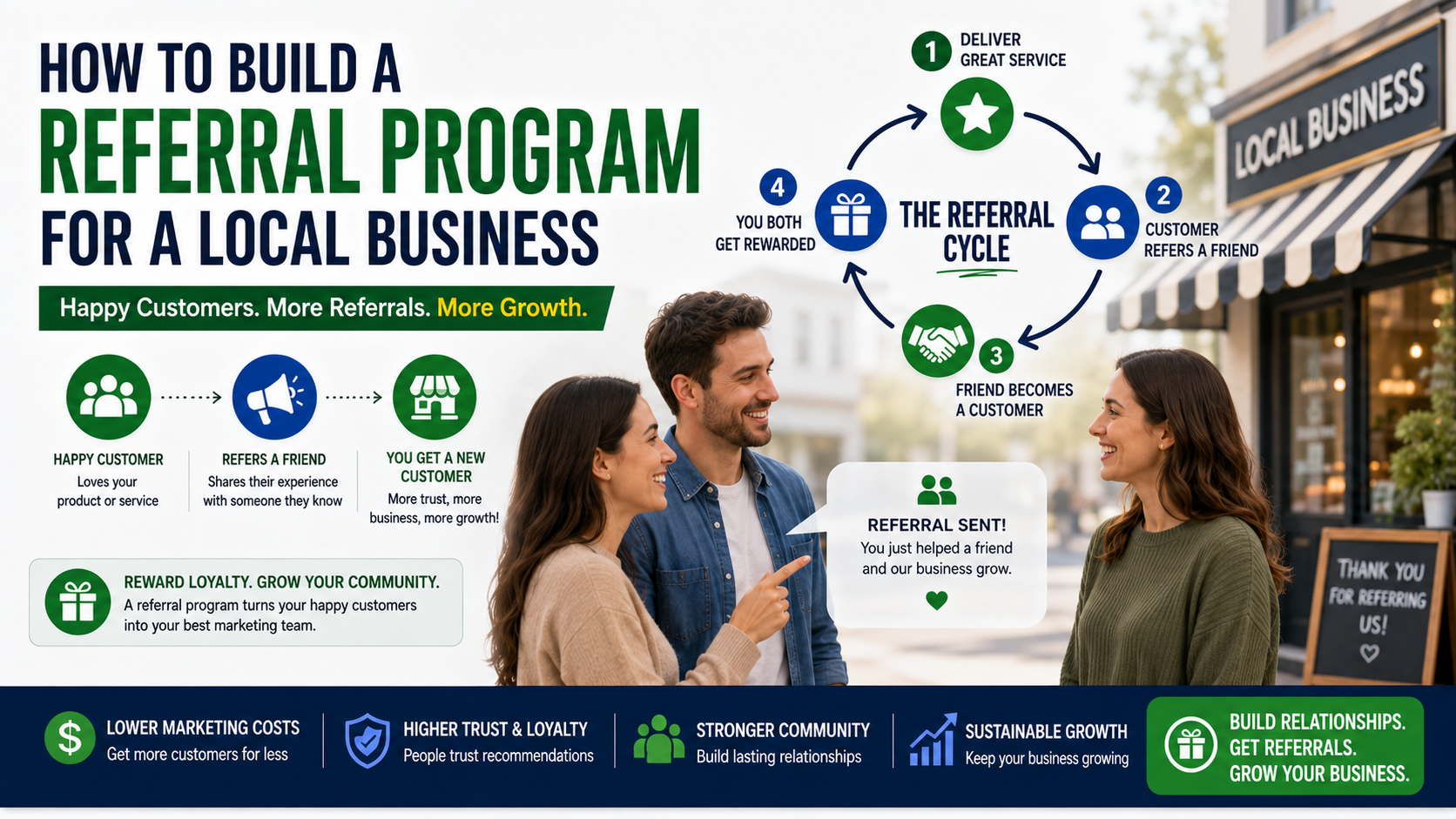
A local contractor once told me that referrals were his best source of work.
When I asked how his referral program worked, he laughed and said, “We don’t really have one. People just tell their friends about us.”
That answer is common.
Many local businesses already receive referrals, but the process is completely informal. A satisfied customer recommends the company occasionally, someone mentions the business in a neighborhood Facebook group, or a past client forwards a phone number to a friend.
The referrals are valuable, but they happen by accident.
The business rarely tracks who made the introduction, which customers refer most often, or whether anyone was thanked afterward. In some cases, the referred customer gets excellent service while the person who made the recommendation never hears from the company again.
A referral program does not need to be complicated.
You do not need custom software, points, membership levels, or a large cash reward. You need a clear offer, a simple way to share it, and a reliable process for recognizing the people who send new customers your way.
Done properly, a referral program feels like a thank-you.
Done badly, it feels like the business is paying customers to pressure their friends.
The difference usually comes down to timing, transparency, and simplicity.
Why Referrals Work So Well for Local Businesses
Local customers often feel nervous when hiring someone new.
They are allowing a contractor into their home, trusting a mechanic with their car, choosing a clinic, hiring a cleaner, or spending money on a service they may not fully understand.
Advertising can create awareness, but a personal recommendation reduces uncertainty.
When a friend says, “I used this company, and they were reliable,” the business starts the conversation with trust already in place.
That does not mean the sale is guaranteed.
The referred person will still consider price, availability, reviews, communication, and service quality. But the recommendation gives the business a stronger starting point than a cold advertisement.
Referral leads can also be easier to qualify.
The existing customer often explains what the business does, what it costs, and what the experience was like. By the time the new prospect makes contact, they may already have realistic expectations.
The challenge is turning occasional word-of-mouth into a repeatable system without making the relationship feel transactional.
Start With a Service Worth Recommending
A referral program cannot rescue a poor customer experience.
Before offering rewards, look at what happens after someone contacts the business.
Ask:
- Do calls and messages receive quick replies?
- Do customers understand the price?
- Does the team arrive on time?
- Are delays explained?
- Is the final result consistent?
- Are complaints handled professionally?
- Does the business follow up after the service?
Customers recommend businesses when they feel confident that the referral will reflect well on them.
That last point matters.
When someone recommends your business to a friend, they are lending you part of their reputation. If the experience goes badly, the customer may feel embarrassed for making the introduction.
Before launching a formal referral program, review recent feedback and complaints.
Fix repeated problems first.
A small reward will not persuade a customer to recommend a business they do not fully trust.
Decide What Counts as a Successful Referral
This sounds obvious, but it causes confusion in many referral programs.
Does someone earn the reward when their friend:
- Provides contact details?
- Requests a quote?
- Books an appointment?
- Pays a deposit?
- Completes a purchase?
- Remains a customer for 30 days?
The rule should match the business.
For a local coffee shop, a referral might count when the new customer makes their first purchase.
For a renovation company, giving a reward for every quote request could become expensive because many quotes never turn into jobs. It may make more sense to reward the referring customer after the new customer pays a deposit or completes the project.
For a cleaning service, the reward might be triggered after the referred customer completes the first paid cleaning.
Choose one clear event.
For example:
A referral qualifies when the new customer completes their first paid service.
That sentence is easy to understand.
Avoid vague wording such as “Rewards may be issued for eligible referrals at our discretion.” It may protect the business legally, but it creates distrust when used as the main explanation.
Choose a Reward That Fits the Customer Relationship
Cash is not always the best referral reward.
The right incentive depends on what the business sells and how frequently customers return.
Common options include:
- Account credit
- A discount on the next service
- A free upgrade
- A complimentary add-on
- A gift card
- Store credit
- A small cash reward
- A charitable donation
- Loyalty points
- A free product
- Priority booking
For a recurring cleaning business, a credit toward the next visit makes sense.
For a salon, the reward could be a free treatment upgrade.
For an auto repair shop, it might be a service credit.
For a restaurant, a meal voucher may be more natural than cash.
For a high-value service that customers use only once every few years, a gift card can be more useful than account credit.
Imagine a roofing company offering $100 toward the customer’s next roof replacement. That reward may not feel valuable because the customer does not expect to replace the roof again soon.
A general gift card or cash thank-you would be easier to appreciate.
Consider Rewarding Both People
A two-sided referral program gives something to the existing customer and the new customer.
For example:
- The existing customer receives a $25 credit.
- The referred customer receives $25 off their first service.
This structure can make sharing feel more comfortable.
The existing customer is not only earning something for themselves. They are also giving their friend a benefit.
That changes the message from:
“Use my code so I get a reward.”
To:
“Here is a discount you can use, and the business also gives me a thank-you.”
A two-sided reward is not necessary for every business. It can reduce profit if the amounts are too generous.
Calculate the total cost before launching it.
If the business gives $30 to each person, the total referral cost is $60. That may be reasonable for a $1,000 service, but not for a $75 purchase.
Calculate What You Can Afford
Do not choose a reward because it sounds attractive.
Start with the numbers.
Suppose a local service business has:
- An average sale of $500
- A gross profit of $200
- A normal customer acquisition cost of $70
- A healthy repeat-purchase rate
A referral reward costing $40 may be reasonable because it remains below the normal cost of acquiring a new customer.
Now imagine another business has:
- An average sale of $80
- A gross profit of $25
- No repeat purchases
A $30 referral reward would consume most of the profit.
The business could offer a lower-cost benefit instead, such as a small add-on, upgrade, or credit with a controlled cost.
Consider:
- Average sale value
- Gross profit
- Customer lifetime value
- Normal marketing cost
- Redemption cost
- Administration time
- Fraud risk
The reward should be appealing without making every referred sale unprofitable.
Keep the Rules Short
Customers should not need to read a page of conditions before referring someone.
A basic program may need only a few rules:
- The new customer must mention the referrer’s name or use their referral code.
- The new customer must not already be in the company’s database.
- The reward is issued after the first paid service.
- The offer cannot be combined with certain promotions.
- Employees and immediate family may be excluded, depending on the business.
- The company may limit rewards in cases of suspected misuse.
Write the rules in normal language.
If additional legal terms are needed, place them on a separate page, but keep the main explanation readable.
Customers should quickly understand:
- What they need to do
- What their friend receives
- What they receive
- When the reward arrives
Give Customers an Easy Way to Refer
A referral program fails when sharing it requires too much effort.
Do not ask customers to remember a complicated code, explain several rules, and tell their friend to visit a hidden page.
Provide a simple method.
Options include:
- A shareable link
- A referral code
- A QR code
- A small printed card
- A WhatsApp message
- A prewritten email
- A website form
- A unique coupon
- A simple name-based system
For a small local business, the easiest method may be:
“Ask your friend to mention your full name when booking.”
This works when lead volume is manageable and customer records are organised.
A larger business may need unique links or codes to avoid confusion.
Tools such as Google Forms, Typeform, Jotform, HubSpot, Airtable, and basic CRM forms can collect referrals without custom development.
A simple referral form could ask for:
- Existing customer’s name
- Existing customer’s email or phone number
- Referred person’s name
- Referred person’s contact information
- Service required
- Consent confirmation
Be careful about asking customers to submit a friend’s personal information without permission.
A safer approach is often to give the customer a link they can send directly. The friend then chooses whether to contact the business.
Ask at the Right Moment
The best time to mention a referral program is when the customer already feels positive.
Good moments include:
- After the customer gives a compliment
- After the project is completed successfully
- After a positive review
- After a problem is resolved well
- When the customer renews
- When the customer makes a repeat purchase
- During a friendly follow-up call
Imagine a customer says:
“The team did a great job. I’m really happy with how it turned out.”
That is a natural opening.
The response could be:
“Thank you, I’m glad you’re happy with it. We have a simple referral program as well. If someone you know needs the same service, they receive $25 off, and we send you a $25 thank-you credit after their first booking.”
The request fits the conversation.
Now compare that with asking for a referral while the customer is waiting for a delayed delivery.
The program may be good, but the timing makes it feel insensitive.
Do Not Ask Before Earning Trust
Some businesses promote referrals immediately after the first purchase.
That can work for simple retail products, but it feels premature for many services.
A new customer may not know whether the service is reliable yet.
Wait until they have experienced the result.
For a home renovation company, that could be after the project is complete.
For a recurring service, it might be after the second or third successful visit.
For a restaurant or salon, the request can happen sooner because the customer experiences the result quickly.
The right timing depends on how long it takes the customer to judge the service.
Write a Natural Referral Message
The message should sound like something a real person would send.
Avoid exaggerated language such as:
“Unlock unlimited rewards by becoming an elite brand ambassador!”
Most local customers do not want to become brand ambassadors.
They may simply be happy to recommend a business they trust.
A practical message could say:
“Thanks again for choosing Oak Street Cleaning. If a friend or neighbor needs help with home cleaning, send them this link. They’ll receive $20 off their first visit, and we’ll add a $20 credit to your account after the service is completed.”
The message explains everything without pressure.
You can share it through:
- SMS
- Printed receipts
- Thank-you cards
- Invoice emails
- Customer portals
- Social media
- The company website
Do not send referral requests constantly.
One well-timed message is better than a reminder every week.
Train the Team to Mention It Consistently
A referral program cannot depend entirely on the owner remembering to bring it up.
Create a simple team process.
For example:
- Complete the service.
- Confirm the customer is satisfied.
- Ask for feedback.
- Mention the referral program.
- Send the referral link.
- Record the request in the CRM.
Give staff a short script, but allow them to speak naturally.
For example:
“If you know someone else who needs this service, we have a referral program. They receive $20 off their first booking, and you receive a $20 credit afterward. I can text you the link.”
This is clear and low-pressure.
Train employees not to ask for referrals when the customer is unhappy or an issue remains unresolved.
Track Every Referral
A referral program becomes difficult to manage when rewards depend on memory.
Create a simple tracking system.
A spreadsheet can include:
- Referral date
- Referrer’s name
- Referrer’s contact information
- New customer’s name
- Service requested
- Booking date
- Purchase status
- Purchase value
- Reward status
- Reward date
- Notes
Use clear reward statuses:
- Pending
- Qualified
- Reward issued
- Cancelled
- Duplicate
- Not eligible
For a small program, Google Sheets may be enough.
As the program grows, HubSpot, Zoho CRM, Pipedrive, Airtable, Referral Rock, ReferralCandy, or other referral software may help automate tracking.
Do not buy complex software before proving that customers will use the program.
Start manually.
Learn where confusion happens.
Then automate the parts that take too much time.
Thank the Referrer Quickly
The reward is important, but recognition matters too.
When a new customer mentions a referrer, send a thank-you message.
For example:
“Hi Emma, thank you for recommending us to Daniel. He has booked his first appointment for next week. We really appreciate the introduction, and your referral credit will be added after the service is completed.”
This confirms that the referral was recorded.
After the qualifying purchase, send another message:
“Daniel’s first service is complete, so we’ve added a $25 credit to your account. Thanks again for recommending us.”
Do not make the referrer chase the business for the reward.
A delayed or forgotten reward can damage more trust than having no program at all.
Protect the Program From Misuse
Most customers will use the program honestly.
Still, basic safeguards are useful.
Common problems include:
- People referring themselves with a second email address
- Existing customers being presented as new customers
- Fake contact information
- Multiple people claiming the same referral
- Employees submitting personal leads improperly
- Rewards being issued before payments clear
- Customers cancelling after receiving discounts
You can reduce these issues by:
- Requiring a completed purchase
- Checking the new customer’s contact details
- Recording the referrer before or during the first booking
- Limiting one referrer per new customer
- Issuing rewards after the cancellation period
- Creating clear employee rules
- Reviewing unusual referral patterns
Do not make the program so strict that honest customers feel suspected.
Use reasonable checks behind the scenes.
Promote the Program Without Overdoing It
A referral program needs visibility.
Customers cannot use an offer they do not know exists.
Useful places to mention it include:
- Thank-you emails
- Receipts
- Invoices
- Appointment reminders
- Customer newsletters
- The website
- Social media
- Printed cards
- Store signage
- Packaging
- Customer portals
The referral message should appear after the main customer need has been handled.
For example, an invoice email should make the payment information clear before promoting the referral program.
A post-service email might follow this order:
- Thank the customer.
- Confirm the service is complete.
- Explain support or warranty information.
- Ask for feedback.
- Mention the referral program.
That feels customer-focused rather than sales-focused.
Use Reviews and Referrals Together
Reviews and referrals support each other, but they are not the same.
A review helps strangers evaluate the business.
A referral introduces the business through a trusted relationship.
After a positive experience, you can ask for both, but avoid placing too many requests in one message.
A better approach is to separate them.
First, ask for feedback or a review.
Later, once the customer has responded positively, mention the referral program.
This keeps the customer from feeling like the business is asking for three favors at once.
Example: Referral Program for a Cleaning Business
Imagine a residential cleaning company with an average booking value of $140.
The company creates this offer:
- The new customer receives $20 off the first cleaning.
- The existing customer receives a $20 credit after the cleaning is completed.
The process is simple:
- After the second successful cleaning, the customer receives a referral email.
- The email contains a shareable booking link.
- The new customer enters the referrer’s name while booking.
- The office checks that the customer is new.
- After the first paid cleaning, the CRM creates a reward task.
- The existing customer receives the credit and a thank-you message.
The company tracks:
- Number of referral invitations
- Links shared
- Referred bookings
- Completed first services
- Credits issued
- Repeat bookings
- Revenue generated
This program fits the business because customers may use the service repeatedly, making account credit valuable.
Example: Referral Program for a Local Contractor
A contractor completing higher-value projects may need a different structure.
Suppose the average project is worth $8,000.
The company could offer:
- A $100 gift card to the referring customer
- A free consultation for the new customer
- The reward issued after the new customer signs the agreement and pays the deposit
The contractor sends the referral message after project completion, once final issues have been resolved.
The message includes a link the customer can forward.
The landing page explains:
- Services offered
- Areas covered
- What the referred customer receives
- What the existing customer receives
- When rewards are issued
Because projects are less frequent, a gift card is more useful than credit toward another major renovation.
Example: Referral Program for a Salon
A salon may use a faster, lower-cost program.
For example:
- Refer a new client.
- The new client receives 15% off the first appointment.
- The existing client receives a free treatment upgrade at the next appointment.
A printed referral card or simple booking code may be enough.
The receptionist can mention the program after a positive appointment and add the reward to the customer profile when the referral completes a service.
The benefit feels immediate and relevant.
Common Referral Program Mistakes
Offering an Unclear Reward
“Earn exciting benefits” does not tell customers anything.
State exactly what each person receives.
Making the Reward Too Small
A reward does not need to be expensive, but it should feel meaningful.
A $2 discount on a $500 service may look careless.
Making the Reward Too Generous
A large incentive can attract low-quality referrals and reduce profit.
Calculate the numbers first.
Asking at the Wrong Time
Do not request referrals before solving an open complaint.
Creating Too Many Rules
Complicated terms reduce participation.
Keep the main process simple.
Forgetting to Pay or Issue Rewards
This is one of the fastest ways to damage trust.
Track rewards carefully.
Rewarding Leads Instead of Customers
Paying for every submitted name can encourage fake or weak referrals.
For many businesses, it is safer to reward completed purchases.
Sending Too Many Reminders
Customers do not need weekly referral messages.
Ask at relevant moments.
Ignoring Referred Customers
A referred prospect expects good treatment.
Respond quickly and mention the person who made the introduction when appropriate.
Failing to Measure Profitability
A referral program can generate sales while still costing too much.
Track revenue, gross profit, and reward costs.
Measure More Than the Number of Referrals
Useful referral program metrics include:
- Customers invited to participate
- Referrals submitted
- Qualified referrals
- New customers acquired
- Referral conversion rate
- Average referred sale value
- Reward cost
- Customer acquisition cost
- Repeat-purchase rate
- Revenue from referred customers
- Top referring customers
Compare referred customers with other lead sources.
Do they book faster?
Do they spend more?
Do they stay longer?
Do they require fewer sales calls?
The answers help determine whether the program is worth expanding.
Improve the Program Slowly
Do not redesign the referral offer every week.
Run it long enough to understand how customers use it.
Ask participants what felt confusing.
You may discover that:
- Customers prefer gift cards to account credit
- The referral link is difficult to find
- Staff forget to mention the program
- The reward takes too long to arrive
- Customers want a message they can forward
- The new-customer discount is not attractive
- The rules are unclear
Change one part at a time.
This makes it easier to see what improves participation.
A Simple Launch Plan
A local business can launch a basic referral program in one week.
Day One: Review the Numbers
Calculate the average sale, profit, and normal customer acquisition cost.
Day Two: Choose the Reward
Decide what the existing and new customers receive.
Day Three: Write the Rules
Define who qualifies and when the reward is issued.
Day Four: Create the Sharing Method
Build a short form, referral link, code, card, or WhatsApp message.
Day Five: Create the Tracking Sheet
Add fields for the referrer, new customer, sale, and reward.
Day Six: Train the Team
Explain when and how to mention the program.
Day Seven: Invite a Small Group
Start with ten to twenty satisfied customers.
Watch how the process works before promoting it to everyone.
A small test will reveal missing details without creating a large administrative problem.
Make the Program Feel Like Appreciation
A referral program works best when it grows from a good customer relationship.
The reward is not supposed to buy fake enthusiasm.
It is a way to recognize someone who trusted the business enough to make an introduction.
Keep the process easy.
Explain the reward clearly.
Ask after earning the customer’s confidence.
Respond quickly to the referred person.
Track every introduction.
Deliver rewards without making people ask twice.
The most successful local referral programs usually do not feel like formal marketing campaigns. They feel like a well-organized version of something customers already want to do: recommend a reliable business to someone they care about.
When the service is good and the process is simple, referrals stop being lucky surprises.
They become a dependable part of how the business grows.