The first time I built a cold email campaign, I thought the hardest part was writing the first email.
It wasn’t.
The harder part was deciding what to do after nobody replied.
Do I follow up tomorrow?
Wait a week?
Send the same message again?
Change the subject line?
Add more detail?
At one point, I had a prospect open an email several times without replying, and I spent far too much time trying to interpret what that meant.
Maybe they were interested.
Maybe they forwarded it.
Maybe the tracking was inaccurate.
Maybe they simply opened it by accident.
That experience taught me something useful: cold email follow-ups work better when you stop reacting to every tiny signal and start using a simple, repeatable sequence.
People miss emails.
They read them during meetings.
They tell themselves they will reply later.
They forward them to someone else.
They are interested but busy.
They are not interested at all.
A good follow-up sequence gives the right prospects a few reasonable opportunities to respond without turning you into the person who emails them every other day for a month.
The goal is persistence without annoyance.
That balance matters more than any “perfect” follow-up template.
Why Follow-Ups Matter So Much
A lot of cold email campaigns stop after the first message.
That is understandable.
You send an email.
Nobody replies.
It feels like rejection.
But silence is not always a clear no.
Imagine your prospect receives 100 emails in a day.
Your message arrives at 10:14 AM.
They open it between two meetings.
The message seems relevant.
Then someone walks into the office.
Twenty minutes later, they have forgotten about it.
That is a very normal situation.
A follow-up gives your email another chance to appear when the timing is better.
The mistake is assuming every follow-up needs a completely new sales pitch.
It does not.
Sometimes all you need is a short reminder with a little extra context.
What a Good Follow-Up Sequence Should Do
I think of a cold email sequence as a conversation that has not started yet.
Each message should make sense even if the prospect only remembers part of the previous one.
A good sequence should usually do four things:
- Remind them why you contacted them
- Add some useful context
- Make replying easy
- Know when to stop
The sequence should not feel like:
“Email 1: Buy from me.”
“Email 2: Buy from me.”
“Email 3: Buy from me.”
“Email 4: Why aren’t you buying from me?”
That gets annoying quickly.
Instead, each follow-up can approach the same problem from a slightly different angle.
How Long Should You Wait Before the First Follow-Up?
For many B2B cold email campaigns, I prefer waiting a few business days.
Something like two to four business days is often reasonable.
Why not the next morning?
Because people need time.
If I receive a cold email on Monday and another one Tuesday morning saying:
“Just following up on this…”
it can feel impatient.
The sender barely gave me time to think.
On the other hand, waiting three weeks for the first follow-up may be too long unless your buying cycle is naturally slow.
There is no universal timing rule.
A local service business may use one rhythm.
A recruitment agency may use another.
An enterprise software company with long buying cycles may spread follow-ups further apart.
The important thing is that your cadence makes sense for the type of decision you are asking the prospect to make.
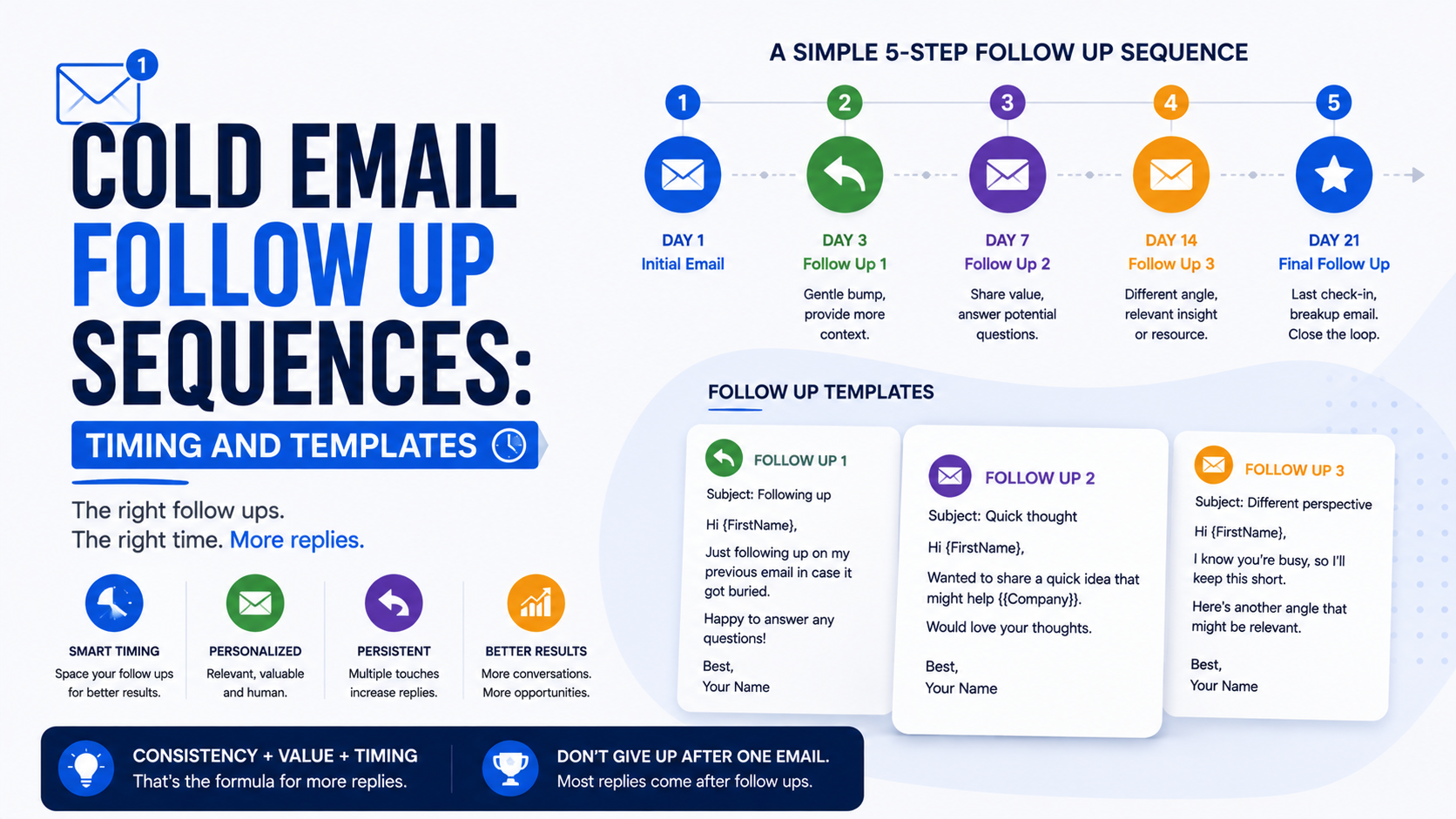
A Simple Cold Email Follow-Up Schedule
If I were building a standard B2B sequence from scratch, I might start with something like this:
Day 1: Initial email
Day 3 or 4: First follow-up
Day 7 or 8: Second follow-up with more context
Day 12 to 14: Third follow-up
Day 20 or later: Final polite check-in
That is only a starting framework.
You can adjust it based on your market.
For high-value consulting services, you may spread messages further apart.
For time-sensitive offers, a shorter sequence may make sense.
The key is avoiding constant pressure.
Follow-Up #1: The Simple Reminder
The first follow-up does not need to be creative.
Its job is simply to bring the original email back to the top of the inbox.
Subject: Re: [Original Subject]
Hi [First Name],
Just bringing this back up in case it got buried.
I reached out because [one-sentence reason for contacting them].
Happy to send over [small next step] if that would be useful.
[Your Name]
Example
Hi Mark,
Just bringing this back up in case it got buried.
I reached out because I noticed a few competitors with fewer reviews are still appearing above your company for some local roofing searches.
Happy to send over the two gaps I noticed if useful.
Alex
That is enough.
No new pitch.
No guilt.
No “I know you are busy but…”
Just a reminder.
Follow-Up #2: Add Something Useful
By the second follow-up, I like adding information.
This gives the prospect a new reason to engage.
Subject: Re: [Original Subject]
Hi [First Name],
One thing I didn’t mention in my last note: [useful observation].
That is usually one of the first areas we look at when working with [type of business].
Would it be useful if I sent a quick example?
[Your Name]
Example for Web Design
Hi Sarah,
One thing I didn’t mention in my last note: the booking button disappears once someone moves deeper into a few of the mobile treatment pages.
That is usually one of the first things we look at for clinic websites.
Would it be useful if I sent a screenshot?
Chris
This is much stronger than:
“Any thoughts?”
You are giving the prospect something new.
Follow-Up #3: Use Proof
If the prospect still has not replied, a short case study or relevant example can help.
Do not send a giant success story.
One or two lines are enough.
Subject: Re: [Original Subject]
Hi [First Name],
We recently worked with a similar [type of business] that was dealing with [similar problem].
After [brief action], they saw [credible result, if you can verify it].
Not sure if the same approach would apply here, but I thought the example might be relevant.
Worth a quick look?
[Your Name]
If you do not have a strong measurable result, do not invent one.
You can simply say:
“We recently worked on a similar issue for another multi-location clinic.”
That is still useful credibility.
Follow-Up #4: Ask a Different Question
Sometimes the original call to action is the problem.
Maybe you asked:
“Want to schedule a call?”
The prospect was not ready for that.
A later follow-up can reduce the commitment.
For example:
Hi Daniel,
Quick question before I close this out.
Is [problem/service] something you handle internally, or do you already work with an outside provider?
Either answer helps me know whether this is relevant.
Thanks,
Maya
This is easy to answer.
The prospect does not have to commit to a meeting.
They only have to explain their current situation.
Follow-Up #5: The Polite Final Email
I prefer ending sequences clearly rather than continuing forever.
A final email could say:
Hi [First Name],
I’ll leave this here after this note.
I reached out because [brief reason].
If [service/problem] becomes a priority later, happy to help.
If not, no worries.
[Your Name]
This is calm and professional.
You do not need dramatic “breakup email” language.
I would avoid things like:
“Have you given up on growing your business?”
or:
“I guess improving your sales isn’t a priority.”
Those tactics may get reactions, but they also make you look unnecessarily aggressive.
Should You Use “Breakup Emails”?
They can work, but I do not love the dramatic versions.
You have probably seen something like:
“Since I haven’t heard back, I assume this is not important to you.”
That sounds slightly passive-aggressive.
A better version is simply:
“Looks like this may not be a priority right now, so I’ll stop reaching out.”
That respects the prospect and closes the loop.
You can always contact them again much later if there is a genuinely new reason.
Follow-Up Template for Local Service Businesses
Suppose you run commercial cleaning.
Your original email introduced your company.
The follow-up could be:
Subject: Re: Cleaning provider
Hi Karen,
Just following up on this.
We handle office cleaning for a few businesses around Midtown and I wanted to see whether you ever review alternative providers or keep backup vendors on file.
Happy to send over our service details if useful.
Steve
This works because it recognizes that the prospect may already have a provider.
You are not asking them to replace anyone immediately.
Follow-Up Template for SEO Services
Subject: Re: Your Google visibility
Hi James,
One quick follow-up.
I checked the local results again and noticed two competitors ranking above you despite having fewer Google reviews.
That usually points to issues beyond review count alone.
If useful, I can send the two areas I’d check first.
Ryan
The message adds a specific insight.
Follow-Up Template for Web Design
Subject: Re: Your mobile site
Hi Amanda,
One thing I noticed after my last email: the contact CTA becomes less visible on several mobile service pages.
That is something I’d test before considering a larger redesign.
Want me to send a quick screenshot?
Chris
Again, low-friction CTA.
Follow-Up Template for Recruitment
Subject: Re: Backend hiring
Hi Alex,
Quick follow-up on the backend roles.
Are those positions tied to an immediate project deadline, or are you mainly hiring for longer-term team growth?
We usually help when internal hiring is taking longer than delivery timelines allow.
Maya
This shifts the conversation from “Do you want recruiting help?” to a more useful business question.
Follow-Up Template for Software Development Services
Subject: Re: Development support
Hi Daniel,
Just following up.
If the engineering roles you’re filling are connected to current roadmap deadlines, we sometimes support teams with short-term React or Node.js capacity while permanent hiring continues.
If that situation doesn’t apply, no problem.
Worth sending a short example of how we normally structure that?
Sarah
This keeps the offer specific.
Follow-Up Template for Bookkeeping
Subject: Re: Bookkeeping question
Hi Rachel,
Quick follow-up.
The reason I reached out is that agencies around your size often hit a point where reconciliation, contractor payments, and month-end reporting start taking more owner time than expected.
Are you still managing most of that internally?
Emma
This is simple and conversational.
Follow-Up After “Send Me Information”
This situation deserves its own sequence.
A prospect says:
“Send me some details.”
You send them.
Then nothing.
Do not send:
“Did you review my proposal?”
immediately.
Try:
Hi Mark,
Just checking whether the information I sent answered the main question you had.
If helpful, I can also send [specific relevant example/pricing detail/case study].
No rush — just wanted to make sure I sent the right thing.
Alex
That sounds much less pushy.
Follow-Up After a Proposal
Proposal follow-ups should be slightly different from cold email follow-ups because the prospect has already shown some interest.
A simple version:
Hi Sarah,
Wanted to check in on the proposal I sent Tuesday.
Was there anything in the scope or pricing that you wanted me to clarify?
Happy to walk through anything that is unclear.
Chris
Notice how the question invites feedback.
That is better than:
“When will you make a decision?”
Follow-Up After a Sales Call
After a call, I like sending a short recap fairly quickly.
For example:
Hi Daniel,
Good speaking earlier.
Based on the call, it sounds like the main priorities are:
- Improve local search visibility
- Fix tracking around lead sources
- Reduce reliance on paid traffic
I’ll keep the next steps focused on those areas.
I’ve attached/sent [next item].
Let me know if I missed anything important.
Ryan
This type of follow-up is less about persistence and more about clarity.
Should Every Follow-Up Stay in the Same Thread?
Usually, yes.
Keeping follow-ups in the same email thread gives the recipient context.
They can scroll down and see the original message.
It also feels more like a continuing conversation.
Starting a completely new thread every two days can make you look more aggressive.
That said, there are exceptions.
If you contact the prospect again months later with a genuinely new reason, a new subject line may make more sense.
Do Not Overuse “Just Following Up”
There is nothing wrong with the phrase.
But if every email says:
“Just following up…”
it starts feeling repetitive.
You can vary the opening naturally.
For example:
“One thing I forgot to mention…”
“Quick note on this…”
“Wanted to add one detail…”
“I took another look at…”
“Before I close this out…”
Variation should come from having something new to say, not just finding synonyms.
Follow-Ups Should Usually Get Shorter
The first email contains the context.
The follow-ups do not need to repeat the entire pitch.
If your original email was 100 words, the first follow-up might be 50.
The next might be 60 because you add a useful detail.
A final message might be 30.
People should be able to understand the email quickly.
Do not paste the full company description into every follow-up.
Stop Asking “Did You See My Email?”
I rarely like this wording.
“Did you see my email?”
creates unnecessary pressure.
The person may have seen it and intentionally not replied.
A better approach is to make the follow-up useful on its own.
Instead of:
“Did you see my email?”
write:
“I wanted to add one thing that may be relevant…”
Now the prospect has a fresh reason to read.
Do Not Guilt the Prospect
I have seen follow-ups like:
“I’ve reached out three times and haven’t received the courtesy of a response.”
Never do this.
The prospect does not owe you a reply simply because you emailed them.
Cold outreach is an interruption.
You may believe your service is valuable, but the recipient still gets to decide whether they want the conversation.
Professional follow-up respects that.
Timing Should Match Buying Intent
Not every prospect needs the same sequence.
Someone who recently requested pricing is different from someone who has never replied.
A warm prospect may deserve faster follow-up.
A completely cold prospect probably needs more space.
You can think about timing roughly like this:
Cold Prospect
A few days between messages.
Interested Prospect
Follow up based on what they requested.
Proposal Sent
Follow up around the agreed decision timeline.
“Call Me Next Month”
Actually wait until next month.
Do not turn every situation into the same automated cadence.
Use CRM Reminders for Manual Follow-Ups
Not every follow-up should be automated.
High-value prospects are often worth handling manually.
Tools such as HubSpot, Pipedrive, Close, Zoho CRM, Salesforce, or even Google Calendar can remind you to follow up at the right time.
For smaller businesses, a Google Sheet with a “Next Follow-Up” column can work.
The system matters less than consistency.
If a prospect tells you:
“Contact me after September 15.”
write it down.
Do not rely on memory.
When Automation Helps
For larger cold email campaigns, platforms such as Smartlead, Instantly, Lemlist, Mailshake, Apollo, Reply.io, and similar tools can automate follow-up sequences.
This is useful because you do not have to manually remember every prospect.
But automation creates one important responsibility:
Stop the sequence when someone replies.
Most outreach platforms can handle this automatically if configured correctly.
Make sure they do.
Nothing looks more careless than replying to a prospect personally and then having the automation send:
“Just checking whether you saw my last email.”
an hour later.
Do Not Automate Sensitive Replies
If someone asks a real question, respond manually.
If they raise an objection, respond manually.
If they ask about pricing, timelines, security, or implementation, respond manually.
Automation is good for unanswered outreach.
It is not a replacement for an actual sales conversation.
How Many Follow-Ups Are Too Many?
There is no universal number.
But there is definitely a point where persistence becomes noise.
For many campaigns, three to five total follow-ups may be enough.
Some industries use fewer.
Some use more.
I care less about the exact number and more about whether each message still has a reasonable purpose.
Ask:
Am I adding anything?
Is this prospect still a realistic fit?
Has enough time passed?
Have they asked me to stop?
Would I be annoyed receiving this message?
If the last answer is yes, rethink the email.
What to Do When Someone Says “Not Now”
Do not keep them in the same sequence.
Ask when the timing may be better.
For example:
“Understood. Would it make sense for me to check back around October?”
If they say yes, set a reminder.
Then follow up in October.
This is much better than continuing to email them every week.
Timing objections are useful.
Respect them.
What to Do When Someone Says “We Already Have Someone”
You have two options.
If they are happy:
Leave them alone.
If they sound uncertain:
You could say:
“Makes sense. If anything changes, would it be useful to keep my details as a backup?”
Do not immediately attack the current provider.
That puts the prospect in a defensive position.
What Metrics Should You Track?
Do not only track email opens.
Open tracking is imperfect and can be distorted by privacy features.
I prefer looking at:
Reply rate
Positive reply rate
Qualified replies
Meetings booked
Opportunities created
Unsubscribe rate
Bounce rate
Revenue
Then break results down by sequence step.
For example:
Initial email: 10 positive replies
Follow-up 1: 6 positive replies
Follow-up 2: 3 positive replies
Follow-up 3: 1 positive reply
That tells you whether your later follow-ups are still contributing.
Test Timing Without Overcomplicating It
You can test cadence, but do not change everything at once.
Suppose Sequence A follows up after two days.
Sequence B follows up after five days.
Keep the audience and messaging reasonably similar.
Then compare outcomes.
Do not test:
Different timing
Different industries
Different offers
Different copy
Different subject lines
all at once and then pretend you learned something from the results.
Simple tests are easier to interpret.
Common Cold Email Follow-Up Mistakes
Following Up Too Soon
Give people time to respond.
Sending the Exact Same Email Again
Add context or shorten it.
Writing Longer and Longer Messages
Follow-ups usually should not become essays.
Using Guilt
Nobody owes a stranger a reply.
Fake Urgency
Do not invent deadlines.
Too Many Follow-Ups
Know when to stop.
Ignoring Replies
If someone responds, remove them from automation.
Ignoring Opt-Out Requests
Stop contacting anyone who asks you to stop.
Using Open Tracking as Your Only Signal
Replies and conversations matter more.
Forgetting What the Prospect Said
If they asked you to contact them in three months, do not email again next week.
A Follow-Up Sequence I Would Actually Use
If I were building a simple service-based campaign today, it might look like this:
Email 1 — Day 1
Personalized observation.
Relevant problem.
Simple offer.
Low-friction question.
Follow-Up 1 — Day 3 or 4
Short reminder.
No new pitch.
Follow-Up 2 — Around Day 7 or 8
Add a useful observation or example.
Follow-Up 3 — Around Day 12 to 14
Ask a different qualifying question.
Final Follow-Up — Around Day 20+
Politely close the sequence.
That is enough for many campaigns.
You can always adapt the cadence based on real reply patterns.
Follow-Up Templates Should Sound Like You
This is something I would strongly recommend.
Do not copy templates exactly because they sound “optimized.”
Read them out loud.
If you would never say:
“I wanted to circle back and synergize around this opportunity…”
do not send it.
Say:
“Quick follow-up on this.”
If your company has a relaxed tone, write naturally.
If your industry is more formal, keep the tone professional.
The best follow-up is usually the one that sounds like a real person continuing a real conversation.
Persistence Works Best When There Is a Reason Behind It
Cold email follow-ups are not about forcing someone to answer.
They are about giving a relevant message a few fair chances to be seen.
The difference matters.
If your targeting is good, the prospect has a real problem, and the offer makes sense, a follow-up can revive an opportunity that would otherwise disappear in a crowded inbox.
But if the original email is irrelevant, sending it five more times does not make it more relevant.
That is why I treat follow-ups as an extension of good targeting, not a replacement for it.
Give the prospect space.
Add useful context.
Make replying easy.
Track what actually works.
And stop when the sequence has run its course.
That approach may feel less aggressive than some high-volume sales playbooks, but it usually creates better conversations.
And better conversations are the real point of cold email in the first place.