A business owner once showed me a blog that had been updated every week for nearly a year.
The website contained more than 50 articles. Some posts received decent search traffic, and a few ranked on the first page of Google.
It sounded like a successful content strategy.
Then we checked how many enquiries those articles had generated.
Almost none.
The problem was not the writing quality. The articles were readable, well-formatted, and reasonably optimized. The real issue was that the topics had no clear connection to the services the company wanted to sell.
The business had published broad industry news, motivational advice, and general trend pieces. People visited, read, and left because there was no natural reason to contact the company.
That experience changed how I think about content marketing.
Traffic is useful, but traffic alone is not the goal. A content marketing strategy for lead generation should attract the right person, answer a real question, build trust, and guide that person toward a sensible next step.
That does not mean turning every article into a long sales pitch.
It means creating content around the problems people experience before they become customers.
Content Marketing Is Not Just Blogging
When people hear “content marketing,” they often think of publishing blog posts.
Blogging is only one part of it.
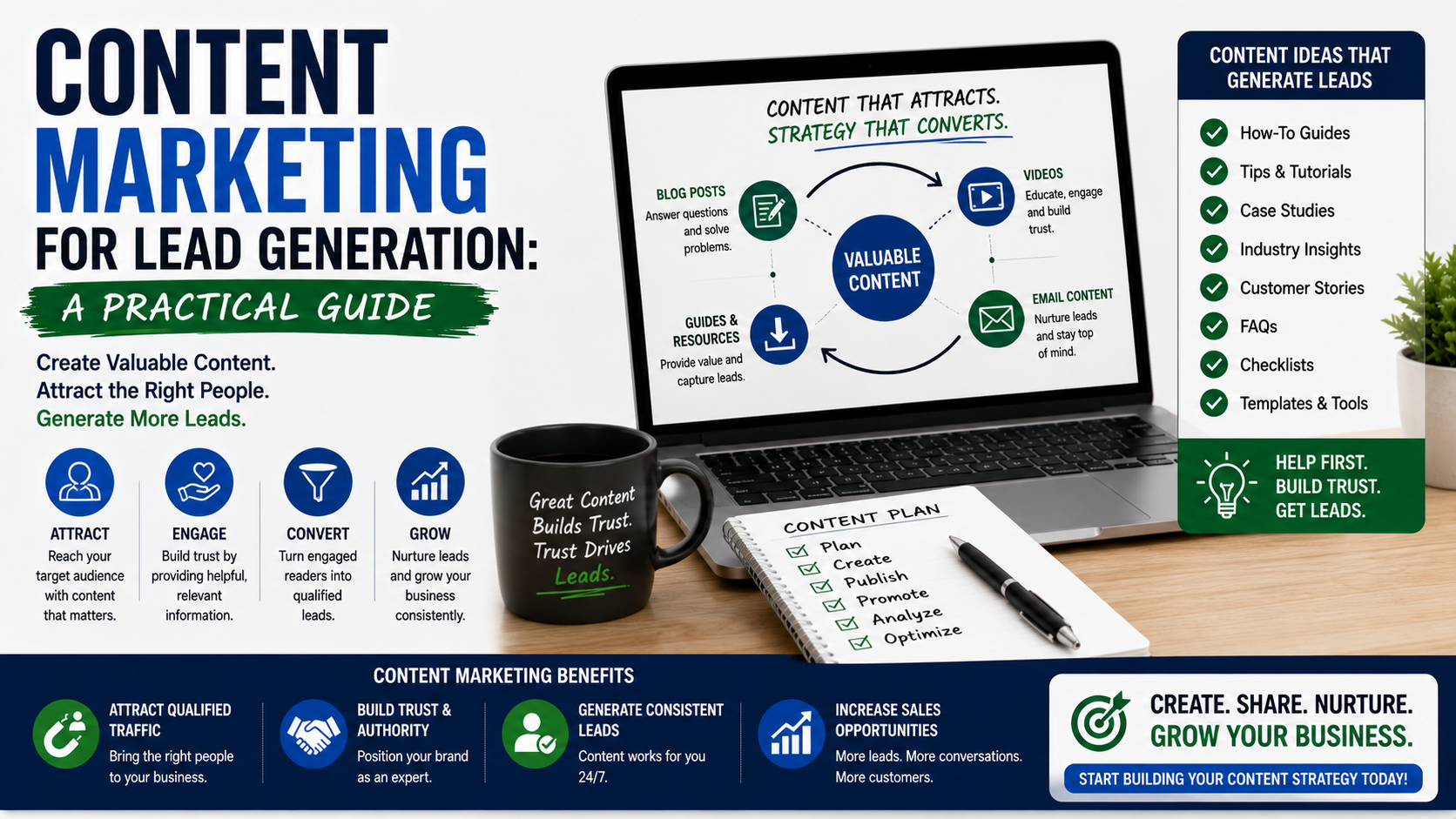
Content can include:
- Service pages
- How-to articles
- Case studies
- Videos
- Checklists
- Comparison guides
- Email newsletters
- Webinars
- Social media posts
- Calculators
- Templates
- Frequently asked questions
- Product demonstrations
- Customer stories
- Industry reports
- Podcasts
- Downloadable guides
The format matters less than the purpose.
A two-minute video answering a common customer question may generate more enquiries than a 2,000-word article. A detailed service page may produce more sales than 20 educational blog posts. A simple checklist may start more useful conversations than a polished ebook.
The right content depends on what your customers need to understand before they can confidently buy.
Start With the Problem You Want to Solve
One of the biggest content mistakes is starting with:
“What should we post this week?”
A better question is:
“What customer problem do we want this content to help solve?”
For example, a web design agency may want more ecommerce projects.
It could publish broad topics such as:
- Latest web design trends
- The history of online shopping
- Best colors for modern websites
Those topics may attract readers, but they do not necessarily attract store owners preparing to hire a web agency.
More useful topics would include:
- Why Shopify stores get traffic but no sales
- How much an ecommerce website redesign costs
- Shopify vs WooCommerce for a growing store
- Signs your checkout process is losing customers
- How long an ecommerce redesign takes
- What to prepare before hiring a Shopify developer
These topics are closer to a buying decision.
They answer questions a potential customer may ask before requesting a quote.
Learn the Difference Between Traffic Content and Lead Content
Not every piece of content needs to generate a lead directly.
Some content exists to create visibility.
Some builds trust.
Some helps people compare options.
Some supports the final buying decision.
The problem begins when a business publishes only top-of-funnel content and expects immediate sales.
Imagine a local accountant publishes an article titled:
“Ten Famous Entrepreneurs Who Started With Nothing.”
It might receive social shares, but it has a weak connection to accounting services.
An article titled:
“How Much Does a Small Business Accountant Cost?”
may attract fewer readers, but those readers are more likely to need an accountant.
The second topic has stronger commercial value.
A healthy content strategy can contain both broad and specific topics, but lead-focused content should receive priority when the business needs enquiries.
Understand the Customer Journey
Most people do not read one article and immediately buy an expensive service.
They move through several stages.
Stage One: Recognizing the Problem
The person knows something is wrong but may not understand the cause.
Example searches:
- Why is my website not generating leads?
- Why does my roof keep leaking?
- Why are my Facebook leads not answering?
- Why is my electricity bill suddenly high?
At this stage, educational content works well.
Stage Two: Exploring Solutions
The person understands the problem and is comparing approaches.
Example searches:
- SEO vs Google Ads for local businesses
- Roof repair vs roof replacement
- CRM vs spreadsheet for lead tracking
- WordPress vs Shopify for ecommerce
Comparison content is useful here.
Stage Three: Comparing Providers
The person is considering hiring someone.
Example searches:
- How much does local SEO cost?
- Questions to ask a roofing contractor
- Best CRM for a small sales team
- What is included in a website redesign?
Pricing guides, case studies, service pages, and process explanations help at this stage.
Stage Four: Making a Decision
The person wants reassurance.
They may look for:
- Reviews
- Results
- Timelines
- Guarantees
- Service details
- Examples
- Availability
- Consultation options
A good website should support all four stages.
If every page says “Contact us today,” early-stage visitors may leave because they are not ready.
If every page is educational and never explains the service, ready-to-buy visitors may leave because they do not know what to do next.
Build Content Around Real Customer Questions
The best content ideas usually come from conversations, not brainstorming sessions.
Look through:
- Sales calls
- Contact forms
- Support emails
- WhatsApp chats
- Customer reviews
- Proposal meetings
- Social media comments
- Live chat logs
- Lost-deal notes
- Google Search Console queries
- Reddit and industry communities
Write down the questions that appear repeatedly.
Questions asked before a sale are especially valuable.
For example, an interior design studio may hear:
- How much does interior design cost?
- Can you work with my existing furniture?
- Do I need architectural drawings first?
- How long will the design process take?
- Do you handle construction too?
- Can you design one room instead of the whole house?
Each question could become:
- An article
- A short video
- A service-page section
- A social post
- An email
- An FAQ
- A downloadable checklist
This approach saves time because one real question can support several content formats.
Use Keyword Research Without Letting It Control the Writing
Keyword research helps you understand how people search.
It should guide the topic, not make the article unreadable.
Tools such as Google Search Console, Google Keyword Planner, Ahrefs, Semrush, and Google’s search suggestions can reveal:
- Common phrases
- Related questions
- Search demand
- Competition
- Location-based searches
- Comparison terms
- Pricing questions
Suppose you discover that people search for:
- Cost of local SEO
- Local SEO pricing
- How much does local SEO cost?
- Local SEO monthly price
You do not need to repeat every variation in every paragraph.
Choose one main topic and use related phrases naturally.
A useful article written for a real reader will usually cover relevant language without forced repetition.
Keyword stuffing may make the page awkward and less trustworthy.
The article should sound like someone explaining the subject, not someone trying to satisfy a word-count formula.
Choose Topics With Business Value
Search volume is not the only factor.
A keyword with 10,000 monthly searches may be less useful than a keyword with 100 searches if the smaller topic attracts people closer to buying.
Before selecting a topic, ask:
- Does this problem connect to a service we sell?
- Is the reader likely to become a suitable customer?
- Can we provide a useful answer from real experience?
- Is there a natural next step after reading?
- Do we have proof, examples, or tools to support the advice?
For example, an IT company targeting law firms may get more business value from:
“Cybersecurity Checklist for Small Law Firms”
than from:
“Most Popular Technology Trends.”
The first topic is narrower but much more relevant.
Create One Clear Content Goal
Every content piece should have one main job.
That goal might be:
- Rank for a commercial search
- Collect email subscribers
- Generate consultation requests
- Educate existing leads
- Support a sales conversation
- Answer an objection
- Promote a webinar
- Demonstrate expertise
- Attract local customers
- Help prospects compare options
Trying to achieve everything in one article often produces confusing content.
Suppose the goal is consultation requests.
The article should:
- Attract a suitable reader
- Explain the problem clearly
- Demonstrate practical knowledge
- Show when professional help is useful
- Offer a relevant consultation
It does not need five pop-ups, three downloads, a newsletter form, and several unrelated service promotions.
One clear next step is usually stronger.
Write From Experience, Not Just Research
Readers can tell when an article only repeats information found elsewhere.
Experience makes content more believable.
You can add experience by explaining:
- A mistake you made
- A result that surprised you
- A process you changed
- A tool that worked well
- A tool that created problems
- A customer objection
- A project complication
- A lesson from a failed campaign
- What you would do differently
For example:
We initially shortened a client’s contact form because we assumed fewer fields would increase enquiries. Form submissions did increase, but most were poorly qualified. Adding two questions about location and budget reduced the total lead count while increasing booked calls.
That paragraph teaches something practical.
It also demonstrates that the advice came from actual testing rather than theory.
Avoid inventing dramatic stories or results.
Small, honest observations are more credible than exaggerated success claims.
Make the Introduction Earn Attention
A weak introduction often starts by defining the topic.
For example:
Content marketing is an important strategy used by businesses to attract customers.
That sentence is not wrong, but it gives the reader little reason to continue.
A stronger introduction begins with a recognizable situation:
Your website traffic has increased for six months, but the contact form is still quiet.
Or:
Publishing an article every week feels productive until you check how many customers those articles actually generated.
The opening should show that you understand the reader’s problem.
Then explain what the article will help them do.
Avoid spending 500 words warming up before providing useful information.
Keep the Content Easy to Scan
Most readers do not begin by reading every word.
They scan:
- Headings
- Short paragraphs
- Bold text
- Examples
- Lists
- Screenshots
- Callout boxes
Make the structure easy to follow.
Use descriptive headings instead of vague ones.
Weak heading:
Important Things to Consider
Stronger heading:
Choose Topics That Connect to Your Services
Keep paragraphs short, especially on mobile.
Avoid breaking every sentence into a separate paragraph, but do not create large walls of text either.
Use lists when they genuinely make the information easier to process.
Add Real Examples
Examples turn general advice into something usable.
Suppose you are explaining content funnels.
A real example could show how a local landscaping company uses content:
Awareness Content
“Why Water Collects in One Area of Your Garden”
Consideration Content
“French Drain vs Surface Drainage: Which One Do You Need?”
Buying Content
“How Much Does Garden Drainage Installation Cost?”
Conversion Page
“Request a Garden Drainage Assessment”
The reader can now see how separate pieces connect.
Without the example, “build a content funnel” may sound like marketing jargon.
Create Content for Specific Services
Businesses often publish large amounts of general content while their important service pages remain weak.
That is a mistake.
A strong service page is one of the most valuable pieces of lead-generation content.
It should explain:
- What the service is
- Who it is for
- What problem it solves
- What is included
- How the process works
- What affects the price
- How long it takes
- What customers need to prepare
- Why the business is credible
- What happens after an enquiry
Supporting articles should link naturally to the service page.
For example, a web agency’s Shopify development page could be supported by articles about:
- Shopify development costs
- Shopify theme vs custom design
- Shopify migration timelines
- Common checkout problems
- Shopify maintenance
- Preparing product data for migration
The articles answer individual questions.
The service page explains how the agency helps.
Use Case Studies as Sales Content
Case studies are often more persuasive than general advice because they show how the work happens.
A useful case study should not only celebrate the final result.
Explain:
- The customer’s situation
- The problem
- What had already been tried
- The approach
- Challenges
- The result
- What was learned
Avoid vague case studies like:
We helped a client increase growth using our proven strategy.
Be specific where permission allows.
For example:
The company was receiving website enquiries, but the sales team could not tell which services generated them. We rebuilt the forms, added source tracking, connected submissions to HubSpot, and created separate landing pages for its three main services.
Even without sharing confidential numbers, the process demonstrates expertise.
Case studies can also support sales calls, proposals, social posts, and email follow-ups.
Create Lead Magnets That Solve a Small Problem
A lead magnet is a useful resource someone receives in exchange for contact information.
Examples include:
- Checklists
- Templates
- Worksheets
- Calculators
- Short guides
- Audit tools
- Planning documents
- Email scripts
- Comparison sheets
The resource should help the reader take one practical step.
Avoid creating a huge ebook simply because ebooks are common.
A one-page website launch checklist may be more valuable than a 50-page guide to digital strategy.
The lead magnet should also connect to the service.
A bookkeeping company could offer:
- Monthly expense checklist
- Year-end preparation sheet
- Cash-flow template
A web agency could offer:
- Website redesign brief
- Conversion audit checklist
- Content collection template
A property maintenance company could offer:
- Seasonal inspection checklist
- Tenant turnover checklist
- Roof leak assessment sheet
The natural next step should be clear.
Do Not Hide Everything Behind a Form
Businesses sometimes place every useful resource behind an email form.
This can reduce trust.
Some information should be freely available.
A practical balance is:
- Publish the main educational answer openly.
- Offer a useful tool, template, or expanded worksheet as the optional download.
The article proves that the business is helpful.
The download gives the reader something practical to keep.
If the entire article exists only to force an email signup, people may leave before understanding the value.
Build a Clear Conversion Path
A visitor should not finish an article and wonder what to do.
The next step should match the topic and the reader’s stage.
Possible calls to action include:
- Read a related guide
- View a relevant case study
- Download a checklist
- Use a calculator
- Request an assessment
- Book a consultation
- Ask a question
- Compare service options
- Join an email list
- View pricing guidance
For an article titled “How Much Does a Small-Business Website Cost?” a relevant call to action might be:
Need a more accurate estimate? Send us your current website, required pages, and desired launch date. We’ll explain which cost range fits the project.
That is more relevant than:
Subscribe to our newsletter for updates.
The newsletter may still be useful, but it is not the strongest next step for someone actively researching pricing.
Use Internal Links Intentionally
Internal links connect related pages on your website.
They help readers continue learning and help search engines understand the site structure.
Link an article to:
- Related service pages
- Case studies
- Comparison guides
- Pricing pages
- Supporting articles
- Contact or consultation pages
For example, an article about lead response time could link to:
- Lead tracking guide
- Lead qualification guide
- CRM setup service
- Follow-up workflow template
Do not add links randomly.
Each link should answer the reader’s next likely question.
Use descriptive link text.
Weak:
Click here
Better:
Learn how to build a simple lead-tracking system
Repurpose Strong Content
Creating content takes time.
A useful article should not be used once and forgotten.
One detailed article can become:
- Three LinkedIn posts
- A short video
- An email newsletter
- A carousel
- Several social captions
- A webinar topic
- A sales follow-up resource
- A checklist
- An FAQ section
- A podcast discussion
Suppose you publish an article about qualifying sales leads.
You could also create:
- A LinkedIn post about budget questions
- A video explaining lead scoring
- A checklist for discovery calls
- An email about unqualified proposals
- A downloadable lead qualification sheet
Repurposing works best when each format is adapted.
Do not copy the entire article into every platform.
Use the part that fits the audience and format.
Promote Content After Publishing
A useful article does not automatically find an audience.
Promotion may include:
- Sharing it on LinkedIn
- Sending it to email subscribers
- Adding it to relevant sales follow-ups
- Posting useful extracts on social media
- Linking it from service pages
- Sharing it with referral partners
- Answering relevant community questions
- Including it in proposals
- Adding it to onboarding emails
Do not drop links into unrelated groups or discussions.
Share content when it directly helps answer the question being asked.
For example:
We recently wrote a breakdown of the factors that affect commercial cleaning prices. The section on building size and cleaning frequency may help with your comparison.
That is more useful than:
Read our latest blog!
Use Email to Turn Readers Into Leads
Not every reader is ready to contact the business.
Email allows you to continue the relationship.
A basic nurturing sequence could include:
Email One: Deliver the Resource
Send what the person requested.
Keep the email simple.
Email Two: Explain a Common Mistake
Share one practical lesson related to the resource.
Email Three: Show an Example
Use a case study or real scenario.
Email Four: Answer a Buying Question
Discuss cost, process, timeline, or preparation.
Email Five: Offer the Next Step
Invite the person to book a consultation, request an estimate, or reply with a question.
Tools such as Mailchimp, Brevo, ConvertKit, HubSpot, and ActiveCampaign can manage these sequences.
Automation should not pretend to be personal when it is not.
Write clearly and allow people to unsubscribe easily.
Track More Than Page Views
Page views tell you whether people visited.
They do not tell you whether the content helped the business.
Useful content marketing metrics include:
- Organic traffic
- Search impressions
- Keyword rankings
- Time on page
- Scroll depth
- Internal-link clicks
- Form submissions
- Downloads
- Email signups
- Consultation bookings
- Qualified leads
- Customers
- Revenue influenced by content
Google Search Console can show which search queries bring visitors.
Google Analytics can help track pages, traffic sources, and conversion events.
Microsoft Clarity can show recordings and heatmaps that reveal where readers stop, click, or struggle.
A CRM such as HubSpot, Pipedrive, or Zoho can connect enquiries to sales outcomes.
The most important question is:
Did the content contribute to a qualified opportunity?
A page with 300 monthly visitors and ten strong leads may be more valuable than a page with 20,000 visitors and no sales.
Track Assisted Conversions
Content does not always generate the final click before an enquiry.
A person may:
- Discover an article through Google.
- Leave the website.
- Return through LinkedIn.
- Read a case study.
- Search the company name.
- Submit the contact form.
If you only look at the last source, the article may receive no credit.
This is why it helps to ask prospects how they discovered the business and what content they viewed.
You can also review landing pages, user paths, and CRM notes.
Content often supports the sale rather than completing it alone.
Review Lead Quality by Topic
Do not assume the article with the most leads is the best article.
Check whether those leads are suitable.
For each content topic, review:
- Services requested
- Locations
- Budgets
- Timelines
- Qualification rate
- Meetings booked
- Proposals sent
- Customers won
- Revenue
You may discover that a broad “free marketing ideas” article generates many small enquiries, while a detailed technical guide attracts fewer but much larger projects.
That insight should shape future content.
Update Existing Content Before Publishing More
Businesses often keep producing new articles while old pages become inaccurate.
Updating existing content can produce faster results than creating another weak post.
Review:
- Outdated statistics
- Broken links
- Old screenshots
- Changed software interfaces
- Missing examples
- Weak calls to action
- Poor formatting
- Pages that rank near the first page
- Articles receiving traffic but no leads
Suppose an article ranks well but generates no enquiries.
You may need to:
- Improve the introduction
- Add a clearer service connection
- Include examples
- Add a comparison table
- Link to a case study
- Improve the call to action
- Add pricing guidance
- Make the page easier to scan
Do not rewrite a page only to change the publication date.
Update it because you can make it more useful.
Common Content Marketing Mistakes
Publishing Without a Strategy
A calendar full of topics is not automatically a strategy.
Each topic should support a customer problem, service, or sales stage.
Choosing Topics Only by Search Volume
High traffic does not guarantee high business value.
Writing for Search Engines Instead of People
Awkward repetition reduces trust and readability.
Using Generic Information
Add real examples, decisions, mistakes, and lessons.
Producing Content With No Next Step
Help the reader continue naturally.
Promoting Every Service in Every Article
Keep the call to action relevant to the topic.
Ignoring Service Pages
Blog posts cannot compensate for unclear service information.
Creating Large Downloads With Little Value
A short practical template may perform better.
Giving Up Too Early
Search-based content can take time to gain visibility.
Ignoring Distribution
Publishing is only part of the work.
Measuring Only Traffic
Track qualified leads and customers.
Never Updating Old Content
Useful pages need maintenance.
Publishing Too Frequently
One strong article can create more value than five shallow posts.
Copying Competitors
Use competitor content for research, not imitation.
Your experience should make the article different.
A Practical 90-Day Content Plan
A small business does not need to publish every day.
A focused three-month plan can be enough to build a useful foundation.
Month One: Build the Core
Create or improve:
- One main service page
- One pricing guide
- One common-problem article
- One case study
- One clear contact path
Set up tracking before promoting the content.
Month Two: Answer Buying Questions
Publish:
- One comparison guide
- One process article
- One timeline article
- One objection-handling article
Turn each piece into social posts and email content.
Month Three: Improve Conversion
Review:
- Which pages receive traffic
- Which pages create enquiries
- Which leads are qualified
- Where readers leave
- Which calls to action get clicked
Update the strongest pages.
Create one lead magnet connected to the highest-value service.
This plan may look modest, but it creates content around actual buying decisions instead of filling the website with random posts.
A Simple Content-to-Lead Workflow
A practical system could look like this:
- Record questions from sales calls.
- Group them by service and buying stage.
- Choose a topic connected to a business goal.
- Research how customers describe the problem.
- Create the content using real examples.
- Add a relevant next step.
- Link it to related service and proof pages.
- Promote it through suitable channels.
- Track enquiries and sales outcomes.
- Improve the content using real data.
This process keeps content connected to the business.
It also prevents the marketing team from publishing simply because the calendar says a post is due.
Content Should Make the Sales Conversation Easier
The best content does more than attract traffic.
It prepares the customer.
A strong pricing guide gives the prospect realistic expectations.
A process article explains what happens after hiring.
A case study shows how the business handles problems.
A comparison page helps the buyer choose an approach.
A checklist helps them prepare.
By the time the person contacts the business, they may already understand:
- What the service does
- Whether it fits their situation
- What it may cost
- What information they need
- What results are realistic
- Why the company may be credible
That creates a better sales conversation.
The team spends less time explaining basic information and more time discussing the actual project.
Content marketing for lead generation is not about publishing the largest number of articles.
It is about creating useful answers at the moments when customers need them.
Start with real questions.
Choose topics connected to real services.
Add proof from actual work.
Make the next step easy.
Then track whether the content creates qualified conversations, not just visits.
When that system is working, content stops feeling like a weekly marketing task.
It becomes part of how potential customers discover the business, understand the value, and decide to make contact.