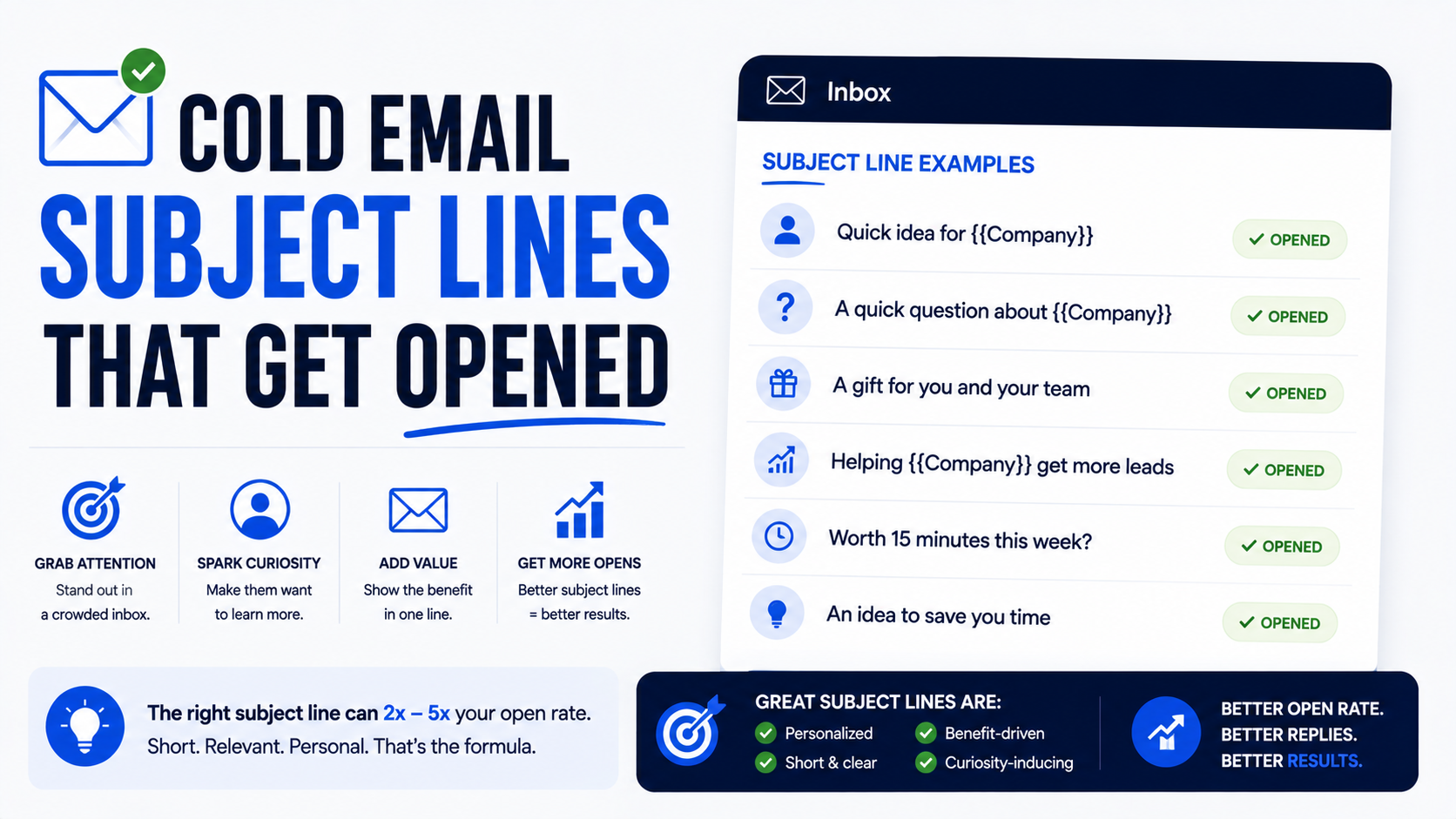
I used to spend far too much time writing cold email subject lines.
I would sit there with a spreadsheet open, rewrite the same six words five times, and convince myself that one tiny wording change was going to completely transform the campaign.
“Quick question”
“Quick question about your website”
“Website question”
“Question for John”
“John, quick question”
After a while, I learned something that made subject lines much easier to write: the subject line does not need to sell the service.
It only needs to earn the open.
That sounds simple, but it changes the way you write.
A lot of cold emails fail because the sender tries to squeeze the entire pitch into the subject line.
“Get 200% More Leads With Our Proven Marketing System”
That does not feel like an email from a real person.
It feels like an advertisement.
The subject lines that have consistently felt strongest to me are usually much more ordinary. They are short, specific, relevant to the person receiving them, and curious enough to make someone want to see what is inside.
That does not mean there is one perfect cold email subject line.
There isn’t.
But there are patterns that make some subject lines much easier to open than others.
Your Subject Line Has One Job
When someone receives a cold email, they usually make a very fast decision.
Open.
Ignore.
Delete.
Maybe mark as spam.
They are not analyzing your copywriting technique.
They are scanning their inbox between meetings, while eating lunch, on a phone, or while replying to something more important.
Your subject line therefore needs to do one thing well:
Give them a reasonable reason to open the message.
Not trick them.
Not scare them.
Not make an unrealistic promise.
Just give them enough context or curiosity to continue.
This is why I tend to prefer subject lines like:
“Question about your Dallas location”
over something like:
“URGENT: You’re Losing Local Customers”
The second subject line may sound dramatic, but it also creates immediate resistance.
The first sounds like a normal business conversation.
Why Simple Subject Lines Often Work Better
One of the unexpected lessons from cold outreach is that “boring” subject lines can perform surprisingly well.
That is because most business inboxes are full of people trying too hard to get attention.
You see subject lines like:
“Scale Your Business FAST 🚀”
“10X Your Sales This Month”
“Don’t Miss This Opportunity”
“Last Chance”
“Massive Growth Potential for Your Company”
Then you see:
“Question about Acme Roofing”
The simple version often feels more trustworthy.
It does not promise anything ridiculous.
It does not look like a newsletter.
It does not scream that someone is trying to sell you something before you even open the message.
For B2B cold email, that matters.
Use the Prospect’s Company Name When It Makes Sense
One of the easiest ways to make a subject line more relevant is to mention the company.
For example:
“Acme Roofing website”
“Question about Bright Dental”
“Quick question about Northstar”
“Northstar hiring”
“Regarding your Austin office”
This works especially well when the body of the email genuinely relates to that company.
The mistake is using the company name just to create fake personalization.
For example:
“John, let’s grow Acme Roofing 10X!”
That still sounds like a mass sales message.
Personalization only helps when it supports relevance.
Subject Lines Based on a Specific Observation
These are some of my favorite subject lines because they connect directly to the reason for the email.
Imagine you provide web design services.
You notice that a company’s mobile booking button is difficult to find.
Your subject line could be:
“Your mobile booking page”
Or:
“Question about the booking page”
If you sell SEO and notice something in local search:
“Your Google visibility”
“Question about local search”
“Dallas rankings”
If you sell recruiting and the company is hiring:
“Your backend roles”
“Question about engineering hiring”
“React hiring”
These subject lines work because they immediately connect with something real.
When the recipient opens the email, the body should continue the same idea.
That consistency is important.
If the subject line says:
“Your Dallas location”
and the email immediately launches into a generic software pitch that has nothing to do with Dallas, the prospect feels tricked.
The “Quick Question” Subject Line
“Quick question” is probably one of the most common cold email subject lines ever written.
And strangely, it can still work.
But I would not use it blindly.
The problem is that almost every salesperson has used it.
A slightly more specific version often feels better:
“Quick question about your website”
“Quick question about hiring”
“Quick question about Acme”
“Quick question, Sarah”
The benefit is that the prospect gets a little more context.
If I had to choose between:
“Quick question”
and:
“Quick question about your Dallas office”
I would normally prefer the second.
It tells the reader why the message may matter.
Subject Lines for SEO Outreach
If you are emailing businesses about SEO, avoid dramatic claims.
Subject lines like:
“Get to #1 on Google”
“Guaranteed SEO Results”
“Your SEO Is Broken”
create distrust immediately.
Better options could include:
“Question about your Google visibility”
“Acme Roofing search results”
“Local SEO question”
“Your Dallas rankings”
“Google Maps question”
“Question about your location pages”
These subject lines are much easier to connect to a useful email.
For example:
Subject: Your Dallas rankings
“Hi Mark,
I noticed your company has more than 150 Google reviews, but a few competitors with fewer reviews are appearing above you for several Dallas roofing searches…”
The subject and opening work together naturally.
Subject Lines for Web Design Outreach
Web designers often make the mistake of criticizing the website before the prospect even opens the email.
Avoid:
“Your Website Needs a Redesign”
“Your Website Looks Outdated”
“Your Website Is Costing You Customers”
Even if you are technically right, that is not a good way to start a relationship.
Instead, try:
“Question about your website”
“Your mobile site”
“Your quote form”
“Website question”
“Booking page question”
“Acme website”
These create curiosity without insulting the person receiving the email.
Remember that the owner may have personally designed the current website.
Subject Lines for Marketing Agencies
If you sell marketing services, your prospect has probably received hundreds of marketing pitches.
You need to sound different by sounding normal.
Options include:
“Question about your ads”
“Acme’s landing page”
“Your Meta campaigns”
“Google Ads question”
“Question about lead generation”
“Your Houston campaigns”
Avoid:
“Explosive Growth Opportunity”
“We Can Triple Your Leads”
“Dominate Your Market”
Those phrases sound like every other aggressive agency email.
Subject Lines for Software and SaaS Sales
Software companies can often create good subject lines around workflows or business problems.
For example:
“Question about support tickets”
“Your reporting process”
“Customer onboarding”
“Question about your CRM”
“Your sales workflow”
“Automation question”
If you have a clear trigger:
“Your support hiring”
“Regarding your new locations”
“Question about the new sales team”
A specific operational problem is usually more interesting than the name of your software.
Subject Lines for Recruitment Outreach
Recruitment emails can be very straightforward.
Examples:
“Your frontend roles”
“Question about engineering hiring”
“React hiring”
“Regarding your open roles”
“Hiring question”
“Your backend team”
The key is matching the subject line to actual hiring activity.
Do not send:
“Your open engineering roles”
to a company with no open engineering jobs.
That is how automated personalization starts looking careless.
Should You Use the Person’s First Name?
Sometimes.
A subject line such as:
“Sarah, quick question”
can feel natural.
But adding the first name does not automatically make a subject line better.
Compare:
“Sarah, unlock explosive growth!”
with:
“Question about your Austin location”
The second is far more relevant even without the name.
I treat first names as optional.
Useful context matters more.
Should You Use Emojis?
For most B2B cold email campaigns, I usually avoid them.
That does not mean emojis are always bad.
They may fit certain consumer brands, creative businesses, event promotions, or casual industries.
But for professional cold outreach, subject lines like:
“🚀 10X YOUR SALES 🚀”
often look more like promotional email than personal communication.
If the rest of your brand is casual and an emoji genuinely fits, test it.
Do not add one simply because you think it will increase opens.
Attention is not always positive attention.
Avoid Fake “Re:” and “Fwd:” Tricks
I strongly dislike subject lines such as:
“Re: partnership”
when there has been no previous conversation.
It may temporarily make the email look like a reply.
But once the recipient opens the message, they immediately understand what happened.
You traded trust for an open.
That is not a good deal.
The same applies to fake forwarding:
“Fwd: website project”
Use “Re:” only when you are actually replying to an existing thread.
Honest subject lines may occasionally generate fewer curiosity opens, but the conversation starts on much better terms.
Do Not Use Fake Urgency
Cold email already begins with a trust problem.
The recipient does not know you.
Using fake urgency makes that worse.
Avoid:
“URGENT”
“Final Notice”
“Last Chance”
“Action Required”
“Respond Today”
unless the situation genuinely justifies it.
Imagine receiving “FINAL NOTICE” from a software company you have never spoken to.
It feels ridiculous.
Cold outreach works better when the tone is calm.
Avoid Making Huge Claims
Subject lines such as:
“300% Revenue Increase”
“Guaranteed 50 Leads”
“Double Your Sales”
may attract attention, but they also create skepticism.
If you genuinely have a strong case study, you can mention results inside the email where you have enough room to explain the context.
The subject line is not the right place for exaggerated promises.
You want curiosity.
Not disbelief.
Keep Subject Lines Short Enough for Mobile
A lot of people check email on phones.
That means long subject lines may get cut off.
Instead of:
“Quick Question Regarding Your Current Digital Marketing and Lead Generation Strategy”
write:
“Question about lead generation”
Much cleaner.
I generally prefer subject lines that can be understood almost instantly.
You do not need to count every character obsessively.
Just avoid turning the subject line into a sentence.
Make Sure the Preview Text Helps
Subject lines do not exist in isolation.
Most email apps show some preview text from the beginning of the email.
Imagine this inbox:
Subject: Question about your website
Preview: Hi Sarah, I noticed your mobile booking page…
That works nicely.
Now compare:
Subject: Question about your website
Preview: I hope this email finds you well. My name is John and I am…
Much weaker.
This is another reason I skip long introductions.
Your opening sentence helps support the subject line.
Test Subject Lines Properly
This is where people can get misleading results.
Suppose you test two subject lines.
Subject A:
“Quick question”
Subject B:
“Question about your website”
But you send Subject A to dentists and Subject B to roofing companies.
That is not a clean test.
The audience changed.
If you want to compare subject lines, try to keep other variables reasonably consistent.
Same audience.
Similar sending conditions.
Same email body.
Then change the subject.
Tools like Instantly, Smartlead, Lemlist, Mailshake, HubSpot, Apollo, or other email platforms may offer campaign testing features depending on your setup.
But even a spreadsheet can work for small campaigns.
The main thing is to avoid changing five things at once.
Do Not Obsess Over Open Rates
This is important.
Open rates are not as reliable as they used to be.
Privacy features, image loading, and email systems can make open tracking less accurate.
So do not declare a campaign successful just because the dashboard says 70% of people opened it.
Look at:
Replies
Positive replies
Qualified conversations
Meetings booked
Opportunities created
Revenue
The subject line helps open the door.
The email body determines whether anyone wants to continue the conversation.
A High Open Rate Can Still Be a Bad Sign
This sounds strange, but it happens.
Imagine you use this subject line:
“Important issue with your account”
People open it because they think something is wrong.
Then they discover a sales pitch.
You may get a fantastic open rate.
You may also get irritated prospects and spam complaints.
This is why the goal should not simply be “maximum opens.”
The goal is relevant opens from people who might actually want the conversation.
A subject line should accurately represent the email.
Write the Email Before the Subject Line
This is a simple habit that helped me.
Write the body first.
Then ask:
What is the most natural label for this conversation?
If the email is about a booking problem:
“Booking page question”
If it is about local SEO:
“Question about Google visibility”
If it is about hiring:
“Your backend roles”
This often produces better subject lines than sitting down and trying to invent something clever before you know what the email actually says.
A Simple Subject Line Formula
You do not need complicated formulas, but this structure is useful:
Relevant topic + light curiosity
Examples:
“Question about [Company]”
“Your [specific page]”
“Regarding [specific activity]”
“[Location] question”
“Question about [business problem]”
“[Company] + [topic]”
For example:
“Acme Roofing + Google Maps”
“Question about your Dallas office”
“Your Shopify checkout”
“Regarding your open developer roles”
These are simple because simplicity is the point.
Realistic Subject Line Examples by Situation
Here are some examples I would actually consider using.
Local SEO
“Google Maps question”
“Your Dallas visibility”
“Acme Roofing rankings”
“Local search question”
Web Design
“Your quote page”
“Mobile website question”
“Acme website”
“Booking page”
Recruitment
“Your backend roles”
“Hiring question”
“React positions”
“Engineering hiring”
SaaS Sales
“Your reporting workflow”
“Customer support question”
“Onboarding process”
“CRM question”
Marketing
“Your Google Ads”
“Landing page question”
“Lead generation”
“Your Meta campaigns”
Bookkeeping
“Quick bookkeeping question”
“Month-end reporting”
“Finance process”
“Question about bookkeeping”
Commercial Services
“Your office cleaning”
“Dallas location”
“Facility question”
“Current cleaning provider”
None of these are exciting.
That is intentional.
They sound like messages someone could reasonably receive during a normal workday.
Common Subject Line Mistakes I Would Avoid
Trying Too Hard to Be Clever
If someone needs to interpret your subject line like a riddle, simplify it.
Using Too Many Capital Letters
“INCREASE YOUR SALES TODAY”
looks like an advertisement.
Adding Multiple Exclamation Marks
“Quick question!!!”
There is rarely a reason for this.
Writing the Entire Pitch in the Subject
Keep the explanation inside the email.
Using Generic Buzzwords
“Growth”
“Synergy”
“Transformation”
“Opportunity”
without context usually says very little.
Creating Fear
“You’re Losing Thousands Every Month”
Unless you have reliable evidence, this is manipulative and often inaccurate.
Personalizing With Bad Data
“Congrats on your new role!”
sent to someone who has held the role for six years makes the entire email look automated.
Forgetting the Email Body
A strong subject line cannot rescue a weak offer.
If people open but do not reply, stop endlessly changing subject lines and inspect the rest of the campaign.
How I Would Build Subject Lines for a New Campaign
If I were starting a campaign for a small business, I would use a very simple process.
First, write down the exact reason for contacting the prospect.
For example:
“They are hiring multiple backend developers.”
Second, identify the most natural topic.
“Backend hiring.”
Third, create three simple versions.
“Your backend roles”
“Backend hiring”
“Question about engineering hiring”
Fourth, choose the one that sounds most like a normal email.
Fifth, make sure the email body immediately explains the subject line.
Then send enough emails to get useful data.
Do not panic after ten sends.
Do not rewrite the campaign every afternoon.
Give the test enough room to show a pattern.
Subject Lines Are Important, but Targeting Is More Important
This is probably the biggest point I would want a small business owner to remember.
You can spend an hour writing the perfect subject line.
But if the recipient has no need for your service, it does not matter.
Imagine a roofing company actively looking for help with local SEO.
Even a basic subject like:
“Google Maps question”
could work.
Now imagine a company that is perfectly happy with its marketing and has no plans to change anything.
No clever subject line is going to manufacture a strong need.
The subject line gets attention.
Targeting creates relevance.
The offer creates interest.
The email creates the conversation.
All four pieces matter.
The Best Subject Lines Usually Feel Almost Too Simple
When people first start writing cold email, they often expect the winning subject line to be something brilliant.
A hidden formula.
A psychological trick.
A phrase that somehow forces people to open the message.
I have become much less interested in that approach.
I would rather send:
“Question about your Austin location”
than:
“Discover the Secret Strategy That Can Transform Your Business”
The first one sounds human.
It creates just enough context.
And if the email actually contains a relevant observation about the Austin location, the recipient does not feel misled after opening it.
That is the standard I use now.
Not:
“Will this get the highest possible open rate?”
But:
“Would a reasonable person understand why I used this subject line after reading the email?”
If the answer is yes, you are usually heading in the right direction.
Cold email subject lines do not need to shout.
They need to make sense.
Keep them short.
Keep them relevant.
Use real context when you have it.
Avoid fake urgency and exaggerated promises.
Then spend at least as much time improving the list and the offer as you do rewriting those five words at the top of the email.
Because the subject line may get the email opened.
But relevance is what gets the reply.