The first landing page I ever built was supposed to take a few hours.
It ended up taking almost an entire week.
The idea looked simple:
Create a page → Add some text → Add a button → Collect leads.
But once I started building it, I realized there were many small decisions that actually affected results.
Where should the headline go?
How much information is too much?
Should the form have three fields or seven?
Should the button say “Submit” or something more specific?
The page looked good, but it was not converting.
That was the moment I learned something important about landing pages:
A landing page is not just a website page.
It is a focused sales tool.
Over time, I tested different landing page builders for different projects. Some were excellent for beginners. Some were better for marketers who wanted advanced testing. Some looked impressive but created unnecessary complexity.
The best landing page builder is not always the one with the most templates.
It is the one that helps you create a clear message, a smooth user experience, and a page that gets visitors to take action.
In this guide, I will compare the best landing page builders based on practical experience, not just feature lists.
What Makes a Good Landing Page Builder?
Before choosing a tool, it helps to understand what actually matters.
Many platforms advertise hundreds of templates and integrations, but most businesses need a few important things.
Easy Page Creation
The biggest advantage of landing page builders is speed.
You should be able to:
- Choose a template
- Edit content
- Add images
- Connect forms
- Publish quickly
If every small change requires a developer, the tool loses its purpose.
Mobile-Friendly Designs
A large percentage of visitors will see your landing page on their phone.
A good builder should automatically handle:
- Mobile layouts
- Button sizes
- Image scaling
- Text readability
A beautiful desktop page that looks broken on mobile will hurt conversions.
Conversion Features
A landing page builder should help you create pages designed for action.
Useful features include:
- Forms
- Call-to-action buttons
- A/B testing
- Analytics
- Email integrations
- Popups
Integrations
Your landing page usually connects with other tools.
Examples:
Someone fills a form.
↓
Lead goes into CRM.
↓
Email sequence starts.
↓
Sales team receives notification.
Good integrations make this process smoother.
1. Leadpages: Best Simple Landing Page Builder for Small Businesses
Leadpages is one of the platforms I would recommend for businesses that want to create landing pages without getting overwhelmed.
Its biggest strength is simplicity.
You do not need to understand coding or web development.
The workflow is straightforward:
Pick template → Edit content → Connect tools → Publish
Where Leadpages Works Well
Leadpages is useful for:
- Service businesses
- Consultants
- Small companies
- Coaches
- Local businesses
Example:
A local landscaping company could create a page offering:
“Free Backyard Design Consultation”
Visitors enter their details.
The business receives the lead.
Simple.
What I Learned Using Simple Builders
Many people underestimate simple tools.
They think more features automatically create better pages.
Usually, the biggest improvements come from:
- Better headline
- Clear offer
- Stronger call-to-action
A simple page with a clear purpose often beats a complicated page full of distractions.
Best For:
✓ Small businesses
✓ Beginners
✓ Lead generation pages
✓ Quick campaigns
2. Unbounce: Best for Conversion Optimization
Unbounce is one of the more advanced landing page builders.
It is designed for marketers who care heavily about improving conversions.
The platform focuses on:
- Testing different versions
- Optimizing campaigns
- Improving visitor actions
Where Unbounce Stands Out
Suppose you run paid ads.
You create a Google Ads campaign.
Visitors click your advertisement.
They land on your page.
The question becomes:
“Which version of this page gets more leads?”
Unbounce helps test different variations.
For example:
Version A:
“Get Your Free Marketing Audit”
Version B:
“Find Your Website Growth Opportunities”
You can compare performance.
The Downside
Unbounce is powerful, but beginners may find it more advanced.
There are more settings and marketing concepts to understand.
Best For:
✓ Marketing teams
✓ Paid advertising campaigns
✓ Businesses focused on conversion rates
3. Instapage: Best for Professional Marketing Teams
Instapage is built mainly for businesses running serious advertising campaigns.
It focuses heavily on creating personalized landing experiences.
For example:
A software company runs ads targeting different industries.
Instead of sending everyone to the same page, they create customized experiences.
One page for healthcare visitors.
Another for real estate companies.
Another for education businesses.
Where Instapage Works Well
It is especially useful for:
- SaaS companies
- Larger marketing teams
- Advertising agencies
The Trade-Off
The platform is powerful, but the pricing and features are usually more suitable for businesses with larger marketing budgets.
A small business running occasional campaigns may not need this level of customization.
Best For:
✓ Enterprise marketing teams
✓ Agencies
✓ Large advertising campaigns
4. HubSpot Landing Pages: Best for CRM Integration
HubSpot takes a different approach.
Landing pages are part of a larger marketing system.
You can connect:
- Forms
- CRM
- Email marketing
- Sales pipelines
- Customer tracking
Example Use Case
A consulting company creates a landing page:
“Download Our Free Business Growth Guide”
Someone fills the form.
HubSpot records the contact.
The person receives follow-up emails.
The sales team can see their activity.
This creates a complete customer journey.
The Limitation
If you only need a simple landing page, HubSpot may feel like more than necessary.
It becomes more valuable when you need the complete marketing ecosystem.
Best For:
✓ B2B businesses
✓ Sales teams
✓ Companies using CRM systems
5. Wix Landing Pages: Best for Beginners Who Want Website Flexibility
Wix is better known as a website builder, but many small businesses use it for landing pages too.
The advantage is flexibility.
You can create:
- Full websites
- Landing pages
- Service pages
- Contact forms
all inside one platform.
Where Wix Works Well
A small business that needs:
Website + landing pages + basic marketing
may prefer Wix because everything stays in one place.
Example:
A photographer can create:
- Portfolio website
- Wedding package landing page
- Contact form
without managing multiple platforms.
Best For:
✓ Small websites
✓ Beginners
✓ Businesses wanting everything together
6. ClickFunnels: Best for Sales Funnels
ClickFunnels is designed around the idea of complete sales funnels.
Instead of just creating one page, you create a journey.
Example:
Landing page
↓
Email capture
↓
Sales page
↓
Checkout
↓
Follow-up
Where ClickFunnels Works Well
It is popular among:
- Online course creators
- Coaches
- Digital product sellers
The Downside
For someone who only needs a simple lead collection page, ClickFunnels can feel excessive.
You are paying for a complete funnel system.
Best For:
✓ Digital products
✓ Online businesses
✓ Sales funnels
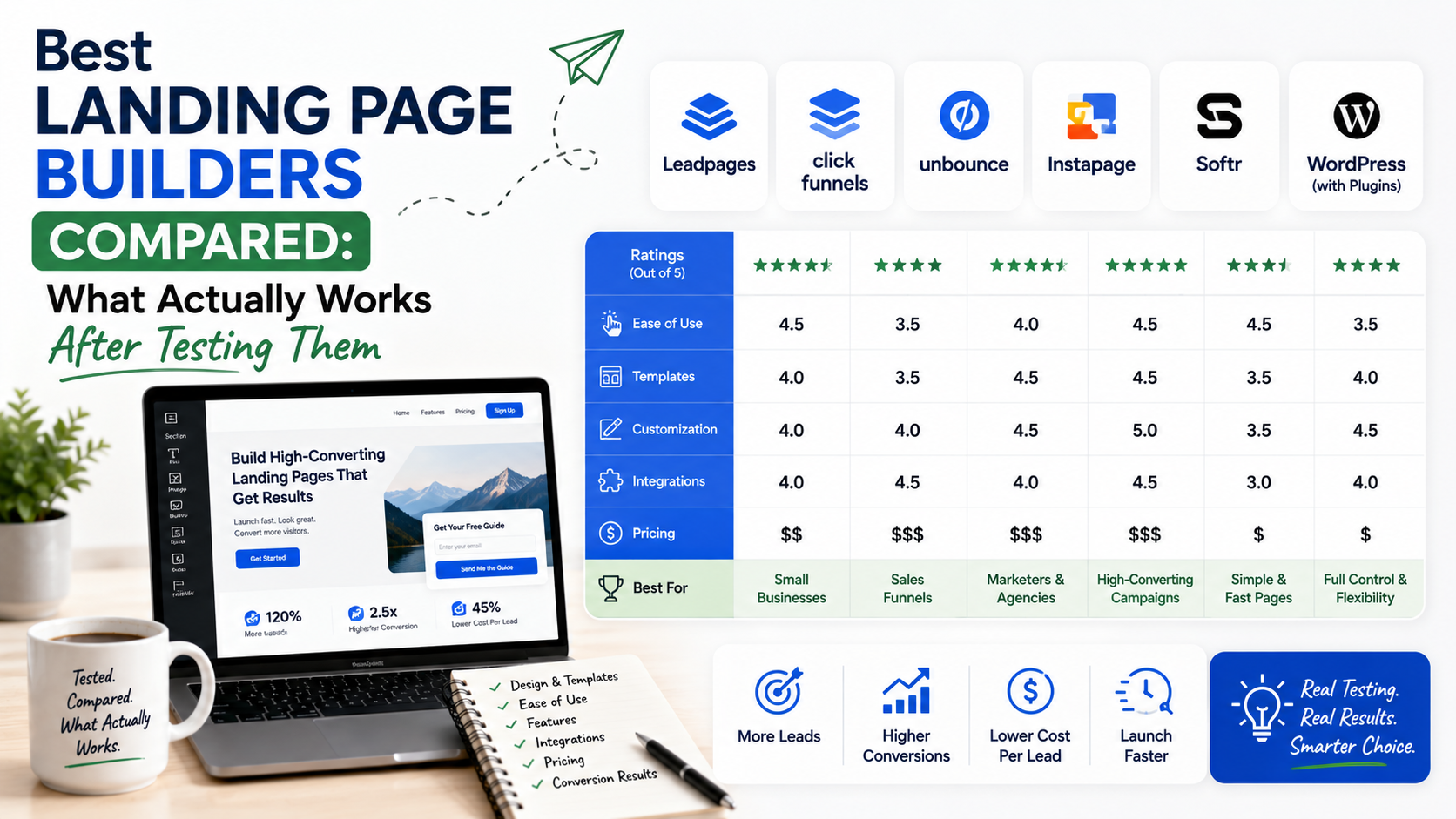
Landing Page Builder Comparison Table
| Tool | Best For | Main Strength | Possible Challenge |
| Leadpages | Small businesses | Easy setup | Fewer advanced features |
| Unbounce | Marketers | Conversion testing | Learning curve |
| Instapage | Large teams | Personalization | Expensive for small users |
| HubSpot | B2B companies | CRM connection | More complex |
| Wix | Beginners | Website flexibility | Less marketing-focused |
| ClickFunnels | Online sellers | Complete funnels | Overkill for simple pages |
How to Choose the Right Landing Page Builder
Choosing the right tool becomes easier when you focus on your actual goal.
Step 1: Define Your Landing Page Purpose
Ask:
What action should visitors take?
Examples:
Download a guide?
Book a consultation?
Buy a product?
Join an email list?
One page should usually have one main goal.
Step 2: Consider Your Marketing Strategy
Different situations need different tools.
Running Paid Ads?
Consider:
- Unbounce
- Instapage
because testing matters.
Collecting Local Leads?
Consider:
- Leadpages
- Wix
because simplicity matters.
Selling Products or Courses?
Consider:
- ClickFunnels
because funnels matter.
Managing Sales Leads?
Consider:
- HubSpot
because CRM connection matters.
Step 3: Do Not Overcomplicate Your First Page
One mistake I see often is businesses trying to create a perfect page before launching.
They spend weeks adjusting:
- Colors
- Fonts
- Images
but ignore the message.
A better approach:
Launch.
Collect data.
Improve.
Your visitors will tell you what works.
Common Landing Page Mistakes to Avoid
1. Too Many Goals
A landing page should not try to do everything.
Bad example:
Buy product
Read blog
Follow social media
Subscribe
Contact us
Too many options create confusion.
2. Weak Headlines
Your headline is usually the first thing visitors see.
A weak headline:
“Welcome to Our Website”
A stronger headline:
“Get a Free Website Audit in 24 Hours”
Specific wins.
3. Slow Loading Pages
People leave slow pages.
Optimize:
- Images
- Videos
- Unnecessary scripts
Speed matters.
4. Ignoring Mobile Users
Always test your page on:
- Desktop
- Smartphone
- Tablet
A page that works only on your laptop is not ready.
5. Forgetting Tracking
Without tracking, you do not know what works.
Connect tools like:
- Google Analytics
- Meta Pixel
- Conversion tracking
Data helps improve decisions.
My Personal Recommendation
If I was choosing a landing page builder today, I would choose based on the business.
For a small business owner who wants something simple:
Leadpages
For marketers running paid campaigns:
Unbounce
For larger advertising teams:
Instapage
For businesses needing CRM and sales tracking:
HubSpot
For simple websites and pages:
Wix
For selling courses or digital products:
ClickFunnels
Final Thoughts
After working with different landing page builders, I learned that the software itself is rarely the biggest factor.
The biggest factor is clarity.
A landing page works when visitors immediately understand:
- What you offer
- Why it matters
- What they should do next
A powerful tool cannot save a confusing message.
A simple builder can create excellent results when the strategy is right.
Start with your business goal, choose the platform that matches your workflow, and improve your page based on real visitor behavior.
The best landing page builder is not the one with the longest feature list.
It is the one that helps you turn visitors into customers without making your marketing process harder than it needs to be.