A few years ago, I watched a small business lose a perfectly good lead for a surprisingly simple reason.
The prospect had filled out a contact form, asked for pricing, and even mentioned a rough project timeline. The sales team replied once, did not receive an immediate answer, and then followed up every day for the next week.
By the fourth message, the tone had changed from helpful to uncomfortable.
“Just checking again.”
“Did you see my last email?”
“Are you still interested?”
The prospect eventually replied, but not with a booking.
They asked to be removed from the list.
That experience stuck with me because the lead was not cold. The person had shown real interest. They simply needed time to compare options, speak with a business partner, and decide whether the project could fit the budget.
The company treated silence as rejection and tried to force a decision.
That is where lead nurturing often goes wrong.
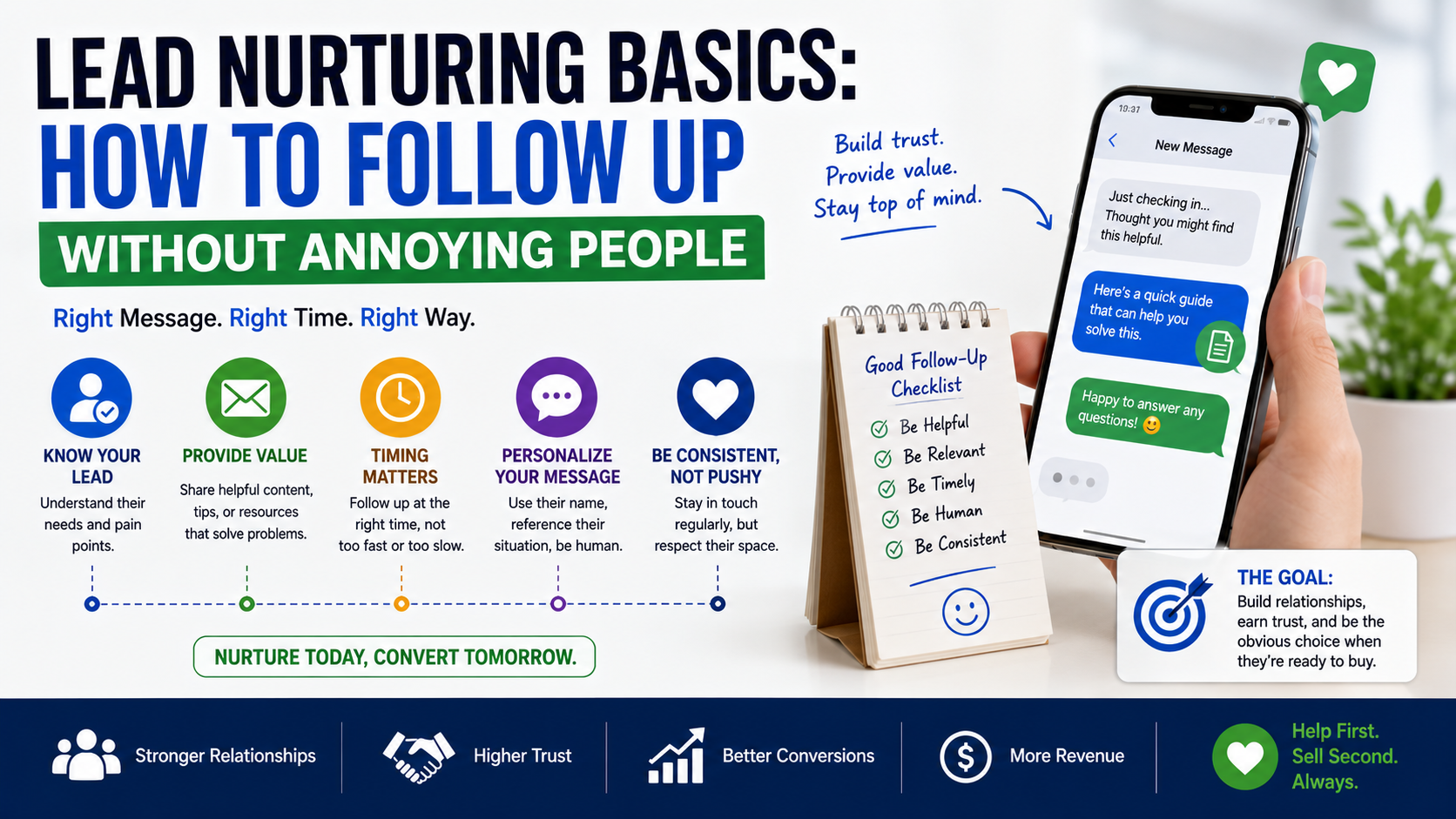
Good follow-up does not mean chasing someone until they surrender. It means staying useful, relevant, and easy to contact while the person works through their decision.
The best lead nurturing feels less like pressure and more like good customer service.
What Lead Nurturing Really Means
Lead nurturing is the process of staying in contact with people who may become customers but are not ready to buy yet.
Some prospects need a few days.
Others may need several weeks or months.
They could be waiting for:
- Budget approval
- A business partner’s decision
- The end of an existing contract
- A property purchase
- A quieter season
- Internal planning
- More information
- A comparison with other providers
- A personal or professional deadline
A lead who does not buy immediately is not automatically a bad lead.
They may simply be early.
Lead nurturing helps you remain part of the conversation without repeatedly asking, “Are you ready now?”
That distinction matters.
When every follow-up is a request for a decision, the prospect starts feeling like a target.
When follow-ups answer questions, reduce uncertainty, or help with planning, the communication feels useful.
Why People Stop Replying
Sales teams often assume silence means a lack of interest.
Sometimes it does.
But people also stop replying because:
- They became busy
- Your email was buried
- They are waiting for someone else
- They do not know how to respond
- The next step feels unclear
- They are worried about the price
- They are still researching
- They are not ready to say no
- Your messages feel repetitive
- You contacted them too often
I have seen leads disappear after asking for a proposal, then return six weeks later ready to move forward.
Nothing dramatic happened during that period. The timing simply changed.
This is why a good nurturing system should not rely on mood or guesswork.
You need a basic process that tells you when to follow up, what to send, and when to stop.
Start by Understanding Where the Lead Stands
Before following up, work out what kind of lead you are dealing with.
Not every person should receive the same message.
A lead who requested an urgent plumbing quote needs a fast response.
A company exploring a website redesign for next quarter does not need three phone calls in one day.
A simple way to organise leads is to place them into three groups.
Ready Soon
These people have a clear need, suitable budget, and near-term timeline.
They may have asked for a proposal, consultation, appointment, or quote.
They deserve direct and timely follow-up.
Interested but Not Ready
These leads are a good fit but have a delay.
They may be waiting for approval, planning for a later date, or still comparing providers.
They need useful check-ins rather than constant sales messages.
Early Research
These people are learning.
They may have downloaded a guide, viewed a pricing page, attended a webinar, or asked a general question.
They are not necessarily ready for a sales call.
They benefit more from educational content and occasional reminders.
This simple classification prevents one of the most common mistakes: treating every lead like an emergency.
Respond Quickly, but Do Not Overwhelm Them
The first response should usually be fast.
When someone fills out a form or asks for a quote, they want confirmation that the message was received.
A strong first response can be short:
“Thanks for reaching out. I’ve received your details and will review them today. I’ll reply with the next steps by 3 p.m.”
That message does three things:
- Confirms the enquiry arrived
- Sets an expectation
- Reduces uncertainty
Tools such as HubSpot, Pipedrive, Zoho CRM, ActiveCampaign, Mailchimp, and Brevo can send automatic confirmation emails.
Even a simple Gmail template can work.
The automatic message should not pretend to be a personal reply if it is not one. People can usually tell.
Keep it honest and useful.
For example:
“Thanks for contacting us. This is an automatic confirmation so you know your message reached the right place. A member of our team will reply within one business day.”
That feels more trustworthy than an automated email pretending someone personally reviewed the request within three seconds.
Give Every Follow-Up a Reason
One of the best rules I have learned is this:
Do not follow up just to say you are following up.
“Just checking in” adds nothing.
The prospect already knows you want an answer.
Instead, each message should have a purpose.
You might:
- Clarify a question
- Share a relevant case study
- Explain the process
- Provide a pricing range
- Send a planning checklist
- Answer a common concern
- Confirm availability
- Offer a simpler option
- Share a deadline that genuinely affects the project
- Suggest a specific next step
Compare these two messages.
Weak follow-up:
“Hi, just following up on my previous email. Are you still interested?”
Useful follow-up:
“Hi, I wanted to share a short example of a similar project we completed for a local retailer. Their main concern was completing the website without interrupting existing sales, so we handled the launch in stages. I thought it might help with the question you raised on our call.”
The second email gives the person a reason to open it.
It also shows that you listened.
Use the Prospect’s Own Context
Generic nurturing emails are easy to ignore.
Personalisation does not mean adding someone’s first name to a mass email.
Real personalisation comes from remembering what matters to them.
Suppose a prospect mentioned:
- They are opening a second location
- Their current website is slow
- They need approval from a partner
- Their busy season begins in October
- Their team has no in-house designer
- They are worried about project delays
Your follow-up should connect to one of those details.
For example:
“You mentioned that October is your busiest month. Based on the usual six-week timeline, starting by mid-August would leave enough room for testing before traffic increases.”
That is useful because it connects timing to the prospect’s situation.
A CRM can help you store these details.
You do not need an advanced system.
At minimum, record:
- What the person needs
- Their timeline
- Main concern
- Budget range
- Decision process
- Last contact date
- Next follow-up date
Without notes, every conversation starts again from zero.
How Often Should You Follow Up?
There is no perfect schedule for every business.
The right timing depends on the service, urgency, and stage of the lead.
Still, a simple structure works well for many small businesses.
After a Direct Enquiry
Immediately: Send a confirmation.
Within the same business day: Send a personal response or make the first call.
Two to three days later: Follow up with a clear question or useful resource.
Five to seven days later: Send another helpful message.
One to two weeks later: Send a final active follow-up.
After that, move the person into a slower nurturing process unless they asked you to stop.
After Sending a Proposal
A practical proposal follow-up might look like this:
One day later: Confirm that the proposal arrived and ask whether anything needs clarification.
Three to four days later: Address a likely concern, such as timeline, scope, or payment structure.
One week later: Ask whether the project is still active and offer a short call.
Two weeks later: Close the loop politely.
Do not send a full sequence if the prospect has already given you a decision date.
If they say, “We will review this at our meeting next Thursday,” respect that timeline.
Following up on Monday, Tuesday, and Wednesday will not speed up the meeting.
It will only make you look impatient.
Ask for Permission to Follow Up
One simple question can prevent awkward communication:
“When would it be helpful for me to follow up?”
This gives you a clear date.
It also lets the prospect stay in control.
You can ask this during a call or at the end of an email.
Examples include:
- “Would next Tuesday be a sensible time to reconnect?”
- “You mentioned reviewing the budget this month. Should I check back during the first week of September?”
- “Would you prefer that I email you after your internal meeting?”
- “Should I send the updated details now, or wait until the project receives approval?”
When a prospect agrees to a date, your next message no longer feels random.
It is expected.
Use More Than One Channel Carefully
Not everyone prefers email.
Some people reply faster by phone, text, LinkedIn, or WhatsApp.
Using multiple channels can help, but it can also become intrusive quickly.
Do not email, call, text, and send a LinkedIn message within ten minutes.
That feels less like good service and more like being surrounded.
Use the channel the person chose first.
If they completed a website form and provided an email, start there.
If they asked to speak by WhatsApp, use WhatsApp.
If they booked a phone consultation, calling may be appropriate.
You can also ask:
“What is the easiest way to reach you?”
Tools such as WhatsApp Business allow you to create labels like:
- New lead
- Follow-up needed
- Proposal sent
- Waiting for approval
- Won
- Lost
This can work well for a small team, although a proper CRM becomes more useful as lead volume grows.
Keep Messages Short
A follow-up email should not feel like homework.
Long paragraphs, repeated service descriptions, and oversized company introductions make the message harder to answer.
A simple structure usually works:
- Mention the previous conversation
- Share one useful point
- Ask one clear question
- Suggest one next step
For example:
“Hi Sarah,
You mentioned that the team needs to review the website budget before moving forward. I’ve attached a simpler version of the scope that keeps the booking system and removes the optional content package.
Would this version be closer to the range you discussed?
I’m available Wednesday afternoon if a quick call would help.”
The prospect knows exactly why you contacted them and how to respond.
Do Not Hide Behind Automation
Automation can make lead nurturing easier.
It can also make your business sound careless.
Automated emails are useful for:
- Confirmations
- Appointment reminders
- Educational sequences
- Long-term check-ins
- Sending requested resources
- Reminding staff to follow up
- Moving leads between pipeline stages
They are less suitable for sensitive or specific situations.
For example, if a prospect told you their project was delayed because of a family emergency, a cheerful automated email saying “Ready to grow your business?” would feel inappropriate.
Automation should support judgment, not replace it.
Platforms such as ActiveCampaign and HubSpot allow you to pause automated sequences when a lead replies or changes stage.
That setting is important.
Few things feel more robotic than receiving a scheduled “We haven’t heard from you” email after already having a conversation with someone from the company.
Test your automation before using it.
Subscribe with your own email address and go through the sequence.
Check:
- Timing
- Formatting
- Mobile readability
- Links
- Reply address
- Personalisation fields
- Unsubscribe option
- What happens after a reply
- What happens after a booking
A small error repeated across hundreds of leads becomes a large problem.
Send Content That Answers Real Questions
Lead nurturing content should help someone make a better decision.
It should not exist only to keep your brand visible.
Useful content may include:
- A pricing guide
- A comparison between service options
- A project checklist
- A short case study
- A frequently asked questions page
- A video showing the process
- A timeline example
- A preparation guide
- A list of common mistakes
- A calculator
- A recorded demonstration
- A customer story
Imagine a homeowner considering a kitchen renovation.
Instead of sending “Ready to get started?” every week, the contractor could send:
- A guide to planning a realistic renovation budget
- A checklist of decisions to make before design begins
- An explanation of how long different project stages take
- A case study from a similar-sized kitchen
- Advice on living in the home during construction
By the time the homeowner is ready, the contractor has already been helpful several times.
That builds trust without forcing a sale.
Use Real Triggers, Not Random Dates
The best follow-ups are connected to something meaningful.
A trigger could be:
- The end of a contract
- A planned launch date
- A seasonal deadline
- A budget meeting
- A property handover
- A product release
- A scheduled event
- A requested callback date
- A period of inactivity
- A visit to a key website page
For example, if a business owner says their current SEO contract ends in December, there is little value in sending aggressive sales emails in August.
A better plan would be:
- Send a useful comparison guide in September
- Check in during October
- Offer an audit or planning call in November
This matches the decision timeline.
Advanced CRM tools can also trigger actions when someone opens an email, clicks a pricing link, revisits a service page, or books a meeting.
Use those signals carefully.
Do not write:
“I noticed you visited our pricing page three times last night.”
Even when the data is available, that level of detail can feel uncomfortable.
Use the information to improve timing, not to make the person feel watched.
Know When to Stop Following Up
Good nurturing includes knowing when to leave someone alone.
You should stop or reduce contact when:
- The person asks you to stop
- They unsubscribe
- They say the project is cancelled
- They chose another provider
- They are clearly not a fit
- Your messages repeatedly bounce
- They never respond after several reasonable attempts
- They no longer have the need
- You do not have permission for ongoing marketing
A final message can close the conversation respectfully.
For example:
“Hi Daniel,
I have not heard back, so I will close this enquiry for now rather than keep filling your inbox.
If the project becomes active again, you are welcome to reply to this email and I’ll pick things up from there.
All the best with the planning.”
This message removes pressure.
Surprisingly, it also gets replies.
Some prospects respond because the message gives them an easy way to explain the delay.
Others appreciate that you respected their time.
Do not use fake breakup language such as:
“I guess you are no longer serious about growing your business.”
That tone may create a reaction, but it does not create trust.
A Simple Lead Nurturing Workflow
A small business does not need a complicated 40-email funnel.
Start with a straightforward process.
Step 1: Capture the Lead Properly
Record the name, contact information, source, service, and enquiry date.
Step 2: Send Confirmation
Tell the person the enquiry was received and explain what happens next.
Step 3: Qualify the Lead
Check need, fit, location, budget, timeline, and decision process.
Step 4: Assign a Stage
Use stages such as:
- New
- Contacted
- Qualified
- Proposal sent
- Waiting
- Nurture
- Won
- Lost
Step 5: Agree on the Next Action
Every active lead should have a next step and date.
“Follow up later” is not specific enough.
“Call on 12 August after the budget meeting” is better.
Step 6: Share Something Useful
Send information that matches the prospect’s current concern.
Step 7: Review the Lead Regularly
Move inactive leads out of the active sales pipeline.
Step 8: Close the Loop
When the opportunity is no longer active, record the reason.
This workflow can be managed inside HubSpot, Pipedrive, Zoho CRM, Monday.com, Notion, Airtable, or even Google Sheets.
The tool matters less than the consistency.
Example: Nurturing a Web Design Lead
Suppose a restaurant owner asks for a new website but says the project will not start for two months.
A poor approach would be to call every week asking whether they are ready.
A better sequence could look like this:
Day 1
Send a thank-you message and recap the main goals:
- Mobile-friendly menu
- Online reservations
- Better local search visibility
- Easier updates for staff
Day 5
Send a short checklist of content the restaurant should start collecting, such as photos, menu files, opening hours, and staff information.
Day 14
Share a relevant restaurant website case study.
Day 30
Ask whether the timeline has changed and offer help reviewing the content.
Day 50
Confirm availability for the planned start date and suggest booking the kickoff call.
Each message helps the prospect move toward the project.
Nothing feels like repeated pressure.
Example: Following Up After a Service Quote
Imagine a homeowner requests a roof repair quote.
The contractor inspects the property and sends the estimate.
A useful follow-up sequence might be:
The Next Day
“Did the estimate arrive clearly? I’m happy to explain any part of the repair plan.”
Three Days Later
“The main issue we identified was the damaged flashing around the chimney. I’ve attached two photos from the inspection so you can see where the water is entering.”
One Week Later
“We still have availability during the week of 18 August. Would you like me to hold a date while you review the quote?”
Final Follow-Up
“I’ll close the estimate for now so you do not keep receiving reminders. The inspection notes will remain on file if you decide to move forward later.”
The messages answer questions and provide context.
They do not simply ask for money four times.
Common Lead Nurturing Mistakes
Following Up Too Often
Daily messages may be appropriate for a genuine emergency, but not for most sales decisions.
Give people enough space to think.
Sending the Same Message Repeatedly
Changing “just checking in” to “circling back” does not make it new.
Add useful information or do not send the message.
Using False Urgency
Do not invent limited availability, fake deadlines, or imaginary price increases.
Real deadlines can be helpful. Fake pressure damages trust.
Ignoring What the Prospect Said
If someone asks you to follow up next month, do not contact them tomorrow.
Good notes prevent this.
Making Every Email About Your Company
Prospects care about solving their problem.
They do not need your full company history in every message.
Over-Automating Personal Conversations
Once a lead begins replying, switch from generic automation to human communication.
Forgetting Existing Customers
Nurturing is not only for new leads.
Past customers may need maintenance, upgrades, renewals, or related services.
Helpful post-sale communication can create repeat business without aggressive selling.
Failing to Measure Results
Track which nurturing messages lead to:
- Replies
- Calls
- Bookings
- Proposals
- Sales
- Unsubscribes
- Complaints
An email with a high open rate is not automatically successful.
The real question is whether it helped move suitable leads forward.
Measure the Whole Journey
A lead nurturing system should connect marketing activity to actual sales.
Useful numbers include:
- Response rate
- Meeting-booking rate
- Proposal rate
- Time from enquiry to sale
- Close rate
- Unsubscribe rate
- Number of follow-ups before conversion
- Revenue by lead source
- Reason opportunities were lost
You may discover that leads from Google Ads convert quickly but require faster phone follow-up.
Leads from SEO may take longer but close at a higher rate.
Referral leads may need fewer messages because trust already exists.
Different sources often need different nurturing.
That is another reason not to place every lead into the same automated sequence.
Helpful Follow-Up Beats Persistent Follow-Up
People rarely become annoyed because a business communicated clearly.
They become annoyed when the communication feels repetitive, irrelevant, or difficult to escape.
Good nurturing respects three things:
- The prospect’s timing
- The prospect’s attention
- The prospect’s right to say no
Respond quickly when someone reaches out.
Ask when they would like to hear from you again.
Remember what they told you.
Give each follow-up a useful purpose.
Make the next step easy.
And when there is no real reason to keep contacting them, close the conversation politely.
You do not need to disappear after one unanswered email, but you also do not need to chase every lead forever.
The goal is not to be the loudest company in the inbox.
It is to be the company that remains helpful, professional, and easy to return to when the timing is finally right.