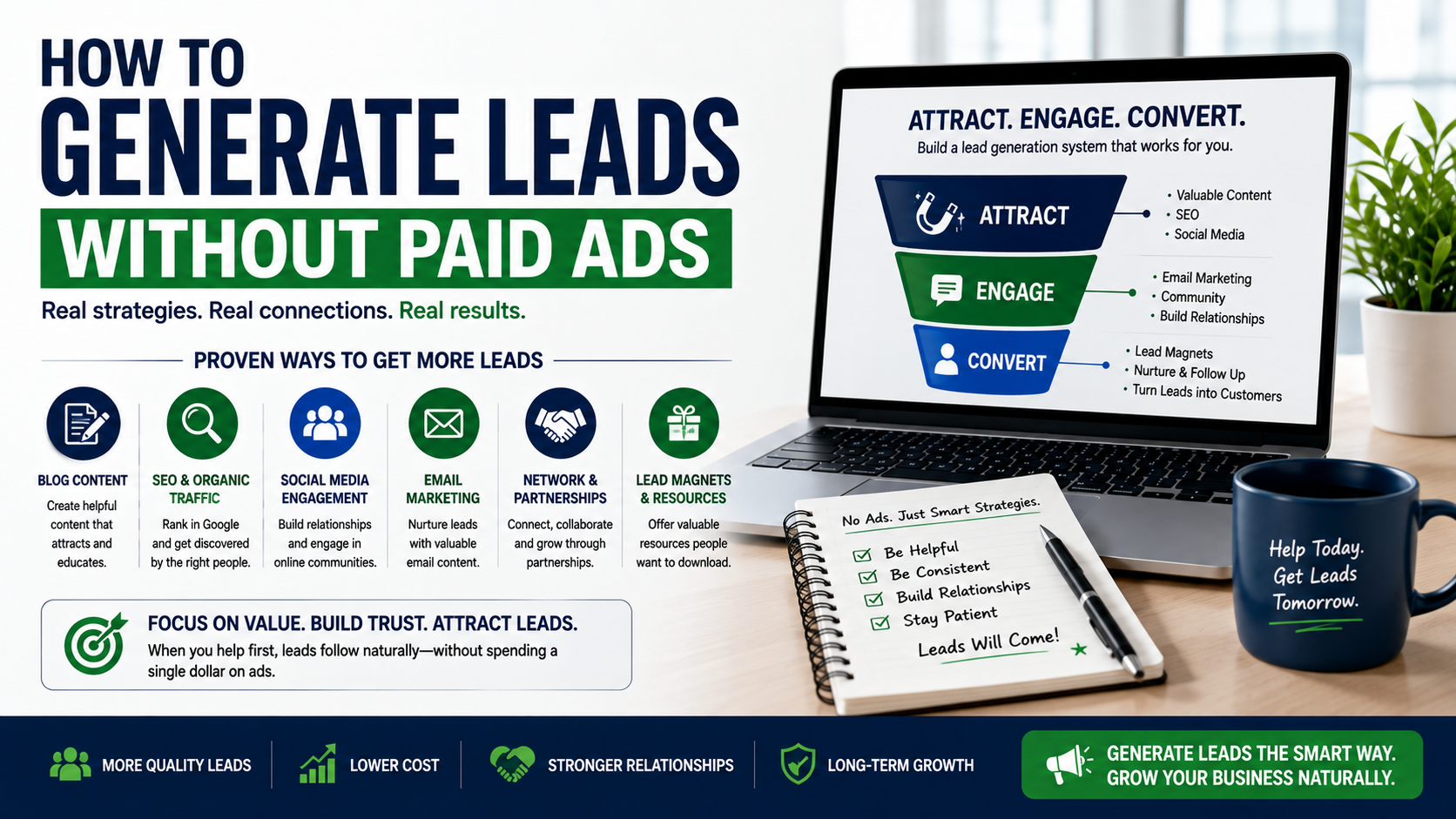
A small service business I worked with once paused its advertising campaigns because cash flow had become tight.
The owner expected enquiries to stop almost immediately.
For the first few days, that prediction seemed correct. Website traffic dropped, the inbox became quieter, and the phone rang less often.
But something interesting happened over the next few weeks.
A helpful article the company had published months earlier started bringing in local visitors. Two past customers sent referrals. A short project video posted on LinkedIn led to a conversation with a new prospect. Several people found the business through its Google Business Profile.
The company did not suddenly discover a secret source of free customers.
It simply began paying attention to lead generation channels that had been ignored while advertising was doing most of the work.
Generating leads without paid ads is possible, but it is not completely free.
You may not pay Google, Facebook, or LinkedIn for each click, but you still invest time, knowledge, consistency, and sometimes the cost of software or content production.
The main advantage is that the work can continue producing results after you finish it.
A useful guide may attract visitors for months. A strong customer relationship may generate several referrals. A well-optimized Google Business Profile can keep producing calls without charging for every enquiry.
The goal is not to use every unpaid marketing method available.
It is to build a few reliable systems that help suitable customers discover, trust, and contact your business.
Start With the Customers You Already Have
When businesses need more leads, they often look for completely new audiences.
They create new social media accounts, start a blog, record videos, and join networking platforms.
Meanwhile, they ignore the people who already know and trust them.
Past customers are usually the easiest place to begin.
They have seen your work. They understand your process. If the experience was good, they may already be willing to recommend you.
The problem is that most businesses never ask.
A simple referral request can be enough:
“Hi Sarah, I’m glad the project is working well for you. We’re currently taking on a few similar projects, so if you know another business that needs help with its website, I’d really appreciate an introduction.”
This feels more natural than sending a mass message saying, “Refer three friends and earn rewards.”
Referral incentives can work, but they are not always necessary. Sometimes people simply need a reminder that you are accepting new work.
Good moments to ask for a referral include:
- After a successful project
- After receiving positive feedback
- When a customer renews
- After solving an important problem
- When the customer mentions your work publicly
- During a regular account review
- After achieving a measurable result
Do not ask immediately after sending an invoice or while a customer is waiting for support.
Timing affects how the request feels.
Improve Your Google Business Profile
For a local business, the Google Business Profile is one of the most useful sources of unpaid leads.
It can appear when people search for services nearby or look for a specific company.
A complete profile should include:
- Correct business name
- Phone number
- Website
- Service area
- Opening hours
- Business category
- Services
- Real photographs
- Customer reviews
- Regular updates
- Accurate contact information
Many businesses create the profile once and rarely touch it again.
The photographs become outdated. Holiday hours remain incorrect. Services are missing. Reviews go unanswered.
That makes the profile look neglected.
Start by checking the basics.
Make sure the phone number works. Test the website link. Confirm that the location or service area is accurate. Add recent photographs showing the team, completed work, equipment, office, or storefront.
Avoid using only stock images.
People searching for a local contractor, clinic, restaurant, consultant, or repair service want evidence that the business is real.
Reviews are especially important.
Ask satisfied customers for honest feedback, but do not tell them exactly what to write.
A simple request works:
“Thanks again for choosing us. Would you mind sharing a short Google review about your experience? It helps other local customers understand what working with us is like.”
Reply to reviews professionally.
That includes negative reviews.
An angry or defensive response can damage trust more than the original complaint.
Create Service Pages That Answer Buying Questions
A common website mistake is having one page called “Services” with a short paragraph covering everything the business does.
That may be enough for someone who already knows the company.
It is not enough for a person searching for a specific solution.
Create a separate page for each important service.
A landscaping company might have pages for:
- Landscape design
- Garden maintenance
- Irrigation installation
- Patio construction
- Commercial landscaping
A marketing agency might create pages for:
- Local SEO
- Google Ads management
- Website design
- Content marketing
- Ecommerce SEO
Each page should explain:
- Who the service is for
- What problem it solves
- What is included
- How the process works
- What affects the price
- How long it normally takes
- Common concerns
- Examples of previous work
- The next step
Do not write the page only for search engines.
Write it for the person trying to decide whether your business can solve their problem.
A useful service page can generate leads because it removes uncertainty before the prospect contacts you.
Publish Content Based on Real Customer Questions
Blogging often fails because businesses publish topics nobody asked for.
They write broad articles such as “Why Quality Matters” or “Top Trends This Year.”
Those topics may sound professional, but they rarely help someone make a buying decision.
A better content strategy starts with questions customers already ask.
Check:
- Emails
- Contact forms
- Sales calls
- WhatsApp conversations
- Support requests
- Social media comments
- Google Search Console
- Reddit discussions
- Industry forums
- Competitor FAQs
Write down the questions that appear repeatedly.
For example, a roofing company may hear:
- How much does roof repair cost?
- Can a roof be repaired during winter?
- How long does replacement take?
- Does insurance cover storm damage?
- How do I know whether I need repair or replacement?
A web designer may hear:
- How much does a small-business website cost?
- Should I use WordPress or Shopify?
- How long does a website redesign take?
- Who writes the website content?
- Can I update the site myself?
Each question can become a useful article, video, checklist, or FAQ.
This content attracts better leads because it reaches people already thinking about the problem you solve.
Use Search Engine Optimization Without Overcomplicating It
SEO can sound technical, but the foundation is straightforward.
You want search engines to understand:
- What your business offers
- Who it serves
- Where it operates
- Why the content is useful
- How different pages are connected
Start with basic improvements:
- Give every page a clear title.
- Use one main topic per page.
- Mention the service and location naturally.
- Add descriptive headings.
- Link related pages together.
- Compress large images.
- Make the website mobile-friendly.
- Fix broken links.
- Add clear contact options.
- Update outdated information.
Tools such as Google Search Console can show which searches bring people to your website.
Google Analytics can help you understand which pages generate enquiries.
Screaming Frog can identify technical problems such as broken links, missing titles, and duplicate pages.
You do not need to check every SEO metric each morning.
Focus on whether the right people are finding the site and whether those visits become conversations.
Show Your Work Instead of Only Describing It
People trust proof more than promises.
A company can say it offers excellent service, professional quality, and reliable results. Almost every competitor says the same thing.
Specific examples are more convincing.
Show:
- Before-and-after photographs
- Project walkthroughs
- Screenshots
- Customer results
- Design drafts
- Installation stages
- Problems discovered
- Decisions made
- Lessons learned
- Finished outcomes
A case study does not need to be long.
A simple structure is enough:
The situation: What was happening before the customer contacted you?
The problem: What needed to be fixed?
The work: What did you do?
The result: What changed?
The lesson: What should a similar customer know?
Suppose a website agency redesigned a local clinic’s website.
Instead of writing, “We created a modern and responsive website,” explain that the old site was difficult to use on mobile, appointment requests were being missed, and important service information was hidden.
Then show how the redesign improved navigation, simplified the booking form, and made the phone number easier to find.
That story helps a potential client recognise their own problem.
Use LinkedIn for Business-to-Business Leads
LinkedIn can be useful when you sell to companies, professionals, or decision-makers.
The biggest mistake is using it only as a place to send cold sales messages.
A message such as “We help businesses grow. Would you like to book a call?” gives the recipient no reason to respond.
Start by making your profile clear.
A visitor should quickly understand:
- What you do
- Who you help
- What problem you solve
- What kind of work you have completed
- How to contact you
Then share useful observations from your work.
You might post about:
- A common client mistake
- A project lesson
- A before-and-after result
- A simple process
- An industry change
- A problem you solved
- A customer question
- A tool you tested
Keep the posts practical.
You do not need to sound inspirational.
A useful post could explain how a company was losing website enquiries because the contact form did not work on mobile. Share how the issue was found, how it was fixed, and what other businesses should check.
That type of post demonstrates expertise without directly asking for a sale.
When someone comments or asks a question, have a real conversation.
Do not immediately move every interaction into a sales pitch.
Participate in Relevant Online Communities
Facebook groups, Reddit communities, Slack groups, Discord servers, and specialist forums can generate leads when used carefully.
They can also damage your reputation if every contribution is promotional.
Join communities where your customers or industry peers already spend time.
Read the rules before posting.
Then answer questions honestly.
For example, if someone asks why their Shopify store has traffic but no sales, a useful response might mention product-page clarity, shipping costs, trust signals, mobile performance, and checkout problems.
Do not end every answer with:
“Message me for services.”
A good answer already gives people a reason to look at your profile.
Community-based lead generation works slowly.
You build recognition by being consistently helpful.
Trying to force immediate results usually leads to ignored posts or removal from the group.
Build Partnerships With Related Businesses
Some of the best unpaid leads come from businesses serving the same customers without directly competing.
Examples include:
- A web designer partnering with a copywriter
- A real estate agent partnering with a mortgage broker
- A wedding photographer partnering with event planners
- A landscaper partnering with home builders
- An accountant partnering with business consultants
- An interior designer partnering with architects
- A moving company partnering with property managers
The relationship should be useful to both sides.
Do not approach someone and immediately ask them to send customers.
Start by understanding what they offer and where your services connect.
You might say:
“We often work with businesses that need product photography after their website is complete. I noticed that you specialise in ecommerce photography. It could be useful to learn more about your process so we can confidently refer suitable clients.”
A good referral partner needs to trust that you will treat their customer well.
One bad experience can damage both relationships.
Offer a Useful Free Resource
A free resource can attract leads when it solves a small but meaningful problem.
Useful examples include:
- Checklists
- Templates
- Calculators
- Planning guides
- Audit sheets
- Email scripts
- Budget worksheets
- Comparison guides
- Short video lessons
- Readiness assessments
Avoid creating a 70-page ebook nobody has time to read.
A two-page checklist that helps someone prepare for a renovation consultation may be more useful.
The resource should connect naturally to the paid service.
A bookkeeping firm might offer a monthly expense checklist.
A web agency might offer a website launch checklist.
A recruitment consultant might provide an interview scorecard.
A cybersecurity company might create a small-business security review sheet.
You can collect an email address before providing the resource, but explain what the person will receive.
Do not automatically add them to aggressive daily promotions.
Use Email to Stay Helpful
An email list can produce leads without paid ads, particularly when people already know the business.
The key is sending useful messages rather than constant promotions.
A practical monthly email might include:
- One helpful tip
- One recent project
- One common question
- One relevant offer
- One clear next step
For example, a property maintenance company could send seasonal reminders about gutter cleaning, roof inspections, pipe protection, and exterior repairs.
The message helps customers avoid problems while reminding them that the business is available.
Platforms such as Mailchimp, Brevo, HubSpot, ConvertKit, and ActiveCampaign can manage email lists and automated sequences.
Keep the list clean.
Remove invalid addresses. Respect unsubscribe requests. Do not purchase random email databases and treat them as subscribers.
A smaller list of people who recognise your business is more valuable than thousands of contacts who never asked to hear from you.
Ask for Reviews and Testimonials
Reviews help people make decisions.
Testimonials can support:
- Service pages
- Landing pages
- Proposals
- Social posts
- Google Business Profiles
- Case studies
- Email campaigns
The most useful testimonials are specific.
“Great service” is positive but vague.
A stronger review explains:
- What problem existed
- What service was provided
- How communication felt
- What changed
- Whether the customer would recommend the business
You can make this easier by asking a few questions:
- What problem were you trying to solve?
- Why did you choose us?
- What did you find most helpful?
- What result did you notice?
- What would you tell someone considering the same service?
Do not write fake testimonials or invent results.
Trust is difficult to build and easy to lose.
Turn Social Media Into a Proof Library
Posting every day is not necessary for every business.
Consistency matters more than volume.
Use social media to document real work.
A simple content mix could include:
- A completed project
- A short educational tip
- A customer question
- A behind-the-scenes moment
- A common mistake
- A team introduction
- A process explanation
- A customer review
A construction company can show project stages.
A software business can demonstrate a feature.
A consultant can explain a decision-making framework.
A designer can show early concepts and the final result.
Do not focus only on likes.
A post with 12 likes may still generate a valuable enquiry from the right person.
Track conversations, profile visits, website clicks, and leads—not only visible engagement.
Contact Old Leads Again
Businesses often spend all their energy finding new people while hundreds of previous enquiries sit inside spreadsheets, email inboxes, and CRMs.
Some old leads did not buy because:
- The timing was wrong
- The budget was delayed
- The project was paused
- Another decision-maker said no
- They chose a temporary solution
- They became busy
- Your original follow-up was weak
Review old opportunities.
Contact the ones that were suitable but not ready.
A natural message might say:
“Hi Michael, we spoke a few months ago about redesigning your company website. At the time, the project had been delayed until after the product launch. I wanted to check whether the timeline has changed or whether it would be useful to revisit the plan.”
This is better than pretending the previous conversation never happened.
Use the notes you already have.
Generic reactivation messages feel like spam.
Attend Local Events and Industry Meetups
Online marketing is useful, but face-to-face conversations still generate business.
Look for:
- Chamber of commerce events
- Trade shows
- Local business groups
- Workshops
- Community events
- Professional associations
- Property events
- Industry conferences
- Coworking meetups
Do not attend with the goal of handing a business card to every person in the room.
Try to have a few useful conversations.
Ask what people are working on.
Listen for problems your experience can help solve.
Follow up afterward with something relevant.
For example:
“It was good speaking with you about the new office opening. You mentioned that the team is comparing internet providers, so I’m sending the checklist we discussed.”
That message is much stronger than:
“Nice meeting you. Let me know if you need our services.”
Create a Simple Free Audit
A small audit can open useful sales conversations when it provides genuine value.
Examples include:
- Website speed review
- Local SEO check
- Social profile review
- Energy-efficiency assessment
- Property maintenance inspection
- Security checklist
- Branding review
- Conversion review
Set boundaries.
A free audit should identify the main issue and explain possible next steps.
It should not require several days of unpaid consulting.
For a website audit, you might review:
- Mobile performance
- Page speed
- Contact forms
- Basic SEO problems
- User experience
- Tracking setup
Then present three or four useful findings.
Avoid frightening the prospect with exaggerated claims.
The purpose is to help them understand the situation, not make them feel helpless.
Make It Easy for People to Contact You
A surprising number of businesses make lead generation harder than necessary.
The phone number is hidden in the footer.
The contact form contains 18 required fields.
The email address does not work.
The mobile menu covers the call button.
The visitor cannot tell which locations are served.
Check your website as if you were a new customer.
Can you quickly find:
- The main service
- The service area
- The phone number
- The contact form
- Business hours
- Pricing guidance
- Reviews
- The next step
Test the experience on a phone.
Most small-business websites look acceptable on a large computer screen but become frustrating on mobile.
A person should not need to search for permission to contact you.
A Simple 30-Day Lead Generation Plan
Trying everything at once usually leads to inconsistent work.
Use a focused monthly plan instead.
Week One: Fix the Foundation
- Update your Google Business Profile
- Test all website forms
- Make contact details visible
- Ask three satisfied customers for reviews
- Create one clear service page
- Set up a simple lead-tracking sheet
Week Two: Create Useful Content
- List ten customer questions
- Write one detailed article
- Turn the article into two social posts
- Record one short video answering a common question
- Add helpful FAQs to a service page
Week Three: Reconnect
- Contact suitable old leads
- Ask past customers for referrals
- Reach out to two potential business partners
- Reply to unanswered enquiries
- Check proposals that never received a decision
Week Four: Build Consistency
- Publish a project example
- Share a customer testimonial
- Send one useful email to existing contacts
- Review which activities produced conversations
- Plan the next four pieces of content
Do not judge the entire strategy after one month.
Unpaid channels often take time to build.
The first goal is to create a repeatable routine.
Common Mistakes When Generating Leads Without Ads
Trying Too Many Channels
It is difficult to publish blogs, record YouTube videos, manage five social platforms, attend events, send emails, and build partnerships at the same time.
Choose two or three channels that suit your customers.
Publishing Without a Clear Offer
Content may attract attention, but people still need to understand what you sell.
Make the next step visible.
Expecting Immediate SEO Results
Search visibility usually grows gradually.
Keep improving useful pages rather than publishing large amounts of weak content.
Writing Only About the Company
Customers are more interested in their problem than your history.
Connect your experience to the questions they are asking.
Ignoring Follow-Up
An enquiry is not a sale.
Track each lead and schedule the next action.
Copying Competitors
Competitor research can provide ideas, but repeating the same articles and offers makes your business harder to remember.
Use your own examples and observations.
Hiding Prices Completely
You may not be able to give an exact quote, but useful price ranges can help qualify people.
Treating Every Community as a Sales Channel
Join discussions to help, not to place links everywhere.
Giving Up Too Early
A blog post may need time to rank. A partnership may require several conversations. A referral system takes time to become a habit.
Consistency is the main advantage.
Free Lead Generation Still Needs Tracking
Even when you are not paying for ads, measure where enquiries come from.
Track sources such as:
- Organic Google search
- Google Business Profile
- Referrals
- Partnerships
- Events
- Blog content
- Direct website visits
Record:
- Number of leads
- Qualified leads
- Appointments
- Proposals
- Customers
- Revenue
- Time invested
A channel may cost no advertising money but require many hours.
That does not make it bad.
It simply means you should understand the real return.
For example, spending six hours writing an article that brings ten qualified leads over a year may be an excellent investment.
Spending five hours each week creating social posts that produce no conversations may not be.
Build Assets Instead of Chasing Attention
Paid advertising can produce results quickly, but the traffic usually stops when the budget stops.
Unpaid lead generation works differently.
You are building assets:
- Search rankings
- Helpful content
- Customer reviews
- Email subscribers
- Referral relationships
- Case studies
- Community trust
- Brand recognition
- Business partnerships
Each asset may seem small at first.
Together, they reduce your dependence on advertising.
Start with the people who already trust you.
Answer real customer questions.
Show proof of your work.
Make it easy to contact you.
Follow up properly.
You do not need to become a full-time content creator or spend every evening networking.
Choose a few methods that fit your business and use them consistently.
The first results may feel slower than turning on an advertising campaign.
But when a customer finds an old article, reads a genuine review, sees a project example, and contacts you directly, the enquiry arrives with something paid traffic does not always provide:
Trust that began forming before the first conversation.