There is a point in almost every outbound sales campaign where someone asks the same question:
“Should we be emailing these leads or calling them?”
It usually happens after one channel has a bad week.
The cold emails are getting opens but very few replies, so someone suggests picking up the phone.
Or the sales team spends half a day calling prospects, reaches voicemail after voicemail, and suddenly email looks much more attractive.
The temptation is to declare one method better than the other.
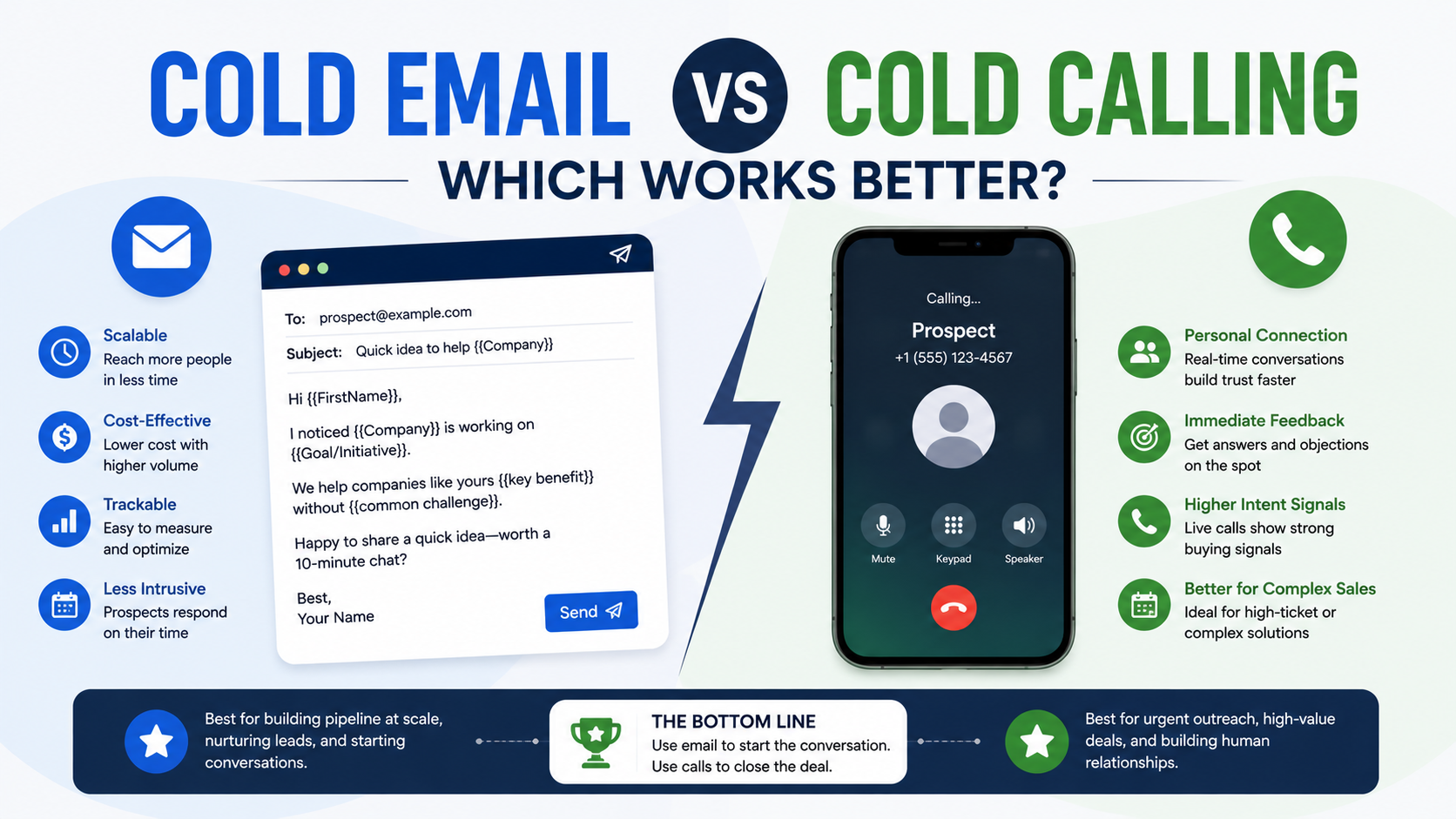
Cold email scales better.
Cold calling gets faster answers.
Email is less intrusive.
Calling creates stronger conversations.
All of those statements can be true.
The problem is that they are true in different situations.
A commercial cleaning company trying to reach 50 property managers has a very different sales process from a SaaS company prospecting 5,000 marketing directors.
The best channel depends on what you sell, who you are contacting, how expensive the service is, how urgent the problem is, and how easy the offer is to understand.
After looking at both methods across different types of outreach, I have stopped thinking of cold email versus cold calling as a competition.
The better question is:
Which channel gives this particular prospect the easiest path into a real conversation?
That is what actually matters.
What Cold Email Does Well
Cold email gives the prospect space.
They can read the message when they have time.
They can check your website.
They can forward it to someone else.
They can reply with a short answer without committing to a meeting.
That makes email particularly useful when your offer needs a little context.
Suppose you provide SEO services.
You might email:
“Hi Sarah,
I noticed your clinic has more than 150 Google reviews, but a couple of competitors with fewer reviews are still appearing above you for several local searches.
We work with multi-location clinics on that exact issue.
Happy to send over the two areas I’d look at first if useful.”
The prospect can read that in 20 seconds.
There is no pressure to make an immediate decision.
That is one of email’s biggest strengths.
What Cold Calling Does Well
A phone conversation gives you something email cannot easily provide:
Immediate feedback.
You ask:
“How are you currently handling commercial cleaning?”
The prospect answers.
You can ask a follow-up question.
They explain the problem.
You clarify something.
Within two minutes, you may learn more than you would from five emails.
That makes calling especially useful when the prospect’s situation is difficult to predict from outside the company.
For example, imagine you sell bookkeeping services.
You can research the company size, but you probably cannot tell from the website whether:
The owner still handles bookkeeping.
They have an internal accountant.
They outsource everything.
They are unhappy with their current provider.
A phone conversation can answer that very quickly.
Cold Email Is Easier to Scale
This is probably the most obvious advantage.
One salesperson can manually make only so many calls in a working day.
Even with dialing software, each genuine conversation consumes time.
Email is different.
With a properly managed campaign, you can contact a larger number of prospects without manually writing every message.
Tools such as HubSpot, Apollo, Smartlead, Instantly, Lemlist, Mailshake, Reply.io, and Close can help organize sequences and follow-ups.
That does not mean you should send thousands of generic emails.
Automation does not fix bad targeting.
But once you have:
A clear customer segment.
Clean contact data.
A relevant message.
A sensible follow-up sequence.
email gives you much more reach.
For businesses with large potential markets, that matters.
Calling Gives You Faster Information
Email may scale better, but it can also leave you waiting.
You send a message Monday.
No reply.
You follow up Thursday.
Still nothing.
You do not know whether:
They are not interested.
They missed the email.
The email went to spam.
You contacted the wrong person.
They already have a provider.
The timing is bad.
A call can resolve some of those questions immediately.
“Hi Mark, I’m trying to figure out who handles your landscaping contracts. Is that something you manage?”
Mark can say:
“No, speak with Jennifer.”
Thirty seconds later, you have better information.
That speed is difficult to replicate with email.
Email Is Usually Less Interruptive
This is one reason I prefer email for certain audiences.
A phone call interrupts whatever the prospect is currently doing.
Maybe they are:
Driving.
Talking to a customer.
In a meeting.
Finishing payroll.
Handling a problem.
They did not schedule time for your pitch.
Email allows them to choose when to engage.
That can make it especially useful when contacting executives, technical people, agency owners, or anyone whose schedule makes unscheduled calls difficult.
The downside is obvious.
Because email is easy to ignore, people often do exactly that.
Cold Calling Forces You to Improve Your Pitch Quickly
There is something useful about hearing real objections.
With email, you can spend weeks convincing yourself the problem is your subject line.
Calling does not let you hide from the market that easily.
If ten prospects in a row say:
“We already have that covered.”
you learn something.
If they keep asking:
“What exactly do you do?”
your positioning is probably unclear.
If everyone says:
“That sounds expensive.”
you have pricing or perceived-value issues.
Cold calling provides raw feedback.
That can help you improve not only your calls but also your email copy, landing pages, and offer.
Email Is Better When You Need to Show Something
Some services are easier to explain visually.
Suppose you are a web designer.
You notice a specific issue on a prospect’s site.
An email allows you to say:
“I noticed the quote button disappears on several mobile service pages. I can send a screenshot if useful.”
If they respond, you can show exactly what you mean.
The same applies to:
Design work.
SEO reports.
Marketing audits.
Before-and-after photos.
Software screenshots.
Portfolio examples.
Case studies.
Trying to explain a visual website issue over an unexpected phone call can be awkward.
Email gives you room to support the pitch with evidence.
Calling Is Better When the Offer Is Easy to Understand
Some offers need very little explanation.
Commercial cleaning.
Lawn maintenance.
Roof inspections.
Pest control.
Window cleaning.
Staffing.
Local delivery.
A phone call might be enough:
“Hi Sarah, we handle office cleaning for several companies around your area. Are you currently using an outside cleaning provider?”
The prospect immediately understands the service.
There is no need for a three-paragraph email explaining commercial cleaning.
This is why local service businesses can often benefit heavily from calling.
Cold Email Is Better for Detailed Personalization at Scale
Imagine you have 500 prospects.
You know:
Their industry.
Company size.
Job title.
Location.
Technology stack.
Recent hiring activity.
You can segment those prospects and create different messages.
For example, companies hiring developers receive:
“I noticed you’re currently hiring three backend engineers…”
Companies that recently raised funding receive a different message.
That type of structured personalization is easier to manage through email.
Doing the equivalent manually on every phone call requires sales reps to review prospect notes before dialing.
Possible?
Absolutely.
But harder to maintain at scale.
Cold Calls Are Great for High-Value Accounts
If one potential customer could be worth $50,000 per year, I would not rely on one automated email sequence.
High-value prospects deserve more effort.
Research them.
Send a thoughtful email.
Connect on LinkedIn if appropriate.
Call the company.
Figure out who handles the problem.
Follow up intelligently.
The higher the potential account value, the more sensible manual outreach becomes.
This is where cold calling becomes especially valuable.
Spending ten minutes trying to reach a prospect makes much more sense when the account could generate significant revenue.
Email Often Wins for Lower-Ticket, Higher-Volume Offers
Now imagine your average customer is worth $300.
Spending 30 minutes researching and calling each prospect may not make economic sense.
Email automation gives you a way to reach larger groups while keeping customer acquisition costs manageable.
This is why there is no universal winner.
The economics matter.
Your outreach effort should make sense relative to the value of the sale.
Cold Calling Is Better for Urgent Needs
Timing can make phone calls incredibly effective.
Suppose a restaurant’s refrigeration system stops working.
An HVAC or commercial refrigeration provider offering immediate service has an urgent problem to solve.
Or imagine a company suddenly needs temporary staff.
A staffing agency may get much further with a phone conversation than a carefully written email sitting unread for two days.
Urgency favors real-time communication.
Email works better when the prospect has time to evaluate.
Email Gives You a Written Record
This seems minor until you manage hundreds of prospects.
Email naturally creates a record of:
What you said.
What the prospect asked.
When you followed up.
What information you sent.
You can connect that activity to tools such as HubSpot, Pipedrive, Salesforce, Zoho CRM, or Close.
Calls can also be logged and recorded using business phone systems, but someone needs to manage that information properly.
With email, much of the conversation history is naturally visible in the thread.
Cold Calls Build Rapport Faster
You can learn a surprising amount from someone’s voice.
Are they interested?
Rushed?
Confused?
Skeptical?
Friendly?
A good salesperson adjusts immediately.
Email does not give you that emotional context.
Someone can reply:
“Send pricing.”
You have no idea whether they are:
Excited.
Just curious.
Comparing five vendors.
Trying to get rid of you.
On the phone, tone provides useful information.
That makes calls powerful when trust matters.
The Biggest Cold Email Mistake
The biggest email mistake is assuming scale equals success.
It is easy to send more messages.
So people do.
If 100 emails produce no leads, they send 1,000.
If that fails, they add more domains and send 10,000.
But if the targeting is wrong, more sending simply generates more ignored messages.
Before increasing volume, check:
Are these the right companies?
Are we contacting the right people?
Is there an obvious problem?
Does the offer solve that problem?
Is the email easy to understand?
Scaling should happen after you see positive signals.
The Biggest Cold Calling Mistake
The biggest calling mistake is talking too much.
Many callers feel nervous, so once someone answers, they rush through the entire pitch.
“Hi John, I’m calling from ABC Marketing, we’ve been in business for seven years and we specialize in SEO, PPC, web development…”
The prospect barely gets a chance to speak.
A better call begins with context and a question.
“Hi John, Alex from Northstar here. I’ll keep this brief. We work with local roofing companies on Google visibility, and I noticed something in your Dallas rankings. Are you actively doing SEO at the moment?”
Now you have a conversation.
That is what the call is for.
The Biggest Mistake Both Channels Share
Bad targeting.
This is worth repeating.
If you email the wrong person, the campaign fails.
If you call the wrong person, the conversation fails.
Good outreach begins before either action.
Know:
What type of company you want.
What problem they probably have.
Who owns that problem.
What event or signal makes your offer relevant.
The better those answers are, the easier both channels become.
Cold Email Example for a Local Business
Suppose you sell commercial landscaping.
Subject: Landscaping at your Dallas property
Hi Amanda,
I came across your office location on Preston Road and wanted to introduce myself.
We handle commercial landscape maintenance for several businesses around that part of Dallas.
Not sure whether you review landscaping providers regularly, but I’d be happy to send over our details or provide a second quote when it makes sense.
Are you the right person to speak with about that?
Chris
Simple.
Low pressure.
The Same Outreach as a Cold Call
“Hi Amanda, this is Chris from GreenLine Landscaping. I’ll keep this quick. We handle commercial landscaping around Preston Road, and I’m trying to find out who manages the landscaping contract for your location. Is that something you handle?”
Notice how the call is shorter.
That is intentional.
You do not need to explain everything before Amanda responds.
Cold Email Example for a SaaS Company
Subject: Your backend hiring
Hi Daniel,
I noticed your team currently has three backend engineering roles open.
We provide short-term Node.js development capacity for SaaS companies when hiring has not caught up with delivery deadlines.
Not sure whether that applies here, but are those roles tied to an immediate product milestone?
Sarah
The Same Outreach as a Cold Call
“Hi Daniel, Sarah from Apex Development. I saw your team is hiring several backend engineers, and I wanted to ask a quick question. Are those hires mainly for long-term team growth, or are you trying to hit a current product deadline?”
The call goes directly to qualification.
What About Voicemail?
Voicemail is where email and calling can work together nicely.
If the person does not answer, leave a short message.
Do not give the entire sales pitch.
For example:
“Hi Sarah, this is Alex from Northstar. I had a quick question about the new Austin location. I’ll send you a short email as well so you have the context. Thanks.”
Then email:
“Hi Sarah,
I just left you a quick voicemail.
I noticed the new Austin location recently launched, and I had one question about how you’re handling local search visibility across both locations…”
Now your email is no longer completely cold.
The prospect has heard your name.
This Is Why I Prefer Combining Email and Calling
If the prospect is valuable enough, the strongest approach is often multi-channel.
For example:
Day 1
Send a personalized cold email.
Day 2 or 3
Call.
If they answer, have a conversation.
If not, leave a short voicemail when appropriate.
Day 4
Send a brief follow-up.
Day 7 or 8
Call again if the account is valuable and still relevant.
Later
Send another useful email with a case study, observation, or different angle.
This works because each channel supports the other.
The call creates familiarity.
The email gives context.
The voicemail gives the prospect a reason to recognize your name.
Do Not Turn Multi-Channel Into Harassment
This is important.
Multi-channel outreach does not mean:
Email at 8:00.
Call at 8:10.
LinkedIn message at 8:20.
Another call at noon.
Email again at 3:00.
That is not persistence.
That is exhausting.
Give people space.
And if someone says:
“Not interested.”
respect it.
If they ask you not to contact them again, stop contacting them through other channels too.
Good outbound should feel persistent but reasonable.
When I Would Choose Cold Email First
I would normally start with email when:
The market is large.
The offer needs explanation.
I have useful personalization data.
The prospect is senior or difficult to reach by phone.
I want to show examples.
The service is not urgent.
I need scalable outreach.
The audience communicates heavily through email.
Examples might include:
SaaS.
Marketing services.
Development services.
Consulting.
B2B software.
Design.
Recruiting.
Professional services.
When I Would Choose Cold Calling First
I would lean toward calls when:
The offer is easy to understand.
The service is local.
The prospect list is small.
Accounts are valuable.
Timing matters.
I need quick qualification.
Contact information is easier to find by phone than email.
The buyer is comfortable making decisions through conversation.
Examples could include:
Commercial cleaning.
Landscaping.
Roofing.
HVAC.
Property maintenance.
Staffing.
Logistics.
Certain financial or professional services.
What If You Hate Cold Calling?
This is extremely common.
A lot of business owners avoid calling because rejection feels more immediate.
Email gives you emotional distance.
There is nothing wrong with starting there.
But if calling genuinely fits your market, it is worth getting comfortable with basic conversations.
You do not need to become a stereotypical salesperson.
A cold call can simply be:
Who you are.
Why you called.
One question.
For example:
“Hi James, Alex from Northstar here. I noticed you’re hiring several sales reps at the moment. We work with sales teams on prospect research, and I wanted to see if that’s something your reps handle manually right now.”
Then stop talking.
Let them answer.
What If Nobody Answers the Phone?
That is normal.
Do not judge cold calling based only on total dials.
Track:
Dials.
Connections.
Decision-maker conversations.
Qualified conversations.
Meetings.
Opportunities.
Customers.
If you make 100 calls and only connect with 15 people, that does not automatically mean calling failed.
The question is what happened with those 15 conversations.
What If Nobody Replies to Your Emails?
Troubleshoot systematically.
First, targeting.
Are the prospects actually relevant?
Second, email addresses.
Are they correct?
Third, deliverability.
Are messages reaching inboxes?
Fourth, the opening.
Does it explain why you contacted them?
Fifth, the offer.
Is there a reason to care?
Sixth, the CTA.
Is it easy to answer?
Do not automatically assume you need a more clever subject line.
Compare Cost, Not Just Response Rate
Suppose calling creates a higher meeting rate.
That sounds like a clear win.
But what if it also requires five times more employee hours?
You need to compare the economics.
Track:
Time spent.
Software cost.
Data cost.
Calls made.
Emails sent.
Qualified meetings.
Opportunities.
Sales.
Customer value.
You might discover that email generates fewer meetings per prospect but a lower cost per opportunity.
Or calling may generate much better customers even though the process is more labor-intensive.
The only meaningful answer comes from your numbers.
A Simple Test for Your Own Business
If you are genuinely unsure which method works better, test both.
Build a group of similar prospects.
Do not give email all the good prospects and calling the leftovers.
Try something like:
100 good-fit prospects for email.
100 similar good-fit prospects for calling.
Use the same basic offer.
Track:
Responses.
Conversations.
Qualified leads.
Meetings.
Sales.
Time required.
Then compare.
Even better, test a third group with email plus calling.
You may find that the combined approach beats both standalone channels.
Do Not Judge Success by Vanity Metrics
For email, open rate is not the goal.
For calling, number of dials is not the goal.
The actual funnel matters.
A cold email campaign with a lower open rate but five qualified customers can be far better than one with impressive dashboard numbers and no sales.
The same is true for calls.
A salesperson making 150 calls a day is not automatically productive.
If another person makes 50 carefully targeted calls and creates more opportunities, the second process is better.
Track outcomes.
Which One Actually Works Better?
If I had to give the least exciting but most useful answer:
It depends on the sale.
Cold email usually wins on scalability, convenience, written context, and the ability to personalize structured campaigns.
Cold calling usually wins on speed, qualification, immediate feedback, and human connection.
For broad outbound campaigns, I would often start with email.
For valuable accounts or local services, I would add calling quickly.
For high-ticket B2B sales, I would rarely rely on only one channel.
The strongest strategy is often:
Research first.
Send a relevant email.
Call when the account justifies it.
Follow up thoughtfully.
Then stop when the prospect clearly is not interested.
That approach avoids the false choice between email and calling.
Because the goal was never to become excellent at sending emails.
And it was never to make the highest number of phone calls.
The goal is to start useful conversations with the right potential customers.
Use whichever channel makes that conversation easiest.
And when both channels make sense, use them together.