The first time I seriously worked on local link building, I made the mistake a lot of people make.
I searched for something like:
“how to get backlinks for local SEO”
Within ten minutes, I had a spreadsheet full of websites selling guest posts, directory packages, “authority links,” and sponsorship opportunities.
Apparently, building local links was going to require either a decent budget or a willingness to do some fairly questionable SEO.
Neither option felt right.
What eventually worked better was much less exciting.
I started looking at relationships the business already had.
Suppliers.
Customers.
Local organizations.
Journalists.
Community websites.
Businesses we had worked with.
Mentions that already existed without a link.
That is when local link building started making sense.
Google itself says a business’s local prominence can be influenced by information from across the web, including how many websites link to the business. But Google also explicitly warns against creating links primarily to manipulate search rankings, including buying links, excessive link exchanges, automated link building, and low-quality directory links.
So the goal is not:
Get as many backlinks as possible.
The better goal is:
Find legitimate reasons for useful local websites to mention your business.
And surprisingly, many of those opportunities cost nothing.
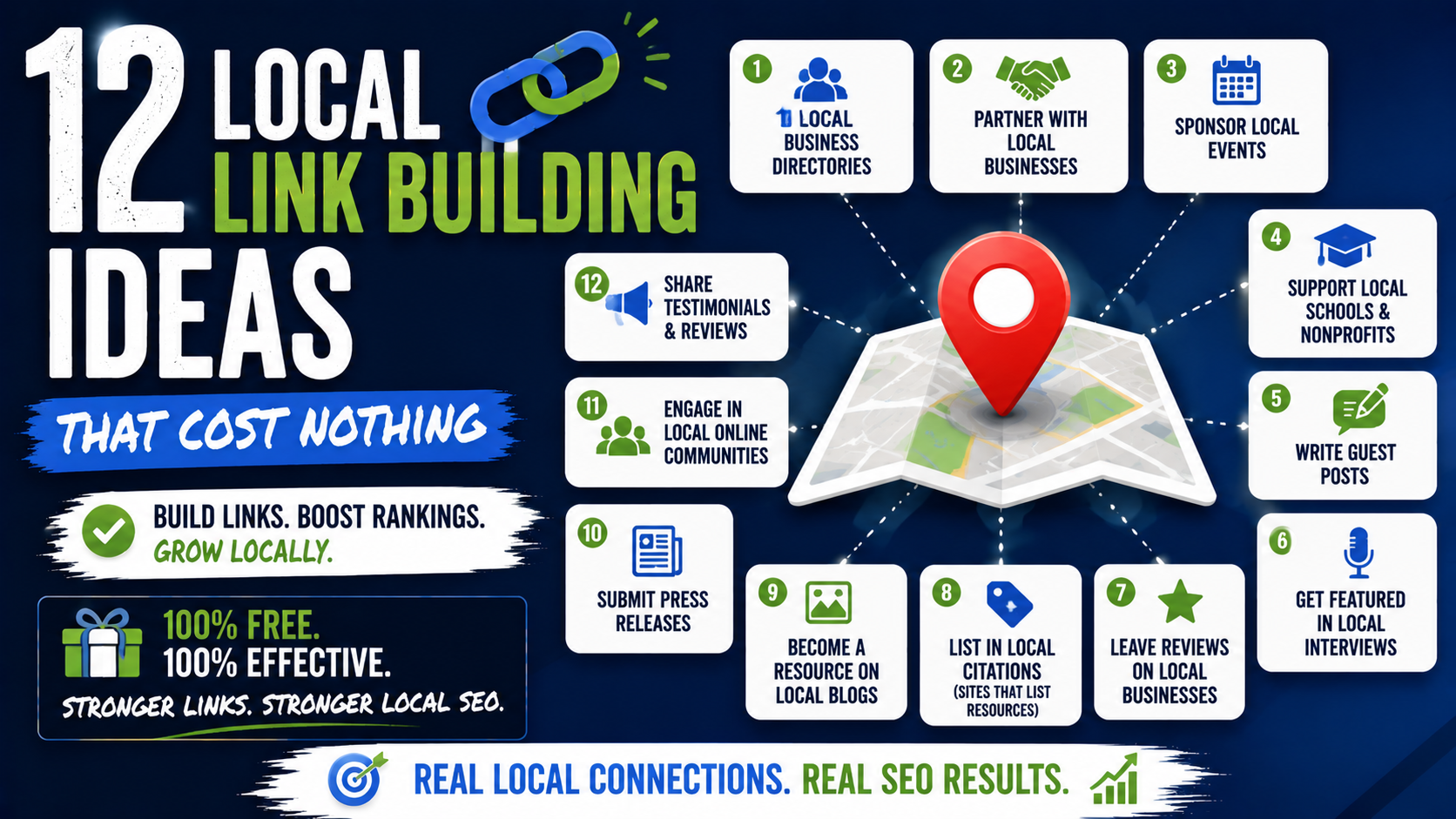
Here are 12 I would actually try.
1. Ask Suppliers and Manufacturers About Their Dealer Pages
This is one of the first places I check for contractors and businesses that sell physical products.
Suppose you install:
- Roofing materials
- Pavers
- Windows
- Flooring
- HVAC systems
- Cabinets
- Solar equipment
- Landscaping products
Visit the manufacturer’s website.
Look for pages called:
- Find an Installer
- Dealer Locator
- Certified Contractors
- Where to Buy
- Partners
- Professionals
- Authorized Installers
If your company already qualifies, getting listed may cost nothing.
I have seen businesses buy random directory links while completely ignoring a manufacturer’s website that already has a page specifically designed to send customers to approved local installers.
That is backwards.
Start with brands you genuinely use.
A paving contractor, for example, could check the manufacturers of the pavers they regularly install.
Do not pretend to be an authorized dealer if you are not.
But if you already have a legitimate relationship, ask the supplier:
“Do you have an installer or contractor directory we should be listed in?”
Simple.
2. Turn Existing Business Relationships Into Natural Mentions
Think about the companies you already work with.
Not companies you found five minutes ago because they have a high domain authority score.
Real relationships.
Maybe you regularly work with:
- Architects
- Interior designers
- General contractors
- Photographers
- Real estate agents
- Property managers
- Accountants
- Marketing agencies
- Cleaning companies
- Event planners
Look at their websites.
Do they have:
- Partner pages?
- Project pages?
- Recommended providers?
- Case studies?
- Vendor resources?
If your businesses genuinely work together, there may be a natural reason for them to mention you.
For example, an interior designer may publish a completed renovation and credit:
Custom cabinetry by ABC Cabinets
with a link.
That is not the same as emailing 100 businesses saying:
“You link to me and I’ll link to you.”
Google specifically lists excessive link exchanges and partner pages created solely for cross-linking as link spam.
The relationship should exist first.
The link simply documents it.
3. Reclaim Unlinked Mentions
This is one of my favorite easy wins.
Sometimes websites already mention your company but never link to it.
Maybe a local newspaper wrote about you.
Maybe a supplier listed your business.
Maybe a community organization thanked you.
Maybe an event page mentioned your company name.
You already earned the mention.
You are simply asking them to make it more useful.
Start with Google searches such as:
“Your Business Name”
Then:
“Your Business Name” -yourwebsite.com
Try variations of the company name and owner’s name too.
If you find a genuine mention without a link, send a short email.
Something like:
“Thanks for mentioning us in your article about the community project. Would you mind linking our company name to our website so readers can find us more easily?”
No complicated pitch required.
This also works when an old article links to your previous website URL.
You can politely ask the publisher to update it.
4. Give Genuine Testimonials to Businesses You Use
Look at the companies your business actually depends on.
That could include:
- Software providers
- Suppliers
- Designers
- Accountants
- Equipment companies
- Local consultants
- Business services
If one of them has genuinely helped you, send them a useful testimonial.
Companies love customer stories because good testimonials help them sell.
Some publish testimonials on dedicated pages or case studies and credit the customer’s business.
The important part is that the testimonial should be real.
Do not write:
“Wonderful company!”
just because you want a backlink.
Explain something specific.
For example:
“We’ve used their scheduling system for two years. It cut down the amount of time our team spends manually confirming landscaping appointments, especially during the spring rush.”
That sounds like an actual customer.
Because it is.
Do not demand a backlink as payment for the testimonial either.
That starts turning a natural endorsement into a link transaction.
Send something useful and let the company decide how it wants to publish it.
5. Find Local Resource Pages
This takes more manual work, but it can uncover excellent opportunities.
Search Google for things like:
Burlington homeowner resources
Hamilton local business resources
Toronto contractor resources
Mississauga community resources
Oakville home renovation resources
Then look at the websites ranking.
You may find:
- Neighborhood associations
- Community websites
- Local blogs
- Municipal resources
- Real estate websites
- Moving guides
- Homeowner guides
- Tourism sites
- Local organizations
Now ask yourself:
Would my business genuinely improve this page?
That question is important.
Do not email a local parenting website asking it to add your commercial concrete company to an article about toddler activities.
That makes no sense.
But if a real estate website has a page called:
Useful Resources for New Homeowners in Burlington
and you run a reputable local plumbing company, there might be a legitimate fit.
Your outreach should explain why their readers would benefit.
Not why you need a backlink.
6. Help Journalists Who Need Expert Sources
Journalists, bloggers, and content writers regularly need knowledgeable people to quote.
That creates opportunities for business owners who actually know their industry.
For example, a journalist writing about:
“Why basement flooding gets worse during heavy summer storms”
might need input from:
- Waterproofing contractors
- Plumbers
- Drainage specialists
- Foundation experts
If you provide a useful answer, the resulting story may mention and sometimes link to your business.
You do not need an expensive PR agency to start.
Qwoted currently has a free Basic plan that includes a limited number of pitches each month and access to journalist opportunities.
Featured also currently offers a free plan with access to media opportunities and journalist-request workflows, although usage is limited compared with its paid plans.
The biggest mistake here is sending promotional answers.
A journalist asks:
“What causes concrete driveways to crack?”
Do not reply:
“ABC Concrete is the number one concrete contractor in Dallas. Contact us today!”
Answer the question.
Give them something quotable.
If they want your company details, provide them clearly at the bottom.
Expertise earns the mention.
7. Pitch Useful Stories to Local Newspapers
You do not always have to wait for a journalist to ask.
Local media needs local stories.
The trick is understanding what counts as a story.
“Local landscaping company provides quality landscaping services”
is not news.
But these might be:
- A local business restoring a public community space
- Unusual weather causing a spike in a specific home problem
- Local data showing changes in renovation demand
- A neighborhood business reaching a meaningful milestone
- A local company helping with a community project
- An expert explaining a problem affecting local homeowners
Think about the reader first.
Why would someone living in your city care?
If you have a genuine answer, find the newspaper’s news desk or reporter covering local business, property, lifestyle, or community stories.
Keep your email short.
Lead with the story.
Not your SEO goal.
Even if an article does not provide a followed backlink, local press coverage can still create brand visibility, referral traffic, citations, and secondary mentions from other websites.
8. Create a Local Resource Worth Linking To
Sometimes the best way to earn links is to create the thing you wish already existed.
This works particularly well for local information.
Suppose you run a landscaping company.
Instead of publishing another article called:
“10 Benefits of Landscaping”
create something genuinely specific:
A Homeowner’s Guide to Burlington Yard Drainage
Include:
- Common drainage problems in the area
- Typical soil issues
- What homeowners should inspect after heavy rain
- When grading may help
- When a drain may be required
- Photos from real examples
- Links to relevant municipal information
Now you have something a:
- Realtor
- Home inspector
- Property manager
- Neighborhood website
- Local blogger
might actually want to reference.
The mistake I see is creating “linkable assets” that obviously exist only for SEO.
A 400-word generic article with a fancy infographic is not automatically worth linking to.
The resource needs to solve a real local problem.
Google’s current Search Essentials continues to emphasize helpful, reliable, people-first content rather than content produced primarily to manipulate rankings.
Make the page useful enough that you would create it even if backlinks did not exist.
9. Replace Broken Links on Local Websites
Broken link building sounds more technical than it is.
You find a useful local page containing a link that no longer works.
If you have a genuinely relevant replacement, tell the website owner.
Imagine a real estate agent has a guide for homeowners that links to:
City Patio Permit Requirements
but the linked resource has disappeared.
If your website has a current, accurate guide covering that same issue, you can email them.
Something like:
“I was reading your homeowner resources page and noticed the patio permit link currently leads to a 404 page. We recently put together an updated guide covering the same topic here if you need a replacement.”
That is useful outreach.
You found a problem.
You offered a solution.
Do not manufacture broken links or create low-value articles just to replace them.
And make sure your replacement genuinely matches what the original page intended to reference.
10. Ask Organizations You Already Support to Credit You Online
Notice the wording here:
already support.
I am not suggesting spending money on sponsorships just to buy links.
Google specifically considers exchanging money, products, or services for ranking links to be link spam unless appropriate link attributes are used.
But many businesses already support:
- Local sports teams
- Schools
- Charities
- Community projects
- Nonprofits
- Neighborhood initiatives
Sometimes these organizations already mention supporters online but forgot your company.
Or they listed your business name without linking it.
If the relationship already exists, ask whether your website can be included in the organization’s supporter or partner information.
The request can be very simple:
“Thanks for including our business on the supporters page. Could you also link our company name to our website? It may help people who want to learn more about the businesses involved.”
There is no need for awkward SEO language.
11. Get Interviewed on Local Podcasts and Blogs
Local podcasts are often easier to approach than large publications.
Search:
[city] business podcast
[city] real estate podcast
[city] entrepreneur podcast
[region] home improvement podcast
Then listen to a couple of episodes.
Do not immediately send:
“Can I come on your podcast and talk about my company?”
Find an angle their audience would care about.
A contractor might discuss:
The biggest renovation mistakes homeowners make before selling.
A landscaper might talk about:
Why new homeowners underestimate yard drainage.
A restaurant owner might discuss:
What it actually takes to run an independent restaurant in the city.
Podcasts often publish episode pages or show notes containing information about guests.
That can naturally include a website link.
Even without a link, you gain exposure to a relevant local audience.
And you have created a piece of content you can reuse on your own website and social channels.
12. Study the Links You Already Have and Repeat What Worked
This sounds obvious, but many businesses never do it.
Open Google Search Console.
Go to the Links report.
Google currently lets site owners see information including top linking sites and top-linked pages, although Google notes that the report is a sample rather than a complete list of every link pointing to your website.
Look at the websites linking to you.
Then ask:
Why did this link happen?
Maybe:
- A supplier linked to your company
- A local blog covered a project
- A client included you in a case study
- A journalist quoted the owner
- A neighborhood organization mentioned you
- A useful guide earned links naturally
Those are clues.
Suppose your most-linked page is:
Homeowner’s Guide to Basement Flooding in Hamilton
That tells you something.
Maybe practical, locally focused guides work well for your business.
Create another useful resource.
If a supplier sent you customers and a backlink, check your other suppliers.
If an interview produced links, look for more interview opportunities.
You do not always need a brand-new link-building strategy.
Sometimes you simply need to understand why your existing links were earned.
A Simple Free Local Link Building Routine
Link building can become overwhelming when you try to do everything at once.
I prefer a small weekly routine.
Monday: Find Opportunities
Spend 20-30 minutes looking for:
- Unlinked mentions
- Supplier directories
- Local resource pages
- Journalist requests
- Broken local links
Save the best opportunities in a Google Sheet.
Useful columns:
Website | Contact | Opportunity | Page | Date Contacted | Status
Tuesday: Send Three Good Emails
Not 100 generic emails.
Three good ones.
Make each request specific.
Explain:
- Why you contacted them
- What you noticed
- Why your resource or business is relevant
Wednesday: Work on Something Worth Linking To
Improve a local guide.
Add useful data.
Upload real project photos.
Create a better explanation.
Build an actual resource.
Thursday: Follow Existing Relationships
Check:
- Suppliers
- Partners
- Clients
- Organizations
- Associations
You may already have link opportunities sitting in your contact list.
Friday: Check Results
Use Search Console occasionally to see whether new websites are appearing in your backlink profile. Keep in mind that Google’s report is not a complete real-time list.
Then repeat.
Five good outreach emails per week can be far more useful than blasting 500 templates.
Common Free Link Building Mistakes
Sending the Same Email to Everyone
People recognize templates.
Especially bad templates.
“Dear Webmaster, I found your amazing article…”
Nobody talks like that.
Mention something specific.
Asking for Links With Nothing to Offer
Why should the website add you?
You need a reason.
Maybe you:
- Found a broken link
- Provided an expert answer
- Created a useful resource
- Already work together
- Were already mentioned
- Contributed to a local project
The link should make sense.
Obsessing Over Anchor Text
Do not email a local newspaper asking them to link your business using:
best emergency plumber Chicago
Just let them use your company name or whatever makes sense editorially.
Google lists manipulative, keyword-optimized link practices among the types of behavior that can violate its spam policies.
Building Low-Quality Directory Links
Google specifically identifies low-quality directory and bookmark-site links as an example of link spam.
A legitimate local directory can still be useful.
The problem is creating hundreds of meaningless directory links purely for rankings.
Trading Links With Everyone
A genuine business partner linking to you is normal.
Creating a network where 40 companies agree to exchange links purely for SEO is a different story.
Google explicitly warns about excessive link exchanges.
Expecting Immediate Rankings
You might earn three good links and see no dramatic change tomorrow.
That is normal.
Google Maps visibility is influenced by multiple factors, including relevance, distance, and prominence. Links are only one part of that wider picture.
Which Free Link Building Ideas Would I Start With?
If the business has never done link building before, I would start with the easiest opportunities.
First, search for existing mentions.
Then check suppliers.
Then check current business partners.
Then look at organizations you already work with.
Those are warm opportunities.
After that, move into active outreach:
- Local journalists
- Resource pages
- Podcasts
- Broken links
- Expert quote platforms
- Original local resources
That order matters.
People often start link building by emailing complete strangers when there may be ten perfectly good opportunities sitting inside relationships the business already has.
Final Thoughts
Free local link building is possible.
But “free” does not mean effortless.
You are replacing money with something else:
Time.
Expertise.
Relationships.
Useful information.
A business that earns links without paying for them usually gives people a genuine reason to mention it.
Maybe you helped a journalist understand a complicated topic.
Maybe you created the best local guide to a common homeowner problem.
Maybe your supplier genuinely recommends you.
Maybe a community organization appreciates your involvement.
Maybe a business partner credited your work.
Maybe somebody already mentioned you and simply forgot the link.
Those are real links created by real relationships and useful content.
That is the type of local link building I prefer.
Not because it produces a neat promise like:
“100 backlinks in seven days.”
It probably won’t.
But it builds an online footprint that actually looks like a real local business.
Google says local prominence can be influenced by websites linking to a business, while its spam policies make clear that links created primarily to manipulate rankings can create problems.
The safest middle ground is also the most sensible one.
Do things worth talking about.
Create information worth referencing.
Build relationships worth documenting.
Then make it easy for people to link to you when the link genuinely helps their audience.
You may only earn a handful of links each month.
For a local business, those can be the links that actually matter.