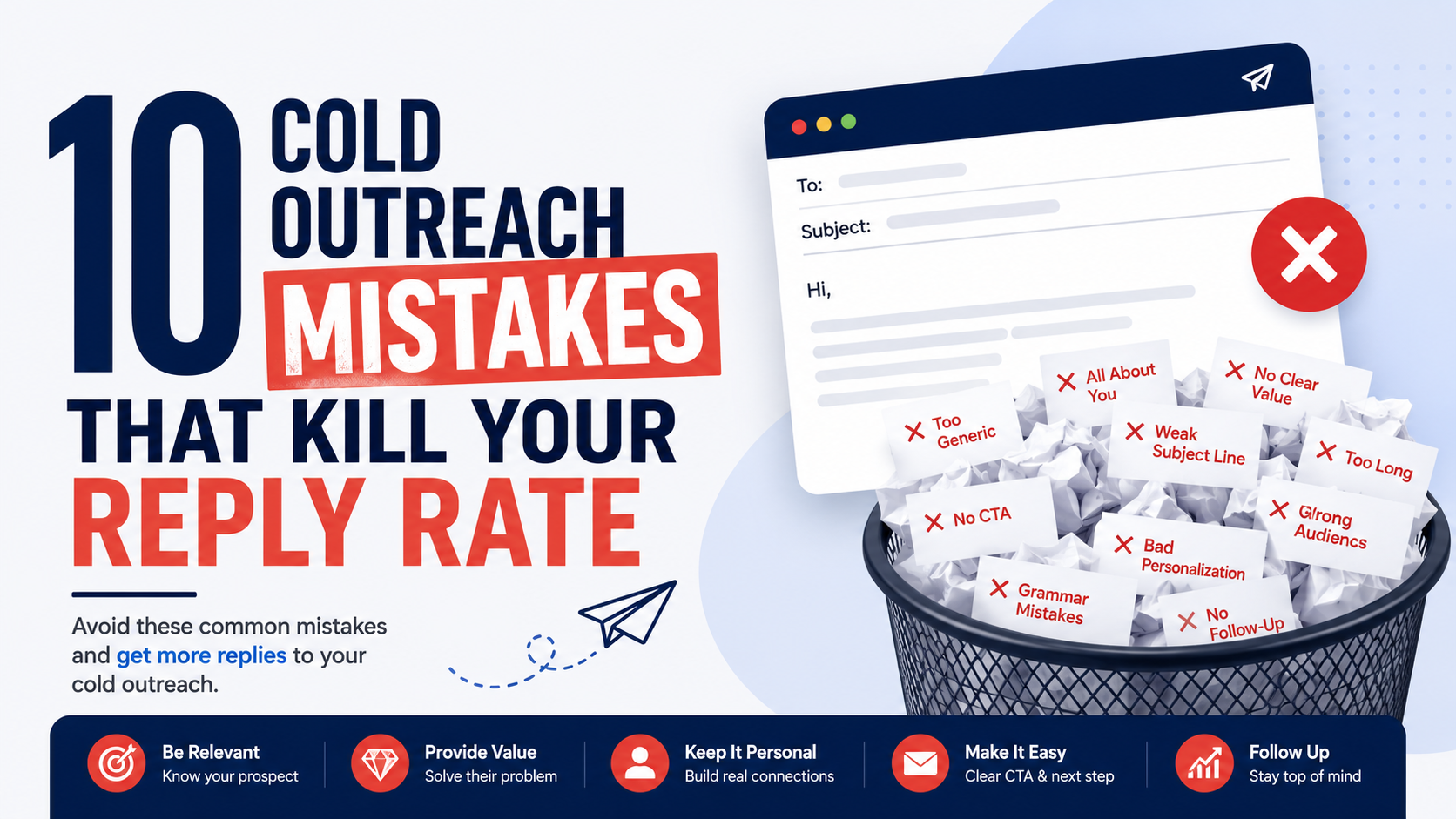
One of the most frustrating things about cold outreach is that a campaign can look completely fine from the outside and still perform terribly.
You have a list.
The emails are going out.
The subject lines look decent.
The offer makes sense.
Maybe people are even opening the messages.
But replies?
Almost nothing.
I have seen this happen more times than I can count, and the natural reaction is usually to rewrite the copy.
Change the subject line.
Shorten the email.
Add a stronger CTA.
Try another follow-up.
Sometimes that helps.
But quite often, the real problem started much earlier.
The wrong people were contacted.
The message had no real reason for reaching them.
The personalization was fake.
The call to action asked too much.
Or the sender kept following up until a neutral prospect became annoyed.
Cold outreach is surprisingly unforgiving.
Small mistakes compound quickly.
The good news is that most of them are fixable.
Here are 10 cold outreach mistakes I would check before blaming your market, your offer, or the entire idea of outbound sales.
Mistake #1: Targeting People Who Were Never a Good Fit
This is the biggest one.
And it is also the mistake people try hardest to solve with better copy.
Imagine you sell SEO services for local businesses.
Your target list contains:
Dentists.
Restaurants.
SaaS companies.
Ecommerce brands.
Manufacturers.
Consultants.
Law firms.
All mixed together.
Then you send:
“We help businesses improve their online visibility and generate more leads.”
Technically, the message applies to everyone.
Practically, it connects deeply with nobody.
Cold outreach performs much better when the audience is narrow enough that the problem feels familiar.
For example:
“Dental practices with two or more locations and weak local search visibility.”
That is a real segment.
Now you can write:
“I noticed your newer location is not appearing as consistently in local search as your original clinic.”
That message has a reason to exist.
How to Fix It
Before writing the email, define:
Who exactly is this for?
What problem do they probably have?
What makes them likely to need the offer now?
If you cannot answer those questions clearly, improve the list before improving the message.
A smaller list of 200 strong prospects is usually worth more than 10,000 random business contacts.
Mistake #2: Opening With Your Company Instead of Their Situation
I used to write cold emails that began like this:
“Hi John, my name is Alex and I’m the founder of ABC Digital. We have been providing marketing services for more than seven years…”
Everything in that sentence may be true.
But John has no reason to care yet.
You are asking him to become interested in your company before giving him a reason to read.
That is backwards.
A stronger opening starts with context.
For example:
“I noticed you recently opened a second location in Austin.”
Or:
“Saw that you’re currently hiring three backend engineers.”
Or:
“I was looking at the mobile version of your quote page and noticed the form takes several steps to reach.”
Now the prospect immediately understands why you contacted them.
How to Fix It
Move your introduction down.
Start with:
An observation.
A business signal.
A relevant problem.
A question.
Then briefly explain what you do.
The prospect does not need your biography in the first five seconds.
Mistake #3: Using Fake Personalization
This one is everywhere.
“Loved your recent post.”
“Really impressed by your company.”
“Your journey is inspiring.”
Then comes a completely generic pitch.
Most prospects can tell when the personalization is fake.
And once they notice, trust disappears.
Real personalization does not need to be flattering.
It just needs to be relevant.
For example:
“I noticed your company is hiring several SDRs right now.”
That is not a compliment.
It is an observation.
But if you sell sales software, recruiting, data enrichment, or outsourced prospecting, it may create a legitimate reason for the message.
Bad Personalization
“Your website looks amazing!”
Better Personalization
“I noticed your paid ads are sending traffic to the general service page rather than a dedicated landing page.”
The second sentence tells the prospect you actually looked at something connected to your offer.
How to Fix It
Ask:
Does this detail explain why I am contacting them?
If not, leave it out.
You do not need to mention their university, hometown, favorite football team, or latest Instagram photo.
Relevant professional context is enough.
Mistake #4: Trying to Sell Everything in the First Message
This is especially common with agencies and service businesses.
The first email says:
“We offer SEO, PPC, web development, social media, branding, content marketing, graphic design, automation, lead generation, and ecommerce development.”
That is not a focused offer.
It is a menu.
The prospect now has to figure out which part matters.
Most people will not bother.
One email should usually focus on one problem.
Suppose you contact a roofing company because its local search visibility is weak.
Talk about that.
Do not also mention:
Website redesign.
Facebook Ads.
TikTok management.
Logo design.
Email marketing.
The narrower the message, the easier it is to understand.
How to Fix It
Pick one:
Problem.
Offer.
Outcome.
For example:
“We help local roofing companies improve Google Maps visibility.”
That is much clearer than:
“We are a full-service digital growth partner.”
You can introduce additional services later.
The first message only needs to start the conversation.
Mistake #5: Asking for Too Much Too Soon
One of my least favorite cold email CTAs is:
“Are you available for a 45-minute discovery call this Thursday?”
Think about what you are asking.
The prospect did not know you existed one minute ago.
Now they are being asked to block almost an hour on their calendar.
That is a big jump.
Cold outreach works better when the first commitment is small.
Examples:
“Worth sending the details?”
“Want me to send the two things I noticed?”
“Are you handling this internally?”
“Would a quick example be useful?”
“Are you the right person for this?”
These questions are easy to answer.
Once the prospect shows interest, then ask for the call.
Real Example
Instead of:
“Can we schedule a 30-minute demo?”
Try:
“I spotted two issues on the mobile quote flow. Want me to send them over?”
If they say yes, you have earned the next step.
Mistake #6: Writing Emails That Are Far Too Long
Long cold emails usually come from good intentions.
The sender wants to explain everything.
So the email includes:
Company background.
Services.
Case studies.
Features.
Benefits.
Pricing.
Testimonials.
Call scheduling.
By the time the reader reaches the bottom, the message looks like a proposal.
The problem is that the prospect has not yet decided whether they care.
You are giving them information before earning attention.
For most cold outreach, I prefer short emails.
Something like:
“Hi Sarah,
I noticed your clinic recently opened a second location in Austin.
We work with multi-location practices on local search visibility, and I spotted one difference in how the new location is set up compared with the original one.
Happy to send it over if useful.
Alex”
That is enough to start.
How to Fix It
Write your email.
Then remove 30%.
Read it again.
If the message still makes sense, remove more.
Keep only what helps the prospect answer:
Why did you contact me?
Why might I care?
What do you want me to do next?
Mistake #7: Following Up With Nothing New to Say
Follow-ups matter.
But bad follow-ups can destroy a decent first message.
You have probably seen sequences like:
“Just following up.”
“Bumping this.”
“Any thoughts?”
“Checking again.”
“Wanted to make sure you saw this.”
“Following up one more time.”
Nothing new is being added.
The sender is simply demanding attention repeatedly.
A useful follow-up gives the prospect another reason to engage.
For example:
“One thing I forgot to mention — your newer location has a different Google Business category setup from the original one.”
Or:
“I took another look at the mobile form and noticed the CTA disappears on two service pages.”
Now the follow-up has value.
How to Fix It
Each follow-up should do at least one of these:
Add a useful observation.
Answer a likely objection.
Share relevant proof.
Ask a different question.
Reduce the commitment.
Close the sequence politely.
Do not follow up just because your automation says Day 5 has arrived.
Mistake #8: Scaling Before You Know Whether the Message Works
This is one of the easiest mistakes to make with outreach tools.
You send 50 emails.
Replies are weak.
So you decide:
“We need more volume.”
Then you send 5,000.
That is usually not the answer.
If a small sample of well-targeted prospects does not understand or care about your offer, increasing volume often creates:
More ignored emails.
More opt-outs.
More complaints.
More wasted data.
More deliverability risk.
Automation platforms such as Smartlead, Instantly, Lemlist, Mailshake, Apollo, and Reply.io can make sending easier.
But they can also make it very easy to scale a bad campaign.
How to Fix It
Start small.
Use a batch of 50 to 100 strong prospects.
Track:
Replies.
Positive replies.
Objections.
Wrong-person responses.
Meetings.
Then improve the campaign.
Scale only after you see evidence that the message is creating real conversations.
Mistake #9: Measuring the Wrong Numbers
This mistake can make a bad campaign look healthy.
Imagine your dashboard says:
Open rate: 68%.
Looks fantastic.
But:
Positive replies: 0.
Meetings: 0.
Customers: 0.
That campaign is not performing well.
Open tracking can also be unreliable because privacy features and automatic image loading can affect the numbers.
I care much more about:
Positive reply rate.
Qualified reply rate.
Meetings booked.
Meetings attended.
Opportunities created.
Customers won.
Revenue.
Bounce rate.
Opt-outs.
A Better Example
Campaign A:
2,000 emails.
70% reported opens.
10 replies.
0 customers.
Campaign B:
500 emails.
45% reported opens.
18 replies.
4 meetings.
2 customers.
Which campaign would you rather run?
Obviously Campaign B.
Vanity metrics should not distract from business outcomes.
How to Fix It
Define success before launching.
If your goal is booked sales meetings, track the full path:
Sent → Delivered → Reply → Positive Reply → Meeting → Opportunity → Customer
Now you can see where the campaign actually breaks.
Mistake #10: Ignoring What Prospects Are Telling You
This may be the most expensive mistake because the answer is sitting right in front of you.
Prospects reply:
“We already have someone.”
“Talk to marketing.”
“Too expensive.”
“Not a priority right now.”
“We only work with local vendors.”
“We’re too small for this.”
And the sender ignores the pattern and keeps running the same campaign.
Replies are market research.
Suppose 40% of responses say:
“We already have an agency.”
Maybe your positioning should change.
Instead of:
“Replace your agency.”
You could test:
“We sometimes help teams with technical SEO projects that fall outside their existing agency scope.”
Or maybe you need a completely different customer segment.
If everyone tells you the same thing, listen.
How to Fix It
Categorize replies.
For example:
Interested.
Not interested.
Wrong person.
Already have provider.
Too expensive.
Not now.
No need.
Unsubscribe.
Then review the patterns every week.
Those categories often tell you exactly what to improve.
Bonus Mistake: Contacting the Wrong Person at the Right Company
This deserves a mention because it happens constantly.
You find a perfect company.
Then automatically email the CEO.
But the CEO does not manage the problem.
Suppose you sell commercial cleaning to a 300-person office.
The CEO probably does not choose the cleaning contractor.
You may need:
Facilities Manager.
Office Manager.
Operations Manager.
Property Manager.
If you sell SEO to a larger company, you may need:
Marketing Director.
Head of Growth.
SEO Manager.
CMO.
Contact the person who owns the problem.
That usually improves reply quality immediately.
Bonus Mistake: Treating Every “No” Like an Objection to Overcome
There is a strange sales idea that every rejection should be challenged.
Someone says:
“Not interested.”
The salesperson replies:
“But why?”
Then:
“What if we could guarantee results?”
Then:
“Can I ask one quick question?”
Sometimes the prospect simply does not want the conversation.
Respecting that is good business.
If someone says:
“Not now.”
you can reasonably ask when timing might be better.
If they say:
“Please stop emailing me.”
stop.
Do not turn every boundary into another sales opportunity.
What a Good Cold Outreach Message Actually Looks Like
After stripping away all these mistakes, a good cold message often looks surprisingly simple.
For example:
Subject: Your Dallas location
Hi Mark,
I noticed your company recently opened a second location in Dallas.
We work with local service businesses on Google Maps visibility, and I spotted one difference between how the two locations are currently set up.
Would it be useful if I sent it over?
Alex
That email works because it answers:
Why Mark?
The new location.
Why now?
There is a setup difference.
What do you do?
Local search visibility.
What should Mark do?
Say yes or no to seeing the detail.
That is enough.
A Better Cold Outreach Workflow
If your reply rate is weak, I would not immediately rewrite the email.
I would troubleshoot in this order.
Step 1: Review the Audience
Are these actually good potential customers?
Step 2: Review the Decision-Maker
Are you contacting the right person?
Step 3: Review the Trigger
Why are you contacting them now?
Step 4: Review the Opening
Does the first sentence explain the reason for the message?
Step 5: Review the Offer
Is it specific?
Step 6: Review the CTA
Is it easy to answer?
Step 7: Review the Length
Can you remove unnecessary information?
Step 8: Review Follow-Ups
Are they adding anything useful?
Step 9: Check Deliverability
Are messages actually reaching inboxes?
Step 10: Review the Replies
What patterns are prospects giving you?
That process usually finds the problem faster than randomly testing ten subject lines.
Use Tools to Organize, Not to Replace Thinking
There are plenty of useful cold outreach tools.
For prospecting:
LinkedIn Sales Navigator.
Apollo.
Clay.
Google Maps.
Hunter.
For email verification:
NeverBounce.
ZeroBounce.
Hunter Verify.
For sending and follow-ups:
Smartlead.
Instantly.
Lemlist.
Mailshake.
Reply.io.
Apollo.
For CRM:
HubSpot.
Pipedrive.
Close.
Zoho CRM.
Salesforce.
These tools can save huge amounts of time.
But none of them can answer the most important question for you:
Why should this particular person care?
That still requires judgment.
Read Your Message Like the Prospect
This is one of the simplest checks I use.
Pretend you have never heard of your company.
Open the email.
Read it on your phone.
Ask:
Do I immediately know why I received this?
Do I understand what the sender does?
Does the message feel relevant?
Is there anything obviously exaggerated?
Does the sender ask for too much?
Would I reply?
If your honest reaction is:
“I would probably delete this.”
do not send it to 5,000 people.
Fix it first.
Your Reply Rate Is Usually a Symptom
People often say:
“Our reply rate is bad.”
But reply rate is rarely the real problem.
It is usually the symptom of something else.
Bad targeting.
Weak relevance.
Wrong person.
Poor offer.
Too much copy.
Aggressive CTA.
Weak follow-ups.
Poor deliverability.
Bad timing.
That is why chasing a magical reply-rate benchmark is not especially useful.
Different markets behave differently.
A high-ticket enterprise campaign targeting 100 senior executives cannot be judged the same way as a local service campaign sending to 2,000 businesses.
What matters is whether the campaign produces enough qualified conversations to make economic sense.
The Biggest Improvement Usually Happens Before You Hit Send
The best cold outreach campaigns I have seen are not necessarily the ones with the cleverest writing.
They are the ones where the sender clearly knows:
Who they are targeting.
Why the prospect might care.
What problem they solve.
Why the timing makes sense.
Who the correct decision-maker is.
What the easiest next step should be.
Once those pieces are right, the copy becomes much easier.
You do not need psychological tricks.
You do not need fake urgency.
You do not need 12 follow-ups.
You do not need to pretend you “loved” a LinkedIn post you barely read.
You need relevance.
That is the part people often skip because buying another outreach tool feels easier than fixing the prospect list.
But if your reply rate is struggling, I would start there.
Look at the people you are contacting.
Look at the reason behind the message.
Look at what prospects are actually telling you.
Then fix the obvious friction one piece at a time.
Cold outreach usually does not fail because of one disastrous sentence.
It fails because several small mistakes make the message easy to ignore.
Remove those mistakes, and you often do not need a dramatically better pitch.
You simply need a clearer reason for the right person to answer.