“Marketing just does not work for my business.”
A fence installer said this to me last spring, arms crossed, absolutely certain. He had numbers to back it up. Around 900 people visited his website every month, and from all that traffic he was getting three, maybe four inquiries. He had concluded the whole game was rigged.
Here is what I found in one afternoon. His website had no phone number above the fold. His contact page had a form with eleven fields, including one that asked for a “project specification document.” On mobile, the form did not even load properly.
Marketing was working fine. Nine hundred interested people were showing up every month. They were just falling through a hole in the floor right before the finish line.
That hole has a name. It is a stage in what marketers call the lead generation funnel, and once you understand the funnel, you stop saying “marketing does not work” and start saying “stage three is broken.” One of those statements you can fix.
What the Funnel Actually Is
Forget the fancy diagrams. The funnel is just the path every customer walks, broken into stages, so you can see where people quit walking.
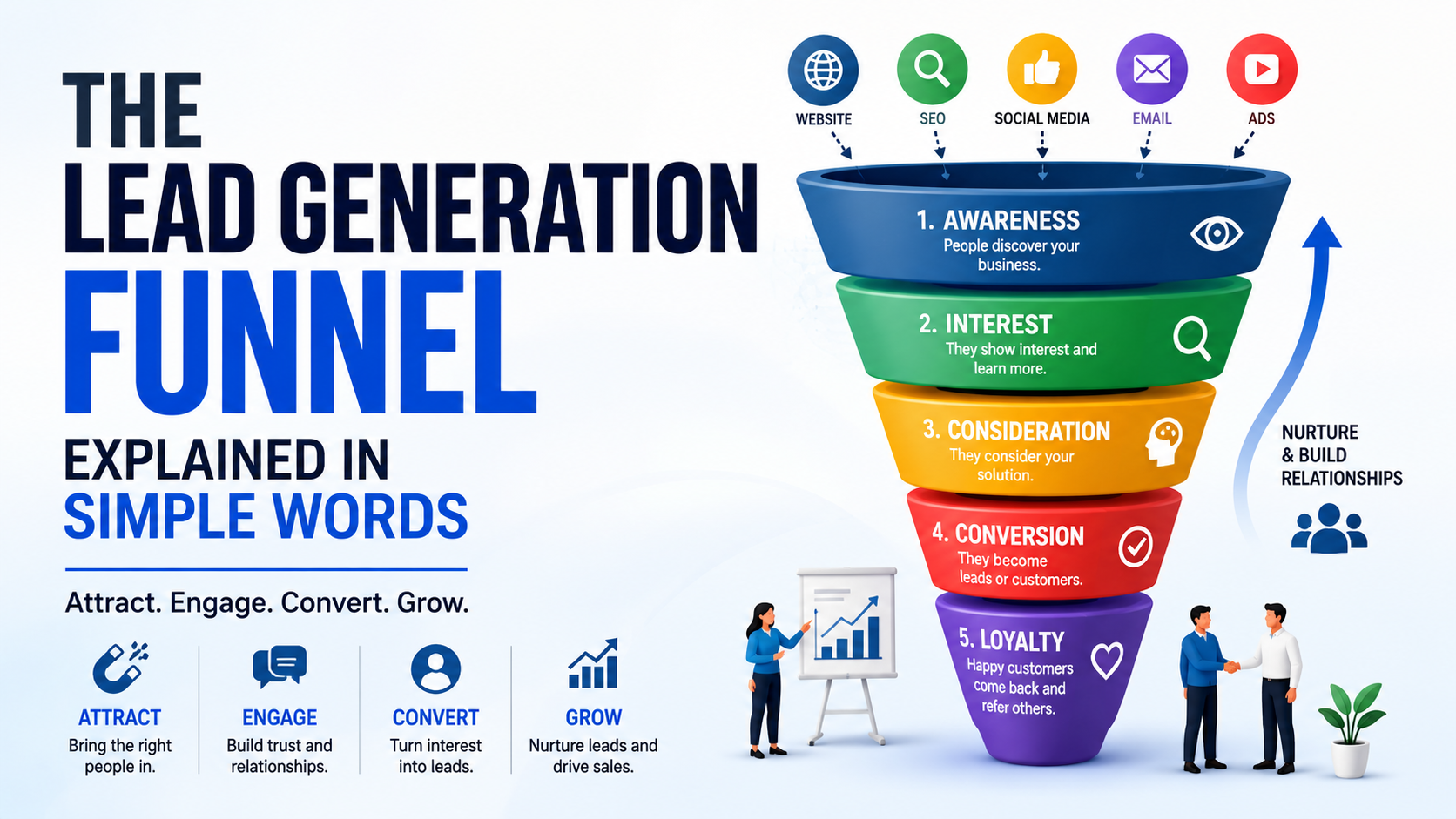
I explained the short version in my complete lead generation guide, and it has four stages:
Stranger. They do not know you exist.
Visitor. They found you and are looking at you.
Lead. They contacted you or shared their contact info.
Customer. They paid you.
It is called a funnel because the numbers shrink at every stage. Lots of strangers, fewer visitors, fewer leads, fewer customers. That shrinking is normal. Every business on earth loses people at every stage.
The question that changes everything is not “am I losing people?” You are. The question is “where am I losing an unusual amount of people?” That one spot is your leak, and your leak is where all your effort should go.
Walking Through the Four Stages
Stage 1: Stranger to Visitor
This is visibility. Someone searches “fence company near me,” scrolls Facebook, or hears your name from a neighbor, and ends up looking at your website, your Google Business Profile, or your page.
What feeds this stage: local search rankings, reviews, ads, social posts, word of mouth, your truck wrap sitting in traffic.
How to measure it: website visits (your analytics show this), Google Business Profile views (free in the profile dashboard), profile visits on social.
If this stage is broken, the symptom is silence everywhere. Nobody visits, nobody calls, nothing. You do not have a conversion problem, you have an invisibility problem.
Stage 2: Visitor to Lead
This is capture, and it is the stage my fence installer had broken. An interested human is looking at you right now, and the only question is whether contacting you is easy and worth it.
What feeds this stage: a visible phone number, a short form, clear services and service area, photos of real work, reviews that calm nerves, a reason to act like “free quotes this month.”
How to measure it: divide monthly leads by monthly visitors. If 900 people visit and 4 reach out, that is roughly half of one percent. For a local service site, something between 2 and 5 percent is a reasonable expectation. He was leaving about 25 inquiries a month on the table.
Stage 3: Lead to Customer
This is closing. They reached out, now it is conversations, quotes, and follow up.
What feeds this stage: fast response, showing up when promised, a clear quote, and follow up after the quote. Knowing which leads are hot and which are warm matters a lot here, I wrote a full piece on lead types that pairs well with this one.
How to measure it: divide customers by leads. Ten inquiries becoming three jobs is a 30 percent close rate, which is healthy for many local services. Ten inquiries becoming one job means something in your sales conversation, pricing, or follow up needs attention.
Stage 4: After the Customer (The Stage Everyone Forgets)
Textbook funnels end at purchase. Real businesses should not. A happy customer can feed the top of your funnel through reviews and referrals, which makes the whole machine cheaper over time. One review request text after every job is funnel work, even if no diagram shows it.
How to Find Your Leak in One Evening
Grab three numbers for last month. Do not aim for perfect data, close enough is fine:
- Visitors: website visits plus Google Business Profile views
- Leads: every call, form, and message asking about work
- Customers: jobs actually booked
Now look at the two gaps:
- Visitors but almost no leads? Your capture stage leaks. Fix the website basics first.
- Leads but few customers? Your closing stage leaks. Fix response speed and follow up first.
- Barely any visitors at all? Your visibility stage leaks. Fix your Google Business Profile and reviews first.
One evening, three numbers, and you know exactly what deserves your next month of effort. Compare that to the usual approach: feeling anxious, buying ads, and hoping.
A warning from experience: fix one stage at a time, starting with the one closest to the money. If both capture and visibility are weak, fix capture first. There is no point paying to pour more visitors into a bucket with a hole in it.
What Happened With the Fence Installer
We did not touch his traffic at all. Same 900 visitors. We put his phone number in the header, cut the form to three fields (name, phone, what do you need), added twelve photos of finished fences, and put his four best reviews on the homepage.
The next month he had 19 inquiries. The month after, 24. Same marketing spend, which was zero. He then had a brand new problem: his closing stage got sloppy because he was not used to that many quotes, so we built him a simple follow up habit for stage three. That is how funnel work goes. You fix one stage, volume moves to the next stage, and you fix that one. It never really ends, and each round makes the business stronger.
Funnel Mistakes I See Constantly
Pouring traffic on a broken funnel. Running ads while your form is broken on mobile is paying money to disappoint strangers at scale. Always check stages two and three before spending on stage one.
Measuring nothing. Without those three numbers, every marketing decision is a guess dressed up as a plan. A notebook by the phone counts as a measurement system. Start there.
Fixing the fun stage instead of the broken one. Owners love redesigning websites and posting content. Almost nobody enjoys tightening up their quote follow up. The funnel does not care which stage is fun.
Assuming the leak is where it was last year. Funnels change. A competitor with 200 reviews moves into town, and suddenly your capture rate drops because trust moved. Re-check the numbers every few months.
Making it too complicated. I have seen owners with seven stage funnels, color coded, in software they pay $99 a month for, who could not tell me their close rate. Four stages and three numbers beat a beautiful system nobody maintains.
The Funnel Is a Flashlight
That is really all it is. Not a strategy, not a magic system, just a flashlight that shows you where the customers you have already earned are slipping away.
The fence installer thought he needed more marketing. He needed a shorter form. Somewhere in your business, there is probably a version of that eleven field form quietly costing you jobs, and the three numbers will point straight at it.
Pull last month’s numbers tonight. Find the biggest gap. Spend the next thirty days on that one stage and nothing else. That is funnel work, and it is the highest paying afternoon most business owners never do.