A small-business owner once showed me an advertising report that looked impressive at first glance.
The campaign had generated 18 leads from roughly $500 in ad spend. The dashboard displayed a cost per lead of less than $28, which sounded like a good result.
Then we looked at the actual enquiries.
Several people had submitted incorrect phone numbers. A few were looking for jobs. Others lived outside the company’s service area. Only two seemed genuinely interested in buying.
That $28 cost per lead suddenly did not feel so affordable.
This is where many small businesses get confused about lead generation costs. The amount displayed inside Google Ads or Meta Ads Manager is only one part of the expense. You also have to consider the website, landing page, creative work, tracking software, campaign management and the time spent following up.
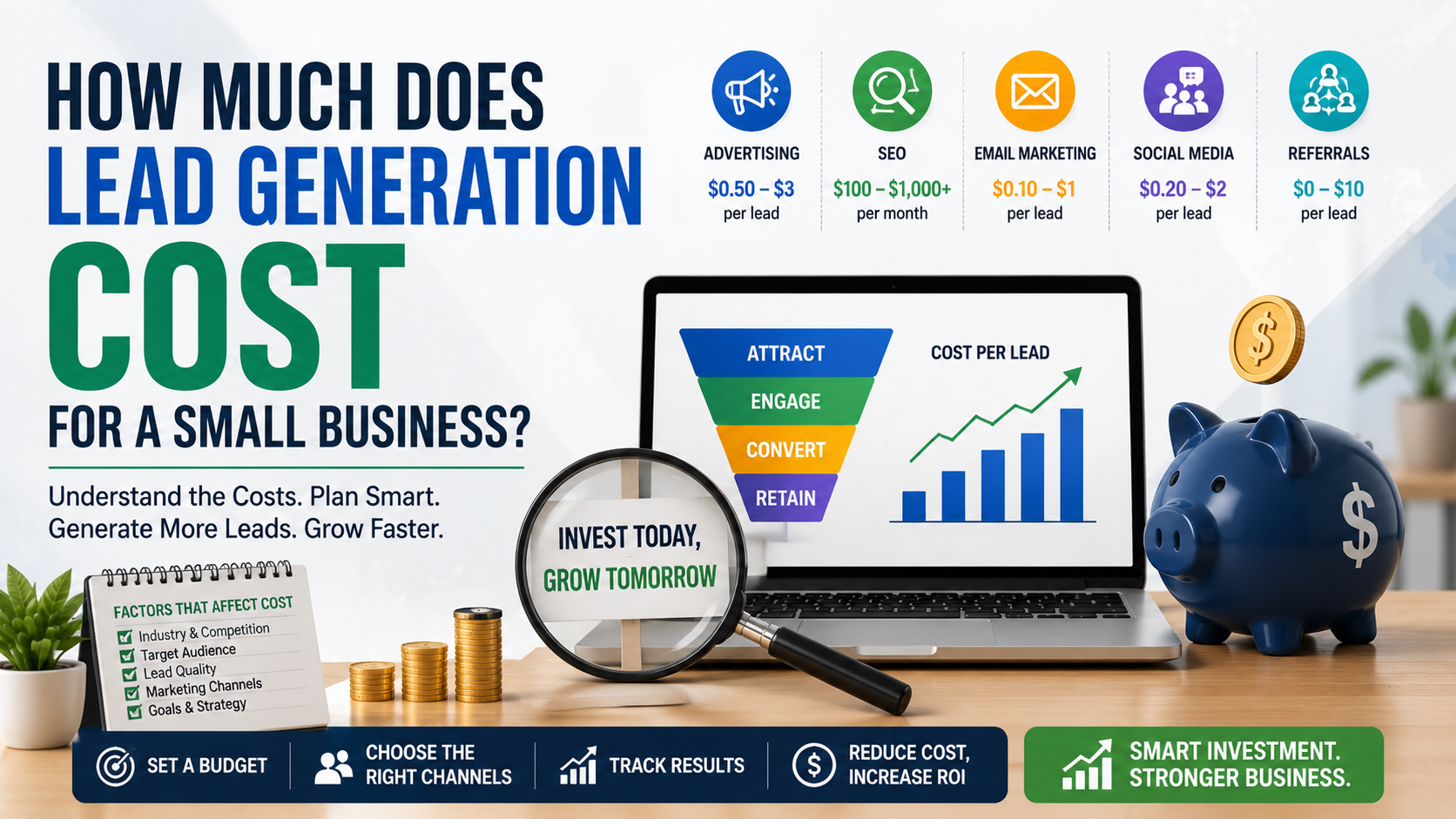
For most small businesses, lead generation can cost anywhere from a few hundred dollars per month for a simple do-it-yourself system to several thousand dollars for a professionally managed campaign.
The more useful question is not simply, “How much does a lead cost?”
It is:
How much does it cost to generate a qualified lead who has a realistic chance of becoming a customer?
What Counts as a Lead Generation Cost?
When someone says they are spending $1,000 per month on lead generation, they often mean they are spending $1,000 on ads.
That does not necessarily mean their total lead generation cost is $1,000.
A complete lead generation system may include:
- Advertising spend
- Campaign setup
- Landing page design
- Website improvements
- Ad images or videos
- Copywriting
- Call tracking
- Form tracking
- CRM software
- Email or SMS follow-ups
- Agency or freelancer fees
- Sales staff time
Some businesses already have a fast website, professional branding and a working CRM. Others need to build everything from scratch.
That is why two companies can use the same advertising platform and end up with completely different costs.
A plumber with a strong local reputation, hundreds of reviews and a good website may convert traffic quickly. A new plumbing company with no reviews and a slow website may pay for the same clicks but receive far fewer enquiries.
The advertising platform is only bringing people to the door. The rest of the system still has to convince them to come inside.
How Much Does a Lead Usually Cost?
There is no universal cost per lead.
The price changes based on your industry, location, offer, competition, sales value and advertising platform.
Current benchmark data gives us a useful starting point. WordStream’s 2025 Google Ads benchmark report placed the average Google Search Ads cost per lead across industries at approximately $70.11. Some industries were considerably more expensive. Legal services averaged more than $130 per lead, while business services averaged more than $100.
Meta advertising is often cheaper at the initial lead stage. Recent benchmark data placed the average cost per lead for Meta lead campaigns at approximately $27.66, although the quality and buying intent of these leads can vary.
These figures should not be treated as guaranteed prices.
A $20 lead could be expensive if none of the leads answer the phone. A $120 lead could be profitable if one out of every four leads becomes a $5,000 customer.
The value of the lead matters more than the price alone.
A Practical Small-Business Lead Generation Budget
Instead of choosing a random monthly amount, it helps to think in three budget levels.
1. Lean DIY Budget: $300 to $800 per Month
This level is suitable for a business owner who is willing to do most of the work.
You might use:
- A simple landing page on your existing website
- One advertising platform
- Basic images created in Canva
- Google Sheets or a simple CRM to track enquiries
- Manual phone, email and WhatsApp follow-up
- A small local advertising campaign
At this level, there may not be enough budget to test several audiences, keywords, offers and creative ideas at the same time.
It can still work, particularly for a niche local service with low competition. However, the owner needs to monitor the campaign closely.
A common mistake is splitting a small budget across too many channels. Spending $200 on Google, $150 on Facebook, $100 on Instagram and $100 on another directory rarely gives any platform enough data to perform properly.
It is usually better to test one channel properly than to run four weak campaigns.
2. Focused Growth Budget: $1,000 to $2,500 per Month
This is a more practical testing range for many local service businesses.
The budget may cover:
- $700 to $1,800 in advertising
- A dedicated landing page
- Several ad variations
- Conversion and call tracking
- Basic campaign management
- A structured follow-up process
At this level, a business can start learning which keywords, services, locations and offers produce the best enquiries.
For example, a roofing company may discover that “emergency roof repair” generates expensive clicks but converts quickly. A broader keyword such as “roofing company” may attract more traffic but include people researching prices, jobs or do-it-yourself repairs.
Without enough budget and tracking, both keywords may look the same.
With proper data, the company can move money toward the searches that generate booked inspections rather than just form submissions.
3. Professionally Managed Budget: $3,000 to $7,500+ per Month
This level is more suitable for businesses operating in competitive markets or targeting several locations.
The total might include:
- Google Ads
- Meta retargeting
- Landing page testing
- Professional copy and creative
- CRM automation
- Call recording or call tracking
- Agency or specialist fees
- Search engine optimization
- Regular reporting
A larger budget does not automatically create better results.
It simply gives the business more opportunities to test, learn and scale. If the offer is weak or the sales team responds slowly, increasing the budget may only produce more wasted leads.
Google Ads Lead Generation Costs
Google Ads works particularly well when people are already searching for a service.
Someone searching for “emergency electrician near me” has a clear and immediate need. That level of intent is valuable, which is also why the click can be expensive.
Google Search Ads costs usually depend on:
- Keyword competition
- Geographic location
- Ad relevance
- Landing page quality
- Industry
- Device type
- Time of day
- Conversion history
Google recommends setting an average daily budget of at least three times the expected cost per acquisition for certain conversion-focused campaigns. Google also notes that campaign spending can reach up to twice the average daily budget on higher-traffic days, with spending balanced across the month.
This creates a practical problem for small businesses.
Suppose you expect a qualified lead to cost $50. A very small daily budget of $10 may not provide enough room for Google to generate and optimize conversions consistently.
That does not mean every business must immediately spend $150 per day. It means the budget should be realistic compared with the price of the keywords and the expected lead cost.
Before launching Google Ads, check the average cost per click for your main keywords using Google Keyword Planner.
Then estimate how many clicks may be required for one enquiry.
For example:
- Expected cost per click: $5
- Landing page conversion rate: 10%
- Estimated clicks needed per lead: 10
- Estimated cost per lead: $50
If the campaign receives only two or three clicks per day, it may take several days to produce one lead. That makes testing slow and can lead to premature decisions.
Facebook and Instagram Lead Generation Costs
Meta Ads can generate leads through Facebook and Instagram, even when people are not actively searching for your service.
This makes the creative and offer extremely important.
A person scrolling through Instagram was probably not planning to request a kitchen renovation quote at that exact moment. The advertisement has to interrupt the scroll, create interest and give the person a reason to act.
Meta recommends starting with a budget of at least $5 and running an advertisement for more than six days so its delivery system has time to find suitable users.
That may be enough to publish a campaign, but it is not always enough to judge whether the channel can produce profitable customers.
For a meaningful local test, the campaign needs enough budget to generate multiple leads. Judging an entire campaign after one or two enquiries is unreliable.
Meta leads can look inexpensive because users can submit a form without leaving Facebook or Instagram. The downside is that easy forms sometimes attract people with weak intent.
I have seen this pattern many times in campaign reviews:
- The ad generates a large number of leads.
- The reported cost per lead looks excellent.
- The sales team complains that nobody answers.
- The business assumes Meta Ads do not work.
The problem is often the process rather than the platform.
Adding one or two qualifying questions can reduce the number of leads but improve their quality. Asking for the project location, required service or estimated timeline creates a small amount of friction.
That friction can be helpful.
A form that is too easy to complete may generate more names. A slightly more thoughtful form may generate more conversations.
SEO Lead Generation Costs
Search engine optimization works differently from paid advertising.
You are not paying Google for every click. Instead, you are investing in content, technical improvements, local visibility, links and website authority.
SEO expenses may include:
- Keyword research
- Technical website fixes
- Service page creation
- Blog content
- Google Business Profile optimization
- Local citation work
- Link acquisition
- Reporting and analytics
SEO can become a valuable long-term source of leads, but it is rarely an instant solution.
A new website in a competitive industry may need months of consistent work before organic traffic turns into regular enquiries. An established local business may see progress sooner because it already has reviews, brand searches and some authority.
One lesson worth remembering is that cheap SEO can become expensive later.
Publishing dozens of thin, repetitive location pages may create the appearance of progress, but those pages often provide little value to users. Cleaning up duplicated or poorly written content can cost more than producing useful pages correctly from the beginning.
SEO works best when the content answers real customer questions.
A pest control company, for example, can create useful pages explaining treatment options, preparation steps, safety concerns, pricing factors and signs of infestation. That content helps customers while also giving search engines a clearer understanding of the company’s expertise.
Email Outreach Costs
Email outreach can be affordable, especially for business-to-business companies.
The basic expenses may include:
- Prospect data
- Email verification
- Sending software
- Additional email domains
- Copywriting
- Personalization
- Appointment scheduling
- Staff time
The software is often not the largest expense.
Finding the right prospects and writing relevant messages takes more effort than most people expect.
Sending 5,000 generic emails is not automatically better than sending 300 carefully targeted messages. A smaller list of companies that genuinely need your service can outperform a huge database of random contacts.
The biggest mistake is treating email outreach like a volume contest.
Poor targeting leads to low response rates, spam complaints and damaged domain reputation. Good outreach starts with a clear reason for contacting each type of prospect.
The Cost People Forget: The Landing Page
Businesses often spend thousands on advertising and send visitors to a slow, cluttered homepage.
The homepage may contain ten services, a company history, staff photos, social links, several menus and no clear next step.
A lead generation landing page should be simpler.
It needs to answer:
- What service is being offered?
- Who is it for?
- Why should the visitor trust the business?
- What should the visitor do next?
- What happens after they submit the form?
Useful landing page elements include:
- A clear headline
- A short explanation of the service
- Real project images
- Customer reviews
- Service area information
- A visible phone number
- A short enquiry form
- A clear call to action
- A privacy notice
- Fast mobile performance
Tools such as Google Analytics 4, Google Tag Manager and Microsoft Clarity can help identify where visitors leave or struggle. Call-tracking platforms can show which campaigns generate actual phone conversations.
Google also recommends mapping the complete journey from lead to sale rather than optimizing only for the initial form submission.
That advice matters because the cheapest form submission is not always the most valuable lead.
Calculate Your Real Cost per Lead
The basic cost-per-lead formula is:
Total campaign cost ÷ Number of leads = Cost per lead
But small businesses should calculate at least three different figures.
Advertising Cost per Lead
This includes only the advertising spend.
Suppose you spend $1,500 and receive 30 form submissions.
Your advertising cost per lead is:
$1,500 ÷ 30 = $50
Total Cost per Lead
Now include the other expenses:
- Advertising: $1,500
- Landing page: $800
- Campaign management: $600
- Tracking tools: $100
The total cost is $3,000.
Your total cost per lead becomes:
$3,000 ÷ 30 = $100
Customer Acquisition Cost
Now suppose only 12 of the leads were qualified, five booked an appointment and two became customers.
Your customer acquisition cost is:
$3,000 ÷ 2 = $1,500
Whether that is good or bad depends on the value of a customer.
If each customer generates $800 in revenue, the campaign has a serious problem.
If each customer generates $8,000 initially and continues buying for several years, a $1,500 acquisition cost may be reasonable.
How to Set a Lead Generation Budget Step by Step
Step 1: Know the Value of a Customer
Start with your average sale value.
Then consider repeat purchases, profit margin and customer lifetime.
Revenue alone can be misleading. A $2,000 project with a very low profit margin may not support an expensive lead generation campaign.
Step 2: Estimate Your Closing Rate
Look at your recent sales data.
If you receive ten qualified enquiries, how many normally become customers?
Do not use your best-ever month. Use a realistic average.
Step 3: Calculate Your Maximum Affordable Lead Cost
Suppose:
- Average gross profit per customer: $1,200
- Desired acquisition cost: no more than 25% of gross profit
- Maximum customer acquisition cost: $300
- Closing rate: one customer from every five qualified leads
Your maximum affordable qualified lead cost would be:
$300 ÷ 5 = $60
That figure gives you a more useful target than copying an industry benchmark.
Step 4: Choose One Primary Channel
Choose the channel that matches customer behaviour.
Use Google Search when people actively search for the service.
Use Meta when the service benefits from strong visual content, local targeting or an attractive offer.
Use SEO when long-term organic visibility matters.
Use email outreach when you can identify specific companies and decision-makers.
Step 5: Build Tracking Before Launching
Test every form, phone number and confirmation page.
Record where each lead came from.
At minimum, track:
- Campaign source
- Service requested
- Location
- Lead status
- Contact outcome
- Appointment status
- Sales result
- Revenue
A basic CRM is much better than relying on memory or scattered WhatsApp conversations.
Step 6: Run the Test Long Enough
Do not pause a campaign after two days because it has not produced a sale.
At the same time, do not leave an obviously broken campaign running for months.
Look for early warning signs such as irrelevant search terms, clicks from the wrong locations, broken forms or a high number of unqualified enquiries.
The goal of the first campaign is not only to make money. It is also to learn what customers respond to.
Step 7: Improve the Weakest Part
Do not automatically blame the advertising platform.
If people click but do not submit the form, review the landing page.
If they submit forms but do not answer, improve lead qualification and follow-up speed.
If they book meetings but do not buy, review pricing, sales calls and expectations.
Lead generation is a chain. Improving the weakest link often produces better results than simply increasing the advertising budget.
Common Lead Generation Mistakes
Measuring Every Form as a Successful Lead
A form submission is only the beginning.
Separate valid prospects from spam, job seekers, existing customers and people outside your service area.
Responding Too Slowly
A person requesting quotes may contact several businesses within minutes.
Waiting until the next day gives competitors time to start the conversation first.
Set up instant email or SMS notifications and define who is responsible for responding.
Buying Leads Without Asking How They Are Generated
Some lead providers sell the same enquiry to several businesses.
Others generate leads using broad offers that attract people with little buying intent.
Ask whether the lead is exclusive, how it is verified and what qualifies it as relevant.
Changing Everything at Once
If you change the targeting, advertisement, budget, landing page and offer on the same day, you will not know what caused the result.
Make controlled changes and keep notes.
Focusing Only on Cheap Leads
Cheap leads feel satisfying in a report.
Qualified opportunities and profitable customers are what pay the bills.
A campaign generating 50 leads at $20 each may be worse than a campaign generating 15 leads at $60 each if the second group produces more sales.
So, What Should a Small Business Spend?
A very small business can start testing lead generation with a few hundred dollars, especially when the owner handles the setup and follow-up.
For many established local businesses, a total monthly budget of $1,000 to $2,500 provides more room for a useful single-channel test.
Competitive industries, multiple service areas and professionally managed campaigns may require $3,000 to $7,500 or more per month.
These are planning ranges, not guaranteed market prices.
The correct amount depends on your customer value, close rate and local competition.
Start with a budget you can afford to test without putting the business under financial pressure. Track every enquiry through to the final sale. Once you know that spending one dollar reliably returns more than one dollar in profit, scaling becomes a much safer decision.
Lead generation does not become affordable simply because the cost per lead is low.
It becomes affordable when the right people contact your business, your team follows up properly, and enough of those conversations turn into profitable customers.