A business owner buys 50 leads from a lead-generation company.
The spreadsheet arrives the same afternoon. It contains names, phone numbers, email addresses and a short note about what each person supposedly needs.
For a moment, it feels like the hard part is over.
Then the calling starts.
Ten people do not answer. Six say they never requested the service. A few have already spoken to three competitors. Several are outside the service area. By the end of the week, the business owner has spent money, made dozens of calls and closed only one small job.
This does not mean buying leads never works.
It means the number of leads in a spreadsheet tells you very little about the actual value of those leads.
Generating your own leads creates a different set of problems. You have to build campaigns, write advertisements, improve your website, install tracking and wait for results. It takes longer and usually requires more effort at the beginning.
However, the business controls the process.
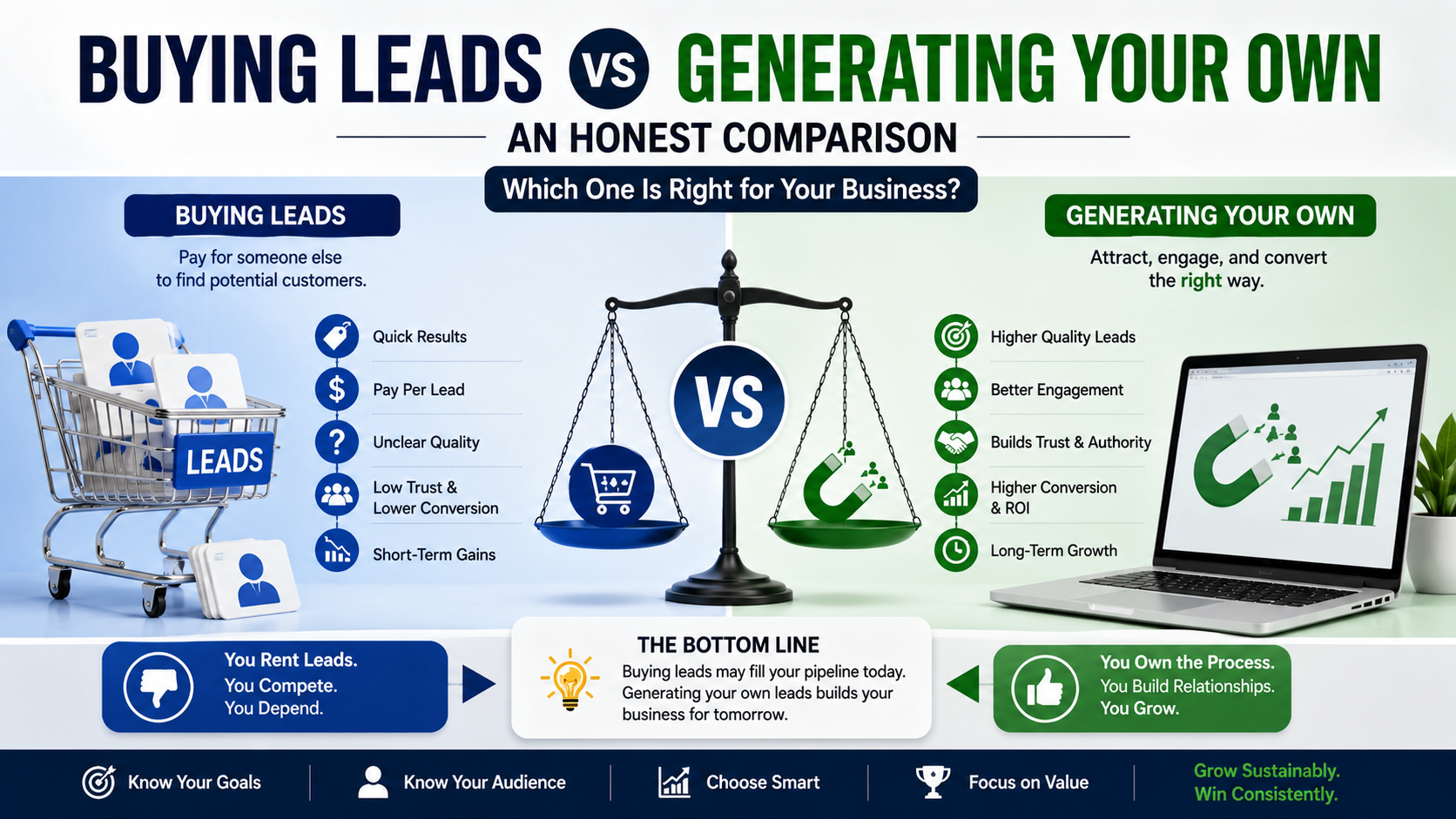
That difference—speed versus control—is at the centre of the buying leads vs generating your own leads debate.
Neither option is automatically better. The right choice depends on your budget, industry, sales process, location and how quickly you need new opportunities.
What Does Buying Leads Actually Mean?
Buying leads usually means paying another company for the contact information of potential customers.
These leads may come from:
- Comparison websites
- Quote-request websites
- Business directories
- Affiliate websites
- Facebook or Google advertising campaigns
- Call centres
- Data providers
- Industry-specific marketplaces
- Appointment-setting companies
The provider generates the enquiry and then sends the information to your business.
You may pay per lead, per call, per appointment or through a monthly package.
For example, a roofing company might pay $40 for each homeowner who requests a roof inspection. A software company might pay $150 for a booked demonstration with a decision-maker. A real estate agent might purchase a monthly package containing buyer and seller enquiries.
The important detail is whether the lead is exclusive.
An exclusive lead is normally sent to one business. A shared lead may be sold to several companies at the same time.
Shared leads are usually cheaper, but they create an immediate race.
By the time you call, the prospect may already be speaking with three competitors.
What Does Generating Your Own Leads Mean?
Generating your own leads means building and controlling the system that attracts potential customers.
This may involve:
- Google Ads
- Facebook and Instagram Ads
- Search engine optimization
- Google Business Profile
- LinkedIn outreach
- Cold email
- Referral campaigns
- Website content
- YouTube videos
- Webinars
- Local partnerships
- Landing pages
- Email marketing
Instead of paying a provider for a completed contact record, you pay for the tools, traffic, content and work required to create the enquiry.
The lead comes directly to your business.
You control the advertisement, message, form, targeting, follow-up and customer data.
This does not guarantee better leads. Poor targeting can still produce irrelevant enquiries.
The difference is that you can see what is happening and make changes.
Buying Leads Can Get You Started Quickly
The biggest advantage of buying leads is speed.
You do not have to wait for a website to rank in Google. You do not need to spend several weeks testing advertisements. You may be able to purchase a package and start calling prospects the same day.
That can be useful for:
- A newly launched business
- A salesperson with an empty pipeline
- A seasonal company entering its busiest period
- A company testing a new service
- A business expanding into a new location
- A contractor with available capacity
- A team that is good at sales but weak at marketing
Suppose a home renovation company has two project slots available next month.
Building an SEO strategy will not fill those slots quickly. Purchasing qualified renovation enquiries could be a reasonable short-term option.
The business gets immediate conversations and learns what customers are currently asking for.
This speed is valuable, but only when the leads are relevant and the sales team responds quickly.
The Quality of Purchased Leads Varies Wildly
The phrase “qualified lead” can mean almost anything.
To one provider, a qualified lead may be someone who entered a phone number into a form.
To another, it may be someone who confirmed their budget, location, timeline and purchasing authority during a phone call.
Those are completely different products.
Before buying leads, ask the provider what actually happens before the lead reaches you.
Useful questions include:
- Where do the leads come from?
- What advertisement or offer generates them?
- Are the leads exclusive?
- How many businesses receive each lead?
- How old are the leads?
- Are phone numbers verified?
- Is the service area confirmed?
- Are budget and timeline questions included?
- What happens if a lead is fake or invalid?
- Can you reject duplicate leads?
- Does the provider record consent?
- Can you see the original landing page?
A provider that refuses to explain its process should make you cautious.
You do not necessarily need access to every technical detail. However, you should know what the prospect saw and what they agreed to.
A person who requested “a free home improvement guide” is not the same as someone who requested “a quote for a kitchen remodel.”
Both may be described as kitchen renovation leads, but their intent is completely different.
Purchased Leads Often Come With Competition Attached
This is the part many businesses underestimate.
A shared lead is not just a lead. It is a small sales competition.
The prospect may receive calls from several companies within minutes.
That changes the conversation.
Instead of speaking with someone who has discovered your business and chosen to contact you, you are speaking with someone comparing multiple options.
Price becomes more important. Response speed becomes more important. Reviews become more important. The salesperson’s confidence becomes more important.
A shared lead can still convert, but the business needs a strong process.
Ideally, the first response should happen within minutes, not several hours later.
Tools such as HubSpot, Pipedrive and Zoho CRM can automatically assign new leads to a salesperson. Zapier or Make can connect a lead provider’s form to your CRM. Twilio can trigger a text message. Calendly can help the prospect book an appointment without waiting for a phone call.
Even a simple setup using Google Sheets, Gmail and WhatsApp Business is better than letting purchased leads sit unread in an inbox.
Speed does not fix poor lead quality, but slow follow-up can ruin a good lead.
Generating Your Own Leads Gives You More Control
When you generate leads yourself, you control the entire customer journey.
You choose:
- Who sees the offer
- What the advertisement says
- Which services are promoted
- Which locations are targeted
- What questions appear on the form
- Where the lead information is stored
- How quickly the follow-up starts
- Which results are measured
This control makes improvement possible.
Suppose a landscaping company runs Google Ads and receives too many enquiries for lawn mowing, while it wants larger garden design projects.
The company can adjust its keywords, rewrite the advertisement, change the landing page and add a minimum project budget question.
With purchased leads, the company may have to accept whatever the provider sends.
That is one of the biggest long-term disadvantages of relying entirely on lead vendors. The business receives the result but learns very little about how the result was created.
When you control the campaign, even a disappointing month can provide useful information.
You learn which services people search for, which locations respond, which offers get attention and which questions improve lead quality.
Generating Leads Yourself Usually Takes Longer
Control comes with responsibility.
Running your own lead-generation campaigns requires more than opening a Google Ads account and adding a credit card.
You may need:
- A clear offer
- A fast website
- A dedicated landing page
- Advertisement copy
- Images or videos
- Keyword research
- Audience targeting
- Conversion tracking
- Call tracking
- A CRM
- Follow-up messages
- Regular campaign reviews
This is where many businesses waste money.
They launch a campaign without installing proper tracking. Leads arrive through phone calls, contact forms, direct messages and WhatsApp, but nobody records which campaign produced each sale.
After three months, the owner knows how much was spent but cannot explain what worked.
Tools such as Google Analytics 4, Google Tag Manager, Meta Pixel and CallRail can help connect enquiries to their original source.
A small business does not need a complicated reporting system.
A spreadsheet with these columns can be enough:
- Lead name
- Date received
- Lead source
- Service requested
- Location
- Qualified or unqualified
- Appointment booked
- Sale won or lost
- Revenue
- Reason lost
The important part is following the lead beyond the initial form submission.
A campaign with expensive leads may still be profitable if those leads close at a high rate. A campaign with cheap leads may be wasting money if nobody buys.
Comparing the Real Costs
Buying leads can appear cheaper because the price is easy to understand.
You might pay $50 per enquiry.
Generating your own leads has several costs:
- Advertising spend
- Landing page creation
- Website hosting
- CRM software
- Call tracking
- Creative work
- Campaign management
- Staff time
At first, generating your own leads may cost more.
However, the cost structure changes over time.
A landing page created this month can continue generating leads next month. A useful article may attract search traffic for years. A retargeting audience becomes more valuable as more people visit your website. Email subscribers can be contacted again without paying for the same lead a second time.
Purchased leads usually stop when the payments stop.
That does not make lead buying bad. It simply means you are renting access to demand rather than building your own source of demand.
A Simple Cost Example
Imagine two local air-conditioning companies.
Company A Buys Leads
The company buys 40 shared leads at $35 each.
Total lead cost:
40 × $35 = $1,400
Out of the 40 leads:
- 20 answer the phone
- 10 are qualified
- 5 book appointments
- 2 become customers
Customer acquisition cost:
$1,400 ÷ 2 = $700
Company B Generates Its Own Leads
The second company spends:
- $1,000 on Google Ads
- $500 on campaign management
- $400 on a landing page
- $100 on call tracking
Total first-month cost:
$2,000
It receives 25 leads and closes four customers.
Customer acquisition cost:
$2,000 ÷ 4 = $500
The first month is only part of the picture.
In the second month, the landing page has already been built. If advertising and management costs remain $1,500 and the company closes another four customers, its acquisition cost drops to $375.
Real campaigns are rarely this neat, but the example shows why cost per lead alone is not enough.
You need to calculate cost per customer.
Lead Ownership Is More Important Than It Sounds
When you generate leads yourself, the customer relationship begins with your business.
The prospect visits your website, sees your branding, reads your reviews and submits your form.
When you buy a lead, the relationship may begin with someone else’s website.
The prospect may remember the comparison platform but not your company.
This affects trust.
It also affects long-term marketing.
A lead generated through your own website can enter your CRM, receive useful follow-up emails and become part of your first-party audience, provided you handle consent and privacy correctly.
You may be able to market related services later.
For example, a company that installs security cameras may later offer maintenance plans, access control systems or upgrades.
With purchased data, your usage rights may be limited. Always check the provider’s terms and applicable privacy rules before adding purchased contacts to long-term marketing campaigns.
A person agreeing to receive one quote has not necessarily agreed to receive promotional emails for the next two years.
When Buying Leads Makes Sense
Buying leads can be a reasonable decision when:
You Need Opportunities Immediately
A business with available staff and no active pipeline may not have time to wait for SEO or content marketing.
You Have a Strong Sales Team
Purchased leads often require confident, fast follow-up.
A business that answers quickly, asks good questions and handles objections well may outperform competitors using the same lead source.
The Provider Offers Genuine Exclusive Leads
Exclusive leads normally cost more, but they reduce the competition surrounding each enquiry.
You Are Testing a New Market
Buying a small number of leads can help you learn whether there is demand before building a complete marketing system.
The Numbers Are Profitable
The final decision should come from the data.
If purchased leads consistently produce profitable customers, there is no rule saying you must stop using them.
When Generating Your Own Leads Makes More Sense
Building your own system is usually the stronger option when:
You Want Long-Term Growth
Your website, content, audience data and campaign history become business assets.
Brand Trust Matters
People buying expensive or sensitive services often research the company before making contact.
Your own website gives you more control over credibility.
Your Service Requires Detailed Qualification
A custom form can ask about budget, location, timeline, property type, team size or technical requirements.
You Want to Improve Lead Quality
You can adjust targeting and messaging based on actual sales data.
You Are Tired of Competing for Every Enquiry
Direct leads are not guaranteed to be exclusive in the broader sense—the customer may still contact other companies—but they have chosen to contact your brand directly.
That creates a different starting point for the conversation.
A Hybrid Approach Often Works Best
The choice does not have to be permanent.
Many businesses use purchased leads for short-term pipeline needs while building their own marketing system.
For example:
- Buy a limited number of exclusive leads each month
- Run Google Ads for high-intent searches
- Improve the Google Business Profile
- Publish useful service pages
- Collect customer reviews
- Build an email follow-up system
- Reduce dependence on purchased leads gradually
This approach gives the business immediate opportunities without making the lead provider its only source of new customers.
Depending on one source is risky.
A provider can increase prices. Google can change advertising costs. A social account can be restricted. Search rankings can move. A referral partner can stop sending work.
A healthier pipeline usually includes several lead sources.
The difference is that each source should be measured separately.
How to Test a Lead Provider Without Wasting a Large Budget
Do not begin with the biggest package because the salesperson offers a discount.
Start with a controlled test.
Step 1: Define a Qualified Lead
Write down the minimum requirements.
For example:
- Located within 30 miles
- Needs the correct service
- Has a working phone number
- Plans to start within three months
- Meets the minimum project budget
Without a written definition, the provider and the business may have completely different ideas about quality.
Step 2: Ask for a Small Test
Purchase enough leads to identify patterns, but do not commit to a long contract before seeing the results.
Step 3: Contact Leads Quickly
Use CRM notifications, text messages and automatic email responses.
Do not evaluate fresh leads using a slow follow-up process.
Step 4: Record Every Outcome
Track whether each person answered, qualified, booked and purchased.
Step 5: Calculate Cost per Customer
Include the full lead cost and any sales labour required.
Step 6: Review the Rejection Policy
Check whether incorrect numbers, duplicates and irrelevant locations receive replacements or credits.
Step 7: Compare With Another Source
Run a small direct campaign at the same time when possible.
This gives you a more useful comparison than judging the provider in isolation.
How to Start Generating Your Own Leads
Building your own system does not require using every marketing channel.
Start with one.
Step 1: Choose a Specific Service
Do not advertise the entire business at once.
A general message such as “We provide complete business solutions” gives people very little reason to respond.
Promote one clear result.
Examples include:
- Emergency boiler repair
- Kitchen renovation consultations
- Tax preparation for freelancers
- Website design for dental clinics
- Commercial cleaning quotes
Step 2: Create a Focused Landing Page
The page should match the advertisement.
Include the service, location, proof, process and next step.
Remove distractions that do not help the visitor make a decision.
Step 3: Add Qualification Questions
Ask only what you need.
Long forms can reduce conversions, but forms that are too short may generate weak leads.
Step 4: Install Tracking
Track forms, phone calls and booked appointments before spending heavily.
Step 5: Set Up Fast Follow-Up
Send an immediate confirmation so the prospect knows the request was received.
Assign responsibility for the first human response.
Step 6: Review Search Terms and Lead Quality
Do not optimize only for cheaper conversions.
Look at which leads become customers.
Step 7: Improve One Part at a Time
Test a new headline, offer or audience without changing everything simultaneously.
Common Mistakes to Avoid
Assuming Every Purchased Lead Is Ready to Buy
Some people are researching. Others are comparing prices. A few may have submitted their information without fully understanding the offer.
Treat them as prospects, not confirmed customers.
Buying Old Leads Because They Are Cheap
A lead that was generated weeks ago may have already purchased, changed their mind or received dozens of calls.
Ask how quickly leads are delivered.
Ignoring the Sales Process
Marketing cannot compensate for unanswered calls, poor communication or unclear pricing.
Listen to sales calls and review why deals are lost.
Generating Leads Without a CRM
Leads disappear surprisingly quickly inside crowded inboxes and WhatsApp chats.
Even a simple CRM creates accountability.
Scaling Before Proving Profitability
More leads do not fix a weak offer or poor close rate.
Prove the numbers on a smaller budget first.
Comparing Lead Sources Using Cost per Lead Alone
Compare:
- Contact rate
- Qualification rate
- Appointment rate
- Close rate
- Customer acquisition cost
- Average sale value
- Profit
- Refund or cancellation rate
This gives you the real picture.
Which Option Is Better?
Buying leads is usually better for speed.
Generating your own leads is usually better for control, learning and long-term value.
Purchased leads can keep a sales team busy while a company develops its own marketing channels. They can also be profitable for businesses with fast response times and strong sales systems.
Generating your own leads takes longer, but the business builds something it owns: website traffic, campaign data, customer relationships, content, reviews and brand recognition.
The smartest choice is rarely based on whether a lead costs $30 or $80.
It comes down to what happens after the lead arrives.
Does the person answer?
Are they suitable for the service?
Do they book?
Do they buy?
Does the sale produce enough profit to justify the acquisition cost?
A cheap spreadsheet full of contacts is not automatically a good deal. A more expensive direct campaign is not automatically better either.
Test both options with clear tracking. Follow every lead through to revenue. Keep the source that produces profitable customers, and reduce the sources that only produce impressive-looking reports.