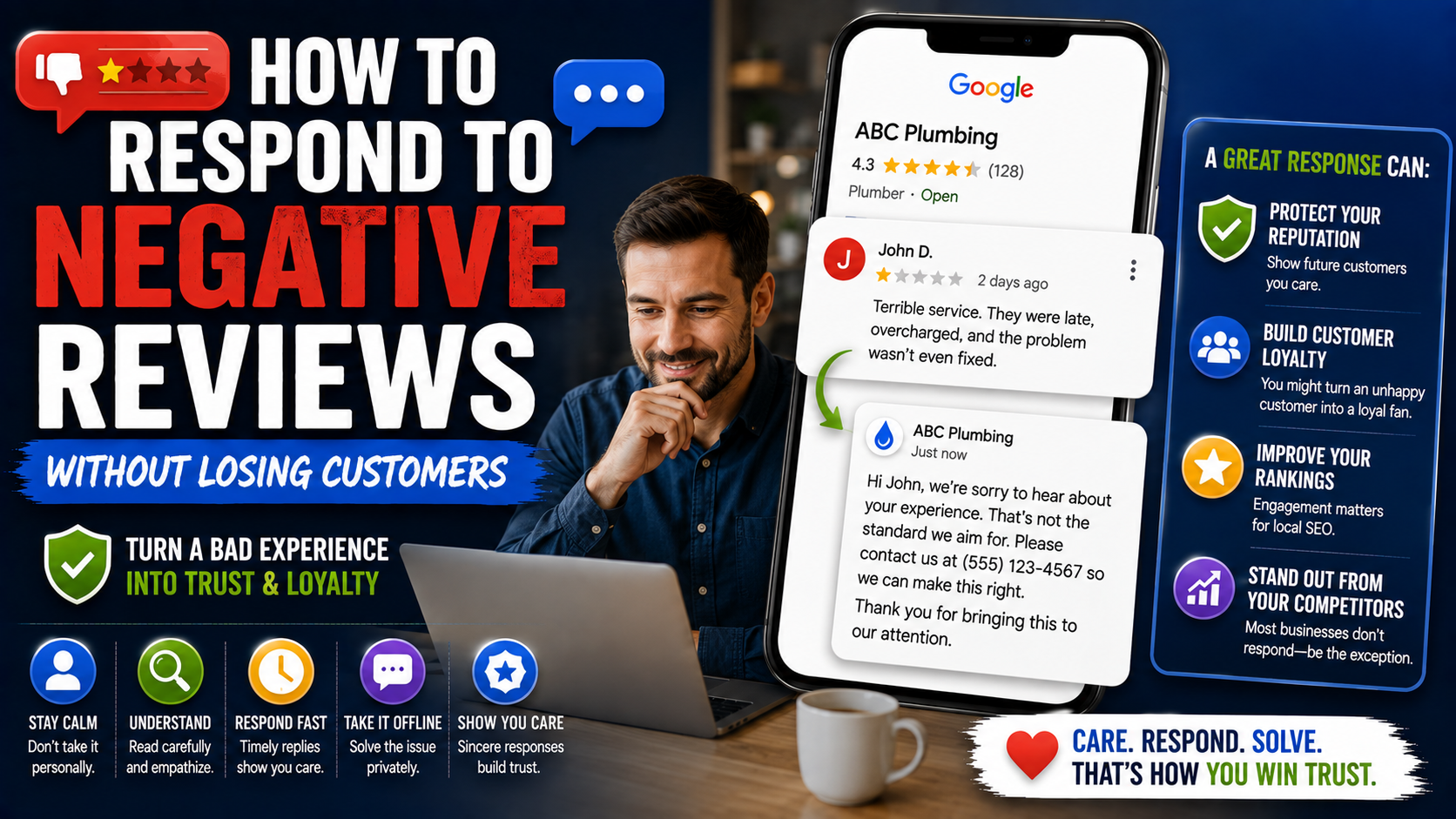
A moving company owner once showed me a reply he was about to post to a one star review. He was so proud of it. He had written four paragraphs explaining, point by point, why the customer was wrong, ending with a line about how “some people can never be pleased.”
I asked him one question: “Who is this reply for?”
He said, “For her. The reviewer.”
And that is the mistake almost every business owner makes. Your reply to a negative review is not for the reviewer. She has already decided. She left one star and moved on with her life. Your reply is for the two hundred strangers who will read that review over the next year while deciding whether to call you.
Once he understood that, he deleted his four paragraphs and wrote three calm sentences instead. That review is still on his profile today, and it has probably won him more customers than some of his five star reviews, because his reply made him look like exactly the kind of person you would trust with your furniture.
Let me walk you through how to do the same, because I have now helped dozens of business owners through this exact moment, and the panic is always the same and always fixable.
Why One Bad Review Is Not the Disaster It Feels Like
First, breathe. Here is something I tell every client: a profile with 47 five star reviews and 3 negative ones often converts better than a profile with 50 perfect ones.
Perfect looks fake. People have been burned by fake reviews, so a flawless wall of five stars raises quiet suspicion. A few negative reviews, each with a calm and professional reply underneath, prove two things at once: the reviews are real, and this business handles problems like an adult.
What actually damages you is not the negative review. It is one of three things: no reply at all, an angry reply, or a pattern of the same complaint appearing again and again. The first two are completely in your control. The third is free consulting, and I will come back to it.
Reviews are also one of the main pieces of how Google ranks local businesses, which I covered in my complete local SEO guide. So handling them well is not just reputation work. It quietly supports your rankings too.
The 24 Hour Rule Before You Type Anything
The moving company owner wrote his four paragraph rant about twenty minutes after the review appeared. That timing is the whole problem.
My rule, learned from watching people embarrass themselves publicly: never reply to a negative review in the first hour, and never wait more than 48 hours.
The first hour, you are angry, and anger leaks through even careful words. After 48 hours, silence starts to look like you do not care. The sweet spot is somewhere in between, once you can read the review without your jaw tightening.
In that waiting window, do two things. First, find out what actually happened. Pull the job record, ask your team, check the messages. Sometimes the customer is right and you did not know. Second, if you have the customer’s number, call them. A real phone call solves more review problems than any public reply ever will. Roughly one in three negative reviews I have dealt with got voluntarily updated or removed after a genuine phone call and a fix. Not because anyone asked them to remove it, but because people soften when they feel heard.
The Four Sentence Reply That Works Almost Every Time
When you do write the public reply, you need four things, in this order. I have used this structure hundreds of times.
Sentence 1: Thank them and acknowledge, without groveling.
“Thank you for taking the time to share this. I am sorry your move did not go the way it should have.”
Notice what that does not say. It does not say “I am sorry you feel that way,” which is a non-apology that readers can smell instantly. It also does not admit fault for things you have not verified. It acknowledges their experience, which costs you nothing.
Sentence 2: Add your side, briefly and only if needed.
“We did have a truck breakdown that morning, which delayed the crew by two hours, and we clearly did not communicate that well.”
One sentence. If there is context, give it, because the strangers reading deserve it. If there is no good context, skip this sentence entirely. What you must never do is turn this into a debate about the details. The moment you start arguing timelines and quotes, you lose the reader even if you win the argument.
Sentence 3: Say what you are doing about it.
“We have since added a policy of calling every customer immediately if a crew is running late.”
This is the sentence future customers care about most. It turns the complaint into proof that you improve.
Sentence 4: Take it offline, with a real name.
“I would like to make this right. Please call me directly at the office and ask for Daniel.”
A named owner offering a direct conversation is the strongest trust signal in the entire reply. It shows there is a human behind the business who does not hide.
Four sentences. Done. Every extra paragraph you add after this reduces the effect.
What About Reviews That Are Fake or Unfair?
This is the question I get with the most emotion behind it, usually along the lines of “but I have never even had a customer by that name.”
It happens. Competitors, ex-employees, someone who confused you with another business. Here is the two track approach:
Track one: reply publicly anyway. Stay calm and factual: “We take all feedback seriously, but we have no record of serving a customer under this name or any job matching this description. If we are mistaken, please contact us directly so we can look into it.” That single reply tells every reader exactly what they need to know. Readers are smarter than you think. A vague angry review next to a calm specific reply discredits itself.
Track two: report it to Google. In your Google Business Profile, find the review, click the three dots, and choose to report it. Be honest with yourself here: Google removes reviews that violate policy, like fake accounts, spam, or off-topic rants. It does not remove reviews just because they are negative and you disagree. Removal takes days to weeks and often fails, which is why the public reply is the part you control and should never skip while waiting.
One warning from a real case: a restaurant owner I know reported a genuine negative review five times hoping it would disappear, replied with sarcasm in the meantime, and the reviewer came back and updated the review to describe the sarcastic reply. The review got longer and worse. Fight fake reviews through the proper channel, and treat real ones as real.
The Pattern Problem: When Reviews Are Trying to Tell You Something
Now the uncomfortable part. Sometimes the reviews are right.
If one person says your crew was late, that is a Tuesday. If five reviews in a year mention lateness, that is not a reputation problem, that is an operations problem wearing a reputation costume. No reply template fixes it.
Every few months, read all your negative reviews in one sitting and look for repeated words. Late. Rude. Overcharged. Never called back. Whatever shows up twice or more is the cheapest business consulting you will ever receive, delivered by the only people whose opinion decides your revenue. The businesses that treat reviews this way stop getting those reviews within a year. The ones that treat every complaint as an attack keep collecting the same one star review forever.
Mistakes That Turn One Bad Review Into Ten
Quick list of things I have personally watched go wrong:
- Arguing in public. You can be completely right and still look terrible. Readers do not award points for winning.
- Copy-paste replies. Posting the same “We are sorry for your experience, please contact us” under every review reads as a machine. Vary your words.
- Mentioning legal action. Nothing empties a customer pipeline like “our lawyer will be in touch” sitting under a review about a scratched table.
- Offering discounts publicly. “We will give you 20 percent off” teaches people that bad reviews are coupons.
- Getting friends to bury it with fake five stars. Google detects sudden bursts of reviews from accounts with no history, and the penalty for fake reviews is far worse than the bad review ever was.
- Ignoring positive reviews while replying to negative ones. Reply to the good ones too, even briefly. It shows the replies come from care, not damage control.
The Review You Cannot Delete Is Still Yours to Frame
Here is the mindset shift I leave every client with. You do not control what people write about you. You fully control what your business looks like standing next to it.
The moving company owner’s one star review is still there. Underneath it sit three calm sentences and his first name. He told me a new customer once mentioned it on the phone: “I read that bad review and your answer, and honestly the answer is why I called you.”
That is the whole game. The review was never the message. The reply is.