Seven weeks into a local SEO project, a pest control company owner sent me a text I have received, in different words, from almost every client I have ever worked with:
“Be honest with me. Is this actually doing anything?”
Fair question. He had done everything right for seven weeks. Rebuilt his Google Business Profile, collected nineteen new reviews, fixed his website, cleaned up his listings. And his phone was ringing exactly as much as before, which is to say, not much.
I showed him his dashboard instead of arguing. His profile views were up 340 percent. He was appearing in searches he had never appeared in before. People were requesting directions to his shop. The calls had not started yet, but the machine was clearly turning.
Month four, the calls started. By month six, he had his best month in three years and asked me to pause things because he could not hire techs fast enough. Nice problem.
I am telling you this story first because the honest answer to “how long does local SEO take” is a range, and ranges frustrate people. So let me give you the range, and then, more usefully, exactly what should be happening inside that range month by month, so you can tell the difference between “slow but working” and “actually broken.”
The Short Answer
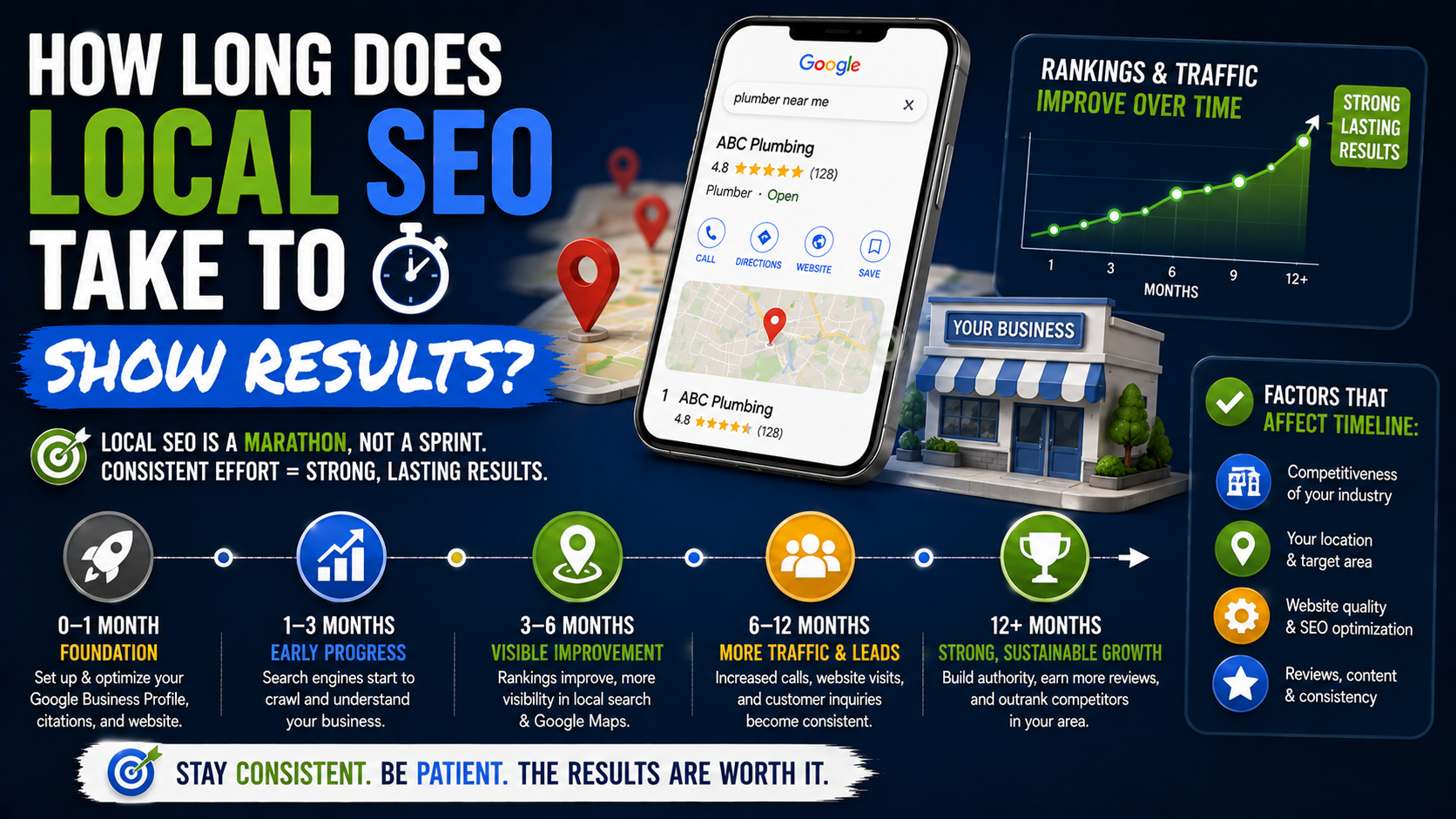
For most local businesses doing consistent work: first visible movement in 6 to 12 weeks, meaningful results in 3 to 6 months, strong results in 6 to 12 months.
If you are brand new to what local SEO involves, my complete local SEO guide walks through all the pieces. This article assumes you are doing that work and want to know when it pays.
Why such a wide range? Because five factors stretch or shrink it, and they are worth understanding before the timeline makes any sense.
What Makes It Faster or Slower
Your competition. This is the biggest one. Ranking for “pest control” in a town of 30,000 with three sleepy competitors is a different sport than ranking in a metro area against forty companies, five of which have marketing teams. Same effort, wildly different timelines.
Your starting point. A business with an eleven-year-old profile, some reviews, and an aging website has assets to build on. A brand new business starts from zero trust, and Google takes time to trust new things. New businesses should add a couple of months to every estimate.
The review gap. If the businesses above you have 400 reviews and you have 12, closing that credibility gap takes months of steady collecting no matter how perfect everything else is. The size of that gap is a decent predictor of your timeline all by itself.
Your consistency. Local SEO rewards rhythm. Weekly posts, steady reviews, regular photos. The owner who does eight hours of work in week one and nothing after will lose to the owner who does one hour a week forever. I have watched this exact race play out multiple times, and the tortoise wins every time.
Your niche’s search volume. An emergency plumber can see call volume change fast once rankings move, because people search for plumbers constantly. A wedding photographer might rank beautifully and wait weeks between searches, because the searches themselves are rarer. Rankings can arrive before the phone proves it.
What Should Happen, Month by Month
This is the part I wish someone had given my pest control client on day one. Not a promise, but a map of normal.
Month 1: Silence, with setup. You claim and complete the profile, fix the website, start the review habit. Expect nothing external. Internally, your baseline numbers are being recorded, and that matters later.
Months 2 to 3: Invisible movement. This is the phase that breaks people. Calls have not changed, but the dashboard has. Profile views climbing. Search impressions growing. Your listing showing up for searches it never appeared in. Maybe you appear in the map pack for one small keyword in your immediate neighborhood. This is the seven-week text moment. If the dashboard numbers are moving, do not stop.
Months 3 to 4: First real signals. A caller says “found you on Google,” and it is not a fluke. Direction requests tick up. You hold a map pack spot for a couple of real keywords. Volume is still modest, but it is provably new business.
Months 4 to 6: The compounding stretch. Reviews have stacked up, activity history looks healthy, and Google trials you in more searches. This is where results stop feeling like luck. My pest control client’s best month in three years happened at month six.
Months 6 to 12: The payoff era. Established map presence for your core services, steady inbound calls, and each additional review or post defends the position. The work shifts from climbing to maintaining, which takes far less time.
One honest caveat: in genuinely tough markets, shift this whole map right by three to six months. The sequence stays the same; the clock runs slower.
How to Know It Is Working Before the Phone Rings
The cruel part of local SEO is that the phone is the last thing to change. Watch these instead, all free inside your Google Business Profile dashboard and Google Search Console:
- Profile views and search impressions. Should trend up within 8 to 10 weeks.
- The searches you appear for. The list should grow month over month.
- Actions: calls, clicks, direction requests. These follow views with a delay.
- Spot checks from around town. Search your services from different areas (or use the free version of a rank checker like BrightLocal). Watch your map position tighten from “nowhere” to “top ten” to “top three.”
Track these monthly in a simple sheet. When motivation dips in month two, that sheet is what keeps you going, because it shows the machine turning before the money arrives.
When Slow Actually Means Broken
Sometimes it is not patience you need; it is a fix. Worry if:
- Nothing has moved at all by month four. Not calls, but impressions and views. Flat dashboards after four months of real work mean something is wrong, usually category choice, a suspended or unverified profile, or work that was not actually consistent.
- Your profile disappeared entirely. That is usually a suspension, not slowness. It needs a reinstatement request, not more waiting.
- You dropped hard after hiring someone cheap. Sudden ranking drops after buying bulk links or fake reviews are penalties. Stop the harmful activity first, then rebuild slowly.
- Someone promised page one in two weeks and delivered it, briefly. Shortcuts sometimes work for a month, then the suspension or penalty lands. Recovery takes longer than doing it right would have.
The difference between broken and slow is always visible in the data. Slow shows small upward movement. Broken shows nothing, or cliffs.
Can You Speed It Up?
Somewhat. The honest accelerators:
- Close the review gap faster. Reviews are the most timeline-sensitive lever. Ask every customer, same day, every time, and go back through past happy customers once.
- Fix everything at once, then maintain. Doing profile, website, and citations together in month one compounds better than fixing one piece per quarter.
- Add photos and posts weekly without fail. Activity is a trust signal, and it costs ten minutes.
- Run Google Ads in parallel if you need calls now. Ads do not speed up SEO, but they buy phone calls during the quiet months so the wait does not hurt the business. Turn them down as organic takes over.
What does not speed it up: buying reviews, buying links, keyword stuffing your business name, or paying anyone who guarantees a specific ranking by a specific date. All of these trade a fake sprint for a real setback.
The Waiting Is the Price
Here is how I frame it for every impatient client, and for myself. The reason local SEO pays so well is precisely that it is slow. If it worked in a week, every competitor would do it, and it would be worth nothing. The three-to six-month wait is the moat. Most of your competitors will start it, hit the month two silence, and quit. You just have to be the one who does not.
The pest control owner keeps a screenshot of that seven-week text on his phone. He shows it to other business owners now, usually around their own week seven, with the same advice I will leave you with: check the dashboard, not your feelings. If the numbers are climbing, the calls are coming.