A small business owner once told me, “I know I need more leads, but I cannot keep feeding money into ads every week.”
That is a common problem.
Paid ads can bring enquiries quickly, but they can also become stressful when every click costs money and the results are inconsistent. One slow month, one weak landing page, or one badly targeted campaign can burn through a budget surprisingly fast.
The good news is that lead generation does not always have to begin with ad spend.
Some of the best leads I have seen came from simple activities: answering a useful question in a local group, following up with an old prospect, improving a Google Business Profile, or asking a happy customer for an introduction.
These methods are not completely free in the literal sense. They still require time, effort, and consistency.
But they do not require you to pay for every impression, click, or form submission.
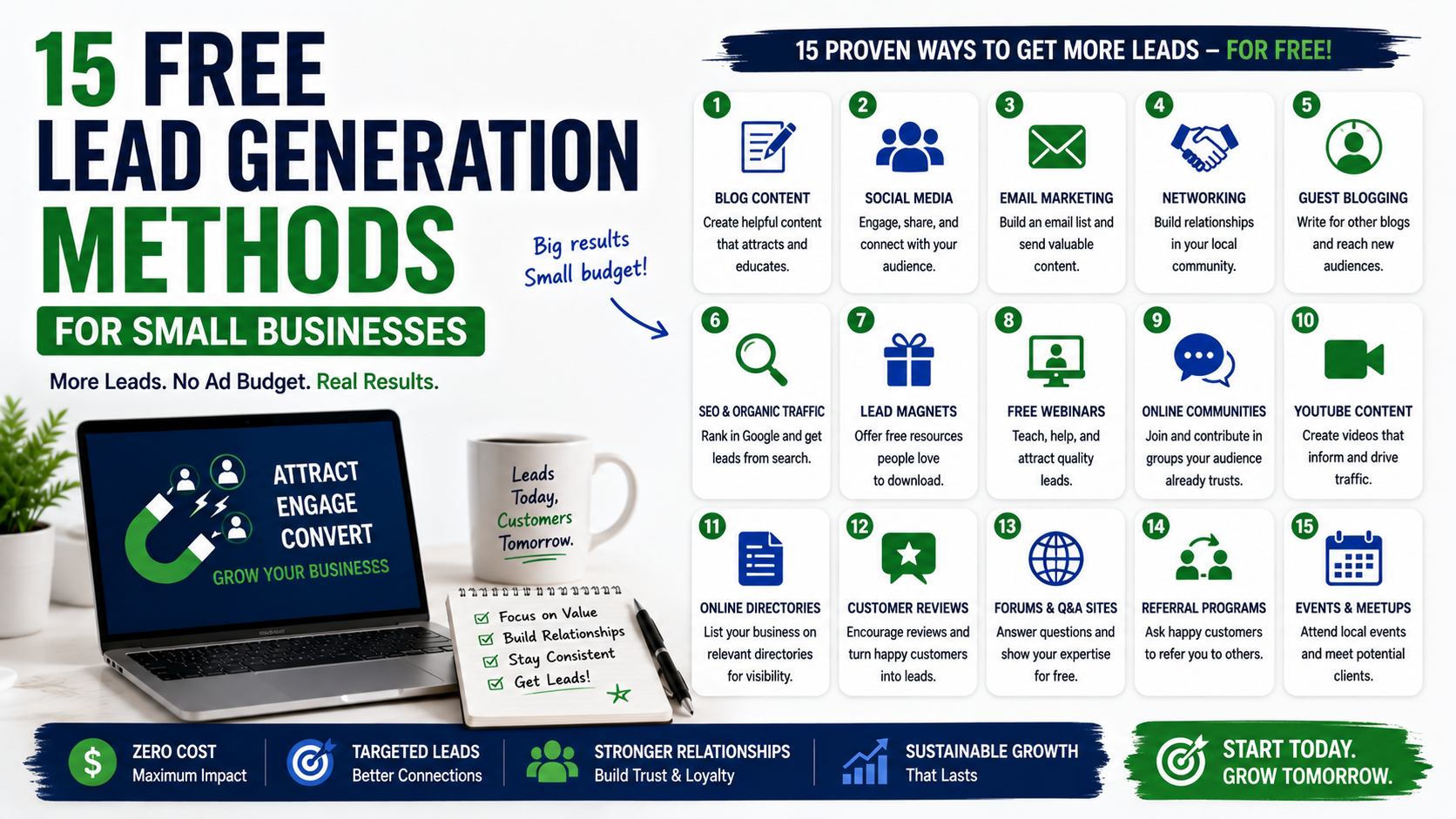
Below are 15 free lead generation methods that small businesses can actually use without building a complicated marketing system.
1. Ask Existing Customers for Referrals
This is one of the easiest methods to ignore because it feels too simple.
Many happy customers are willing to recommend a business, but they do not think about doing it unless someone asks.
The timing matters.
A good moment to ask is after:
- A successful project
- Positive feedback
- A repeat purchase
- A problem has been solved
- The customer compliments your work
- A strong result has been delivered
Keep the request natural.
For example:
“Thanks again for trusting us with the project. We are currently taking on a few similar clients, so if you know someone who needs the same kind of help, I would really appreciate an introduction.”
Do not make the customer feel responsible for finding work for you.
A simple request is enough.
You can also make referrals easier by explaining who you help.
“Anyone you know” is too broad.
“A local restaurant that needs a better website” gives the customer a clearer person to think about.
2. Improve Your Google Business Profile
For local businesses, a Google Business Profile can generate phone calls, website visits, direction requests, and messages without paying for ads.
The problem is that many profiles are incomplete or outdated.
Check whether your profile includes:
- The correct business category
- Accurate opening hours
- Phone number
- Website
- Service area
- Clear business description
- Current photographs
- Services or products
- Customer reviews
Use real photographs whenever possible.
A local customer usually trusts images of your actual team, location, equipment, or completed work more than polished stock photos.
Add new photos regularly.
A contractor can upload completed projects.
A restaurant can show dishes and seating areas.
A clinic can show the reception area and staff.
A consultant can upload event photos, team images, or workshop pictures.
Also respond to reviews.
A profile with active replies feels more trustworthy than one where customer feedback is ignored.
3. Reconnect With Old Leads
Businesses often spend time finding new prospects while old leads sit forgotten in spreadsheets and inboxes.
Some of those people were interested but not ready.
Their budget may have been delayed. The project may have been paused. They may have chosen a temporary solution.
Review your previous enquiries and look for people who were a good fit but did not move forward.
Send a personal message.
For example:
“Hi David, we spoke a few months ago about updating your company website. At the time, the project was being delayed until after your product launch. I wanted to check whether the timing has changed.”
This works better than a generic email blast because it connects to the previous conversation.
Use the notes you already have.
Do not pretend the relationship is new.
4. Publish Answers to Real Customer Questions
One of the simplest content strategies is to answer the questions customers already ask.
Look through:
- Emails
- Contact forms
- WhatsApp chats
- Sales calls
- Social media comments
- Support requests
- Reviews
Write down the questions that appear repeatedly.
A plumber might hear:
- Why is my water pressure low?
- Can a leaking pipe be repaired without replacing it?
- How much does an emergency visit cost?
A web designer might hear:
- How long does a website take?
- Do I need to provide the content?
- Which platform should I choose?
Turn those questions into useful blog posts, short videos, FAQs, or social posts.
This works because the topic already matters to your audience.
You are not guessing what people want to know.
You are using real conversations as research.
5. Create Better Service Pages
A short “Services” page with a list of everything you do is rarely enough.
Create a separate page for each important service.
Each page should explain:
- Who the service is for
- What problem it solves
- What is included
- How the process works
- What affects the price
- How long it takes
- Common questions
- The next step
For example, a landscaping company should not rely on one general page.
It may need separate pages for:
- Landscape design
- Garden maintenance
- Irrigation
- Patio installation
- Commercial landscaping
This helps potential customers find information that matches their exact need.
It also gives search engines a clearer understanding of your business.
Avoid filling the page with vague claims such as “best service” or “high-quality solutions.”
Use practical details instead.
6. Use LinkedIn to Share Work Lessons
LinkedIn can generate useful business-to-business leads without paid promotion.
The key is posting from experience rather than trying to sound impressive.
Useful post topics include:
- A mistake you fixed
- A lesson from a client project
- A common industry problem
- A simple process
- A tool you tested
- A before-and-after result
- A surprising customer question
For example:
“A client thought they needed more website traffic. After reviewing the site, we found the contact form was broken on mobile. Fixing that produced more enquiries without increasing traffic.”
That is more useful than writing:
“We help brands grow with innovative digital solutions.”
The first post shows what you actually do.
The second sounds like everyone else.
You do not need to post every day.
Two useful posts each week can be more effective than daily generic content.
7. Participate in Local Facebook Groups
Local Facebook groups often contain people asking for recommendations.
You may see posts such as:
- Can anyone recommend a reliable electrician?
- I need someone to build a small business website.
- Looking for a local accountant.
- Does anyone know a good photographer?
Do not reply with a long advertisement.
A simple response is better:
“Hi, we help local businesses with this. I have sent you a message with a few examples, but I am also happy to answer any questions here.”
Even better, contribute before you need leads.
Answer questions.
Recommend useful resources.
Help people understand common problems.
Group members notice businesses that consistently provide useful information.
They also notice businesses that appear only to post promotions.
Read the group rules before sharing links.
8. Build Referral Partnerships
A referral partner serves the same type of customer but offers a different service.
Examples include:
- A web designer and copywriter
- A real estate agent and mortgage broker
- An architect and interior designer
- A photographer and wedding planner
- An accountant and business consultant
- A landscaper and home builder
Start with a genuine conversation.
Learn what the other business does and which customers are a good fit.
Do not immediately say, “Send me leads.”
A better opening is:
“We often work with business owners who need professional photography after their website is finished. I would like to understand your service better so we can confidently recommend you when that need comes up.”
Good partnerships take time.
The goal is not to exchange contact lists.
It is to create a trusted referral path for customers.
9. Share Before-and-After Examples
Before-and-after content works because it makes the result easy to understand.
This can be used by:
- Contractors
- Designers
- Cleaners
- Landscapers
- Dentists
- Fitness professionals
- Web developers
- Marketing agencies
- Photographers
Do not only show the finished result.
Explain what changed.
For example:
“The old website had a confusing menu, slow mobile performance, and no clear booking button. We simplified the navigation, reduced page load time, and added a mobile booking flow.”
That explanation demonstrates skill.
It also helps a potential customer recognise similar problems in their own situation.
Always get permission before sharing customer details, private data, or identifiable project information.
10. Create a Useful Free Checklist
A simple checklist can generate leads when it helps someone complete a real task.
Examples include:
- Website launch checklist
- Home renovation planning checklist
- Monthly bookkeeping checklist
- Property inspection checklist
- Social media content checklist
- SEO audit checklist
- Event planning checklist
The resource does not need to be long.
A useful one-page document is better than a 60-page guide nobody reads.
You can offer the checklist through your website, email, LinkedIn profile, or social media.
Make sure it naturally connects to your paid service.
A website launch checklist is useful for a web agency because someone using it may later need help with design, development, or maintenance.
Do not use the free resource as an excuse to send unwanted emails every day.
Explain what people are signing up for.
11. Answer Questions on Reddit and Online Forums
Reddit, specialist forums, and online communities can help people discover your expertise.
The wrong approach is to search for every related question and paste a link to your service.
That quickly looks like spam.
The better approach is to answer the question properly.
Suppose someone asks why their ecommerce store receives traffic but no sales.
You might explain:
- Product pages may be unclear
- Shipping costs may appear too late
- Mobile performance may be poor
- Trust signals may be missing
- Checkout may be confusing
Give enough information to be helpful.
People who find the answer valuable may view your profile or contact you.
Not every useful comment will generate a lead.
That is normal.
Community marketing builds trust gradually.
12. Send Helpful Emails to Past Customers
Past customers already know your business.
A useful email can remind them about services they may need again.
For example, a maintenance company could send seasonal reminders about:
- Roof inspections
- Gutter cleaning
- Pipe protection
- Exterior repairs
- Air-conditioning servicing
A marketing agency might send a monthly email about:
- Website issues
- Search visibility
- Tracking problems
- Content ideas
- Conversion improvements
The email should help first and promote second.
Keep it short.
One useful tip, one example, and one clear next step is enough.
Tools such as Mailchimp, Brevo, HubSpot, and ConvertKit offer free plans or limited free options for smaller lists.
Do not buy email databases.
Contact people who have a legitimate relationship with your business or have agreed to receive messages.
13. Ask for Customer Reviews
Reviews do more than improve reputation.
They also help new prospects decide whether to contact you.
Ask customers shortly after a good experience.
Do not wait six months.
Make the process easy by sending the direct review link.
A simple message works:
“Thanks again for choosing us. Would you mind leaving a short review about your experience? It helps other customers understand what working with us is like.”
Do not ask everyone to write the same words.
Natural reviews are more believable.
You can also reuse reviews on your website, proposals, social media, and sales pages, provided you have permission and present them honestly.
14. Attend Local Networking Events
Free business events, community meetups, and industry gatherings can produce leads without ad spend.
The mistake is trying to sell to everyone in the room.
Focus on having a few useful conversations.
Ask people:
- What kind of work do you do?
- What are you currently working on?
- What is the biggest challenge in your business?
- Who do you usually serve?
Listen before explaining your service.
After the event, follow up with something relevant.
For example:
“It was good speaking with you about the new office opening. You mentioned that your team is still planning the website, so I am sending the checklist we discussed.”
That feels personal.
A generic “Great meeting you, let me know if you need anything” message is much easier to ignore.
15. Offer a Small Free Audit
A basic audit can start a sales conversation when it gives the prospect something useful.
Examples include:
- Website speed check
- Local SEO review
- Social media profile review
- Branding check
- Home maintenance assessment
- Energy-efficiency review
- Conversion audit
Keep the scope controlled.
A free audit should identify the most important issues and suggest the next steps.
It should not become several days of unpaid work.
For a website review, you might check:
- Mobile performance
- Contact forms
- Page speed
- Clear calls to action
- Basic SEO issues
- Broken links
Then provide three to five findings.
Do not exaggerate problems to frighten the prospect.
The audit should build trust, not pressure.
How to Choose the Right Free Lead Generation Methods
Trying all 15 methods at once is a mistake.
You will create several accounts, publish a few posts, lose momentum, and conclude that nothing works.
Choose methods based on how your customers behave.
A local service business may focus on:
- Google Business Profile
- Reviews
- Referrals
- Facebook groups
- Local partnerships
A business-to-business company may focus on:
- Referral partners
- Helpful articles
- Old leads
A visual business may focus on:
- Before-and-after posts
- Customer stories
- Google photos
- Local partnerships
Pick three methods and use them consistently for at least a few months.
A Simple Weekly Routine
A practical weekly system could look like this:
Monday
Review old leads and send three personal follow-ups.
Tuesday
Publish one useful post based on a customer question.
Wednesday
Ask one satisfied customer for a review or referral.
Thursday
Comment helpfully in one relevant group or community.
Friday
Contact one potential referral partner and update your Google Business Profile.
This schedule does not require a large marketing team.
It only requires consistency.
Mistakes That Make Free Lead Generation Fail
Expecting Immediate Results
Some methods produce leads quickly.
Others take time.
SEO, partnerships, and community trust usually grow gradually.
Posting Generic Content
People do not need more motivational quotes or vague business advice.
Share useful details from real work.
Failing to Follow Up
A lead is not valuable if nobody responds.
Track every enquiry and schedule the next step.
Using Too Many Platforms
You do not need to be active everywhere.
Focus on the places your customers actually use.
Hiding the Offer
Helpful content is valuable, but people should still understand what you sell and how to contact you.
Treating Free as Effortless
These methods save advertising money, but they require time.
Set aside regular hours for them.
Focusing Only on Lead Numbers
A method producing ten qualified leads is better than one producing 100 irrelevant enquiries.
Track quality and sales, not just volume.
Track What Actually Produces Customers
Create a simple spreadsheet and record:
- Lead name
- Date
- Source
- Service requested
- Qualified or not
- Follow-up date
- Sale won or lost
- Revenue
After a few months, review the results.
You may discover that referrals produce fewer leads but close at a much higher rate.
You may find that LinkedIn posts create useful conversations but no immediate sales.
You may learn that Google Business Profile leads are more urgent than social media leads.
Without tracking, every method feels like guesswork.
Free Lead Generation Works Best as a System
No single method needs to carry the entire business.
One customer leaves a review.
That review improves trust on Google.
A new prospect finds the profile, visits the website, reads a helpful article, and submits a form.
Another customer shares your post with a friend.
A referral partner introduces you to a suitable business.
These activities support each other.
That is when free lead generation becomes more reliable.
You are not constantly searching for strangers.
You are building a network of content, reviews, relationships, and proof that helps the right people find you.
Start with the easiest opportunity.
Contact an old lead.
Ask a customer for a review.
Improve one service page.
Answer one useful question.
Small actions are easier to repeat, and repeated actions are what eventually create a steady flow of enquiries without paying for every click.