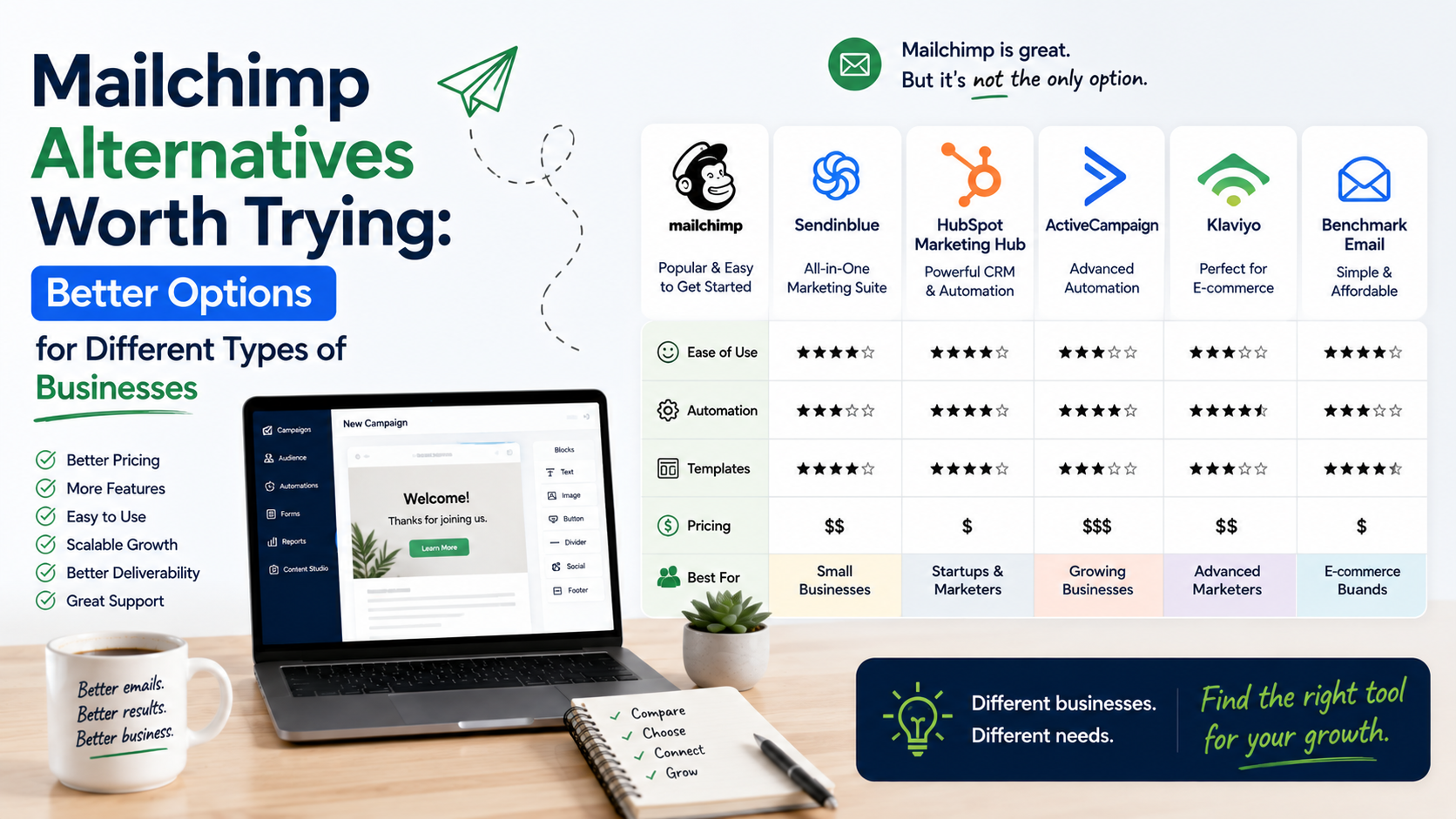
The first time I seriously considered moving away from Mailchimp, it was not because the platform was bad.
Actually, it worked well for what we needed.
The problem was that our needs changed.
At the beginning, we only wanted to send simple newsletters. We had a small subscriber list, a few announcements, and occasional promotional emails.
Mailchimp handled that perfectly.
But as the business grew, we wanted more:
- Better automation
- More detailed customer journeys
- Easier segmentation
- More control over pricing
- Better integration with other tools
That is when I realized something many small businesses eventually discover:
The tool that works when you start is not always the tool you need when you grow.
Mailchimp is still one of the most recognized email marketing platforms, and for many businesses, it is a perfectly good choice.
But it is not the only option.
Depending on your goals, another platform may give you a better experience, better pricing, or features that actually match your workflow.
After testing different email marketing platforms, I found that Mailchimp alternatives are not necessarily “better” across the board.
They are better for specific situations.
A creator, ecommerce store, local business, and SaaS company may all need completely different things.
So let’s look at the best Mailchimp alternatives worth trying and who they are actually built for.
Why Businesses Start Looking for Mailchimp Alternatives
Before comparing tools, it is worth understanding why people leave Mailchimp.
The reasons are usually practical.
1. Pricing Becomes Difficult to Manage
Many businesses start with Mailchimp because the entry-level options are attractive.
But as your subscriber list grows, pricing can become a concern.
A business owner may think:
“We are paying more every month, but we are not using all these features.”
That is when people start exploring alternatives.
2. Automation Feels Limited
Basic email campaigns are easy.
Advanced customer journeys are different.
Many businesses eventually want things like:
- Send different emails based on customer behavior
- Create detailed onboarding sequences
- Follow up automatically
- Segment users more intelligently
Some alternatives focus heavily on automation.
3. Businesses Need Better Segmentation
Sending the same email to everyone is rarely effective.
A customer who purchased your product yesterday should not receive the same message as someone who joined your list five years ago.
Better segmentation helps businesses send more relevant emails.
1. Brevo: Best Mailchimp Alternative for Small Businesses on a Budget
Brevo is one of the alternatives I often recommend for small businesses that want practical features without unnecessary complexity.
One thing I like about Brevo is that it focuses on everyday business communication.
It combines:
- Email marketing
- SMS campaigns
- Automation
- Contact management
- Basic CRM features
Where Brevo Works Well
Imagine a local business:
A dental clinic.
A fitness studio.
A home service company.
They may need:
- Appointment reminders
- Promotional emails
- Customer updates
- Seasonal offers
Brevo handles these use cases well.
What I Learned Using Similar Platforms
Many small businesses do not need a complicated marketing system.
They need something reliable that their team can actually manage.
A simple platform used consistently is usually better than an advanced tool nobody understands.
Best For:
✓ Small businesses
✓ Local services
✓ Businesses using email and SMS together
✓ Budget-conscious teams
2. ConvertKit: Best Mailchimp Alternative for Creators
Kit is built mainly for creators, bloggers, writers, and online educators.
The biggest difference is the philosophy.
Mailchimp traditionally feels like a marketing campaign tool.
ConvertKit feels more like an audience relationship tool.
Where ConvertKit Works Well
For example:
A YouTube creator collects email subscribers.
Instead of sending random newsletters, they create a journey:
Subscriber joins
↓
Receives welcome email
↓
Gets useful content
↓
Receives a course recommendation
↓
Becomes a customer
This approach works well for creators who build trust over time.
The Limitation
If you run a large ecommerce store with complex product marketing needs, ConvertKit may not be the strongest option.
It is focused more on creators than traditional retail.
Best For:
✓ Bloggers
✓ Newsletter creators
✓ Coaches
✓ Personal brands
3. ActiveCampaign: Best for Advanced Automation
ActiveCampaign is one of the strongest options for businesses that want powerful automation.
This is where many people outgrow simpler email tools.
ActiveCampaign allows businesses to create detailed customer journeys.
Example:
Someone downloads a free guide.
↓
They receive educational emails.
↓
They visit a pricing page.
↓
They receive a product-focused message.
↓
Sales team gets notified.
This type of automation can be extremely valuable.
My Experience With Automation Tools
The biggest mistake businesses make is building complicated automation too early.
They create dozens of workflows before understanding customer behavior.
A better approach:
Start simple.
Build one useful automation.
Improve it based on results.
The Downside
ActiveCampaign has more features, but that also means a bigger learning curve.
Beginners may need time to understand the system.
Best For:
✓ Growing businesses
✓ SaaS companies
✓ Advanced marketers
✓ Businesses focused on automation
4. HubSpot: Best Mailchimp Alternative With CRM Features
HubSpot is different because email marketing is only one part of the platform.
It combines:
- CRM
- Email marketing
- Sales tools
- Customer management
- Reporting
This makes it useful for businesses where email is connected to sales.
Example:
A consulting company receives a website inquiry.
The customer enters the CRM.
The team can see:
- Previous conversations
- Email activity
- Sales stage
- Follow-up tasks
This creates a clearer customer journey.
The Trade-Off
HubSpot can become more expensive as businesses need advanced features.
A small company that only wants newsletters may not need this level of functionality.
Best For:
✓ B2B companies
✓ Service businesses
✓ Sales-focused teams
✓ Growing companies
5. MailerLite: Best Simple Mailchimp Alternative
MailerLite is popular among small businesses that want simplicity.
One thing I appreciate about tools like MailerLite is that they do not overwhelm beginners.
You can quickly create:
- Newsletters
- Landing pages
- Forms
- Basic automations
Where It Works Well
A small online store, blogger, or local business can usually get started quickly.
The interface feels clean, and the learning process is easier than many advanced platforms.
Best For:
✓ Beginners
✓ Small newsletters
✓ Simple email campaigns
6. Klaviyo: Best for Ecommerce Businesses
Klaviyo is designed heavily around ecommerce marketing.
If you run an online store, customer behavior matters.
Examples:
Someone views a product.
Someone adds an item to their cart.
Someone purchases frequently.
Someone has not purchased for six months.
Klaviyo helps create targeted campaigns based on these actions.
Example:
Customer leaves items in cart.
↓
Automatic reminder email.
↓
Follow-up discount offer.
This type of automation can improve customer retention.
The Limitation
For a simple newsletter, Klaviyo may feel like too much.
Best For:
✓ Ecommerce stores
✓ Shopify businesses
✓ Product-based companies
Mailchimp Alternatives Comparison Table
| Tool | Best For | Main Strength | Possible Challenge |
| Brevo | Small businesses | Affordable communication tools | Less advanced automation |
| ConvertKit | Creators | Audience building | Less ecommerce-focused |
| ActiveCampaign | Automation | Powerful workflows | Learning curve |
| HubSpot | Sales-focused businesses | CRM integration | Can become expensive |
| MailerLite | Beginners | Simple interface | Fewer advanced features |
| Klaviyo | Ecommerce | Customer behavior targeting | Not ideal for simple newsletters |
How to Choose the Right Mailchimp Alternative
Choosing the right tool is easier when you focus on your actual needs.
Step 1: Identify Your Main Goal
Ask:
Why are you using email marketing?
For example:
“I want to send weekly newsletters.”
Choose something simple.
“I want automated sales journeys.”
Choose a platform focused on automation.
“I want to connect emails with sales.”
Choose a CRM-based platform.
Step 2: Consider Your Business Type
Different businesses need different tools.
Local Business
You may need:
- Promotions
- Customer updates
- Appointment reminders
Brevo or MailerLite may work well.
Creator
You may need:
- Newsletter growth
- Subscriber relationships
- Content automation
ConvertKit makes sense.
Ecommerce
You may need:
- Product recommendations
- Cart recovery
- Customer segmentation
Klaviyo is worth considering.
B2B Company
You may need:
- Sales tracking
- Customer history
- Team collaboration
HubSpot may fit better.
Common Mistakes When Switching From Mailchimp
Moving Without Cleaning Your List
Before migrating, remove:
- Invalid emails
- Inactive subscribers
- Duplicate contacts
A clean list performs better.
Choosing Features Instead of Workflow
A platform can have hundreds of features.
But ask:
“Will my team actually use these?”
A simpler tool that fits your process is often better.
Expecting Better Software to Fix Poor Emails
Changing platforms will not automatically improve results.
You still need:
- Good subject lines
- Useful content
- Proper segmentation
- Clear offers
The tool supports the strategy.
It does not replace it.
My Final Thoughts
Mailchimp is not a bad platform.
It became popular because it solved a real problem for millions of small businesses.
But businesses change.
The tool you choose should match your current stage.
If you want simplicity, MailerLite or Brevo can be excellent options.
If you are building an audience, ConvertKit is worth exploring.
If automation is your priority, ActiveCampaign is powerful.
If your business depends on customer relationships and sales tracking, HubSpot may be the better fit.
For ecommerce, Klaviyo stands out.
The biggest lesson I have learned from testing marketing tools is that the “best” platform is rarely the one with the most features.
It is the one that makes your daily work easier.
Choose based on your customers, your workflow, and your goals.
That is what turns email marketing from another subscription into a tool that actually helps your business grow.