There is a point almost every small business owner reaches where referrals stop feeling predictable.
One month is great. A few past customers recommend you, three new leads arrive, and business feels easy.
Then the next month is quiet.
You start checking your inbox more often. You post on LinkedIn. Maybe you boost a Facebook post. You ask an old client whether they know anyone who might need your service.
That uncertainty is exactly why cold email becomes attractive.
Instead of waiting for people to discover your business, you can identify companies or customers that appear to need what you offer and start the conversation yourself.
The problem is that most small businesses approach cold email in one of two ways.
They either overthink it until they never send anything, or they download a massive contact list and blast the same generic message to everyone.
Neither approach works particularly well.
Good cold email sits somewhere in the middle. It is targeted enough to feel relevant, simple enough to scale, and respectful enough that even people who are not interested do not feel like they were tricked into opening another spam message.
This guide covers how to build that kind of cold email system from scratch.
What Cold Email Actually Does for a Small Business
Cold email is not magic lead generation.
It is simply outbound prospecting through email.
You identify someone who may have a legitimate reason to care about your product or service, contact them without an existing relationship, and try to start a useful conversation.
That last part matters.
The first email usually should not try to close the sale.
Imagine receiving this from someone you have never spoken to:
“Hello, we offer SEO, website development, PPC, social media marketing, branding, graphic design, and content writing. Our packages start at $1,500. Please let us know when you can schedule a 30-minute meeting.”
That is a lot to ask from a stranger.
A better first email might simply say:
“Hi Mark,
I found your roofing company while checking local search results in Phoenix.
You have a strong review profile, but I noticed a few competitors with fewer reviews are appearing above you for several roofing searches.
We work with local contractors on that specific problem.
Would it be useful if I sent over the two gaps I noticed?”
Now the goal is not “buy my SEO package.”
The goal is “reply.”
That is a much easier first step.
Cold Email Works Better When You Stop Targeting Everyone
One of the first mistakes small businesses make is building a prospect list that is far too broad.
For example:
“Small businesses in the United States.”
That is not a useful audience.
A dentist, SaaS company, roofing contractor, accounting firm, restaurant, and real estate agency may all be small businesses, but their problems are completely different.
Narrowing the audience makes the email easier to write.
Instead of:
“Small businesses”
try:
“Independent dental clinics in Texas with one to three locations.”
Instead of:
“Ecommerce companies”
try:
“Shopify stores selling home products that are actively running Meta Ads.”
Instead of:
“Contractors”
try:
“Roofing companies in Florida with at least 50 Google reviews.”
The narrower the segment, the easier it becomes to say something relevant.
Start With the Problem You Solve
A cold email campaign becomes much easier once you can finish this sentence:
“We help [specific type of customer] solve [specific problem].”
For example:
“We help local HVAC companies generate more estimate requests from Google.”
Or:
“We help accounting firms redesign outdated websites that are difficult to use on mobile.”
Or:
“We help growing SaaS companies add development capacity while they are hiring internally.”
Or:
“We help small ecommerce brands improve product photography without running full studio shoots.”
Notice how different that sounds from:
“We provide innovative business solutions.”
People understand problems.
They rarely care about vague descriptions of services.
How to Build a Good Prospect List
Your list is arguably more important than your email copy.
A mediocre email sent to a very relevant prospect can still start a conversation.
A brilliant email sent to someone who does not need the service usually goes nowhere.
For small campaigns, you can build lists manually.
Google Maps is particularly useful for local businesses.
LinkedIn works well for B2B companies.
LinkedIn Sales Navigator gives you more filters when you need to narrow companies by size, industry, role, seniority, and other professional criteria.
Apollo can help with company and contact research.
Hunter can be useful for finding or verifying professional email addresses.
Clay is helpful when you need to combine multiple sources of company data and create more advanced enrichment workflows.
If your target market is small, do not feel pressured to build some enormous automated system.
A Google Sheet containing 100 carefully selected prospects may be more useful than a database containing 20,000 random contacts.
What Information Should You Collect?
You do not need to know everything about the prospect.
Collect information that helps you decide whether they are a good fit and why you should contact them.
A simple spreadsheet might include:
- First name
- Last name
- Company
- Job title
- Website
- Industry
- Location
- Reason for contacting
- Personalization note
- Last contact date
- Status
- Follow-up date
The most important column may be:
Reason for contacting
That might contain notes such as:
“Recently opened second location.”
“Hiring three developers.”
“Running Google Ads to weak landing page.”
“Strong reviews but weak local visibility.”
“Website difficult to use on mobile.”
“Recently launched new product line.”
Now you have an actual reason for each email.
Research Without Spending 30 Minutes Per Prospect
Cold email personalization can quickly become inefficient.
If you research every prospect for half an hour, you may write beautiful emails but never send enough of them to learn anything.
For most small business outreach, a few minutes is enough.
Check the prospect’s:
Website
LinkedIn profile
Company LinkedIn page
Google Business Profile
Recent posts
Job openings
Major service pages
Reviews
You are looking for one useful observation.
Not ten.
For example:
“I noticed you recently opened a second clinic.”
That is enough.
Or:
“I saw that you’re hiring two sales representatives.”
Enough.
Or:
“I noticed the mobile quote form requires several steps before a customer can submit.”
Enough.
One relevant fact is usually better than a paragraph of fake personalization.
How to Write the Subject Line
People often make cold email subject lines unnecessarily dramatic.
Examples I would avoid include:
“URGENT BUSINESS OPPORTUNITY!!!”
“10X YOUR REVENUE”
“Massive Growth Opportunity”
“You’re Losing Customers”
These may attract attention, but they also look like marketing emails immediately.
For business outreach, simple subject lines often feel more natural.
Examples:
“Quick question, Sarah”
“Regarding Acme Roofing”
“Your Dallas location”
“SEO question”
“Website question”
“Question about hiring”
“Acme’s quote page”
The subject line should create enough curiosity to open the message without misleading the recipient.
Do not add “Re:” to make an email look like an existing conversation when it is not one.
Short-term tricks are rarely worth damaging trust.
Writing the Opening Line
Do not waste your first sentence introducing yourself with a company biography.
“Hi, my name is James and I am the founder of Innovative Digital Solutions…”
The reader does not know James yet.
Instead, start with why you contacted them.
For example:
“I came across your roofing company while checking local businesses around Austin.”
Or:
“I noticed you’re currently hiring two backend developers.”
Or:
“I was looking through your website on mobile and noticed something on the booking page.”
The first line should make the recipient understand:
This email has a reason for being in my inbox.
Explain the Problem Simply
After the opening, connect your observation to something relevant.
Suppose you sell web design.
You might write:
“I noticed the request-a-quote button disappears once someone moves deeper into the mobile service pages. For service businesses, that can make it harder for visitors to take the next step.”
You are not saying:
“Your website is terrible.”
You are identifying a specific issue.
If you sell local SEO:
“You already have a strong review count, but several competitors with fewer reviews are appearing above you for local searches.”
If you sell recruitment:
“You have several engineering positions open at the same time, so I wasn’t sure whether internal hiring is keeping up with the current workload.”
If you sell bookkeeping:
“Companies around your size often reach a point where month-end reporting and reconciliation start taking more owner time than expected.”
Simple.
Relevant.
Easy to understand.
Explain What You Do in One or Two Sentences
Do not turn the middle of the email into your website’s services page.
You do not need to explain everything.
Say what matters for this prospect.
For example:
“We help local contractors improve Google visibility and turn that traffic into estimate requests.”
Or:
“We build conversion-focused websites for small service businesses.”
Or:
“We provide short-term React and Node.js development support for SaaS teams.”
The prospect should understand what you do within seconds.
Avoid sentences like:
“We leverage innovative technologies and comprehensive digital strategies to create measurable outcomes for businesses across multiple verticals.”
That sounds impressive until you try to figure out what it actually means.
Add Proof Carefully
Credibility helps, especially when you are a small business contacting someone who has never heard of you.
But keep it short.
For example:
“We recently worked on a similar issue for another multi-location clinic.”
Or:
“We’ve built websites for several local construction companies.”
Or:
“Our team regularly works with Shopify brands running paid traffic.”
If you have a specific and verifiable result that is relevant, you can use it.
For example:
“After simplifying the landing page, qualified form submissions increased without increasing the ad budget.”
Do not invent impressive numbers just because you think every sales email needs a case study.
Realistic proof is better than dramatic proof.
End With a Small Question
Your call to action matters.
One of the most common mistakes is asking too much.
“Are you available for a 45-minute strategy session on Thursday?”
That is a fairly large commitment for someone who did not know you existed 30 seconds ago.
Try something easier.
“Worth sending the details?”
“Want me to send the two things I noticed?”
“Is this something you’re currently working on?”
“Would an example be useful?”
“Are you handling this internally?”
A simple question lowers the effort required to reply.
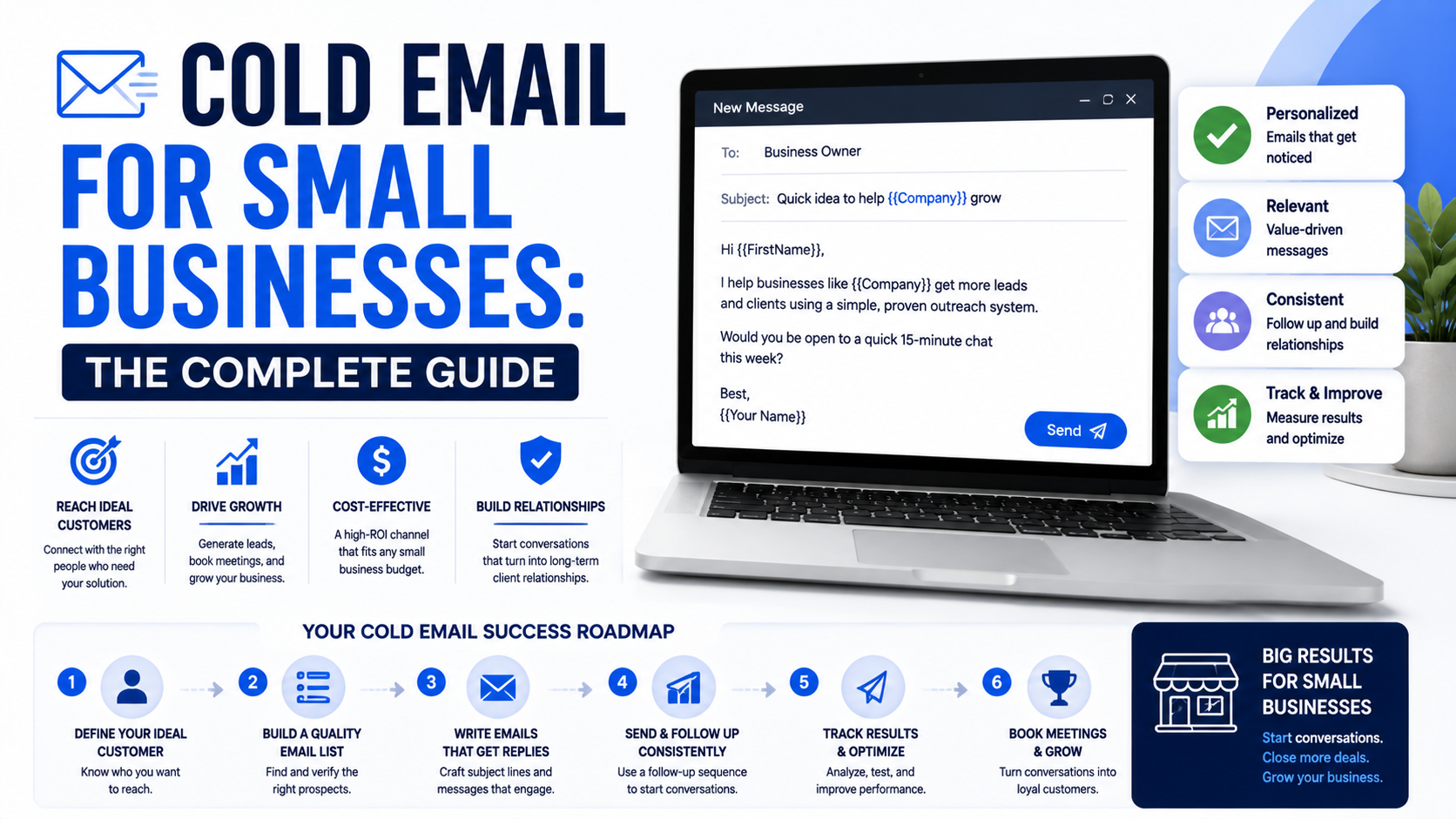
A Complete Cold Email Template
Here is a flexible structure you can adapt:
“Hi [First Name],
I noticed [specific business observation].
It looks like [relevant problem or opportunity].
We help [customer type] with [specific outcome].
[Short credibility statement if useful.]
Would it be helpful if I sent over [simple next step]?
[Name]”
That framework is deliberately simple.
Do not copy it word for word for every campaign.
Adapt the message to your market.
Cold Email Example for a Marketing Agency
“Hi Chris,
I came across your plumbing company while looking at local search results around Dallas.
You’ve got more than 100 Google reviews, but I noticed a couple of competitors with fewer reviews are still appearing above you for several high-intent searches.
We help service businesses improve that gap between reputation and local visibility.
I spotted two things I’d look at first.
Want me to send them over?”
Notice what is missing.
No list of 12 services.
No giant agency introduction.
No calendar link.
The email simply creates a reason to reply.
Cold Email Example for a Web Designer
“Hi Rachel,
I was looking through your clinic website on my phone and noticed the appointment button becomes harder to find once you’re inside the treatment pages.
We build websites for local businesses, and mobile booking paths are something we pay close attention to.
I have two simple changes I’d test before considering a redesign.
Would you like me to send them?”
This approach also avoids insulting the current website.
That matters.
The person receiving the email may have designed it themselves.
Cold Email Example for a B2B Software Company
“Hi Daniel,
I noticed your team is currently hiring several customer support reps.
We build support automation tools for growing SaaS companies that want to reduce repetitive tickets before adding more headcount.
Not sure whether that’s relevant to your current hiring push, but are most of the new roles related to increased ticket volume?”
The question makes the email conversational.
The salesperson gets useful information even if the prospect does not immediately want a demo.
Cold Email Example for a Bookkeeper
“Hi Amanda,
I noticed your agency has grown quite a bit over the last year.
Once agencies start adding employees and contractors, reconciliation, payroll coordination, expenses, and reporting can become surprisingly time-consuming.
We handle monthly bookkeeping for small agencies that aren’t ready for an internal finance team.
Are you still managing most of that internally?”
Again, the email starts with the situation rather than a generic pitch.
Personalization Does Not Mean Writing Every Email Manually
Small businesses often avoid cold email because they assume personalization means individually writing 500 emails.
It does not have to.
You can combine personalization with templates.
For example, the structure may stay the same while certain fields change:
First name
Company
Industry
Location
Business signal
Problem
Relevant case study
CTA
Tools such as Clay can help structure this type of research and enrichment.
Platforms such as Smartlead, Instantly, Lemlist, Mailshake, Apollo, Reply.io, Close, or HubSpot can help organize campaigns and follow-ups depending on the complexity of your outreach.
But software does not fix bad targeting.
Automating a terrible campaign simply helps you send terrible emails faster.
Build the logic first.
Then automate it.
Email Deliverability Matters
You can write an excellent message and never get a response because the prospect never sees it.
Cold email has a technical side.
Use a professional business domain.
Make sure your domain authentication is configured correctly.
That usually involves SPF, DKIM, and DMARC.
These records help receiving email systems verify that messages sent using your domain are legitimate.
Avoid sudden, aggressive sending increases.
A new mailbox suddenly sending hundreds of identical emails can look suspicious.
Also:
Avoid excessive links.
Avoid large attachments in first-touch emails.
Keep bounce rates low.
Verify addresses where appropriate.
Keep your emails simple.
Monitor mailbox health.
If you use Google Workspace or Microsoft 365, remember that both have sending and anti-abuse limits.
Do not treat your mailbox like an unlimited bulk email server.
Do Not Ignore Cold Email Laws
Cold outreach is subject to laws and regulations that vary by location and recipient.
Depending on where you operate and who you contact, requirements may come from regulations such as CAN-SPAM in the United States, GDPR and PECR in parts of Europe and the UK, or other local privacy and electronic communication laws.
Do not assume that because an email address appears online, you automatically have unrestricted permission to send whatever you want.
Understand which rules apply to your business.
Be transparent about who you are.
Do not use misleading subject lines.
Honor opt-out requests.
Keep your contact information accurate.
Responsible outreach is not only about compliance.
It also protects your reputation.
How Often Should You Follow Up?
One email is often not enough.
People are busy.
Someone may open your message during a meeting, think “I’ll answer later,” and completely forget.
A follow-up can bring the conversation back.
For example:
“Hi Sarah,
Just bringing this back up in case it got buried.
I still have the two mobile booking suggestions I mentioned if you’d like me to send them.”
Short and simple.
Another follow-up could add information:
“Quick follow-up — one of the issues I noticed is that the booking CTA disappears on several mobile treatment pages.
Happy to send a screenshot if useful.”
That is better than repeatedly writing:
“Any thoughts?”
Or:
“Did you see my previous email?”
Try to bring a little value into the follow-up.
How Many Follow-Ups Are Enough?
There is no universal number.
For many small B2B campaigns, a reasonable sequence might include:
An initial message.
A follow-up several days later.
Another follow-up that adds context or value.
A final polite check-in.
Then stop.
Do not chase people indefinitely.
If someone tells you they are not interested, respect it.
If they ask you not to contact them again, remove them from the campaign.
Persistence can help.
Ignoring someone’s clear request does not.
Track the Right Numbers
Cold email tools give you plenty of statistics.
Not all of them deserve equal attention.
Open rates can be misleading because modern privacy systems can affect tracking.
I care much more about:
Replies.
Positive replies.
Qualified conversations.
Meetings booked.
Opportunities created.
Bounce rate.
Opt-outs.
Revenue.
Suppose one campaign gets an impressive open rate but almost no positive replies.
That is not necessarily a successful campaign.
Maybe the subject line works.
But something is wrong with the audience, offer, or email body.
Keep a Simple CRM
You do not need Salesforce on your first day of cold outreach.
A Google Sheet may be enough.
Track:
Prospect.
Date contacted.
Response.
Interest level.
Next action.
Follow-up date.
Notes.
Once your volume grows, a CRM such as HubSpot, Pipedrive, Close, Zoho CRM, or another platform can make the process easier.
The important thing is not which software you use.
It is whether you actually know what happened after each conversation.
A surprising number of leads are lost because someone says:
“Follow up with me next month.”
And nobody does.
Common Cold Email Mistakes Small Businesses Make
Sending to Everyone
Better targeting almost always makes writing easier.
Know who your ideal customer is.
Writing Huge Emails
Your first message is not a proposal.
Give the prospect enough information to decide whether a conversation makes sense.
Talking Only About Yourself
“We were founded in 2018.”
“We have 20 employees.”
“We offer seven different services.”
Those facts may eventually matter.
They are rarely what gets someone to reply.
Using Fake Personalization
“I loved your recent LinkedIn post!”
If you cannot explain which post or why it matters, leave that sentence out.
Using AI Without Reviewing the Output
AI can help summarize websites, categorize prospects, or suggest relevant observations.
It can also confidently misunderstand a company.
Check important personalization before sending.
Sending Too Many Links
Website.
Portfolio.
Calendly.
YouTube.
PDF.
Case study.
LinkedIn.
That is too much for a first email.
Give the prospect one clear next step.
Making Unrealistic Promises
“We guarantee 10X revenue in 30 days.”
“Guaranteed #1 Google rankings.”
“Guaranteed 100 appointments.”
Avoid claims you cannot responsibly support.
Long-term business is built on credibility.
Giving Up Too Early
Some campaigns fail after 20 emails and the sender immediately changes everything.
That is usually not enough information.
Gather enough data to identify patterns.
How to Improve a Campaign That Is Not Getting Replies
Do not automatically rewrite the entire email.
Troubleshoot it in order.
First, check targeting.
Are these companies actually good prospects?
Second, check deliverability.
Are messages reaching inboxes?
Third, check the offer.
Is there a real reason for the prospect to care?
Fourth, check the opening.
Does the email quickly explain why you contacted them?
Fifth, check the CTA.
Is replying easy?
Only then start obsessing over individual words.
A poorly targeted campaign cannot be rescued by changing:
“Would you be interested?”
to:
“Would you be open to exploring this?”
The big decisions matter more.
A Simple Cold Email Workflow for Small Businesses
If I were building a small campaign from scratch, I would keep it very simple.
Step 1: Choose One Audience
For example:
“Roofing companies in Texas with 50+ Google reviews.”
Step 2: Choose One Problem
For example:
“Strong reputation but weak local search visibility.”
Step 3: Build 50 to 100 Prospects
Do not start with 10,000.
Start small enough that you can inspect the data.
Step 4: Research One Relevant Detail
Find something that explains why you’re contacting each business.
Step 5: Write a Short Email
Aim for clarity rather than cleverness.
Step 6: Prepare Follow-Ups
Do this before launching so you are not improvising later.
Step 7: Check Your Technical Setup
Make sure your domain, authentication, and sending process are healthy.
Step 8: Send in Manageable Volumes
Do not suddenly blast your entire list.
Step 9: Record Responses
Track what prospects actually say.
Step 10: Improve Based on Real Conversations
If prospects repeatedly tell you:
“We already have an agency.”
That tells you something.
If they keep asking:
“How much does it cost?”
That tells you something too.
Your replies are market research.
Use them.
What Cold Email Should Feel Like
Good cold email is surprisingly ordinary.
It does not need a shocking subject line.
It does not need psychological tricks.
It does not need a six-paragraph success story.
The strongest outreach usually answers four questions quickly:
Why me?
Why now?
What do you do?
What should I do next?
For a small business, that simplicity is an advantage.
You do not need the enormous sales stack used by a company with 200 representatives.
You need a clear offer, a focused prospect list, a reliable sending setup, a short message, and a habit of following up properly.
Start with a small list.
Read the replies.
Notice which problems create conversations.
Improve the targeting.
Adjust the message.
Then scale what is actually working.
That is a much healthier way to approach cold email than sending thousands of generic messages and hoping someone eventually says yes.
The goal is not to make your email look like it was handcrafted for hours.
It is to make the person reading it understand why you chose to contact them.
Once that part makes sense, cold email stops feeling like random outreach and starts behaving more like what it should have been from the beginning: a simple way to introduce your business to people who may genuinely need it.