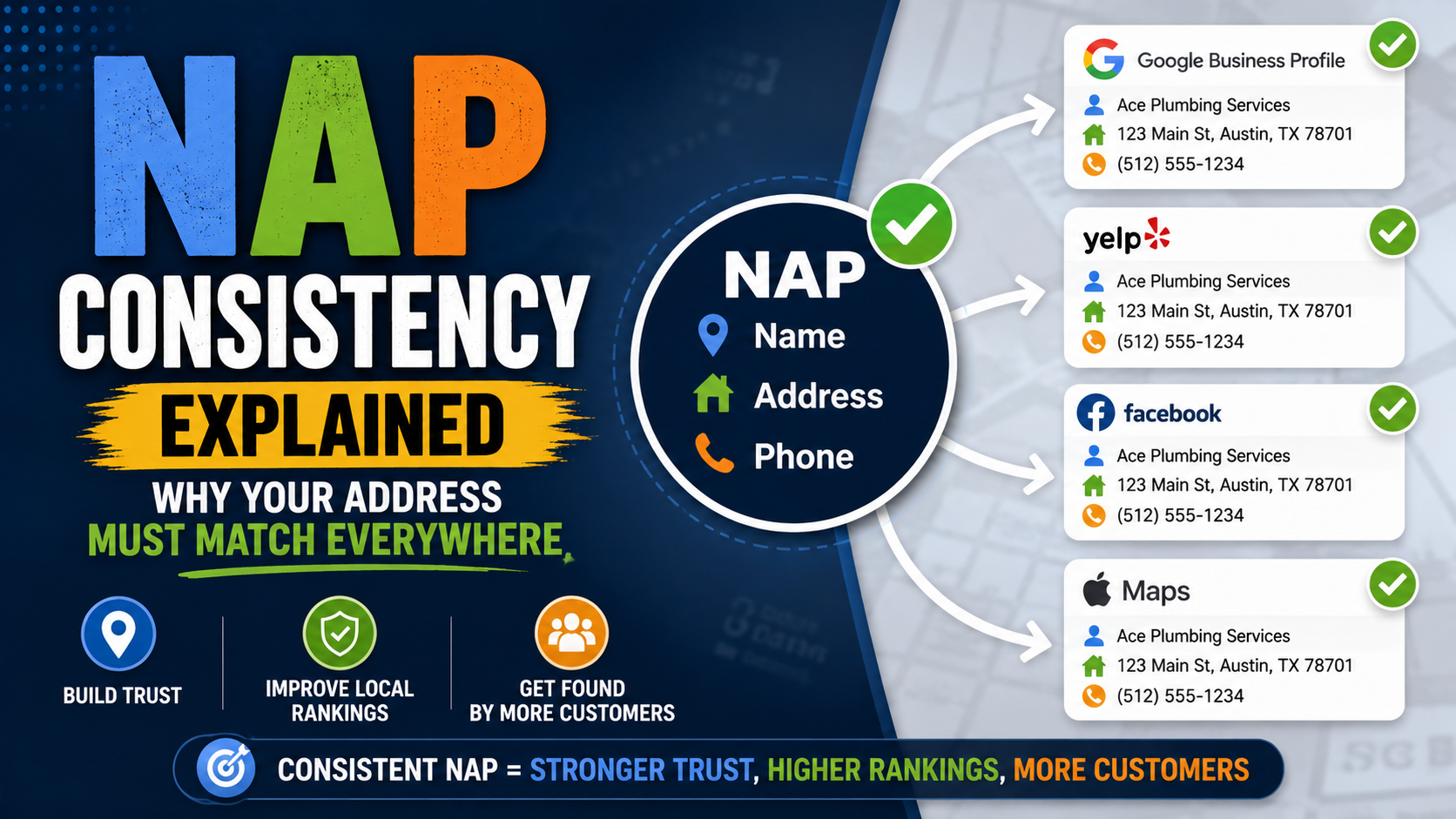
I once came across a local business where finding the correct phone number felt like detective work.
Google Business Profile showed one number.
Facebook showed another.
A directory had a third number that had apparently belonged to the company several years earlier.
The website had the right number, but the footer still displayed the old office address.
If I were a customer trying to book the business, I probably would have given up.
That is the practical side of NAP consistency that sometimes gets lost in SEO discussions.
People talk about citations, algorithms, entity matching, and local ranking signals, but there is a much simpler issue underneath all of it:
Can Google and your customers confidently identify the same business everywhere they find it?
That is what NAP consistency is really about.
And despite what some old SEO checklists suggest, you do not need to panic because Yelp says “Main St.” while your website says “Main Street.”
The important thing is that the actual business information is correct.
Let’s break down what matters, what does not, and how I would clean up a messy local business presence.
What Does NAP Mean?
NAP stands for:
Name
Address
Phone number
These are three of the most basic pieces of identifying information for a local business.
For example:
Green Oak Landscaping
125 Main Street
Burlington, ON
555-123-4567
You may also hear people use NAPW, where the W stands for website.
Other business details often travel alongside NAP too, including:
- Opening hours
- Business category
- Website URL
- Service area
- Suite number
- Social profiles
When this information appears on another website, directory, map platform, review site, or local organization page, it may form part of what local SEO professionals call a citation.
BrightLocal’s current local SEO guidance defines NAP in the same way and emphasizes accurate business information across directories, review platforms, social profiles, and other citations.
Why Does NAP Consistency Matter?
There are two separate reasons.
One is search engines.
The other is customers.
The customer side is easier to understand.
Imagine you search for an auto repair shop.
Google says:
245 King Street
Apple Maps says:
98 King Street
Facebook says:
245 King Street
You are now wondering which location is correct.
Or perhaps Google has the correct address, but Yelp contains an old phone number.
You call it.
Disconnected.
Are you going to spend another five minutes researching the company?
Maybe.
A lot of customers will simply choose another business.
Google also wants accurate business information.
Google’s current Business Profile guidelines tell businesses to represent themselves as they are consistently represented in the real world and specifically require accurate, precise address or service-area information.
Google also says businesses with complete and accurate information are more likely to appear for relevant local searches. Local rankings are mainly based on relevance, distance, and prominence.
That does not mean changing “Road” to “Rd.” will suddenly move you three positions higher.
It means accurate business information is part of maintaining a healthy local search presence.
Google Doesn’t Get Business Information From One Place
This is another reason accuracy matters.
You might think:
“My Google Business Profile is correct, so why should I care what some other website says?”
Because Google’s local information does not come exclusively from the details you manually enter into GBP.
Google says local listing information can come from multiple sources, including:
- The business’s official website
- Public web content
- Licensed third-party data
- Business owners
- User contributions
- Google’s own interactions with a place
So imagine your official website says the company moved to:
125 Main Street
but several prominent online sources still say:
48 Lakeshore Road
You have conflicting information circulating about the same business.
That is something worth cleaning up.
Does Every Address Need to Be Written Exactly the Same?
This is where NAP advice sometimes becomes unnecessarily stressful.
No, I would not spend an entire afternoon trying to make these two versions identical:
125 Main Street, Suite 4
and:
125 Main St., Ste. 4
Modern search systems can understand common address abbreviations and formatting differences.
BrightLocal’s updated NAP guidance specifically notes that businesses generally do not need to worry about minor variations such as “Street” versus “St.” or “No.” versus “#”.
Whitespark makes the same point: Google and Bing are capable of normalizing many common address variations and abbreviations.
So I separate formatting differences from factual differences.
Usually Not Worth Panicking About
125 Main Street
versus:
125 Main St.
Or:
Suite 205
versus:
Ste 205
Or:
(555) 123-4567
versus:
555-123-4567
The underlying information is still the same.
Definitely Worth Fixing
125 Main Street
versus:
521 Main Street
Or:
555-123-4567
versus an old disconnected number.
Or:
Green Oak Landscaping
versus an old company name that no longer represents the business.
Those are real inconsistencies.
My rule is simple:
Accuracy first. Formatting second.
Your Business Name Should Match the Real Business
Business names are especially important because some companies deliberately create inconsistencies while trying to improve SEO.
Suppose the legal and real-world business name is:
Green Oak Landscaping
The website uses that name.
The trucks use that name.
Invoices use that name.
But somebody changes the Google Business Profile to:
Green Oak Landscaping | Patio Contractor | Landscaping Burlington
Now the problem is not merely NAP consistency.
It can become a Google policy problem.
Google says the name used on a Business Profile should reflect the business’s real-world name as consistently shown on signage, websites, stationery, and branding. Unnecessary information added to the name is not permitted.
So establish one official version of the business name and use it consistently where possible.
Do not create SEO versions of your company name for different platforms.
Address Problems Are Usually More Serious
Phone-number errors are frustrating.
Address errors can send somebody to the wrong building.
I would pay particular attention to address consistency after:
- Moving offices
- Opening another location
- Closing a location
- Changing suite numbers
- Rebranding
- Switching from storefront to service-area operations
If your company recently moved, it is perfectly normal for old information to remain online for a while.
That does not mean you should ignore it.
Start with the sources customers are most likely to encounter.
Usually:
- Google Business Profile
- Your website
- Apple Maps
- Bing
- Yelp
- Important industry directories
- Local directories
- Chamber or association profiles
Fix those before worrying about an obscure directory nobody has visited since 2014.
Service-Area Businesses Are Different
This is where the phrase “your address must match everywhere” needs some nuance.
Suppose you run a plumbing company from home.
Customers do not visit the house.
You travel to them.
Google’s current guidelines say service-area businesses that do not serve customers at their business address should hide the address from customers and use a service area instead.
So you should not expose your private home address on Google just because somebody told you NAP needs to appear everywhere.
For a service-area business, consistency means accurately representing the way the business operates.
Your:
- Business name
- Phone
- Website
- Service areas
- Branding
should make sense across the web.
You do not need to publish a private address everywhere simply to create a perfect three-part NAP citation.
Accuracy and policy compliance come first.
Phone Number Consistency Matters More Than People Think
A wrong phone number can be more damaging than almost any minor address-formatting issue.
If a customer calls the wrong number, the lead is gone.
This often happens after businesses:
- Change phone providers
- Stop using an old landline
- Switch agencies
- Use call tracking
- Move locations
- Buy another business
I have seen old tracking numbers left on directory listings long after the marketing campaign that created them ended.
That can create a nasty situation where a customer finds your company but cannot actually reach you.
Google’s current Business Profile guidelines recommend providing a phone number that connects to the individual business location and, where possible, using a local number rather than a central call-center number. Google also says the number should be under the business’s direct control.
Create one primary business number that you treat as your standard citation number.
If you use call tracking, set it up carefully rather than replacing numbers randomly across your entire citation ecosystem.
Your Website Should Be the Source of Truth
Whenever I am cleaning up NAP problems, I want one reliable master source.
Usually that is the official website.
For a single-location storefront, I would normally make the business information easy to find on:
- Contact page
- Footer
- Location page
- About page where appropriate
For example:
Green Oak Landscaping
125 Main Street, Burlington, ON A1A 1A1
(555) 123-4567
Then I compare other important listings with that information.
For a multi-location company, I prefer dedicated location pages.
For example:
example.com/burlington/
example.com/oakville/
example.com/hamilton/
Each page can contain its own:
- Location name
- Address
- Phone
- Hours
- Local content
- Directions
- Services
Do not put three locations into one confusing footer and expect every platform to figure out which phone number belongs to which address.
Build a Master NAP Document
This is one of the simplest local SEO systems you can create.
Open a Google Sheet.
Create something like:
Official Business Name:
Green Oak Landscaping
Address Line 1:
125 Main Street
Address Line 2:
Suite 205
City:
Burlington
Province/State:
Ontario
Postal Code:
A1A 1A1
Country:
Canada
Primary Phone:
555-123-4567
Website:
https://example.com/
Primary Category:
Landscaper
Opening Hours:
Monday-Friday, 8 AM-6 PM
Now anyone creating a directory profile can copy from the same source.
This becomes especially useful when several people manage the business:
- Owner
- SEO agency
- Social media manager
- Office manager
- Web developer
Without a master record, people start guessing.
One person enters:
Green Oak Landscaping Ltd.
Another enters:
Green Oak Landscape
Another uses:
Green Oak Landscaping & Pavers
A year later, nobody remembers which one is supposed to be official.
How to Audit Your Existing NAP
You do not need expensive software to begin.
Start with Google.
Search your business name in quotation marks:
“Green Oak Landscaping”
Then:
“Green Oak Landscaping” Burlington
Then search the phone number:
“555-123-4567”
If you know the business used an old number, search that too.
Search the old address.
Search older business names.
You may uncover listings you forgot existed.
I would record everything in a spreadsheet:
Platform
Listing URL
Business Name
Address
Phone
Website
Correct?
Claimed?
Action Needed
You might discover something like:
Google – correct.
Facebook – old address.
Yelp – correct address, old phone.
Local chamber – correct.
Old directory – previous company name.
Now you have a cleanup plan.
Fix the Most Important Listings First
Do not try to correct the whole internet in one afternoon.
Prioritize.
Priority 1: Google Business Profile
Make sure the profile accurately reflects the real business.
Priority 2: Official Website
Your own site should not contain conflicting information.
Priority 3: Major Maps and Search Platforms
Check important ecosystems such as Apple and Bing.
Priority 4: Major Review and Social Profiles
Yelp, Facebook, Tripadvisor, or relevant alternatives depending on the industry.
Priority 5: Industry Directories
For example, legal, medical, construction, hospitality, or real estate directories.
Priority 6: Local Organizations
Chambers, local associations, neighborhood organizations, and business directories.
Priority 7: Smaller Citations
Clean these as time and value justify it.
The goal is not to achieve some imaginary 100% score across every website ever created.
The goal is to make the major information customers and search engines encounter accurate.
What If You Find Duplicate Listings?
Duplicates deserve attention too.
Suppose Yelp has:
Green Oak Landscaping – 125 Main Street
and another profile:
Green Oak Landscaping – 48 Lakeshore Road
The second listing is from your previous office.
Now there are two versions of the business floating around.
Depending on the platform, you may be able to:
- Claim the listing
- Update it
- Mark it moved
- Merge duplicates
- Request removal
- Contact support
Do not immediately create a third listing because neither existing profile is perfect.
Always search first.
Then correct what already exists when possible.
What Happens When Your Business Moves?
Moving creates the biggest NAP cleanup job.
I would handle it systematically.
Before the Move
Prepare:
- New address
- Move date
- Website updates
- Signage
- Customer communications
Around the Move Date
Update:
- Google Business Profile
- Website
- Apple Maps
- Bing
- Important directories
After the Move
Search the old address and old phone number.
Look for outdated citations.
Keep checking periodically because old business information can continue appearing in search results.
One mistake is deleting the old location information everywhere before the move is actually complete.
Another is leaving the old location online indefinitely.
Time the updates around the real-world change.
What If You Rebrand?
Rebranding creates a similar issue.
Imagine:
Green Oak Landscaping
becomes:
Oak & Stone Outdoor Living
Now you have to decide whether this is simply a name change or a fundamentally different business.
Assuming it is a legitimate rebrand of the same company, update your major online properties consistently.
That includes:
- GBP
- Website
- Social profiles
- Major directories
- Industry profiles
- Local memberships
Do not leave half the web under one brand and half under another without any explanation.
Customers may assume the businesses are unrelated.
Don’t Obsess Over Tiny Differences
This deserves repeating because I have seen businesses waste ridiculous amounts of time on it.
These are not the problems I would prioritize:
Street vs St.
Suite vs Ste.
#5 vs Unit 5
(555) 123-4567 vs 555-123-4567
Search engines can generally understand common variations.
These are the problems I would prioritize:
Wrong building
Old phone number
Old business name
Incorrect website
Duplicate profiles
Fake location
Storefront address for an SAB where customers are not served
Closed location still shown as active
That is where real confusion happens.
NAP Consistency Is Not a Magic Ranking Trick
There is a tendency in local SEO to turn every best practice into a ranking guarantee.
Do not do that with NAP.
You might clean 50 citations and see no dramatic ranking jump the next morning.
That does not mean the work was pointless.
Google’s own local ranking documentation focuses on relevance, distance, and prominence and recommends maintaining complete and accurate business information.
NAP cleanup is foundational work.
It helps create a cleaner, more accurate online presence.
It can reduce customer confusion.
It can help search systems reconcile information about the business.
But it does not replace:
- Good Google Business Profile optimization
- Reviews
- Relevant categories
- Useful service pages
- Local content
- Strong backlinks
- Real-world prominence
Think of it like correcting your company’s contact information on every business card.
Important?
Absolutely.
A complete marketing strategy?
No.
Common NAP Mistakes to Avoid
Using an SEO Version of Your Business Name
Stick to the genuine real-world name.
Leaving Old Phone Numbers Online
Search previous numbers periodically, especially after changing providers.
Forgetting Citations After Moving
Address changes require more than updating Google.
Creating New Listings Instead of Updating Old Ones
Search first.
Publishing a Home Address for an SAB
Follow platform rules and protect private information.
Assuming Every Formatting Difference Is an SEO Emergency
“Street” versus “St.” is not the same as having the wrong street.
Ignoring Your Own Website
Your website should not be one of the sources spreading outdated information.
Letting Different Employees Guess Business Details
Maintain a master NAP document.
Forgetting Multi-Location Differences
Each real location should have the correct address and phone associated with that specific branch.
A 30-Minute NAP Check You Can Do Today
You can find a surprising number of issues very quickly.
Start by opening your Google Business Profile.
Confirm:
- Name
- Address or service area
- Phone
- Website
Then open your website.
Compare them.
Next search Google for:
“Business Name”
and:
“Phone Number”
Check the first few important results.
Then check:
- Apple Maps
- Bing
- Yelp or your main review platform
Write down anything incorrect.
Do not worry about minor punctuation.
Look for factual differences.
If everything is correct, great.
If you find an old address on four major sites, you now know exactly what to fix.
Final Thoughts
NAP consistency sounds like one of those boring SEO housekeeping tasks.
It is.
And that is partly why it matters.
Nobody gets excited about correcting an old phone number on a business directory.
But imagine being the customer who calls that number.
Or the customer who drives to the old office.
Or the person who sees two different addresses and decides the company looks unreliable.
Accurate local business information removes that friction.
Google’s own guidance is straightforward: represent your business as it is recognized in the real world, keep your address or service area accurate, and maintain complete business information.
That is how I would think about NAP consistency.
Not:
Every comma must match.
But:
Every important source should clearly point to the same real business.
Your company should have the same genuine name.
Customers should reach the right phone number.
They should arrive at the correct location.
Your website should support the same information.
Old locations should not continue confusing people years later.
And if you operate as a service-area business, your information should accurately reflect that instead of exposing or inventing a storefront address just to satisfy an SEO checklist.
Get the facts right first.
Standardize the formatting where practical.
Keep a master record.
Audit the important platforms periodically.
And whenever your company moves, rebrands, changes its phone number, or opens another location, make citation updates part of the changeover process rather than something you remember six months later.
That is NAP consistency done properly.
Not perfection for the sake of an SEO score.
Just accurate business information wherever customers are likely to find you.