I once worked through a local business’s online presence and found three different phone numbers for the same company.
Google showed the current number.
One directory had a number the business stopped using two years earlier.
Another listing pointed customers to an old address.
A third had the correct address but the wrong business name.
The owner thought the main problem was rankings.
I was more worried about the customer trying to call them.
That experience changed how I look at local citations.
They are usually discussed as an SEO tactic, but their first job is much simpler: make sure people can find accurate information about your business wherever they happen to look.
That might be Google.
It might be Apple Maps.
It might be Bing, Yelp, Facebook, Nextdoor, Tripadvisor, or an industry-specific directory.
And yes, these listings can support a broader local SEO strategy. But creating 300 random directory profiles is not something I recommend.
A smaller number of accurate, relevant, trustworthy citations is usually a much better use of time.
What Is a Local Citation?
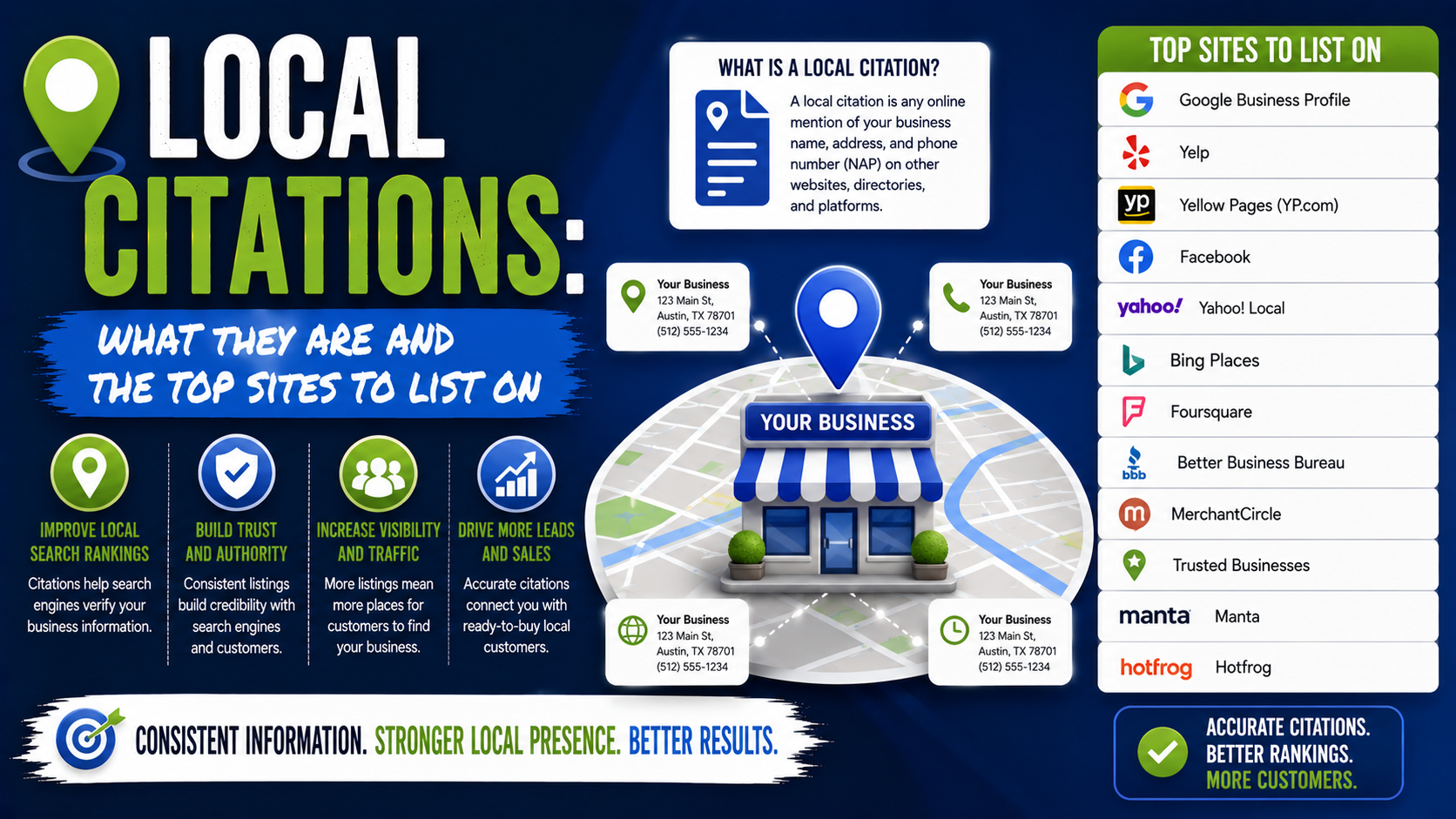
A local citation is an online mention of a business’s identifying information.
Usually that includes:
- Business name
- Address
- Phone number
You will often hear this called NAP, which simply means Name, Address, Phone.
A citation may also contain:
- Website URL
- Opening hours
- Business category
- Services
- Photos
- Description
- Social profiles
Local SEO platform BrightLocal defines citations as third-party listings or mentions of business information and separates them into structured and unstructured citations.
That sounds more complicated than it really is.
If your plumbing company appears on Yelp with its name, address, phone number, website, and opening hours, that is a citation.
If a local newspaper publishes an article mentioning your plumbing company and its location, that can also be considered a citation.
The format is simply different.
Structured vs. Unstructured Citations
You will normally come across two types.
Structured Citations
These are the traditional directory listings most people mean when they talk about citation building.
The business information appears in specific fields.
For example:
Green Oak Landscaping
125 Main Street
Burlington, Ontario
555-123-4567
greenoaklandscaping.com
You might find this format on:
- Google Business Profile
- Apple Maps
- Bing
- Yelp
- Foursquare
- Business directories
- Industry directories
The structure makes it easy for both users and platforms to understand what information belongs to the business.
Unstructured Citations
An unstructured citation appears naturally inside other content.
Imagine a local news website writes:
“Green Oak Landscaping recently donated materials for a community garden project in Burlington.”
That is a business mention, even though the information is not sitting inside a traditional directory profile.
Other examples include:
- Local news articles
- Chamber websites
- Sponsorship pages
- Local blogs
- Association websites
- Community event pages
- Supplier websites
BrightLocal’s current citation guidance treats both directory listings and relevant third-party mentions as useful forms of citation.
Personally, I would rather earn one genuine mention from a respected local organization than create 30 profiles on directories nobody in the city has ever heard of.
Do Citations Actually Help Local SEO?
This is where I would avoid exaggerated claims.
You will find companies promising:
“500 citations = guaranteed Google Maps rankings.”
That is not how local search works.
Google says local results are mainly based on relevance, distance, and prominence. Google also explains that prominence can be influenced by information such as links to a business and reviews.
Google does not publicly say:
“Build exactly 75 NAP citations and move up three positions.”
So I do not treat citations like a mathematical ranking formula.
Instead, I use them as part of the foundation.
Accurate listings can help with:
- Business discovery
- Consistent contact information
- Brand visibility
- Referral traffic
- Customer trust
- Reviews on third-party platforms
- Building a wider online presence
Local SEO research and industry guidance also continue to treat citations as a foundational part of local search campaigns.
The key word is foundation.
Citations will not rescue a terrible website, fake Google Business Profile, weak reviews, or completely irrelevant location.
But they are still worth getting right.
Why Citation Accuracy Matters More Than Citation Quantity
Imagine a customer searches your company name.
Google says:
Open until 6 PM
Yelp says:
Open until 5 PM
Apple Maps shows:
Closed permanently
An old directory sends them to your previous location.
That is not an SEO problem anymore.
That is a business problem.
This is why I start with accuracy instead of volume.
The information I want standardized includes:
- Business name
- Address
- Main phone number
- Website
- Opening hours
- Business category where possible
There can be legitimate differences.
For example, one platform might format:
Suite 205
as:
#205
That is not something I would lose sleep over.
Likewise, a phone number written as:
555-123-4567
instead of:
(555) 123-4567
is still clearly the same phone number.
The goal is not obsessive character-for-character matching.
The goal is making sure the underlying information is correct.
Which Citations Should You Build First?
I normally divide citations into three groups.
Tier 1: Major Platforms
These are the sites and ecosystems I would check for almost every eligible local business.
Tier 2: Industry-Specific Directories
These depend on what type of business you run.
Tier 3: Local Opportunities
These include chambers, associations, local publications, community organizations, and city-specific directories.
That approach makes far more sense than submitting every business to the same 200 websites.
Here are the platforms I would start with.
1. Google Business Profile
This is the obvious first priority for most local businesses.
If you serve local customers and qualify for a Business Profile, this should generally be handled before minor directories.
A properly managed Google Business Profile can display information in Google Search and Maps.
Google specifically recommends that businesses keep their information complete, accurate, and up to date because this helps Google match businesses with relevant local searches.
Check:
- Business name
- Address or service area
- Phone
- Website
- Hours
- Primary category
- Secondary categories
- Services
- Photos
Do not create duplicate profiles just to get more citations.
One accurate eligible profile is better than several risky duplicates.
2. Apple Maps / Apple Business Connect
This is one I have seen businesses forget completely.
They optimize Google heavily and never check what iPhone users see.
Apple allows businesses to claim and manage location information through Apple Business Connect. Business information can appear across services including Maps, Siri, Safari, Calendar, and other Apple experiences.
Apple’s current business tools let location owners manage information such as photos, place-card information, phone numbers, websites, and location details.
For a local business, I would definitely check:
- Pin placement
- Address
- Phone
- Website
- Hours
- Photos
- Business category
Do not assume that because Google has the correct information, Apple automatically does too.
Check it yourself.
3. Bing Places for Business
Bing gets less attention than Google, but I still include it in core citation work.
Microsoft currently directs business owners to Bing Places for Business to add, claim, or update information that appears in Bing Maps search results.
The process is straightforward enough that there is little reason to ignore it.
Make sure it reflects the same real business details you use elsewhere.
For small businesses, this is one of those tasks I would complete once, verify carefully, and then revisit when something changes.
4. Yelp
Whether you personally use Yelp or not, you should check whether your business already has a page there.
Businesses can exist on Yelp before the owner ever creates an account.
Yelp currently lets authorized business owners claim existing pages for free. Once claimed, owners can update details such as address, phone number, opening hours, website information, photos, and other business information.
That makes it an important citation to check.
I would especially prioritize Yelp for industries where customers actively compare local options, such as:
- Restaurants
- Home services
- Salons
- Automotive businesses
- Professional services
- Retail
- Hospitality
One thing I would not do is create or manipulate fake Yelp reviews.
Claim the profile.
Make the information accurate.
Let genuine customer feedback develop naturally.
5. Facebook
A Facebook Page is not just a place to publish social posts.
For many local businesses, it is another public business profile that customers discover when searching for the company name.
Meta currently recommends creating a Facebook Page when the goal is to represent a business, brand, or product. Pages can contain business information, profile and cover images, and action buttons.
Make sure your Page uses your real:
- Business name
- Website
- Contact information
- Business description
- Location where appropriate
An abandoned Facebook Page from 2017 showing an old phone number is exactly the kind of citation problem I try to clean up.
6. Nextdoor
For neighborhood-based businesses, Nextdoor deserves a look.
It can be especially relevant for:
- Landscapers
- Plumbers
- Electricians
- Roofers
- Cleaners
- Handymen
- Contractors
- Pest control
- Local pet services
Nextdoor currently offers free Business Pages that local business owners can create or claim. These pages can display contact information, photos, posts, and recommendations from neighbors.
This is a good example of why relevance matters.
For a local plumber, a neighborhood platform can make far more sense than a random global directory that has never generated a visitor.
7. Foursquare
Foursquare is another platform worth checking because it maintains a business listings ecosystem.
Its current business listing tools allow owners to create or manage listings and keep information such as contact details, website, and business hours updated.
I would not necessarily spend hours optimizing a Foursquare profile.
But if the business is already present, claim or correct it where possible.
Citation cleanup is partly about controlling important information already circulating online.
8. Better Business Bureau
For businesses in the United States and Canada, BBB is worth checking.
The Better Business Bureau maintains profiles for millions of businesses, and consumers use those profiles for business information, reviews, complaints, ratings, and accreditation information. BBB also provides a route for businesses to get listed.
Accreditation is a separate decision and may involve fees.
Do not confuse:
having a BBB business profile
with:
paying for BBB Accreditation.
For citation purposes, the first thing I care about is whether the company’s information on BBB is accurate.
9. Tripadvisor
Tripadvisor is not relevant to every local business.
But if you operate in travel, hospitality, attractions, or restaurants, it moves much higher on the priority list.
Tripadvisor currently allows qualifying businesses to claim listings and manage information, photos, reviews, and other listing details.
For restaurants and hotels specifically, Tripadvisor provides free listing-claim workflows for owners.
If I were working with a hotel, for example, Tripadvisor would matter far more than 20 generic directories.
That is exactly why citation building should be customized by industry.
10. Industry-Specific Directories
This is where citation work gets much more useful.
Instead of asking:
“What are the top 100 directories?”
ask:
“Where do people look for businesses like mine?”
A few examples:
Lawyers
Avvo is an obvious example in the United States.
Attorneys can currently claim and manage their Avvo profiles, which include professional information and reviews.
Other legal directories and state or regional bar directories may also be relevant.
Architects, Designers, and Remodelers
Houzz can be useful for businesses in:
- Architecture
- Interior design
- Remodeling
- Home construction
- Landscaping
- Home improvement
Houzz currently supports professional business profiles where businesses can provide category, location, service, description, and project information.
Medical Businesses
Doctors, dentists, therapists, and clinics should look for authoritative directories specific to their profession and country.
Real Estate
Agents and brokers should check major property platforms, local real estate associations, and professional directories relevant to their market.
Restaurants and Hospitality
Tripadvisor, tourism websites, reservation platforms, and local visitor guides may all make sense.
The rule is simple:
The more relevant the directory is to your actual customers, the more interested I am in it.
11. Your Local Chamber of Commerce
This is one of my favorite citation opportunities because it is genuinely local.
Search:
[city] chamber of commerce
Then see whether members receive an online business listing.
Many local chambers maintain directories containing member information.
Do not join purely because somebody told you a chamber backlink is an SEO trick.
Look at the broader value.
Could membership provide:
- Networking
- Referrals
- Events
- Local visibility
- Business directory exposure
- Partnerships
If yes, the citation becomes a bonus inside something that already makes business sense.
That is the kind of link and citation I prefer.
12. Local and Regional Directories
Most cities have websites that national SEO tools never mention.
You might find:
- Local business associations
- Tourism directories
- Downtown business improvement districts
- Neighborhood associations
- Local marketplaces
- Regional trade organizations
- City business portals
These can be particularly useful because they have genuine geographic relevance.
Search Google for things like:
business directory [city]
business association [city]
shop local [city]
contractors association [region]
visitor guide [city]
Then manually inspect the results.
Do not submit blindly.
Look at the website first.
Is it maintained?
Does it rank?
Are real businesses using it?
Does the organization actually exist?
Would a customer trust it?
If not, skip it.
What Information Should You Prepare Before Building Citations?
This saves a huge amount of time.
Create a simple document or spreadsheet containing your official business information.
I usually prepare:
Business Name:
Green Oak Landscaping
Address:
125 Main Street, Burlington, ON
Phone:
555-123-4567
Website:
https://example.com
Primary Category:
Landscaper
Secondary Categories:
Paving Contractor, Masonry Contractor
Business Description:
Short approved version
Opening Hours:
Monday-Friday 8:00 AM-6:00 PM
Logo:
High-resolution file
Photos:
A folder containing approved business images
Social Profiles:
Facebook, Instagram, LinkedIn, etc.
Now you are not guessing every time you create a listing.
Copy from the master record.
How I Audit Existing Citations
Before creating anything new, I search for what already exists.
Start with the business name in quotation marks:
“Green Oak Landscaping”
Then search:
“Green Oak Landscaping” Burlington
Then search the phone number:
“555-123-4567”
Try the old number too if the business previously changed it.
You would be surprised what appears.
I have found:
- Old business names
- Former addresses
- Duplicate profiles
- Wrong websites
- Tracking phone numbers that should no longer be active
- Profiles created by old agencies
- Listings nobody knew existed
Put the results into a spreadsheet.
Useful columns include:
| Directory | Listing URL | Name Correct? | Address Correct? | Phone Correct? | Claimed? | Action |
| URL | Yes | Yes | Yes | Yes | None | |
| Yelp | URL | Yes | No | Yes | No | Claim + fix |
| Bing | URL | Yes | Yes | No | Yes | Update |
| URL | Yes | Old | Old | Yes | Update |
That gives you a real cleanup plan.
Should You Use Citation Tools?
You can absolutely build citations manually.
For one small business location, that is often manageable.
Once you are dealing with:
- Multiple locations
- Dozens of directories
- Franchise businesses
- Large-scale citation cleanup
software becomes more useful.
Common local SEO platforms include tools from companies such as:
- BrightLocal
- Whitespark
- Yext
- Semrush
These can help discover, build, monitor, or manage listings depending on the service.
But software does not remove the need for judgment.
A tool may suggest 80 websites.
You still need to decide whether those listings are important for your particular business.
I would rather see:
25 accurate, relevant citations
than:
250 low-quality profiles created simply to increase a spreadsheet count.
Common Citation Building Mistakes
1. Building Hundreds of Low-Quality Directories
More is not automatically better.
BrightLocal’s own updated citation guidance warns against low-value and irrelevant citation-building practices and recommends prioritizing trusted industry and local sources.
If a directory looks abandoned, spammy, or completely unrelated to your business, I usually leave it alone.
2. Using Fake Addresses
Do not create fake offices just to get citations in more cities.
Your listings should represent the real business.
3. Creating Duplicate Profiles
Always search before creating.
You may already have a listing.
Claim the existing one where appropriate instead of producing another duplicate.
4. Using Different Business Names for SEO
Do not list:
Green Oak Landscaping
on one site and:
Green Oak Landscaping Best Patio Contractor Burlington
on another simply because you want keywords.
Use the real business name.
5. Forgetting Old Citations After Moving
A change of address should trigger a citation audit.
Update your important profiles.
Otherwise customers may continue receiving directions to the old location.
6. Treating Every Citation Like a Backlink Opportunity
Sometimes people only care whether the directory provides a followed SEO link.
That misses the point.
A citation can still be useful because customers discover and verify your business through it.
7. Ignoring Industry Directories
A lawyer should not use the same citation list as a restaurant.
A hotel should not use the same citation strategy as an electrician.
Relevance matters.
What I Would Prioritize for a New Local Business
If I were launching a new local service company tomorrow, I would not order 500 citations on day one.
I would do this instead.
First
Set up or claim:
- Google Business Profile
- Apple Business Connect
- Bing Places
- Yelp
Next
Check whether the business belongs on:
- Nextdoor
- BBB
- Foursquare
Then
Find the best industry-specific platforms.
For example:
- Tripadvisor for hospitality
- Avvo for attorneys
- Houzz for home design and remodeling
After That
Look locally:
- Chamber of commerce
- Trade associations
- Local organizations
- Regional directories
- Sponsorship opportunities
- Local publications
Then keep the information updated.
That is enough to build a strong citation foundation without turning the process into busywork.
Final Thoughts
Local citations are not one of the glamorous parts of SEO.
There are no impressive traffic graphs when you correct an old phone number on a forgotten directory.
But that does not make the work unimportant.
Think of citations as your business’s public information layer.
Wherever customers find you, the basic story should make sense:
Same company.
Correct location.
Correct phone number.
Correct website.
Real services.
Current opening hours.
Start with the platforms people actually use.
Google.
Apple Maps.
Bing.
Yelp.
Facebook.
Then add platforms that make sense for your industry and your city.
A restaurant may need Tripadvisor.
A lawyer may need Avvo.
A remodeling business may benefit from Houzz.
A neighborhood contractor may find Nextdoor valuable.
And almost every genuinely local company should at least investigate its chamber, local associations, and relevant community directories.
What I would not do is chase a magical number like:
“You need exactly 150 citations to rank.”
Local search does not work that neatly.
Google itself describes local visibility primarily through relevance, distance, and prominence, not through a published citation quota.
So build citations for the right reason.
Make the business easier to discover.
Make its information easier to verify.
Remove confusing old data.
Show up on platforms your customers actually use.
Then combine that foundation with the things that really make a local business competitive: a properly managed Google Business Profile, useful service pages, genuine reviews, strong local content, real links, and a business people are willing to recommend.
That is a much healthier local SEO strategy than submitting the same company to every directory you can find.