A small-business owner once showed me a campaign report with a big smile.
The ads had generated 94 leads in one month. The cost per lead looked reasonable, the contact form was busy, and the marketing dashboard showed plenty of green numbers.
Then we opened the sales tracker.
Only 11 people had answered the phone. Four were outside the service area. Three were looking for something the company did not provide. One booked an appointment, and nobody had followed up with the remaining contacts after the first call attempt.
The campaign had produced activity, but the business had almost nothing to show for it.
That situation is more common than most owners realize.
Lead generation is often treated as a simple volume problem: run more ads, publish more content, send more emails, or collect more phone numbers. But leads do not become customers automatically.
A good lead can still be wasted by slow follow-up, unclear pricing, poor tracking, or a confusing sales process. At the same time, a campaign that appears unsuccessful may actually be attracting strong prospects that the business is handling badly.
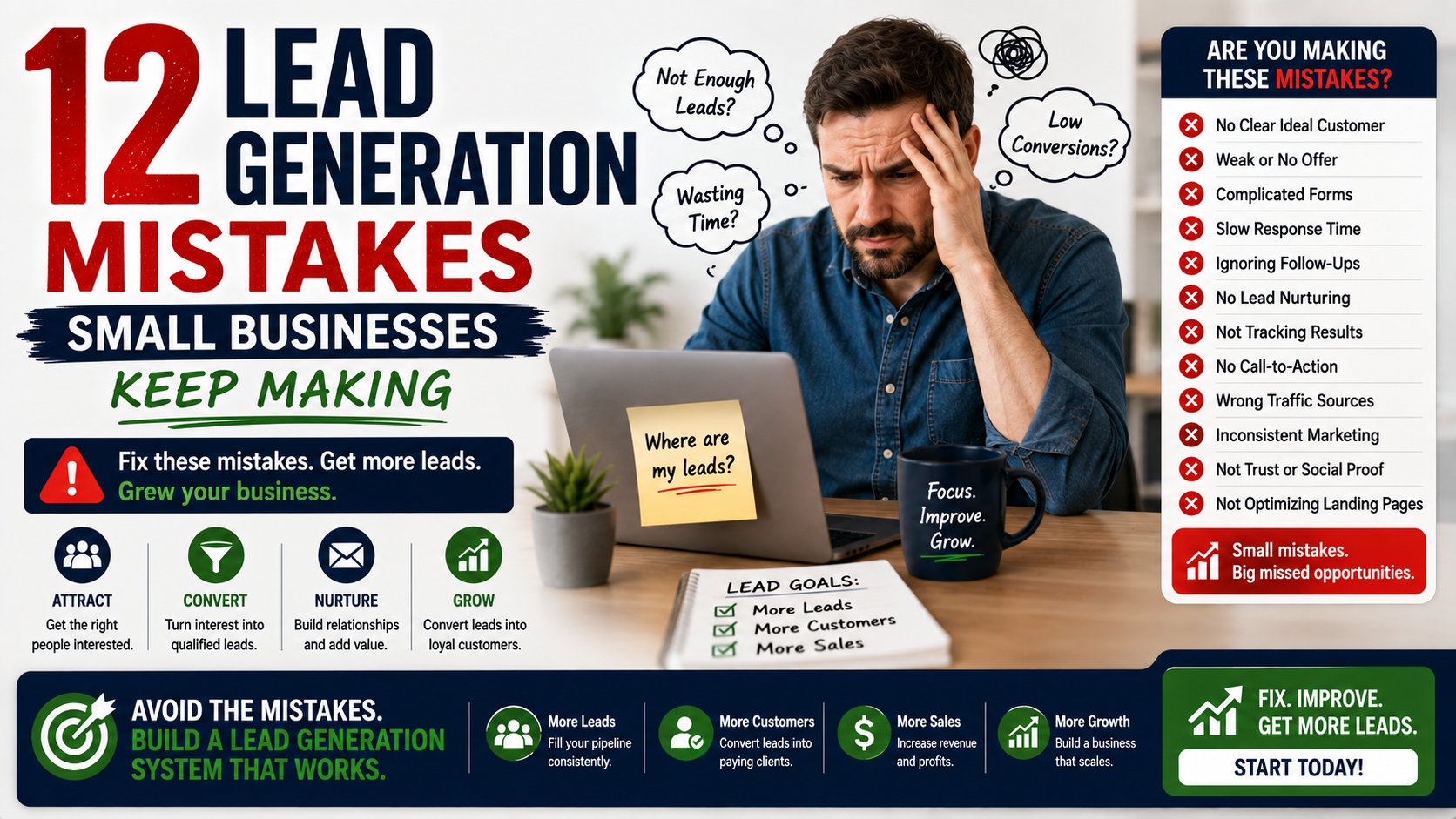
Here are 12 lead generation mistakes small businesses keep making, along with practical ways to correct them.
1. Chasing More Leads Before Fixing the Sales Process
When sales are slow, the first reaction is usually:
“We need more leads.”
Sometimes that is true.
But I have seen businesses request twice as many enquiries when they were already failing to respond properly to the leads they had.
Before increasing the marketing budget, check:
- How quickly new leads are contacted
- How many receive more than one follow-up
- Whether quotes are sent on time
- How many appointments become sales
- Why prospects choose not to buy
- Whether every enquiry has a clear owner
Suppose a business receives 50 leads and closes five customers.
That is a 10% lead-to-customer conversion rate.
If the company doubles its lead volume without improving anything else, it may get ten customers—but it will also double the number of calls, quotes, reminders, and missed follow-ups.
Now imagine the business improves its conversion rate from 10% to 20%.
It can win the same ten customers from 50 leads instead of 100.
Improving the sales process is often cheaper than buying additional traffic.
Start by following a few recent leads from beginning to end. Look for delays, unclear handovers, unanswered questions, and missing follow-ups.
The problem may not be lead generation at all.
2. Treating Every Form Submission as a Good Lead
A dashboard may call every completed form a conversion.
Your business should not automatically call every form a qualified lead.
Some submissions come from:
- People outside your service area
- Job seekers
- Vendors
- Students
- Competitors
- People with unrealistic budgets
- Customers requesting unsupported services
- Bots or spam
- People who entered incorrect details
- Early-stage researchers
These contacts still need to be reviewed, but they should not all be counted as genuine sales opportunities.
Create a simple qualification standard.
For example, a local contractor may consider a lead qualified when the person:
- Needs a service the company provides
- Lives within the service area
- Has a realistic project timeline
- Meets the minimum budget
- Owns or manages the property
- Provides valid contact information
Track both total enquiries and qualified leads.
If an advertising campaign generates 100 forms but only 20 are suitable, its qualification rate is 20%.
That tells you much more than the raw lead count.
A campaign producing 35 enquiries with 25 qualified prospects may be far more valuable.
3. Using an Offer That Is Too Broad
One of the most common lead generation messages is:
“We provide high-quality solutions for all your needs. Contact us today.”
It sounds professional, but it says almost nothing.
What needs?
Which service?
Who is it for?
Why should someone contact the business now?
Broad offers force customers to work too hard to understand whether the service fits their situation.
A renovation company might advertise:
We handle all types of construction and renovation work.
A more focused offer would be:
Planning a kitchen renovation in Lahore? Book a site measurement and initial layout consultation.
The second version is easier to understand because it identifies:
- The service
- The customer
- The location
- The next step
This does not mean the company must offer only one service.
It means each campaign or landing page should usually focus on one clear problem.
Create separate messages for:
- Kitchen renovations
- Bathroom renovations
- Office fit-outs
- Exterior work
- Repair services
Focused offers also improve lead quality. People know what they are responding to before submitting their information.
4. Sending Traffic to a Weak Homepage
A small business may spend thousands on advertising and send every visitor to its homepage.
The homepage usually contains:
- Several services
- Company history
- Team information
- Social media links
- Blog posts
- Multiple menus
- General photographs
- Several calls to action
That is useful for someone researching the whole company.
It is not always useful for someone who clicked an advertisement about one specific service.
Suppose the ad promotes emergency air-conditioning repair.
The visitor should reach a page that immediately explains:
- Emergency AC repair
- Areas covered
- Opening hours
- Response process
- Common problems handled
- Phone or booking options
They should not have to search through a general website to find the service mentioned in the ad.
A focused landing page keeps the message consistent.
The headline should match the advertisement. The images should represent the real service. The form should ask only for information needed for the next step.
Before launching a campaign, test the page on a phone.
Check:
- How quickly it loads
- Whether the text is readable
- Whether the phone number works
- Whether the form submits correctly
- Whether the call-to-action button is visible
- Whether the confirmation message appears
A strong campaign cannot compensate for a broken or confusing landing page.
5. Asking for Too Much Information Too Soon
Some lead forms feel like a mortgage application.
The business asks for the person’s full address, company size, annual revenue, exact budget, project history, preferred date, job title, and a detailed description before offering any useful information.
Long forms can reduce spam and improve qualification, but every question adds friction.
The goal is to collect enough information to decide the next step—not everything the business may eventually need.
For a local cleaning company, the first form may only need:
- Name
- Phone number
- Area
- Property size
- Service required
- Preferred date
The company can ask about pets, access instructions, surface materials, and special requests during the conversation.
At the other extreme, asking only for a name and email may produce too many weak leads.
Find the middle ground.
Add questions that help answer:
- Can we serve this person?
- Which service do they need?
- How urgent is the request?
- Is the project roughly within our normal range?
- What should our team prepare before contacting them?
Use dropdowns and multiple-choice questions where possible. They are easier to complete and easier to review.
6. Responding Too Slowly
A person who contacts your business is not always waiting patiently for your reply.
They may have also contacted three competitors.
This is especially common for:
- Emergency repairs
- Home services
- Legal consultations
- Property enquiries
- Cleaning services
- Medical appointments
- Marketing agencies
- Software providers
The first company to respond has the first opportunity to understand the problem, build trust, and book the next step.
Slow response can make a strong lead look weak.
By the time your team calls, the prospect may have already booked an appointment elsewhere.
Set an internal response target.
For high-intent enquiries during business hours, aiming for a response within 5 to 15 minutes is a useful goal. If that is not realistic, respond as quickly as your team can consistently manage.
Use tools such as:
- HubSpot
- Pipedrive
- Zoho CRM
- WhatsApp Business
- Slack
- Microsoft Teams
- Zapier
- Make
- Gmail filters
- Mobile notifications
An automatic confirmation can reassure the customer, but it should not replace personal contact.
A useful message might say:
Thanks for contacting us. We have received your request about the bathroom leak. A team member will call you within 20 minutes during business hours.
Do not promise a response time the business cannot maintain.
Reliable expectations are better than impressive but inaccurate promises.
7. Giving Up After One Call
Many good leads do not answer the first call.
They may be:
- Driving
- Working
- In a meeting
- Looking after children
- Speaking with another provider
- Unfamiliar with the number
- Not ready to talk at that exact moment
One unanswered call should not automatically move a lead to the lost column.
Use a reasonable follow-up sequence.
For example:
- Call shortly after the enquiry.
- Leave a short voicemail where appropriate.
- Send an SMS or WhatsApp message.
- Try again later that day.
- Follow up the next business day.
- Send one final helpful message.
The message should explain who you are and why you called.
Weak message:
Call me back.
Better message:
Hi Ayesha, this is Omar from ClearFlow Plumbing. You requested help through our website with a kitchen pipe leak. I just tried calling. You can reply here with a suitable time or send a photo if that is easier.
This feels legitimate and gives the lead an easy way to respond.
Do not turn follow-up into harassment. Several calls within a few minutes usually create more frustration than sales.
8. Focusing on Cost per Lead Instead of Cost per Customer
Cheap leads look good in reports.
They are easy to celebrate in meetings.
But cost per lead is only one part of the picture.
Imagine two campaigns.
Campaign A
- Advertising spend: $1,000
- Leads: 100
- Cost per lead: $10
- Customers: 2
- Cost per customer: $500
Campaign B
- Advertising spend: $1,000
- Leads: 25
- Cost per lead: $40
- Customers: 5
- Cost per customer: $200
Campaign A generated cheaper leads.
Campaign B generated cheaper customers.
The second campaign is more valuable even though its cost per lead is four times higher.
Track:
- Total leads
- Qualified leads
- Contacted leads
- Appointments
- Quotes
- Customers
- Revenue
- Gross profit
- Customer acquisition cost
Also consider customer lifetime value.
A lead that becomes a recurring customer may be worth far more than someone who makes one small purchase.
The cheapest source is not always the most profitable one.
9. Failing to Track Where Leads Came From
A business owner may say:
“Most of our customers come from Instagram.”
When asked how they know, the answer is often:
“That is where we get the most messages.”
Messages are not customers.
A lead may first see an Instagram post, search the company on Google, read reviews, visit the website, and then call.
Another customer may say they came through Google even though a friend originally recommended the company.
Lead attribution is rarely perfect, but basic tracking is much better than guessing.
Record:
- Original source
- Campaign
- Advertisement or post
- Service requested
- Final outcome
- Revenue
Use UTM parameters for links shared through:
- Partner websites
- Google Ads
- Newsletters
Google Analytics can track website activity, while a CRM or spreadsheet should track what happened after the enquiry.
For phone calls and WhatsApp messages, ask:
How did you first hear about us?
The answer may not always be exact, but it provides additional context.
Do not rely only on platform dashboards. Facebook knows that someone submitted a lead form. It may not know whether that person paid an invoice six weeks later.
10. Using the Same Message for Every Customer
Generic sales messages save time but often reduce response rates.
Consider this reply:
Thank you for your interest in our services. We provide high-quality solutions at competitive prices. Please book a call to learn more.
It could be sent by almost any company.
Now compare it with:
Thanks for reaching out about SEO for your dental clinic. I checked the location you mentioned, and it is within our target area. Before suggesting the next step, could you confirm whether the clinic already has a Google Business Profile for each branch?
The second message shows that someone read the enquiry.
Personalization does not require writing a completely new essay for every lead.
It means using the information the person has already provided.
Mention:
- The requested service
- Their location
- The property or business type
- Their stated problem
- Their preferred timeline
- A relevant question
Templates are useful, especially for repeated enquiries.
Create saved replies for common situations, but adjust them before sending.
A template should speed up human communication, not replace it.
11. Sending Proposals Before Proper Qualification
Preparing a proposal can take hours.
The team may research the project, calculate pricing, build a presentation, outline deliverables, and schedule internal discussions.
Then the prospect says:
“I was expecting this to cost around $200.”
The company normally charges $4,000.
That mismatch should have been discovered before the proposal.
Before creating detailed pricing, confirm:
- The problem
- Required service
- Approximate scope
- Budget range
- Timeline
- Decision-maker
- Approval process
- Competing priorities
- What success looks like
You do not need every answer before giving basic guidance.
But a full proposal should usually come after a proper qualification conversation.
For higher-value projects, ask:
- Who else will review the proposal?
- Has a budget been approved?
- When does the project need to begin?
- Are other providers being considered?
- Is there a decision date?
- What could delay approval?
This prevents proposals from becoming free planning documents for people who were never realistic buyers.
It also allows you to tailor the proposal to the actual decision rather than sending the same package to everyone.
12. Keeping Dead Leads in the Pipeline Forever
A sales pipeline can look impressive when it contains 200 open opportunities.
But if 150 of them have not responded in three months, the pipeline is giving the business false confidence.
Teams often avoid closing leads because they think the person may return one day.
That is possible.
But inactive leads should not remain mixed with current opportunities.
Create clear rules.
For example:
- After three reasonable follow-ups with no response, move the lead to long-term nurture.
- If the project is delayed, schedule a future contact date.
- If the person chooses another provider, mark the opportunity lost.
- If the service is unsuitable, record the reason and close it.
- If the budget is not currently available, ask when it may be reviewed.
Possible pipeline stages include:
- New
- Contacted
- Qualified
- Appointment booked
- Proposal sent
- Decision pending
- Long-term nurture
- Won
- Lost
Every active lead should have a next action and date.
A lead marked “follow up later” without a date will probably be forgotten.
A lead marked “contact on 10 September after budget approval meeting” has a clear next step.
Cleaning the pipeline does not mean throwing away future opportunities.
It means separating active deals from people who may become ready later.
The Mistake Behind Most Lead Generation Problems
Many of these mistakes come from the same misunderstanding:
The business treats lead generation as a marketing activity that ends when contact information is collected.
In reality, lead generation continues through:
- First response
- Qualification
- Appointment booking
- Proposal
- Follow-up
- Sale
- Customer onboarding
- Revenue tracking
A marketing campaign can produce the right prospect and still fail because the phone was unanswered.
A sales team can handle leads well and still struggle because the offer attracts the wrong audience.
The full system has to work together.
A Simple Lead Generation Audit
You can find many of these problems by reviewing the last 30 to 50 leads.
Create a spreadsheet containing:
- Date received
- Source
- Service requested
- Location
- First-response time
- Number of follow-ups
- Qualified or not
- Appointment status
- Quote or proposal status
- Won or lost
- Revenue
- Lost reason
Then ask:
Were Leads Relevant?
If many requests were unsuitable, review the offer, targeting, and qualification questions.
Were They Contacted Quickly?
If response time was slow, improve notifications and ownership.
Did People Answer?
If contact rates were poor, test SMS, WhatsApp, email, and different calling times.
Did They Book?
If people answered but did not book, review the first conversation and offer.
Did They Attend?
If no-shows were common, add confirmations and reminders.
Did They Buy?
If appointments happened but few purchased, review pricing, trust, sales skills, and service fit.
Why Were Deals Lost?
Group lost reasons and look for patterns.
This type of audit often shows that the business does not need a completely new marketing strategy.
It needs to repair one or two weak stages.
Build a Simple System That the Team Will Use
A small business does not need an expensive setup on day one.
A useful system can begin with:
- One central spreadsheet or CRM
- Clear lead stages
- One assigned owner per lead
- Immediate notifications
- A first-response script
- Follow-up reminders
- Qualification questions
- Lost-reason tracking
- A weekly pipeline review
Google Sheets may be enough for a solo owner.
HubSpot, Pipedrive, Zoho CRM, or Monday.com may be more suitable when several people handle sales.
The tool matters less than the habit.
A complex CRM with missing data is less useful than a basic spreadsheet updated every day.
What to Fix First
Trying to correct all 12 mistakes at once can become another unfinished project.
Start with the biggest leak.
Use this order:
1. Make Sure Leads Reach the Team
Test every form, phone number, inbox, and integration.
2. Improve Response Speed
Turn on notifications and assign ownership.
3. Define a Qualified Lead
Agree on service, location, budget, timeline, and fit.
4. Create a Follow-Up Process
Decide how many attempts will be made and through which channels.
5. Track Outcomes
Record appointments, customers, revenue, and lost reasons.
6. Improve the Offer and Landing Page
Use what you learned from real conversations.
This order prevents the business from spending more money before it can properly handle the results.
More Leads Are Not Always the Answer
A business can have too few leads.
But it can also have enough leads and a weak system.
Before increasing traffic, check whether suitable prospects are already being lost through slow responses, poor qualification, unclear offers, weak follow-up, or missing tracking.
A smaller number of well-matched leads handled properly can create more revenue than hundreds of low-quality enquiries.
The useful question is not:
“How can we generate the most leads?”
It is:
“How can we attract the right people and make sure none of the good opportunities are wasted?”
Once the offer, tracking, response process, qualification, and follow-up are working together, lead generation becomes much easier to judge.
You stop celebrating names in a spreadsheet.
You start measuring conversations, customers, and profitable sales.