I once worked with two business owners in the same month who had the exact opposite problem.
The first ran a landscaping company. He was spending two hours every evening sending messages to strangers on Facebook, offering free quotes. Response rate: almost zero. Meanwhile his Google Business Profile, the thing local customers actually search, was an empty shell with one photo.
The second ran a small web design studio. She had spent a year writing blog posts and waiting for clients to find her. Traffic was growing slowly, but rent was due monthly. She needed clients that quarter, not next year.
Both were working hard. Both had picked the wrong tool for their situation. He was doing outbound when inbound was sitting right there. She was doing inbound when outbound would have paid the bills.
That is really what the inbound vs outbound question comes down to. Neither one is better. One of them fits your situation right now, and the other one does not. Let me help you figure out which is which.
The Two Approaches in Plain Words
Quick recap in case you are new to this. I cover the full basics in my complete lead generation guide, so here is the short version.
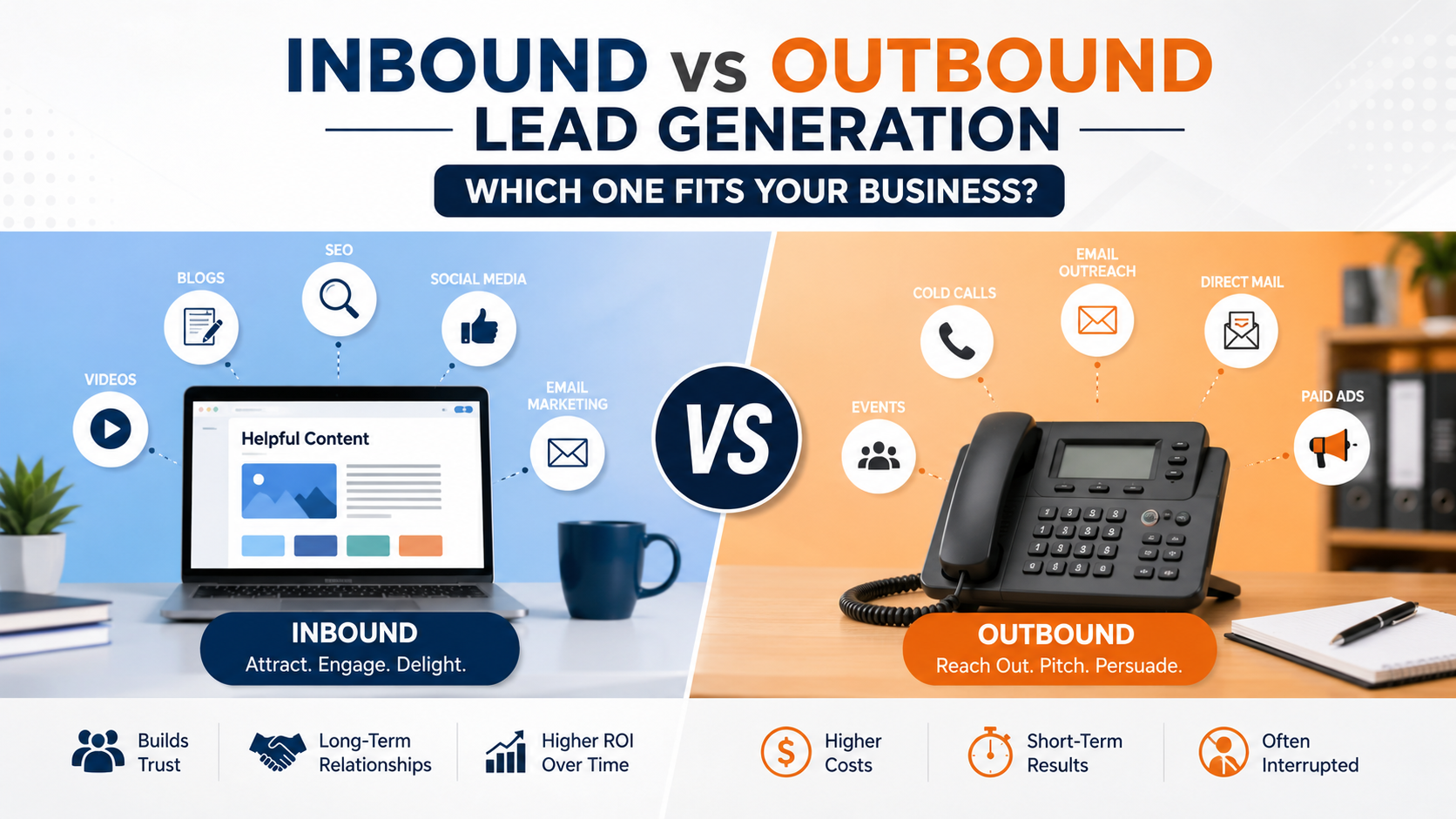
Inbound means customers find you when they are already looking. Google searches, your Business Profile, reviews, blog content, word of mouth. The customer starts the conversation.
Outbound means you find them first. Cold email, cold calls, LinkedIn messages, door knocking. You start the conversation.
Simple enough. The interesting part is how differently they behave in real life.
How They Feel When You Actually Run Them
On paper, these are just two marketing categories. In practice they feel like two different jobs.
Inbound is like planting an orchard. You do the work now, nothing happens for a while, and then trees start producing fruit on their own. The landscaper’s Google profile took around three months to climb. But once it did, leads arrived while he was on job sites, on weekends, on holidays. He did not touch anything.
Outbound is like hunting. You go out, you get what you get, and tomorrow you go out again. When the web designer started cold outreach to local businesses with outdated websites, she booked her first two discovery calls in nine days. But the day she stopped sending, the calls stopped too.
That trade-off shows up everywhere:
- Speed: Outbound wins. Results in days or weeks. Inbound needs two to six months to build momentum.
- Cost per lead over time: Inbound wins. The orchard keeps producing at no extra cost. Outbound costs the same effort every single month.
- Trust level: Inbound wins big. An inbound lead already wants the service and often already trusts you from reviews. An outbound lead needs convincing from zero.
- Control: Outbound wins. Need more leads this week? Send more emails. You cannot email Google and ask for more searches.
- Scale: Depends. Outbound scales with tools and hours. Inbound scales with rankings and reputation, which compound but slowly.
Notice something? The strengths and weaknesses are mirror images. That is why the answer is about fit, not about which is superior.
Which One Fits You: Four Questions
Walk through these honestly. Your answers point to a clear starting place.
Question 1: Who do you sell to?
If you sell to local consumers, homeowners, patients, families, inbound should almost always come first. These people search Google when they need you, and cold contacting consumers is awkward and heavily restricted anyway. Nobody wants a cold call about teeth cleaning.
If you sell to businesses, outbound becomes a real option. Business owners expect other businesses to reach out. A well written, relevant cold email to a business is normal commerce, not an intrusion.
Question 2: How soon do you need results?
Be honest about your runway. If you need customers within 30 to 60 days and you sell to businesses, outbound is your friend. If you can invest three to six months before judging results, inbound will reward the patience with cheaper, warmer leads for years.
Question 3: What does one customer earn you?
Outbound has a real cost per acquired customer once you count tools, lists, and your hours. It makes sense when one customer is worth a lot, a $3,000 website project, a $15,000 patio build, a monthly retainer. It makes much less sense for a $40 one time service. Inbound, especially local search, works at almost any ticket size because the ongoing cost is so low.
Question 4: What will you actually keep doing?
This one gets ignored and it decides everything. Outbound requires daily rejection tolerance. Some people handle silence and “not interested” fine, others quietly stop after week two. Inbound requires patience with invisible progress. Some people happily post, optimize, and collect reviews for months, others need to see the phone ring to stay motivated. Pick the one you will still be doing in month three, because month three is when either one starts paying.
What This Looks Like for Real Businesses
A few common situations I keep running into:
Local service business, established, no online presence. Landscapers, cleaners, dentists, salons. Start inbound: Google Business Profile, reviews, a basic website. Your customers are literally searching for you right now and finding your competitors.
New B2B service with zero clients. Web design, bookkeeping, marketing, consulting. Start outbound for survival, build inbound in parallel. Cold email tools like Instantly or Smartlead handle the sending, and your first case studies from outbound clients become your inbound content later.
Contractor with big ticket jobs wanting commercial work. Hybrid case. Inbound brings homeowner jobs through local search, while a small targeted outbound effort reaches property managers and general contractors who will never search for you because they already have vendor lists you need to get on.
Online store or low ticket product. Inbound and paid ads territory. Outbound math almost never works when the sale is small and one time.
Mistakes I Keep Seeing
Doing outbound to people who are already searching. The landscaper messaging strangers while his Google profile sat empty. If people search for your service locally, capture that demand first. It is the cheapest lead you will ever get.
Judging inbound on outbound timelines. Someone starts local SEO, sees nothing in three weeks, declares it dead. Inbound at week three is a seed under soil. Judge it at month four, not month one.
Running outbound without a warm place to land. You cold email a business owner, they get curious, they Google you, and they find nothing. No reviews, no website, no proof. The email did its job and your missing inbound assets killed the sale. Even outbound-first businesses need a minimum inbound presence.
Trying to master both at once, alone. Each one done properly is real work. Solo owners who split focus usually end up with two weak systems. Sequence them: get one producing, then add the second.
My Honest Take
If I had to give a one line answer for most small businesses: start inbound if consumers search for your service, start outbound if you sell to businesses and need revenue soon, and plan to end up with both.
The landscaper stopped his evening messaging, built his profile properly, and by summer was getting more quote requests than he could handle from search alone. The web designer kept her blog but added twenty personalized cold emails a day, and signed three retainer clients in two months. Then her blog kept growing in the background, and a year later inbound leads had caught up.
Same tools available to both of them. Opposite starting points. That is the whole lesson: the method is not the strategy. Matching the method to your situation is the strategy.