The hardest part of cold calling usually happens before anyone answers.
You have the phone in your hand, a list of prospects open on your laptop, and suddenly every sentence you planned sounds awkward.
“Hi, my name is…”
Too formal.
“I’m calling because…”
Too salesy.
“Do you have a few minutes?”
Almost guaranteed to get a “not really.”
This is where many small business owners get stuck. They know calling potential customers could generate business, but they hate the idea of sounding pushy.
And that concern is completely reasonable.
Most people have received bad cold calls. The caller talks too fast, reads from a script, asks generic questions, and starts explaining a product before learning anything about the person on the other end.
Good cold calling feels completely different.
It feels more like a short business conversation.
Your first goal isn’t necessarily to sell anything. It’s usually to earn another 30 seconds of attention.
Once you understand that, writing a useful cold calling script becomes much easier.
Why Small Business Cold Calling Often Feels Awkward
Small business owners usually make one of two mistakes.
The first is having no script at all.
They dial a number, introduce themselves, and then try to improvise the entire conversation.
That can work if you’re naturally comfortable on the phone, but most people eventually start rambling.
The second mistake is writing every sentence word for word.
Then the conversation sounds something like this:
“Hello John, my name is David from ABC Marketing Solutions and we specialize in helping businesses like yours achieve increased online visibility through customized digital marketing strategies…”
By this point, John is already looking for a reason to end the call.
A good cold calling script should work more like a map.
It tells you where the conversation should go without forcing you to follow exactly the same road every time.
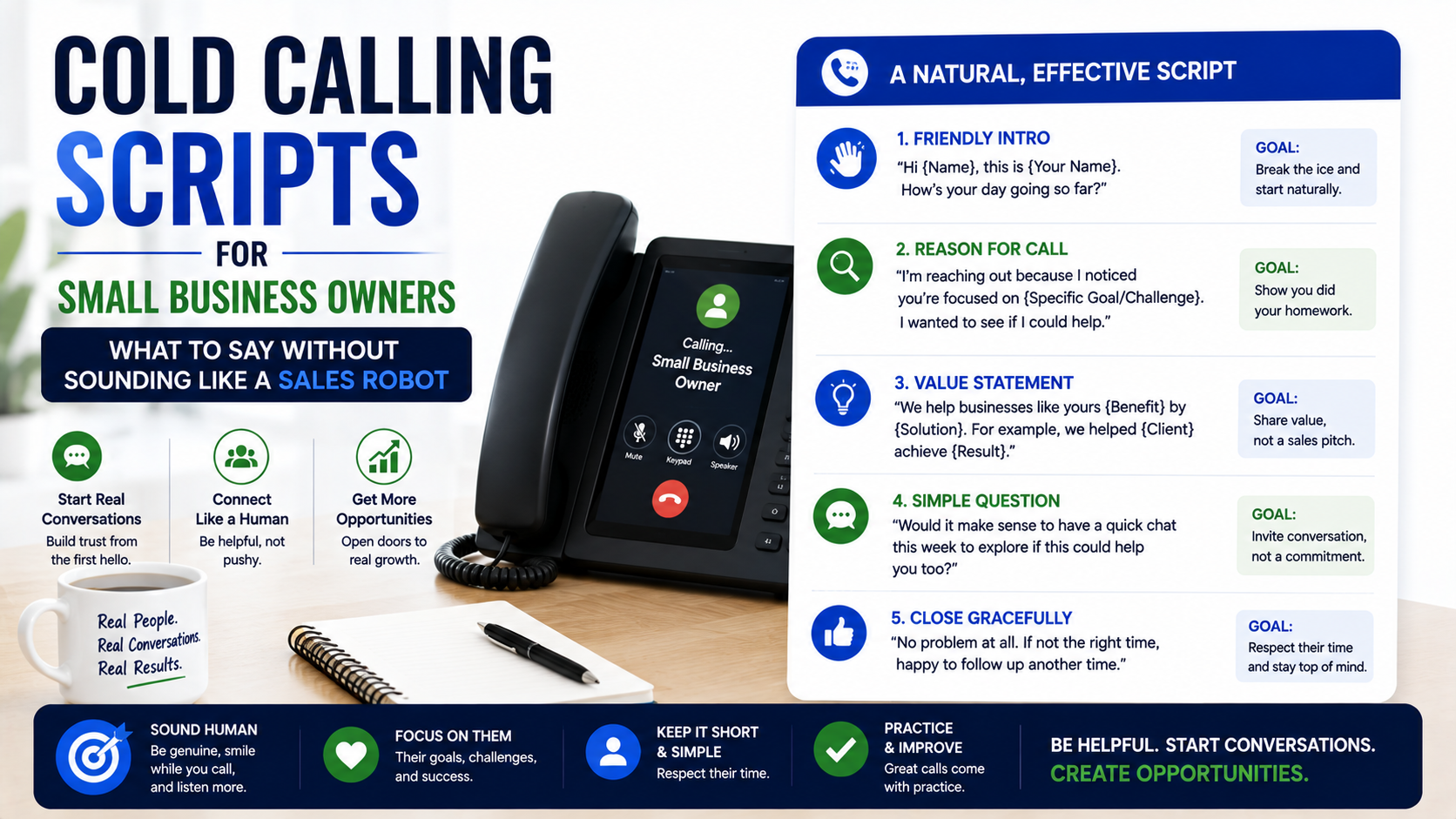
I like breaking a call into five simple parts:
- Introduction
- Reason for calling
- Relevant observation or problem
- Question
- Next step
That structure is flexible enough for almost any small business.
A Simple Cold Calling Script for Small Business Owners
Here is a basic script that works well as a starting point:
“Hi Sarah, this is Mike from Bright Web Design. I know this is a cold call, so I’ll keep it brief.
I was looking at your landscaping business and noticed your website doesn’t currently show many recent projects.
We help local contractors turn their websites into a stronger source of estimate requests.
I was curious, are you currently getting many leads through your website?”
Notice what this script does not do.
It doesn’t immediately explain every service.
It doesn’t mention years of experience.
It doesn’t list awards.
It doesn’t say the company is “industry-leading.”
Instead, it gets into a relevant business problem quickly.
That gives the prospect something specific to respond to.
Why the First 10 Seconds Matter So Much
People decide very quickly whether they want to continue a cold call.
That means your opening shouldn’t be clever.
It should be clear.
One opening I particularly like is:
“Hi Mark, this is Alex from [Company]. I know you weren’t expecting my call, so I’ll keep it quick.”
It works because you acknowledge the obvious.
This is an unexpected sales call.
Pretending otherwise makes the conversation feel strange.
Another option is:
“Hi Lisa, Alex here from [Company]. This is a cold call, but I did have a specific reason for reaching out.”
That naturally creates a little curiosity.
The next sentence needs to justify the call.
For example:
“I noticed you recently opened a second location in Dallas.”
Or:
“I saw you’re running Google Ads for roofing services.”
Or:
“I noticed your company has a lot of strong Google reviews, but your website doesn’t appear prominently for several local searches.”
The more specific the observation, the less generic your call feels.
Cold Calling Script for Selling Marketing Services
Marketing agencies make a huge number of cold calls, which means business owners have already heard plenty of bad pitches.
Avoid opening with:
“We help businesses grow online.”
Almost every agency says some version of this.
Try something more concrete.
“Hi James, this is Ryan from Northside Marketing. I know this is out of the blue, so I’ll be brief.
I found your plumbing company while checking businesses around Austin. You have more than 150 Google reviews, which is great, but I noticed a few competitors with fewer reviews are appearing above you for some local searches.
We work specifically on local search visibility for service businesses.
Are you currently doing anything actively with your Google Business Profile or SEO?”
Now there’s something to discuss.
If James says yes, don’t immediately argue that his existing provider is doing a bad job.
Ask:
“How has that been working for you?”
His answer tells you far more than another minute of pitching would.
Cold Calling Script for Web Design Services
Website sales calls often fail because the salesperson insults the prospect’s website.
Never open with:
“Your website looks outdated.”
The business owner may have designed it themselves.
Instead, focus on business outcomes.
“Hi Amanda, this is Chris from PixelWorks. I was looking at your website earlier and noticed your mobile contact process takes a few steps before someone can request a quote.
We build websites for local service companies, and one thing we often work on is making that conversion path simpler.
I wanted to ask, does your website currently generate many direct inquiries?”
Now you’re discussing leads, not someone’s taste in web design.
Cold Calling Script for B2B Services
Suppose you provide bookkeeping services.
Your script could sound like this:
“Hi Daniel, Sarah from LedgerWorks here. I’ll keep this quick.
We work with small construction companies that have started growing beyond the point where the owner wants to handle invoices, expenses, and monthly bookkeeping themselves.
I wasn’t sure how you’re currently managing that side of the business.
Do you handle bookkeeping internally or use someone outside the company?”
That question is easy to answer.
And easy questions are useful early in a cold call.
You don’t want your prospect mentally solving a complicated business problem 20 seconds after answering the phone.
Cold Calling Script for Local Service Businesses
Cold calling isn’t only for agencies selling to businesses.
Local companies can use it too, especially for commercial work.
Imagine a commercial cleaning company contacting local offices.
“Hi Karen, my name is Steve from ClearWay Cleaning. I’ll be brief.
We already handle office cleaning for a few businesses around the Midtown area, and I wanted to see how you currently manage cleaning for your location.
Are you using an outside company at the moment?”
If they say yes:
“How happy are you with the service?”
If they say no:
“Is that something handled internally?”
Again, the conversation begins with questions rather than a long pitch.
A Cold Calling Script for Appointment Setting
Sometimes the phone call isn’t meant to close the sale.
It’s simply meant to schedule a proper conversation.
That changes your script.
“Hi Robert, this is Adam from Oak Financial. I know I’m catching you unexpectedly.
We work with small business owners who want a clearer picture of business cash flow and tax planning before year-end.
I’m not trying to go through everything over the phone right now.
Would it be unreasonable to schedule 15 minutes next week to see whether what we do would even be relevant?”
The phrase “would it be unreasonable” can make the question feel less aggressive than demanding a meeting.
But don’t rely on clever wording alone.
The prospect still needs a genuine reason to talk.
What to Say When Someone Says “I’m Not Interested”
You’re going to hear this often.
Don’t panic.
And definitely don’t start arguing.
One simple response is:
“Totally understand. Before I let you go, is it mainly because you already have this handled, or is it just not a priority right now?”
That question can reveal useful information.
If they say:
“We already have someone.”
You might respond:
“Makes sense. Are you happy with the results you’re getting?”
If they are, leave them alone.
There is nothing wrong with ending a call politely.
If they say:
“It’s just not a priority.”
You can ask:
“Got it. Is there a better time of year when you normally look at this?”
Sometimes “not interested” really means “not now.”
Other times it means exactly what it sounds like.
Knowing when to end the call is part of being good at cold calling.
What to Say When Someone Says “Send Me an Email”
This is probably one of the most common responses.
The mistake is saying:
“Sure!”
Then sending a generic brochure that gets ignored.
Instead, ask one quick question.
“Absolutely. So I send something relevant, what would be most useful for you to see?”
Or:
“Happy to. Should I focus more on pricing, examples of past work, or how the service works?”
Now the prospect has helped shape the email.
You also have a reason to follow up.
Tools like HubSpot, Pipedrive, Zoho CRM, Salesforce, Close, or even a well-organized Google Sheet can help you track these follow-ups.
For very small businesses, you do not need a complicated sales system on day one.
You simply need to know:
Who did you call?
What happened?
When should you follow up?
What did they care about?
Those four pieces of information are more valuable than having an expensive CRM nobody actually updates.
What to Say When They Ask for the Price
A prospect asking about price is usually better than a prospect trying to get off the phone.
But be careful about giving a number without understanding what they need.
For a simple product or standardized service, answering directly is fine.
For customized services, you could say:
“Pricing usually depends on the scope. Most projects fall between [range], but I’d rather not give you a misleading number before understanding what you actually need.”
Then ask a qualifying question.
For example:
“How many locations are you managing?”
Or:
“How large is the project?”
Or:
“Which services are you currently looking for?”
Be transparent.
Avoid playing games with pricing if you already know exactly what something costs.
The Best Cold Calling Scripts Include Questions
One lesson becomes obvious after listening to enough sales conversations:
The person asking useful questions usually learns more than the person giving the longest presentation.
Some questions worth keeping near your script include:
“What are you currently doing for this?”
“How has that been working?”
“Is this something you manage yourself?”
“What would you want to improve?”
“Is this a priority this quarter?”
“Have you tried anything previously?”
“What happened when you tried that?”
You will not ask all of them.
Pick whichever one naturally fits the conversation.
Research Before You Dial
Cold calling becomes much easier when you know something about the person you’re calling.
You don’t need 20 minutes of research per prospect.
A couple of minutes is often enough.
Check their:
- Website
- Google Business Profile
- LinkedIn company page
- LinkedIn profile
- Facebook or Instagram page
- Recent news or announcements
- Reviews
- Services
- Locations
If you use a prospecting tool such as Apollo, ZoomInfo, Clay, LinkedIn Sales Navigator, Hunter, or similar platforms, verify the information before making important outreach decisions.
Databases are useful, but they are not always perfectly accurate.
You don’t want to confidently congratulate someone on being the marketing director when they left the company eight months ago.
Write Different Scripts for Different Customers
One generic script for every lead usually performs badly.
Imagine you sell commercial insurance.
A restaurant owner, construction contractor, and software company may all need insurance, but their risks and concerns are completely different.
Your script for restaurants might focus on:
- Property
- Employees
- Customer incidents
- Equipment
Your contractor script could focus more on:
- Jobsite risks
- Vehicles
- Equipment
- Liability requirements
Same service.
Different conversation.
Spend time creating separate scripts for your most important customer types.
Don’t Read Your Script Word for Word
Here’s a simple trick.
Write your script.
Then read it out loud.
If you feel ridiculous saying a sentence, rewrite it.
People write differently than they speak.
A sentence that looks professional in Microsoft Word may sound completely unnatural over the phone.
For example:
“Our company provides comprehensive digital transformation solutions specifically tailored to meet the unique requirements of growing organizations.”
Nobody talks like that.
Try:
“We help growing companies replace some of the manual work they’re doing with simpler software.”
Same idea.
Much easier to understand.
I also recommend practicing your opening until you know the structure without needing to stare at the page.
You should know the message, not memorize every word.
Record and Review Your Calls
If laws and company policies in your location allow call recording, listening to your own calls can be uncomfortable but extremely useful.
You’ll notice things you completely missed during the conversation.
Maybe you talk too quickly.
Maybe you interrupt prospects.
Maybe you say “basically” 14 times.
Maybe you spend three minutes answering a question that needed 30 seconds.
Tools such as Aircall, Dialpad, RingCentral, Zoom Phone, JustCall, Close, and other business calling platforms can provide call history, notes, recordings, and sales analytics depending on the plan and local recording rules.
Even without recordings, spend 30 seconds after each call writing down what happened.
Patterns become visible surprisingly quickly.
The Biggest Cold Calling Mistakes I See
Talking Too Much
A common mistake is treating the call like a presentation.
Cold calls work better when the prospect participates early.
Ask a question.
Then actually listen.
Pitching Before Understanding the Problem
You might have five services.
The prospect might only need one.
Find the problem first.
Then explain the relevant solution.
Using Fake Personalization
“I was really impressed by your amazing company…”
Then the caller cannot explain what the company actually does.
That makes personalization worse than no personalization.
Mention something specific or skip the compliment.
Trying to Trick the Gatekeeper
Receptionists and assistants hear sales calls constantly.
Treat them professionally.
You can simply say:
“I’m trying to figure out who handles your commercial landscaping contracts. Could you point me in the right direction?”
Clear questions usually work better than pretending you already know someone.
Ignoring the Prospect’s Tone
If someone sounds rushed, acknowledge it.
“You sound busy. Would another time be better?”
Trying to force your entire pitch into a bad moment rarely helps.
Making Every Call About Closing
Some calls lead to meetings.
Some lead to emails.
Some lead to follow-ups three months later.
Some simply tell you that the prospect is a bad fit.
All of that information has value.
A Simple Cold Calling Workflow You Can Actually Use
If you want to start cold calling for your business, keep the process manageable.
Step 1: Pick One Customer Type
Don’t call everyone.
For example:
“Roofing companies with 5-30 employees.”
That’s much easier than:
“Small businesses.”
Step 2: Identify One Problem You Solve
Maybe roofing companies struggle to generate consistent estimate requests.
Your calls should focus on that problem.
Step 3: Build a Small Prospect List
Start with 25-50 prospects.
You can always expand later.
Step 4: Research Each Prospect Briefly
Find one useful piece of context.
Don’t spend an hour investigating every company.
Step 5: Write Your Opening
Keep it around 20-30 seconds.
Step 6: Prepare Three Questions
Know what information you’re trying to learn.
Step 7: Prepare for Common Objections
At minimum, prepare responses for:
- Not interested
- Send me information
- Already have someone
- Too expensive
- Call me later
Step 8: Make the Calls
This is where people often overprepare.
At some point, you have to dial.
Step 9: Track Results
Record:
Calls made
Conversations
Emails requested
Follow-ups
Appointments
Sales
After 100 calls, you’ll have useful information.
Maybe your opening works but nobody agrees to meetings.
Maybe you’re calling the wrong businesses.
Maybe one industry responds much better than another.
Without tracking numbers, you’re mostly guessing.
A Flexible Cold Calling Script Template
Here is a template you can customize for almost any small business:
“Hi [Name], this is [Your Name] from [Company].
I know this is an unexpected call, so I’ll keep it brief.
I noticed [specific observation about their business].
We work with [type of customer] to help with [specific problem or result].
I was curious, how are you currently handling [relevant area]?”
From there, let the prospect’s answer guide the conversation.
If they have a problem you can genuinely solve, explain how you might help.
If they don’t, don’t manufacture one.
That approach may produce fewer aggressive pitches, but it usually produces better conversations.
Cold Calling Gets Easier When You Stop Trying to Sound Like a Salesperson
The best cold calling script isn’t the one with the cleverest persuasion trick.
It’s the one that helps you comfortably start a relevant conversation.
Know who you’re calling.
Know why you’re calling them.
Explain that reason quickly.
Ask a useful question.
Listen carefully.
Then decide whether there is a logical next step.
Some people will hang up.
Some will reject you immediately.
Some will say they’re happy with their current provider.
That’s part of the process.
But occasionally someone will say:
“Actually, we’ve been having trouble with that.”
That’s the moment the call changes.
You’re no longer trying to convince a stranger to listen to a pitch.
You’re talking to a business owner about a problem they already know exists.
And that’s what a good cold calling script is supposed to help you find.